Connect with us

Technology

IBM Report: Ransomware Persisted Despite Improved Detection in 2022

Published

on

Manufacturing Most Extorted Industry; Email Thread Hijacking Attempts Spike; Time to Ransom Moves from Months to Days

ARMONK, N.Y., Feb. 22, 2023 /PRNewswire/ — IBM (NYSE: IBM) Security today released its annual X-Force Threat Intelligence Index finding that although ransomware’s share of incidents declined only slightly (4 percentage points) from 2021 to 2022, defenders were more successful detecting and preventing ransomware. Despite this, attackers continued to innovate with the report showing the average time to complete a ransomware attack dropped from 2 months down to less than 4 days. 

According to the 2023 report, the deployment of backdoors, which allow remote access to systems, emerged as the top action by attackers last year. About 67% of those backdoor cases related to ransomware attempts, where defenders were able to detect the backdoor before ransomware was deployed. The uptick in backdoor deployments can be partially attributed to their high market value. X-Force observed threat actors selling existing backdoor access for as much as $10,000, compared to stolen credit card data, which can sell for less than $10 today.

“The shift towards detection and response has allowed defenders to disrupt adversaries earlier in the attack chain – tempering ransomware’s progression in the short term,” said Charles Henderson, Head of IBM Security X-Force. “But it’s only a matter of time before today’s backdoor problem becomes tomorrow’s ransomware crisis. Attackers always find new ways to evade detection. Good defense is no longer enough. To break free from the never-ending rat race with attackers, businesses must drive a proactive, threat-driven security strategy.”

The IBM Security X-Force Threat Intelligence Index tracks new and existing trends and attack patterns – pulling from billions of datapoints from network and endpoint devices, incident response engagements and other sources.

Some of the key findings in the 2023 report include:

Extortion: Threat Actors Go-to Method. The most common impact from cyberattacks in 2022 was extortion, which was primarily achieved through ransomware or business email compromise attacks. Europe was the most targeted region for this method, representing 44% of extortion cases observed, as threat actors sought to exploit geopolitical tensions.Cybercriminals Weaponize Email Conversations. Thread hijacking saw a significant rise in 2022, with attackers using compromised email accounts to reply within ongoing conversations posing as the original participant. X-Force observed the rate of monthly attempts increase by 100% compared to 2021 data.Legacy Exploits Still Doing the Job. The proportion of known exploits relative to vulnerabilities declined 10 percentage points from 2018 to 2022, due to the fact that the number of vulnerabilities hit another record high in 2022. The findings indicate that legacy exploits enabled older malware infections such as WannaCry and Conficker to continue to exist and spread.

Extortion Pressure Applied (Unevenly)
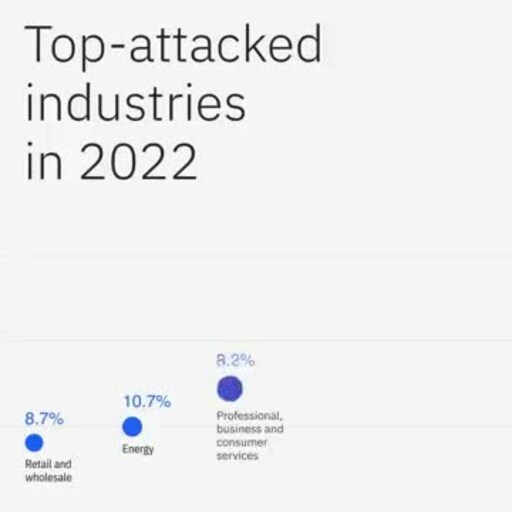
Cybercriminals often target the most vulnerable industries, businesses, and regions with extortion schemes, applying high psychological pressure to force victims to pay. Manufacturing was the most extorted industry in 2022, and it was the most attacked industry for the second consecutive year. Manufacturing organizations are an attractive target for extortion, given their extremely low tolerance for down time.

Ransomware is a well-known method of extortion, but threat actors are always exploring new ways to extort victims. One of the latest tactics involves making stolen data more accessible to downstream victims. By bringing customers and business partners into the mix, operators increase pressure on the breached organization. Threat actors will continue experimenting with downstream victim notifications to increase the potential costs and psychological impact of an intrusion – making it critical that businesses have a customized incident response plan that also considers the impact of an attack on downstream victims.

Thread Hijacking on the Rise
Email thread hijacking activity surged last year, with monthly attempts by threat actors doubling compared to 2021 data. Over the year, X-Force found that attackers used this tactic to deliver Emotet, Qakbot, and IcedID, malicious software that often results in ransomware infections.

With phishing being the leading cause of cyberattacks last year, and thread hijacking’s sharp rise, it’s clear that attackers are exploiting the trust placed in email. Businesses should make employees aware of thread hijacking to help reduce the risk of them falling victim.

Mind the Gap: Exploit “R&D” Lagging Vulnerabilities
The ratio of known exploits to vulnerabilities has been declining over the last few years, down 10 percentage points since 2018. Cybercriminals already have access to more than 78,000 known exploits, making it easier to exploit older, unpatched vulnerabilities. Even after 5 years, vulnerabilities leading to WannaCry infections remain a significant threat. X-Force recently reported an 800% increase in WannaCry ransomware traffic within MSS telemetry data since April 2022. The continued use of older exploits highlights the need for organizations to refine and mature vulnerability management programs, including better understanding their attack surface and risk-based prioritization of patches.

Additional findings from the 2023 report include:

Phishers “Give Up” on Credit Card Data. The number of cybercriminals targeting credit card information in phishing kits dropped 52% in one year, indicating that attackers are prioritizing personally identifiable information such as names, emails, and home addresses, which can be sold for a higher price on the dark web or used to conduct further operations.North America Felt Brunt of Energy Attacks. Energy held its spot as the 4th most attacked industry last year, as global forces continue to affect an already tumultuous global energy trade. North American energy organizations accounted for 46% of all energy attacks observed last year, a 25% increase from 2021 levels.Asia Tops the Target List. Accounting for nearly one-third of all attacks that X-Force responded to in 2022, Asia saw more cyberattacks than any other region. Manufacturing accounted for nearly half of all cases observed in Asia last year.

The report features data IBM collected globally in 2022 to deliver insightful information about the global threat landscape and inform the security community about the threats most relevant to their organizations. You can download a copy of the 2023 IBM Security X-Force Threat Intelligence Report here.

Additional sources

Read more about the report’s top findings in this IBM Security Intelligence blog.Sign up for the 2023 IBM Security X-Force Threat Intelligence Index webinar on Thursday, March 2, 2022, at 11:00 a.m. ET here.Schedule a consult with IBM Security X-Force.

About IBM Security
IBM Security helps secure the world’s largest enterprises and governments with an integrated portfolio of security products and services, infused with dynamic AI and automation capabilities. The portfolio, supported by world-renowned IBM Security X-Force® research, enables organizations to predict threats, protect data as it moves, and respond with speed and precision without holding back business innovation. worldwide security experts, IBM is trusted by thousands of organizations as their partner to assess, strategize, implement, and manage security transformations. IBM operates one of the world’s broadest security research, development, and delivery organizations, monitors 150 billion+ security events per day in more than 130 countries, and has been granted more than 10,000 security patents worldwide.

Press Contact:
IBM Security Communications
Michele Brancati
mbrancati@ibm.com


View original content to download multimedia:https://www.prnewswire.com/news-releases/ibm-report-ransomware-persisted-despite-improved-detection-in-2022-301752400.html

SOURCE IBM

Continue Reading

Technology

dxFeed Introduces ZeroDTE to Bring Greater Transparency to 0DTE Trading Risk

Published

on

By

NEW YORK, Oct. 20, 2026 /PRNewswire/ — dxFeed, a global provider of market data and financial technology solutions, introduced dxFeed ZeroDTE, a new quantitative analytics solution designed to bring greater transparency and precision to the rapidly growing market for zero-days-to-expiration (0DTE) options.

Developed by dxFeed’s AI & Quant Research team, the solution transforms live SPX and XSP options data into comprehensive pricing and risk analytics, enabling brokers, trading platforms, and analytics providers to give traders a clearer understanding of potential outcomes before entering a trade.

The introduction comes as 0DTE options continue to reshape US derivatives markets. According to Cboe, same-day contracts accounted for approximately 65%* of SPX options trading volume in Q3 2026, averaging a record 3.2 million contracts daily. Yet the analytical tools available to traders have not always kept pace with this growth, particularly when it comes to understanding the risks behind complex, multi-leg strategies — a challenge previously highlighted by Jon Light, Senior Director of Product Management, Devexperts.

Beyond Probability of Profit: Understanding the Full Risk
While conventional trading interfaces typically display strikes, premiums, and margin requirements, ZeroDTE reveals the market-implied probabilities behind each strategy, including the likelihood of retaining the full premium, experiencing a partial loss, or reaching the maximum possible loss.

Unlike traditional probability calculations based on a single implied volatility estimate or delta, the solution analyzes the entire live options chain, incorporating the volatility smile and distribution tails to deliver a consistent view of market-implied outcomes.

Through a single API integration, platforms can provide traders with:

Market-implied probabilities of different profit and loss outcomes.Fair value comparisons against displayed market prices.Maximum profit, maximum loss, and break-even levels for individual strategies.Market-implied distribution of today’s close, derived from live options data.Strategies defined in units of the day’s priced move, so the same structure can be compared across days and market conditions .

Supporting popular structures including iron condors, butterflies, straddles, strangles, and vertical spreads, the service brings sophisticated quantitative analytics directly into the trading experience.

“Retail platforms are good at showing a probability of profit, and most will show the maximum loss as well. What they don’t show is how likely that loss is,” said Anton Antonov, Head of AI & Quant Research at dxFeed. “ZeroDTE puts the odds next to the worst case: the chance of keeping the credit, of a partial loss and of the maximum loss, read from the whole option chain rather than a single volatility number. Rather than predicting where the market will go, we give traders the tools to understand what current options prices imply, evaluate different strategies consistently, and make more informed decisions.”

Expanding dxFeed’s Intelligent Market Data Ecosystem
ZeroDTE marks another milestone in dxFeed’s evolution from market data delivery toward advanced analytics, quantitative research, and intelligent financial technology.

The solution joins dxFeed’s growing portfolio of innovative technologies, including SummerFox, its award-winning AI-powered market intelligence solution; Grenadier, an AI-based market data anomaly detection technology; and dxScript, an AI-assisted scripting environment for custom market analytics and indicators.

Together, these solutions reinforce dxFeed’s commitment to transforming high-quality financial data into accessible, actionable intelligence for the global trading community.

The new analytics capabilities have already been integrated into DXcharts, demonstrating how advanced options risk metrics can be incorporated directly into trading and charting interfaces.

For a deeper look at the technical capabilities, key features, and practical applications of ZeroDTE, explore our in-depth article.

*All figures are market-implied from current option prices and are not a forecast or a recommendation

Media Contact:
Kate Zapekina
+49 8999 952020
425091@email4pr.com

View original content to download multimedia:https://www.prnewswire.com/news-releases/dxfeed-introduces-zerodte-to-bring-greater-transparency-to-0dte-trading-risk-302913870.html

SOURCE dxFeed

Continue Reading

Technology

One Third of Florida’s Banks and Credit Unions Not Yet Protected Against Future Quantum Decryption, Open-Source Scan Finds

Published

on

By

Manteiga Foundation publishes a state-of-readiness note on 81 Florida institutions: nothing is broken today, the risk is time, and for most the fix is one setting

MIAMI, Oct. 20, 2026 /PRNewswire/ — Of 81 Florida-headquartered banks and credit unions, 54 already protect their customers’ connections against future quantum decryption and 27 do not yet, according to a state-of-readiness note published today by Manteiga Foundation, a Florida public benefit company. The note, the first from the foundation’s Quantum Ready Labs, lists every institution and its result: quantumreadylabs.com/studies/florida-financial-2026q4.

Nothing is broken today. No account, login or transaction is at risk from what the note describes; every connection tested is encrypted with algorithms no existing computer can break.

The risk is time. Encrypted traffic can be recorded now and decrypted once a large enough quantum computer exists, so anything that must stay confidential for years is already inside the window. That window is narrowing: in 2025 the estimated size of the machine needed to break today’s key exchange fell from about twenty million qubits to under one million, and NIST has set 2030 to begin retiring today’s key exchange and 2035 to end it. Browsers already protect traffic the new way.

The fix is small. The 27 split in two. Ten are Exposed, their sites still on a protocol generation that cannot carry post-quantum protection; the next step is to enable TLS 1.3. Seventeen are At risk, on a modern protocol with the protection not switched on; the next step is one setting, the post-quantum key exchange (X25519MLKEM768), a configuration line or a toggle on current servers. The 54 are Protected (30) or Ready (24). The median score is 85 of 100; the note uses four plain words, no letter grades.

“Nothing is broken today, and that is exactly why this is the moment to act,” said Jaime Manteiga, Co-Founder of Manteiga Foundation. “Confidentiality is the urgent part of the quantum transition, the fix is small, and most of these institutions are one setting away. We built the scanner so that anyone can see where a host stands in a second and what to do next.”

Quantum Ready Labs is free and open source under the MIT licence. Typing a host name at quantumreadylabs.com opens a handful of connections to it, as a browser visit would, and returns the stage, a score for quantum readiness alone, the one next step and the standards cited (NIST IR 8547, FIPS 203, CNSA 2.0), shareable by link or as a five-page PDF; an open API runs the same test for services.

Each institution’s public primary domain was tested on October 18, 2026 with fourteen TLS handshakes and one ordinary connection; no page was opened, no login attempted. Every Exposed result was cross-checked with OpenSSL and curl. The population, from public regulator lists with each domain verified, will be re-scanned quarterly; any institution can run a fresh test at once.

For organizations that want help making the change, the foundation operates N30.ai, its cybersecurity consulting practice. The scanner and its results stay free and open.

About Manteiga Foundation

Manteiga Foundation is a Florida public benefit company at the meeting of technology and art, bringing more beauty into technology through open-source tools for the public good, among them Quantum Ready Labs and medet.ink. manteiga.org.

About N30.ai

N30.ai is Manteiga Foundation’s cybersecurity consulting practice for the post-quantum transition and related security work. More at n30.ai.

Media contact

Jaime Manteiga, Co-Founder, Manteiga Foundation
425109@email4pr.com | 305-709-2909
quantumreadylabs.com/studies/florida-financial-2026q4  |  github.com/manteiga-foundation/quantum-ready-labs

View original content to download multimedia:https://www.prnewswire.com/news-releases/one-third-of-floridas-banks-and-credit-unions-not-yet-protected-against-future-quantum-decryption-open-source-scan-finds-302913890.html

SOURCE Manteiga Foundation

Continue Reading

Technology

CME Group Announces First Trade for Bitcoin Cash and Uniswap Futures

Published

on

By

CHICAGO, Oct. 20, 2026 /PRNewswire/ — CME Group, the world’s leading derivatives marketplace, today announced that FalconX and GSR have executed the first block trade in its new Bitcoin Cash (BCH) and Uniswap (UNI) futures.

“With trading now underway in our Bitcoin Cash and Uniswap futures, we are providing clients with more versatility to manage cryptocurrency risk and exposure through our robust 24/7 marketplace,” said Giovanni Vicioso, Global Head of Cryptocurrency Products at CME Group. “As institutional demand for digital assets continues to grow, we are pleased that investors are turning to CME Group to expand their crypto trading strategies with our regulated and capital-efficient tools.”

“FalconX is pleased to execute the first block trade in CME Group’s new Bitcoin Cash and Uniswap futures alongside GSR. Institutional demand is moving beyond the largest digital assets toward tokens with distinct use cases, like Bitcoin Cash in payments and Uniswap in decentralized finance,” said Griffin Sears, Head of Derivatives, FalconX. “Bringing these assets onto a regulated venue like CME Group gives institutions the hedging and capital-efficient exposure they’ve been asking for, and we look forward to supporting liquidity in these markets as they grow.”

“Providing liquidity in crypto derivatives has long been a cornerstone of GSR’s business, making it a natural fit for us to support CME Group’s new Bitcoin Cash and Uniswap futures from day one,” said Xin Song, CEO of GSR. “We have long believed that expanding institutional-grade derivatives will supercharge institutional adoption of digital assets, and CME Group plays a central role in making that vision a reality.”

The new contracts further extend CME Group’s single-asset cryptocurrency product suite, which includes Bitcoin, Ether, XRP, Solana, Cardano, Chainlink, Stellar, Avalanche‌ and Sui futures. Trading highlights include:

Year-to-date 2026 futures and options average daily volume (ADV) of more than 242,000 contracts ($7.9 billion notional) and average daily open interest (OI) of almost 240,000 contracts ($14.3 billion notional).Nearly $2 billion in year-to-date notional value growth from the 2026 expansion into Cardano, Chainlink, Stellar, Avalanche, and Sui futures.

Bitcoin Cash and Uniswap futures are listed on and subject to the rules of CME. For more information on these products, please visit here.

As the world’s leading derivatives marketplace, CME Group (www.cmegroup.com) enables clients to trade futures, options, cash and OTC markets, optimize portfolios, and analyze data – empowering market participants worldwide to efficiently manage risk and capture opportunities. CME Group exchanges offer the widest range of global benchmark products across all major asset classes based on interest rates, equity indexes, foreign exchange, cryptocurrencies, energy, agricultural products and metals.  The company offers futures and options on futures trading through the CME Globex platform, fixed income trading via BrokerTec and foreign exchange trading on the EBS platform.  In addition, it operates one of the world’s leading central counterparty clearing providers, CME Clearing. 

CME Group, the Globe logo, CME, Chicago Mercantile Exchange, Globex, and E-mini are trademarks of Chicago Mercantile Exchange Inc.  CBOT and Chicago Board of Trade are trademarks of Board of Trade of the City of Chicago, Inc.  NYMEX, New York Mercantile Exchange and ClearPort are trademarks of New York Mercantile Exchange, Inc.  COMEX is a trademark of Commodity Exchange, Inc. BrokerTec is a trademark of BrokerTec Americas LLC and EBS is a trademark of EBS Group LTD. The S&P 500 Index is a product of S&P Dow Jones Indices LLC (“S&P DJI”). “S&P®”, “S&P 500®”, “SPY®”, “SPX®”, US 500 and The 500 are trademarks of Standard & Poor’s Financial Services LLC; Dow Jones®, DJIA® and Dow Jones Industrial Average are service and/or trademarks of Dow Jones Trademark Holdings LLC. These trademarks have been licensed for use by Chicago Mercantile Exchange Inc. Futures contracts based on the S&P 500 Index are not sponsored, endorsed, marketed, or promoted by S&P DJI, and S&P DJI makes no representation regarding the advisability of investing in such products. All other trademarks are the property of their respective owners. 

CME-G

View original content:https://www.prnewswire.com/news-releases/cme-group-announces-first-trade-for-bitcoin-cash-and-uniswap-futures-302914023.html

SOURCE CME Group

Continue Reading

Trending