Connect with us

Technology

Stead’s Blockchain-Powered Floating Cities of the Future

Published

on

DAVAO CITY, Philippines, Feb. 21, 2024 /PRNewswire/ — Stead is an Arbitrum-based DeFi platform (Stead.Builders) that provides liquidity for small marine businesses, fishermen, and fish farmers, most of whom are unbanked or operating in developing countries.

The platform supports numerous types of floating infrastructure, like fishing and transport boats, fish cages, floating docks, and, most impressively, floating houses, hotel rooms, and restaurants.

The platform started when the marine engineering company ArkPad, operating out of the Philippines, wanted to help customers to acquire mortgages for its floating houses.

Getting a mortgage is already difficult enough considering the huge down payments that need to be made, but securing a mortgage for a floating house is another story entirely. Most banks unfamiliarity with unconventional real estate means they pass it over for investment, so ArkPad helped to create the Stead platform in order to decentralize the funding process for floating infrastructure.

From Floating Homes to Financial Aid

While Stead’s initiative for supporting floating houses is tremendously unique, what also sets the company apart is additionally assisting unbanked small businesses in the Philippines and Southeast Asia.
In many developing countries, a large portion of the population is bankless or prevented from accessing loans to expand their businesses. Key reasons include banks having excessive regulations, bureaucratic hurdles in account opening, or simply having relatively small amounts of capital available for loans in the first place. Additionally, on an archipelago nation like the Philippines, many banks simply don’t have any branches present on islands where valuable fish, like Yellowfin Tuna, can be found. In such cash-based societies, lack of physical access to a bank simply means going unbanked.

Stemming from these challenges, many developing countries suffer from having highly unbanked populations, a fertile ground for crypto to fill the unused space.

Building Blocks for Floating Communities

Turning its dreams into a reality, Stead offers a solution like no other, providing liquidity to small businesses, including fisherman, through STEAD tokens.

Upon minting STEAD, stables are put into a pool to purchase a particular asset. In this case, let’s say for a fisherman wanting to purchase a fishing boat. Once enough capital has been garnered to acquire this Real-World Asset (RWA), the fisherman can reap their rewards through the token’s ‘lease-to-own’ program, buying back and burning the STEAD tokens that were initially issued to fund them.

Amplifying the company’s uniqueness, STEAD acts as a ticket to reserve time with the asset. The fisherman can lease time with the boat by burning STEAD, and after a greater dollar amount amount have been burned than were initially minted, they will be transferred full ownership of it. Therefore, the token goes beyond being just RWA; it has an intriguing deflationary supply.

Not only does this burning mechanism result in a reduced circulating supply, but another mechanism is built into the minting mechanics. While STEAD has no maximum supply, the minimum cost to mint a token increases by around 11.4% annually, if price drops below that, minting stops. This means that while the token has no maximum price, the minimum price that it can have is constantly increasing, a novel mechanic not seen in any other token.

A Financial and Architectural Revolution

Spearheaded by Stead’s Co-Founder, Mitchell Suchner, Stead is working hard to make financial resources more easily accessible in Southeast Asia.

RWA tokens are an important emerging niche of crypto, and Stead stands to facilitate some of the most important transactions to serve some of the most profitable, and simultaneously under-served communities, but there is more that sets this project apart from others, and that is there long term goal.

During the first stage of operations, the platform intends to focus on the Southeast Asian market, but during the later stages, they plan to partner with small island nations, DAOs, and other organizations to facilitate the construction of whole floating cities.

The idea of building floating cities in national or international waters has been around for a while, called ‘seasteading’ advocates want to create independent floating jurisdictions of self-run communities where crypto friendly businesses can thrive.

Using ships, docks, and floating houses, communities and villages can be built and connected together to share resources such as fresh water, electricity, and fiber optic cables for internet. Far from being a fantasy, the first floating house has already been built in Boracay, Philippines, with some coastal resorts in the country already planning to purchase their own for listings on AirBnB.

Will Stead’s ultimate dream of building an entirely floating blockchain city become a reality? Only time will tell. However, the technology is here, and buoy, it is impressive. 

View original content to download multimedia:https://www.prnewswire.com/news-releases/steads-blockchain-powered-floating-cities-of-the-future-302067692.html

SOURCE Stead

Continue Reading

Technology

Hyundai Motor Group Accelerates Autonomous Driving Innovation with AI-Powered Data Flywheel
Published

on

By

Hyundai Motor Group hosts “HMG Autonomous Driving Media Day”, outlining its roadmap for the next era of autonomous driving; first showcase of Level 2++ technologyDual-Track strategy accelerates Level 2+ production through NVIDIA collaboration while internalizing key autonomous driving technologies through proprietary Atria AI
…NVIDIA solutions-based Level 2+ production targeted for the H1 2028 and Level 2++ in H2 2028, followed by Atria AI-powered Level 2++ vehicles in H2 2029
…Progressive sensor standardization across Hyundai Motor, Kia, 42dot and Motional brings together autonomous driving capabilities across the GroupData Flywheel strategy establishes a virtuous cycle of data collection, training, validation and deployment to continuously advance AI capabilities
…Expands the Group’s data ecosystem by leveraging its annual sales of 7 million vehicles and Data Union framework, while implementing a data-centric development framework based on hard example mining, continuous training and SER
…Real-world Level 4 pilot to launch in Gwangju by year-end in partnership with Korea’s Ministry of Land, Infrastructure and Transport to secure large-scale validation data42dot shares Vision-Language-Action (VLA)-based autonomous driving technology that integrates visual information and language-based reasoning to guide driving decisions
…VLA research focuses on addressing edge cases, while parallel development of end-to-end (E2E) autonomy and VLA models enhances technical stability and scalability
…VLA model validation currently underway, with on-road testing and the full development process scheduled to run through early next yearNew Atria AI urban driving videos — an executive ride-along, one-take footage, and edge-case handling — are live on the Group’s YouTube channel

SEOUL, South Korea, Sept. 12, 2026 /PRNewswire/ — Hyundai Motor Group (the Group) announced that it has put its Data Flywheel into full operation, marking a new phase in its autonomous driving technology strategy. The system creates a virtuous cycle of data collection, AI training, validation and deployment to secure a competitive advantage through accelerated learning and technology development.

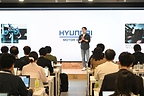
During the Group’s “HMG Autonomous Driving Media Day” at 42dot headquarters in Gyeonggi Province, Korea, the Group presented its autonomous driving development strategy, technology roadmap, key achievements and implementation plans. The presentation underscored the Group’s strategic positioning in the global autonomous driving technology competition and detailed how integrated data and AI systems form the foundation for next-generation vehicle technology.

At the event, the Group identified the Data Flywheel as a key element of its autonomous driving competitiveness and shared the operational framework and execution strategy that transforms large-scale real-world driving data into continuous technology improvements.

42dot also introduced key technologies and the development progress for the Group’s proprietary autonomous driving artificial intelligence, Atria AI, while outlining the background and future plans for its Vision-Language-Action (VLA) technology development initiative.

In line with the event, the Group unveiled footage of an Atria AI-equipped SDV Testbed navigating complex urban traffic without driver intervention. Operating at a Level 2++ capability, the autonomous driving system showcased in the footage illustrates how the Data Flywheel is enabling a continuous cycle of learning, validation and performance improvement. The footage is available on the Group’s official YouTube channel.

“Autonomous driving competition is no longer about comparing specific features. Competitiveness is determined by how much data you secure, how quickly you learn and how effectively you can reflect those results in actual products and services. At its core, autonomous driving competitiveness comes down to having systems that enable continuous, rapid learning. Hyundai Motor Group will develop autonomous driving technology that customers can trust, based on a virtuous cycle of data, AI and validation. Our goal is to ensure the safety and quality levels customers can trust while we learn and improve rapidly.” – Minwoo Park, President and Head of Advanced Vehicle Platform (AVP) Division at Hyundai Motor Group and CEO of 42dot

About Hyundai Motor Group

More information about Hyundai Motor Group can be found at: http://www.hyundaimotorgroup.com or Newsroom: Media Hub by Hyundai, Kia Global Newsroom, Genesis Newsroom

View original content to download multimedia:https://www.prnewswire.com/news-releases/hyundai-motor-group-accelerates-autonomous-driving-innovation-with-ai-powered-data-flywheel-302876366.html

SOURCE Hyundai Motor Group

Continue Reading

Technology

Allstream Energy Partners Nominated in Multiple Categories for Fast Company’s Best Workplaces for Innovators

Published

on

By

Nomination Categories for Fast Company’s Best Workplaces for Innovators in AI & Automation, Advertising, Marketing & PR

HOUSTON, Sept. 12, 2026 /PRNewswire/ — Allstream Energy Partners has been nominated in multiple categories for Fast Company’s Best Workplaces for Innovators program, recognizing organizations redefining their industries through innovation, leadership, and emerging technologies.

The company received nominations in six categories:

Best Workplaces for Innovators North AmericaAI, Automation and Machine Learning ExcellenceAdvertising, Marketing and PRSmall & Mighty CompaniesInnovative Leader of the Year: Efrain Garcia, Founder and CEOInnovative Team of the Year

The nominations recognize Allstream’s investment in proprietary AI-driven marketing technologies, digital publishing solutions, and workflows designed to change how energy companies build visibility, authority, and customer engagement.

Where Oil and Gas Digital Marketing Meets Publishing

Allstream Energy Partners has developed an agency-plus-publisher model combining digital marketing, content creation, industry communications, media publishing, executive networking, and business development.

As artificial intelligence changes how buyers discover suppliers, manufacturers, engineering firms, service companies, and technology providers, Allstream helps clients position themselves to be recommended—not simply found.

Its integrated capabilities include AI marketing strategy, AI-optimized website development, SEO for Oil and Gas, Answer Engine Optimization, Generative Engine Optimization, AI search visibility, content marketing, industry publishing, public relations, social media, paid search, email marketing, event promotion, podcasting, branding, and digital advertising.

Innovation Built for Energy

Unlike a general marketing agency, Allstream was built specifically for oil and gas, energy, engineering, construction, manufacturing, and industrial markets. Each founder brings 27 years of experience supporting sales, business development, capital projects, technical services, industrial marketing, and digital strategy.

This experience gives Allstream an understanding of how technical buyers evaluate suppliers, how projects move through the market, and how engineering, procurement, operations, and executive teams consume information.

The company continues investing in proprietary methodologies that combine industry knowledge, journalism, publishing, AI optimization, communications, and business development strategy. As AI becomes an important starting point for supplier research and vendor discovery, Allstream helps organizations evolve beyond traditional SEO.

“Marketing has fundamentally changed,” said Efrain Garcia, Founder and CEO of Allstream Energy Partners. “Our team recognized early that AI would transform how buyers discover companies, evaluate expertise, and make purchasing decisions. These nominations reflect our commitment to innovation and our mission to help the energy industry succeed in an AI-first world.”

About Allstream Energy Partners

Allstream Energy Partners is a Houston-based, AI-powered marketing and media company serving the energy and industrial supply chain. Through SEO, GEO, AEO, AI-optimized websites, publishing, strategic communications, networking events, and business partnerships, Allstream helps Oil and Gas companies strengthen their brands, improve visibility across search engines and AI platforms, and generate qualified business opportunities.
Visit www.AllstreamEP.com

Media Contact:
Efrain Garcia
efrain@allstreamep.com
8324963004

Photo(s):
https://www.prlog.org/13170255

Press release distributed by PRLog

View original content:https://www.prnewswire.com/news-releases/allstream-energy-partners-nominated-in-multiple-categories-for-fast-companys-best-workplaces-for-innovators-302876887.html

SOURCE Allstream Energy Partners

Continue Reading

Technology

Krelva Accepted Into the HBS Foundry Bootcamp at Harvard Business School

Published

on

By

Foster Britton spent four years learning to trade. Jerry Klamm grew a website to $100,000 a month in high school. Their bootstrapped, pre-launch company, Krelva, joins the new program in October and opens Krelva Meet, small live rooms where day traders trade the market together at their respective skill levels.

BUFFALO, N.Y., Sept. 12, 2026 /PRNewswire-PRWeb/ — Krelva, a bootstrapped, pre-launch Buffalo company built for futures day traders, has been accepted into the HBS Foundry Bootcamp at Harvard Business School, a new online program for founders working toward their first check. Foster Britton started trading in 10th grade, at 15, before settling on futures trading. Jerry Klamm, 19, built Geometry Spot at 16, grew it to more than 175 million pageviews and $100,000 a month in revenue before he finished high school, and left the University at Buffalo to run Krelva full time.

“Krelva Meet is the room I wish I had at 15.” Foster Britton, co-founder, Krelva

Krelva exists because of how hard Britton’s first four years were. Trading is highly complex, the internet is full of people teaching it, and most of what a beginner finds is confusing, contradictory, or sold by someone with something to sell. The question is never whether there is enough information. It is where to start and who to listen to.

“I started trading in 10th grade, in forex before anything else, and it took me four years to get it right,” Britton said. “It was not that the charts were hard. It was that there is so much online, most of it is confusing, and there is no way to know where to start or who to listen to.”

Today Krelva has two things. The first is a free beginner course that shows people where to start; it teaches the basics without promising anyone a payday. The second is Krelva Meet, which opens in October at $50 a month with a 14-day free trial: a new way to trade Nasdaq-100 and S&P 500 futures, not alone and not in a crowd of strangers, but in a small live room with people at your own verified level.

Krelva Meet started with a frustration anyone who has spent time in a trading Discord will recognize. People post their results, and some of those results are real. Screenshots are easy to fake, a few prop firms now issue verified payout cards, and none of it tells a beginner whether the person answering their question is actually where they say they are. So the beginner guesses, and the loudest voice usually wins.

Krelva Meet checks. Every trader has a level that Krelva verifies before they enter a room, and the company is building direct brokerage verification so the check happens automatically. Rooms are built from traders at the same level. Someone who has never passed a prop firm evaluation sits with others who have not either. Pass one, and you move up to rooms with traders who have passed. Get paid out, and you move up again. Alongside the rooms, Krelva is launching a rating: simple, earned over time, and moved by how you answer questions during the session rather than by what you claim. Rooms are not a signal service and tell no one what to buy or sell. They are about the process: reading the market before the open, talking it through with people at your level, and finding out afterward where and why you were right or wrong.

Krelva does not claim to make anyone a better trader faster. It is trying to give people a place to start.

“Krelva Meet is the room I wish I had at 15,” Britton said.

The HBS Foundry Bootcamp at Harvard Business School has drawn attention since its launch for its $699 price and its format, which from Krelva’s understanding pairs weekly live sessions with HBS faculty and guests with AI versions of those same professors, built to push back on weak ideas.

“I’m interested in this new program at Harvard Business School. I think using AI tools to learn is the future, but I’m curious to see how Harvard does it and if it actually works,” Klamm said. “I like that it says the AI professors are built to challenge weak ideas, so I’m going to push it to the limit and see how it performs compared to a real professor.”

The waitlist for Krelva Meet is open now at https://krelva.com.

“Most traders look at the chart at 9:30 every morning by themselves. There are thousands of other traders just like you,” Klamm said. “Why would you trade alone if you could trade with a group you trust? That is the whole idea.”

About Krelva

Krelva is a Buffalo, New York company built for futures day traders. Its free beginner course, built by co-founder Foster Britton, teaches the basics of trading. Its paid product, Krelva Meet, puts traders in small live rooms with other traders at the same verified level to trade Nasdaq-100 and S&P 500 futures together, for $50 a month with a 14-day free trial. Krelva was founded in 2026 by Jerry Klamm and Foster Britton. Learn more at https://krelva.com.

Media Contact

Jerry Klamm, Krelva, 1 716-261-7634, info@krelva.com, https://krelva.com/

View original content to download multimedia:https://www.prweb.com/releases/krelva-accepted-into-the-hbs-foundry-bootcamp-at-harvard-business-school-302876118.html

SOURCE Krelva

Continue Reading

Trending