Connect with us

Technology

Honda Advances Hydrogen Strategy with Production Launch of Fuel Cell Electric Vehicle in Ohio

Published

on

Production of all-new 2025 CR-V e:FCEV fuel cell electric vehicle begins at Performance Manufacturing Center in Marysville, OH – the only FCEV made in AmericaHonda experience with fuel cell vehicles spans over 20 years starting with the 2003 Honda FCX, the world’s first zero-emission fuel cell electric vehicle (FCEV) to receive government certification

MARYSVILLE, Ohio, June 5, 2024 /PRNewswire/ — Honda today celebrated the start of production of the all-new 2025 Honda CR-V e:FCEV fuel cell electric vehicle (FCEV) at the Performance Manufacturing Center (PMC) in Ohio. The all-new CR-V e:FCEV is the only FCEV made in America, as well as the first production1 hydrogen FCEV in the United States to combine an all-new U.S.-made fuel cell system with plug-in EV charging capability. A fun-to-drive compact CUV, the CR-V e:FCEV received a 270-mile EPA driving range rating, combining the fuel cell system with plug-in charging to provide up to 29 miles2 of EV driving around town with the flexibility of fast hydrogen refueling for longer trips. 

The all-new CR-V e:FCEV is the only fuel cell electric vehicle made in America.

“The Performance Manufacturing Center was conceived as a small volume manufacturing facility with a focus on craftsmanship, and I’m proud of how our production technicians leveraged their experience building the Acura NSX to take on the challenge of making this all-new Honda CR-V e:FCEV,” said Patrick McIntyre, lead of PMC. “Producing a zero-emission fuel cell electric vehicle is one more step toward Honda’s global goal of achieving carbon neutrality for our products and operations.”

In addition to producing the Honda CR-V e:FCEV in America, the next gen fuel cell system that powers it is also made in the U.S. at Fuel Cell System Manufacturing LLC, in Brownstown, Michigan – the joint venture production facility established by Honda and General Motors (GM).  The new fuel cell system was co-developed by Honda and GM, achieving higher efficiency and increased refinement, with durability performance doubled and cost reduced by two-thirds compared to the previous fuel cell system in the Honda Clarity Fuel Cell.

PMC Innovations for CR-V e:FCEV Production
Production technicians at PMC navigated several challenges related to new production equipment and processes to effectively transition from building the Acura NSX supercar to the Honda CR-V e:FCEV.  Following is a look at several of these key initiatives. 

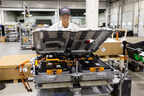
New components: PMC technicians are taking on multiple new assembly processes specific to producing a vehicle powered by both a fuel cell system and a plug-in EV battery, requiring multiple connections for the vehicle’s two power sources and the Power Supply Connector that can provide electrical power for various external devices. These include:Sub-assembly of two hydrogen tanks, attaching high pressure piping and other parts and then installing the tanks in the vehicleCompressing hydrogen to 10,000 PSI via a new onsite station used to fill the CR-V e:FCEV hydrogen fuel tanksInstallation of the fuel-cell system along with connecting high pressure piping and wiringSub-assembly and installation of the under-floor batteryNew Weld System: Transitioning to the CR-V e:FCEV required a complete transformation of the Weld Department, from a highly-automated welding system created for an aluminum spaceframe to a multi-material unibody construction.The previous robotic weld system was removed and replaced with new steel welding robots which were installed with characteristics of a traditional weld system but are unique from mass production plants with a flexible fixture system that rolls around on a track.PMC technicians also now perform some manual MIG welding to apply welds that are difficult for robots to reach to attach closure parts for the doors, hood and tailgate.Paint System Modifications: The larger and heavier all-steel body of the CR-V e:FCEV requires a different corrosion protection application process than the smaller, all-aluminium Acura NSX.The CR-V e:FCEV marks the first application in Honda North America of zirconium to a mixed metal, uni-body, and utilizes the same high-appearance paint coating as the NSX.  The E-coat dip tank was designed for the smaller surface area of the NSX spaceframe, not a full frame vehicle like CR-V with more surface area inside.  So, engineers had to modify the dip tank to enable the CUV body shape to enter at a 38-degree angle, steeper than the 15-degree angle for NSX. More precise control of the E-coat pumps also was required for CR-V, to create higher circulation of the E-coat to cover the surface area inside the frame.Following e-coating, but prior to application of the final paint finish, sealer is applied to prevent water leaks. The CR-V body is mounted on a rotisserie, but unlike the previous equipment arm used to turn the lighter NSX spaceframe, a more robust arm that can maintain stability of the heavier CR-V steel frame is used to turn the frame on its side. This enables associates to manually apply sealer similar to the application for the NSX.

Production of the FCEV at the PMC also is laying the groundwork for production of battery-electric vehicles at the Honda EV Hub in Ohio from the standpoint of software for the Integrated Power Unit (IPU).

Video of these manufacturing innovations can be found here.

CR-V e:FCEV Product Highlights
The Honda CR-V is America’s best-selling CUV of the past quarter century, and the CR-V e:FCEV builds on that foundation to deliver top class cabin space, cargo capacity and power. 

Honda engineers optimized CR-V e:FCEV’s steering and suspension tuning to deliver the same sporty driving experience and class-leading refinement as turbo and hybrid-powered CR-V models.

Moreover, the driver can customize the driving experience of the CR-V e:FCEV with selectable drive modes, including EV modes to maximize efficiency and a Sport mode to prioritize acceleration and responsiveness.

Refueling with hydrogen takes about the same time as filling a tank with gasoline. Recharging the Honda CR-V e:FCEV takes just 1.8-hours using a level 2 charger and adds up to 29 miles of battery-powered range for short trips around town. 

The Honda CR-V e:FCEV also features the Honda Power Supply Connector, turning the CUV into a clean power source capable of running small home appliances, power tools or camping equipment, as well as charging the new Honda Motocompacto e-scooter.

For additional product information, click here.

Honda Hydrogen Business
Honda has identified four core domains for the utilization of its fuel cell system.  In addition to fuel cell electric vehicles (FCEV), the Honda hydrogen business strategy includes commercial vehicles, stationary power stations and construction machinery. Honda is engaged in collaboration with other companies in pursuit of these business opportunities.

Honda recently debuted a Class 8 Hydrogen Fuel Cell Truck Concept powered by three Honda fuel cell systems to showcase the start of a new demonstration project aimed at future production of fuel cell-powered products for the North American market.Honda also began demonstration testing of a stationary fuel cell power station on its Torrance, Calif. campus in March 2023, marking the company’s first step toward future commercialization of zero-emission backup power generation.Honda also is looking at the application of its fuel cell system to equipment such as excavators and wheel loaders, which account for a large segment of the construction machinery market.

Honda Electrification Strategy
Honda has a vision to make battery-electric and fuel cell electric vehicles represent 100% of its new vehicle sales by 2040.  Toward this goal, Honda is establishing its “Honda EV Hub” in Ohio where the company will begin production of EVs in North America.  Honda also recently announced plans to build a comprehensive EV value chain in Canada with an approximate investment of USD$11 billion, to strengthen its EV supply system and capability to prepare for a future increase in EV demand in North America.  It is the role of the Honda EV Hub in Ohio to establish the expertise and experience for EV production that will be shared across the Honda production network in North America, including the EV value chain initiative in Canada.    

Moreover, each Honda auto production facility in North America has a critical role to play in Honda’s electrified future.  Even as Honda accelerates preparation for EV production, the company plans to sustain current ICE and hybrid-electric vehicle production to meet continued strong customer demand.  The sales growth of ICE and hybrid-electric vehicles also will support the required investment in the electrified future.

Importantly, Honda expects to maintain employment stability across all locations during these key next steps in the transition to the electrified future.

1.  Using domestic and globally sourced parts

2. EPA-estimated 29-mile all-electric driving range when fully charged. Use for comparison purposes only. Actual range will vary based on several factors, including temperature, terrain, battery age & condition, loading, use and maintenance.

Honda Manufacturing in America
Honda has been producing automobiles in America for over 40 years, beginning in November 1982 with the start of automobile production at the Marysville Auto Plant.

In 2022, more than two-thirds of all Honda and Acura automobiles sold in the U.S. were made in America, using domestic and globally sourced parts. Honda’s cumulative auto production in America now exceeds 30 million vehicles.

Honda established manufacturing operations in America in 1979 with the start of motorcycle production in Marysville, Ohio, and today has one of the largest and most diverse U.S. manufacturing footprints of any international company. More than 23,000 U.S. associates support the company’s 12 manufacturing plants in America, supporting operations that have an annual capacity of more than 1.27 million automobiles, 1.52 million engines, 500,000 power equipment products and 300,000 powersports products, as well as the HondaJet advanced light jet and GE Honda HF120 turbofan engines.

Cumulatively, Honda has invested $19 billion in its U.S. manufacturing operations, including more than $3.6 billion over the past five years alone. The company also works with 600 U.S. original equipment suppliers, with U.S.-sourced parts purchases of approximately $492 billion since 1979.

Learn more at https://hondainamerica.com/.

More information about Honda is available in the Digital FactBook.

View original content to download multimedia:https://www.prnewswire.com/news-releases/honda-advances-hydrogen-strategy-with-production-launch-of-fuel-cell-electric-vehicle-in-ohio-302165047.html

SOURCE Honda

Continue Reading
Click to comment

Leave a Reply

Your email address will not be published. Required fields are marked *

Technology

Intesa Communications Group Named ‘Customers First’ Winner in San Diego Regional Chamber of Commerce 2026 Small Business Awards

Published

on

By

The award-winning, women-owned San Diego public relations and government affairs firm was recognized for exceptional client service that has fueled 14 years of growth

SAN DIEGO, July 21, 2026 /PRNewswire/ — Intesa Communications Group, a leading San Diego public relations and government affairs firm, has been named the “Customers First” winner in the San Diego Regional Chamber of Commerce’s 2026 Small Business Awards. Announced July 9 at the Chamber’s annual Small Business Awards event, the recognition honors the small business whose commitment to customer service most clearly sets it apart from the competition.

Founded in 2012, the certified women-owned San Diego firm has grown from a boutique agency into one of the region’s leading public relations and government affairs firms. Intesa has doubled its team over the past two years, sustained three consecutive years of double-digit revenue growth and expanded its client portfolio by 26% last year. Intesa provides public relations, strategic communications, and government affairs services for a wide range of organizations, including San Diego State University, SeaWorld San Diego, Expedia Group, H.G. Fenton Company, San Diego Foundation, San Diego Workforce Partnership, and SBCS.

“This award belongs to every member of our team and to the clients who trust us with their most valuable asset: their reputation,” said Margie Newman Tsay, founding partner of Intesa Communications Group. “Our clients stay with us for years because we show up prepared, fully invested and ready for the moments that matter most. Being recognized for putting customers first is the highest compliment our business community can pay us.”

Intesa’s client-first approach has produced measurable results across public relations and government affairs efforts throughout the region. For example, in its first month working with the Jacobs & Cushman San Diego Food Bank, the firm helped reimagine the organization’s summer food drive messaging, generating more than 15 million impressions and helping deliver 489,026 pounds of food and $344,505 in donations — the equivalent of more than one million meals and a 175% increase from the previous year. Similarly, Logan Heights Community Development Corporation credits the firm with an 81:1 return on investment after Intesa parachuted in to help the nonprofit promote the California Mortgage Relief Program.

“Small businesses are the heart of our economy: fueling innovation, creating jobs and defining the character of communities across the San Diego region,” said Chris Cate, president and CEO of the Chamber. “We celebrate the resilience, ingenuity and community impact of our small business leaders. They are the very spirit behind our purpose to champion business and empower leaders.”

The Chamber award is as much a reflection of Intesa’s clients as it is the firm itself. The opportunity to partner with organizations doing meaningful work across the region is what makes recognition like this possible. True to form, the Intesa team plans to mark the win by thanking the clients behind the work.

“We call ourselves dot connectors, and this award is what that looks like in practice,” said Maddy Kilkenny, partner at Intesa Communications Group, who leads the firm’s government affairs practice. “Whether our team of 10 people is helping a client navigate a policy decision at City Hall or a story on the front page of the newspaper, we aim to leave them stronger and more confident than before. Hearing our clients say we deliver on that is the best win of all.”

According to the Chamber’s award requirements, businesses with 100 or fewer employees were eligible for nomination. They were voted on by a panel of chamber members, who reviewed the nominations and selected the winners of all four categories.

The recognition adds to more than 60 awards Intesa has earned for excellence in public relations, strategic communications, and public affairs, including honors from PR News, the Public Relations Society of America, PR Daily, the International Association of Business Communicators, the San Diego Business Journal (SDBJ), MARCOM, and the American Marketing Association, among others. It also comes on the heels of two Intesa team members, Emily Alvarenga and Margaret Lutz Chantung, recently receiving SDBJ’s “40 Under 40” and “Indispensable” awards, respectively.

For more information about Intesa Communications Group, visit www.intesacom.com.

About Intesa Communications Group
Intesa Communications Group is a certified women-owned San Diego public relations and government affairs firm that helps leaders communicate and advocate with confidence. Since 2012, Intesa has partnered with the region’s trusted leaders and organizations, providing strategic communications and public affairs counsel on high-stakes issues at the intersection of reputation, policy and public perception. The firm’s work has earned more than 60 industry awards across 53 recognized client campaigns, including the San Diego Regional Chamber of Commerce “Customers First” 2026 award. Learn more at www.intesacom.com.

View original content to download multimedia:https://www.prnewswire.com/news-releases/intesa-communications-group-named-customers-first-winner-in-san-diego-regional-chamber-of-commerce-2026-small-business-awards-302831350.html

SOURCE Intesa Communications Group

Continue Reading

Technology

The Inner Circle acknowledges Shankari Thiagarajan as Pinnacle Professional of The Year

Published

on

By

HOUSTON, July 21, 2026 /PRNewswire/ — Prominently featured in The Inner Circle, Shankari Thiagarajan is acknowledged as a Pinnacle Professional of The Year for her contributions to Information Technology and Agile Delivery.     

Shankari Thiagarajan has established a distinguished career in information technology project and program management, recognized for her expertise in agile delivery, digital transformation, and cross functional leadership across multiple industries. Currently serving as project manager and scrum master at Astellas Pharma Inc., she oversees agile delivery initiatives supporting global life science programs.

With more than 15 years of experience spanning technology and pharmaceutical sectors, Ms. Thiagarajan has developed a reputation for leading complex implementations and driving operational efficiency. Her expertise includes agile methodologies, project and delivery management, product ownership, healthcare IT, telecom and network optimization, financial services modernization, retail technology upgrades, and GIS and digital mapping solutions.

Ms. Thiagarajan earned a Master of Business Administration in Organizational Leadership from Campbellsville University, a Master of Science in Information Systems from Virginia Tech, and a Bachelor of Engineering in Information Technology from Jawaharlal Nehru Technological University College of Engineering Hyderabad.

Throughout her career, she has contributed to major organizations across a wide range of industries. Her accomplishments include leading agile transformations at Cigna, overseeing retail technology upgrades at Walmart, managing large scale telecom transformation initiatives at T Mobile and Verizon, and modernizing financial platforms at Security Finance. She also contributed to the early development of Google Maps during her tenure at Google India, advancing to team lead within a year.

In addition to her corporate achievements, Ms. Thiagarajan is the creator of the YouTube channel My Experiments with Life – #Positivity #Learning, launched in 2023. Through this platform, she shares motivational content and insights focused on personal growth, technology, spirituality, and lifelong learning.

Her professional accomplishments have been recognized through honors including Marquis Who’s Who 2026, a featured podcast interview with Jim Masters on Close Up TV hosted across Apple Radio, Spotify, and iHeart., recognition in The National Law Review & EIN Presswire, and a certificate of appreciation from Virginia Tech for academic excellence and community involvement.

Outside of her professional work, Ms. Thiagarajan enjoys creating motivational YouTube content, exploring technology and spirituality, listening to contemporary music, and pursuing philanthropic and educational interests. She credits her strong work ethic and determination to the example set by her parents.

Looking ahead, she plans to continue advancing her leadership capabilities and pursue executive level opportunities that allow her to make significant contributions within the information technology sector.

Guided by a philosophy rooted in courage, persistence, and continuous learning, Ms. Thiagarajan remains committed to professional growth while inspiring others to pursue excellence and self-improvement.

Contact: Katherine Green, 516-825-5634, editorialteam@continentalwhoswho.com

View original content to download multimedia:https://www.prnewswire.com/news-releases/the-inner-circle-acknowledges-shankari-thiagarajan-as-pinnacle-professional-of-the-year-302831357.html

SOURCE The Inner Circle

Continue Reading

Technology

University of Phoenix Leaders Present at Building Blackboard Together 2026

Published

on

By

Presentations explored learning technology, accessibility and online pedagogy as higher education adapts to an AI-enabled future

PHOENIX, July 21, 2026 /PRNewswire/ — University of Phoenix leaders shared insights on artificial intelligence, accessibility, online learning and student support at Building Blackboard Together 2026, Blackboard’s flagship user conference, held July 13-15 in Dallas, Texas. The conference brought together educators, institutional leaders and industry experts to explore innovations, technologies and emerging practices shaping the future of teaching and learning.

Representing University of Phoenix were Marc Booker, Ph.D., vice provost of strategy; Kelly Hermann, vice president of Accessibility and Student Affairs; and Erin Amsden, group product manager. Through presentations and panel discussions, the leaders shared perspectives on responsible AI adoption, accessibility leadership, student engagement and the evolving role of learning technologies in supporting institutional goals and student success.

“Building Blackboard Together provides an opportunity to engage with peers across higher education who are navigating many of the same opportunities and challenges around technology, accessibility and learning mobility,” said Dr. Booker. “These conversations help advance practical approaches for supporting learners while thoughtfully integrating innovation into the educational experience.”

During the conference, University of Phoenix was also recognized with the 2026 Blackboard Catalyst Award for Ethical AI Leadership, which honors institutions advancing responsible, transparent and inclusive approaches to artificial intelligence that promote trust and equitable outcomes for learners and educators. The recognition follows the University’s ongoing efforts to support AI literacy, responsible use and AI-enabled learning experiences.

Exploring the Expanding Role of the Learning Management System

As part of the Strategic Leadership Summit, Booker served as a panelist for “The LMS as Mission-Critical: Connecting Learning, Experience & Evidence.” The session examined how learning management systems are evolving beyond course management to support learning, engagement and institutional insight across the student lifecycle.

Panelists discussed how institutions are leveraging learning technologies alongside student information systems to support teaching and learning, advising, co-curricular engagement and data-informed decision-making while addressing increasing expectations surrounding artificial intelligence, student success and accountability.

Sharing Lessons from AI-Powered Student Support

Booker also presented “Scaling AI-Powered Support Across the Student Experience at University of Phoenix,” a session focused on the University’s process for expanding its AI support assistant across the online classroom environment, moving from proof of concept to full-scale deployment over a six-month period.

In addition, Booker participated in “Online Pedagogy to Drive Institutional Growth: Best Practices and Success Stories,” a panel discussion exploring how institutions are designing engaging online learning experiences and leveraging Blackboard technologies to support quality course delivery and student engagement.

Advancing Accessibility Leadership

Hermann joined the session “Communicating Up: Turning Accessibility Work into Leadership-Ready Stories.” The presentation focused on strategies for translating accessibility initiatives into narratives, evidence and visualizations that resonate with institutional leaders.

The discussion explored ways to connect accessibility efforts to broader institutional priorities, demonstrate impact through data and support informed decision-making that advances accessibility and learner success.

Examining Emerging Challenges in Artificial Intelligence

Amsden served as a panelist for “Agentic AI in Pedagogy: Threats and Opportunities.” The session addressed the growing influence of agentic AI and its implications for academic integrity, assessment design and learner engagement.

Panelists explored how technology, pedagogy and security practices can work together to promote authentic student work while helping institutions balance innovation with responsible AI implementation.

Contributing to the Future of Teaching and Learning

Amsden, Booker and Hermann are key members of University of Phoenix’s dynamic leadership team, frequently invited to share their expertise at prestigious national conferences and events. In 2026, University leaders will participate in the ASU + GSV Summit, 1EdTech Learning Impact Conference, SXSW EDU Conference, and PESC Data Summit. These engagements underscore the University’s commitment to innovation and thought leadership in higher education, providing valuable insights and fostering collaborations that drive the future of learning.

About University of Phoenix

University of Phoenix is Built for Real Life. 50 Years Strong. The University innovates to help working adults enhance their careers and develop skills in a rapidly changing world through flexible online learning, relevant courses, academic AI pillars, and skills-mapped curriculum for associate, bachelor’s and master’s degree programs. Active students and alumni have access to Career Services for Life® resources including career guidance and tools. For more information, visit phoenix.edu.

View original content to download multimedia:https://www.prnewswire.com/news-releases/university-of-phoenix-leaders-present-at-building-blackboard-together-2026-302831360.html

SOURCE University of Phoenix

Continue Reading

Trending