Connect with us

Technology

The Top 2024 Cybersecurity Priorities for APAC CISOs and Security Leaders Revealed in Report by Info-Tech Research Group

Published

on

Info-Tech’s Security Priorities 2024 report delves into the pressing issues that APAC IT and security leaders must prioritise over the coming year, including the cybersecurity talent shortage, the rise of AI-driven threats, the integration of security risks with business risks, the adoption of zero-trust frameworks, and the increasing significance of automating security operations. The global IT research and advisory firm explains in the report that by addressing these priorities, organisations can better prepare themselves to face the evolving threat landscape.

SYDNEY, June 6, 2024 /PRNewswire/ — With cyber threats becoming increasingly sophisticated, organisations are facing unprecedented challenges in safeguarding their digital assets. Recognising the urgent need for robust and dynamic security strategies, Info-Tech Research Group has published its Security Priorities 2024 report. The report underscores the critical need for organisations to adapt their security measures in response to the constant changes in cyber threats in 2024 and beyond. The firm’s research highlights the importance of a strategic approach, emphasising the need for clear oversight and effective implementation strategies to develop, deploy, and monitor security initiatives that enhance an organisation’s resilience against threats.

‘The uptake of AI technologies across public and private sectors has added another dimension to an already challenging threat landscape,’ says Robert Dang, principal advisory director at Info-Tech Research Group, APAC. ‘CISOs and security leaders could expect to find themselves in a situation where they must enable the adoption of new AI technologies while managing the risks that come with its rapid evolution. On the opposite end of this situation, delays or failure to enable AI adoption could see them fall behind peer organisations and exacerbate existing challenges like developing their cyber security workforce and operationalising zero trust security.’

The Security Priorities 2024 report reveals the pressing issues that IT and security leaders must prioritise and advocate for a pivot from traditional, reactive security postures to proactive, predictive security strategies. The annual report emphasises the importance of fostering a security-centric culture across the organisation, enhancing collaboration between security teams and other business units, and developing agile security frameworks that can adapt to new threats and business needs.

‘The emergence of advanced technologies has created opportunities for organisations asnd security leaders to explore unique approaches to these challenges while also enhancing existing capabilities to better equip themselves with the right people, process, and technology this year,’ says Ahmad Jowhar, research analyst and lead author of the report. ‘These approaches include assessing the ability to address the talent shortage through upskilling, establishing a foundation to implement AI technologies, and evaluating an organisation’s security risk management with respect to integrating with the enterprise.’

Info-Tech’s latest report is based on comprehensive research, including insights from the firm’s Future of IT survey and in-depth interviews with IT and security professionals across various industries and regions. The diverse approach ensured that the experiences of leaders from both small and large organisations were incorporated into the report and covered a broad spectrum of security budgets. The insights collected and analysed by the firm reflect the realities of managing cybersecurity in different organisational contexts, from multinational corporations to nimble startups, providing a well-rounded view of the challenges and strategies at play in the current security landscape.

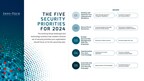
Leveraging the firm’s research findings and data, the Security Priorities 2024 report outlines the following five high-priority initiatives security leaders and their organisations should implement to confidently address security risks for 2024 and the years to come:

Develop and Optimise Cybersecurity Workforce. For the third consecutive year, talent shortage has remained the most pressing cybersecurity challenge, as highlighted by Info-Tech’s survey data. Respondents rated the difficulty of hiring enough security professionals to meet demands at an average concern level of 3.32 out of 5. Security leaders must identify their current skills gap and organisational needs, define their current security resourcing plan, and determine their approach to acquiring the necessary expertise.Secure the AI Revolution. As many organisations are working to leverage the power of AI, measures must be in place to ensure an effective adoption of the technology. Establishing AI governance should be one of the initial initiatives within an organisation’s AI roadmap to ensure a strong and ethical risk management framework is in place. However, according to the report, over 40% of organisations don’t have AI governance in place. In order to address potential vulnerabilities, Info-Tech advises security leaders to prioritise identifying their organisation’s AI goals, determine existing security gaps, and formalise a comprehensive AI governance framework. This framework must define clear accountability, responsibilities, and risk management strategies for AI deployments.Embed Security Risk Management with the Enterprise. With the increasing adoption of AI, organisational reliance on third-party vendor platforms and capabilities will also grow exponentially. This reliance on vendors means increased information sharing and places greater accountability on CISOs or security leaders to safeguard an organisation’s information assets. Despite this critical need, many organisations lack mature vendor risk management practices. As outlined in the report, in many organisations, the responsibility of vendor risk inadvertently falls on the CISO, given their role in protecting sensitive information and assets. To address this issue, security leaders must evaluate their organisation’s existing third-party risk management practices, establish comprehensive policies, and ensure third-party risk management is communicated effectively to executive leadership.Operationalize Zero Trust Strategy. As cyberattacks increase in sophistication due to the advancement of emerging technology and evolving attack techniques, organisations are evaluating various defence strategies to protect their most critical assets. The report emphasises the adoption of a zero trust framework as an effective measure to enhance an organisation’s security posture and align with its business objectives. A zero trust model can significantly reduce an attacker’s capacity for lateral movement within a network, enforce least privilege access across critical resources, and minimise the organisation’s overall attack surface. Info-Tech recommends security leaders adopt an iterative and scalable approach to developing a zero trust roadmap, allowing for continuous improvement and strategic deployment with an initial focus on critical surfaces. Security leaders can start by defining their zero trust strategy, assessing and identifying key capabilities and processes, formulating a comprehensive roadmap, and then consistently monitoring initiatives to identify enhancement opportunities.Automate and Autonomize Security Processes. With automated and AI-based threats becoming increasingly prevalent, the need for security process automation and autonomization has become more pronounced. Organisations should evaluate their capacity for refining security processes to proactively defend against sophisticated attacks and maintain a technological edge. However, the firm’s research shows that not all security processes are prime candidates for automation, as they could introduce risks if automated. The report recommends security leaders start streamlining their security processes by first defining automation objectives and assessing the current and desired states of their security operations to identify any gaps. Subsequently, they should determine the suitability, value, and risks associated with automating each security process, thereby prioritising initiatives accordingly. Finally, a detailed automation roadmap that aligns with the organisation’s strategic objectives must be developed and effectively communicated to executive leadership in order to obtain support.

The 2024 report also includes customisable templates that security leaders can utilise to effectively communicate their organisation’s key security priorities to stakeholders and executives, ensuring a clear understanding of the required security measures.

In the face of ever-evolving cyber threats, the Security Priorities 2024 report provides security leaders with a blueprint for safeguarding their digital environment. By implementing the priorities based on their unique organisational goals and needs, security leaders can enhance their security posture, proactively address and mitigate vulnerabilities, and build a culture of resilience against the cyber threats of the future.

For exclusive media commentary from Robert Dang or Ahmad Jowhar, experts in cybersecurity and privacy, or to access the complete Security Priorities 2024 report, please contact pr@infotech.com.

Info-Tech LIVE 2024

Registration is now open for Info-Tech Research Group’s annual IT conference, Info-Tech LIVE 2024, taking place September 17 to 19, 2024, at the iconic Bellagio in Las Vegas. This premier event will also offer journalists, podcasters, and media influencers access to exclusive content, the latest IT research and trends, and the opportunity to interview industry experts, analysts, and speakers. To apply for media passes to attend LIVE 2024 or to gain access to content and expert insights from the event, please contact pr@infotech.com.

About Info-Tech Research Group

Info-Tech Research Group is one of the world’s leading research and advisory firms, proudly serving over 30,000 IT and HR professionals. The company produces unbiased, highly relevant research and provides advisory services to help leaders make strategic, timely, and well-informed decisions. For nearly 30 years, Info-Tech has partnered closely with teams to provide them with everything they need, from actionable tools to analyst guidance, ensuring they deliver measurable results for their organisations.

To learn more about Info-Tech’s divisions, visit McLean & Company for HR research and advisory services and SoftwareReviews for software buying insights.  

Media professionals can register for unrestricted access to research across IT, HR, and software and hundreds of industry analysts through the firm’s Media Insiders program. To gain access, contact pr@infotech.com

For information about Info-Tech Research Group or to access the latest research, visit infotech.com and connect via LinkedIn and X.

Photo – https://mma.prnewswire.com/media/2431711/Info_Tech_Research_Group_The_Top_2024_Cybersecurity_Priorities_f.jpg

Logo – https://mma.prnewswire.com/media/2431710/Info_Tech_Research_Group_The_Top_2024_Cybersecurity_Priorities_f.jpg

View original content:https://www.prnewswire.com/apac/news-releases/the-top-2024-cybersecurity-priorities-for-apac-cisos-and-security-leaders-revealed-in-report-by-info-tech-research-group-302165364.html

SOURCE Info-Tech Research Group

Continue Reading
Click to comment

Leave a Reply

Your email address will not be published. Required fields are marked *

Technology

Wistron Celebrates Grand Opening of First U.S. Smart Factory Marking Milestone in Global Smart Manufacturing Strategy

Published

on

By

FORT WORTH, Texas, July 21, 2026 /PRNewswire/ — Wistron Corporation (“Wistron”) celebrated the grand opening of its D1 AI smart facility in Fort Worth, Texas, the site where the first NVIDIA GB300 Grace Blackwell Ultra Superchip was built and mass-produced in the United States. The US$ 700 million facility, spanning approximately 324,000 square foot, was officially unveiled during a ceremony led by Wistron Chairman Simon Lin and NVIDIA Founder and CEO Jensen Huang. Jessica Rogers, Director of the Economic Development Department for the City of Fort Worth, and Alexander Tah-ray Yui, Taiwan’s Representative to the United States, were among the government officials and business leaders who attended, marking a milestone in the expansion of Wistron’s global footprint and advanced manufacturing capabilities.

This is a key hub in Wistron’s global AI infrastructure manufacturing network. The facility runs on NVIDIA accelerated computing and integrates NVIDIA’s Nemotron and Cosmos open frontier models and Omniverse and Metropolis libraries, using digital twin technology to optimize factory design, production workflows, and operational efficiency. It is Wistron’s first U.S.-based manufacturing facility, established to serve customers locally and produce NVIDIA’s most advanced and cutting-edge products. Wistron Chairman Simon Lin said “The operation here is not typical manufacturing. It is new, very comprehensive, and high-tech. Right now we produce the NVIDIA GB300 Grace Blackwell Ultra Superchip, and beyond, we are also going to produce the NVIDIA Vera Rubin Superchip here. In the next couple of years, this location will be one of the most important, as we build AI infrastructure here in the United States. I think this is the reason we say that there will be the next chapter, and we are going to empower AI from Texas.”

Responding to Customer Needs: Texas, the Newest Global Manufacturing Hub
At this pivotal moment for global AI infrastructure, Wistron is drawing on decades of global manufacturing experience to expand its footprint in Texas, a state with a well-established ecosystem for logistics, talent recruitment, and advanced manufacturing. The new D1 facility produces the NVIDIA GB300 Grace Blackwell Ultra Superchip and soon, the NVIDIA Vera Rubin Superchip — critical to powering the next generation of AI computing. The new Fort Worth facility strengthens a critical upstream layer of the AI infrastructure supply chain by expanding domestic capacity to assemble and test NVIDIA AI systems. These servers can be integrated into NVIDIA DSX infrastructure, with DSX providing the common architecture and technologies needed to deploy and operate energy-efficient AI factories at scale.

One-Stop Operational Ecosystem Strengthens U.S. AI Supply Chain Resilience
Behind every breakthrough in AI computing lies the manufacturing capability to scale it. Wistron is expanding its AI server production capabilities from Taiwan to the United States, guided by a vision of precision, efficiency, and sustainability. This reflects a broader industry shift: AI leadership is determined not only by technological breakthroughs, but also by the operational capability to transform innovation into high-volume production with consistent quality, supply chain resilience, and predictable delivery. By establishing AI infrastructure manufacturing capacity in the United States, Wistron is building a one-stop operational ecosystem spanning manufacturing and after-sales service — shortening delivery timelines and customer support cycles, strengthening supply chain resilience, and laying the foundation for long-term competitive advantage as AI infrastructure continues to scale.

Partnering with NVIDIA to Pioneer a New Model for Smart Manufacturing and Energy Optimization
As the era of physical AI begins, Wistron is extending its smart manufacturing capabilities to the United States, creating a new model for AI infrastructure production built on digital manufacturing, energy optimization, and local operations. Jensen Huang said: “The largest infrastructure buildout in history is underway. Demand for AI factories—the engine of this next industrial revolution—is incredible, and they must be produced everywhere. Together, NVIDIA and Wistron are restoring US advanced manufacturing capacity in Texas, creating skilled jobs and strengthening America’s AI supply chain.” As demand for advanced manufacturing grows in Texas, smarter planning of production loads and energy use will give the plant greater control and flexibility over its electricity needs.

Turning Global Experience into Scalable AI Infrastructure
Simon Lin stressed that the speed the AI era demands comes with its own responsibility. “In the AI era, the pressure of speed is also a form of responsibility,” Lin said. “We don’t just need to build fast; we need to build right.”

The Fort Worth plant will serve as the core engine of Wistron’s U.S. manufacturing operations, the company said, connecting its global production network with ecosystem partners as it scales advanced AI manufacturing. Wistron said that the investment reflects efforts to deepen its technical capabilities, strengthen the resilience and efficiency of global supply chains, and support the next phase of AI infrastructure development.

About Wistron:
Wistron Corporation is a leading global technology service provider delivering advanced ICT products, AI infrastructure, and manufacturing solutions to technology brands worldwide. With more than 63,000 employees across North America, Europe, and Asia, Wistron continues to expand its AI, cloud, and advanced manufacturing capabilities to support the next generation of intelligent computing. For more information about Wistron, please visit the official website at www.wistron.com. Additional information about the event is available on the event website.

Media Contact:
Joyce WL Chou
joyce_wl_chou@wistron.com

View original content to download multimedia:https://www.prnewswire.com/news-releases/wistron-celebrates-grand-opening-of-first-us-smart-factory-marking-milestone-in-global-smart-manufacturing-strategy-302831439.html

SOURCE Wistron Corporation

Continue Reading

Technology

NSG Bio Accelerates Breakthrough Biotech Innovation in Singapore

Published

on

By

New initiative under NSG Bio Tomorrow will support promising startups developing next-generation approaches in respiratory and neonatal care

SINGAPORE, July 22, 2026 /PRNewswire/ — The NSG Bio Tomorrow initiative aims at supporting emerging life sciences startups working on complex challenges in respiratory and neonatal care.

Launched through the support of Chiesi Group, The Impulse initiative will provide a selected startup with one year of NSG Bio membership and access to a dedicated laboratory bench at NSG Bio Singapore. The initiative is designed to help early-stage biotech companies move from promising science toward stronger proof-of-concept work in a fully equipped research environment.

The initiative comes at a time when the biotech industry is increasingly looking for faster, more connected ways to move high-potential science from the lab toward real-world patient impact. For startups, access to infrastructure is only one part of the challenge. Equally important are the right networks, industry visibility, technical environment, and opportunities to engage with partners who understand the path from early discovery to clinical relevance.

The programme will focus on startups developing innovative biotechnological solutions with potential relevance to chronic respiratory diseases and neonatal conditions. Areas of interest include cell therapies, gene therapies, gene-editing technologies, regenerative tissue engineering, engineered or programmable living systems, lung-targeted delivery platforms, preventive approaches, and small-molecule-based approaches.

The selected startup will gain access to NSG Bio’s laboratory infrastructure, shared workspaces, meeting facilities, and wider community of biotech entrepreneurs, researchers, scientific leaders, and industry partners. The support is intended to help the company advance key research milestones while becoming part of Singapore’s growing life-science innovation ecosystem.

For NSG Bio, the initiative is part of NSG Bio Tomorrow, its ecosystem-building arm created to expand the company’s role beyond facilities and real estate. While NSG Bio is known for providing high-quality laboratory and office infrastructure for biotech companies, NSG Bio Tomorrow focuses on building the programmes, partnerships, and opportunities that help startups grow.

“Biotech companies need more than lab space. They need access, momentum, and the right ecosystem around them,” said Hasyim Sim, Co-Founder and Chief Operating Officer, NSG Bio. “Through NSG Bio Tomorrow, we are building initiatives that help promising startups connect with partners, unlock opportunities, and move their science forward. This initiative reflects exactly the kind of role we want to play in the biotech ecosystem.”

“Chiesi is committed to supporting innovation that can make a meaningful difference for patients, and we work with entrepreneurs, researchers and partners to advance meaningful ideas,” said Fabrizio Conicella, Vice President, Center of Open Innovation & Competence at Chiesi Group. “By supporting this NSG Bio Tomorrow initiative, we want to create an opportunity for early-stage innovators to access the infrastructure and ecosystem support needed to develop impactful science in respiratory and neonatal care.”

NSG Bio Tomorrow programme also reinforces Singapore’s position as a growing hub for biotech innovation in Asia, where startups, research institutions, investors, and industry partners are increasingly coming together to support the next generation of healthcare companies.

Applications open on 22 July 2026 at 09:00 a.m. SGT. Finalists will be invited to present at a virtual pitch event, after which the selected startup will be announced.

About NSG Bio

NSG Bio is Singapore’s leading provider of BSL-2 certified co-working laboratory and office spaces, supporting life-science companies from early research through growth. Through its facilities, community, and ecosystem initiatives, NSG Bio enables biotech innovators to accelerate research, access networks, and build companies that address critical healthcare challenges.

About NSG Bio Tomorrow

NSG Bio Tomorrow is NSG Bio’s ecosystem-building arm, created to support the next generation of biotech innovation through partnerships, programmes, community initiatives, and opportunities that extend beyond physical laboratory infrastructure. Its mission is to strengthen the biotech industry by connecting startups with the resources, expertise, and networks they need to thrive.

About Chiesi Group 

Chiesi is a research-oriented international biopharmaceutical group that develops and markets innovative therapeutic solutions in respiratory health, rare diseases, and specialty care. The company’s mission is to improve people’s quality of life and act responsibly towards both the community and the environment. As a certified B Corp since 2019, Chiesi is part of a global community of businesses that meet high standards of social and environmental impact. 

With 90 years of experience, Chiesi is headquartered in Parma (Italy), with 31 affiliates worldwide, and counts more than 7,900 employees. The Group’s research and development centre in Parma works alongside 6 other important R&D hubs in France, the US, Canada, China, the UK, and Sweden. For further information please visit https://www.chiesi.com/en/home 

Media Contact
Giridharan
Laboratory Manager
NSG Bio
giridharan@nsgbio.com
87797175

View original content to download multimedia:https://www.prnewswire.com/apac/news-releases/nsg-bio-accelerates-breakthrough-biotech-innovation-in-singapore-302830494.html

SOURCE NSG Bio

Continue Reading

Technology

House Judiciary Committee Passes Bill that Would Prevent Future Immigration Crises: Swift Action Needed by Full House, Says FAIR

Published

on

By

WASHINGTON, July 21, 2026 /PRNewswire/ — Today, the House Judiciary Committee passed an updated version of H.R. 2, the landmark border security bill from last congressional session. The bill now awaits consideration by the full House of Representatives. The Federation for American Immigration Reform (FAIR) urges Speaker Mike Johnson to schedule a final floor vote as soon as possible.

The Secure Border Act systematically closes the loopholes that allowed the Biden administration to unleash the largest and most damaging wave of illegal immigration in American history. Enactment of this legislation would prevent future anti-borders administrations from shirking their responsibilities to secure our borders and enforce our immigration laws; asserting unlimited discretion to parole inadmissible aliens to enter the country; or releasing millions of illegal aliens into the country, rather than detaining them or returning them to the country from which they entered.

“We congratulate the Judiciary Committee for its swift action on this critical legislation,” said Dale Wilcox, executive director and general counsel of FAIR. “Ending border chaos and rampant illegal immigration was a key reason that Republicans regained control of the White House and both chambers of Congress in the last election. The clock is ticking on the 119th Congress, and Republicans only have a short time to deliver on the promises they made to voters in 2024, before the midterms.

“Right now, our immigration laws are being enforced in the interests of the American people. As the last administration demonstrated, enforcement of those laws is not guaranteed unless Congress acts to prevent similar abuse in the future. Now is the time for decisive action in the House, where this bill can be passed with a simple majority vote, and an opportunity for Senate Majority Leader John Thune to put every member of that body on record before voters go to the polls in the fall,” Wilcox concluded.

Hayley Hill, hhill@fairus.org 202-328-7004

View original content to download multimedia:https://www.prnewswire.com/news-releases/house-judiciary-committee-passes-bill-that-would-prevent-future-immigration-crises-swift-action-needed-by-full-house-says-fair-302831443.html

SOURCE Federation for American Immigration Reform (FAIR)

Continue Reading

Trending