
Technology
Natural hydrogen: first reports are released on the potential of this emerging resource

Published
2 years agoon
By

A research team at INRS takes stock of the situation in Quebec
QUEBEC CITY, June 14, 2024 /CNW/ – Natural hydrogen, a gas found everywhere on our planet, is the subject of growing interest from governments and industry as an emerging alternative for the production of “cleaner” energy.
Natural hydrogen, which unlike oil and natural gas is carbon free, could become a key element in the energy transition as a complement to green hydrogen.
Knowledge of natural hydrogen and efforts to develop the resource are still in the exploratory stages worldwide, including in Quebec, which is thought to hold undiscovered reserves. Nonetheless, some countries have already started to adapt their regulatory frameworks in anticipation of wider use of the resource, notably France and Australia.
A team from the Institut national de la recherche scientifique (INRS), under the supervision of Professor Jasmin Raymond and Adjunct Professor Stephan Séjourné, also President of Enki GeoSolutions, has just released six research reports funded by Ministère de l’Économie, de l’Innovation et de l’Énergie (MEIE).
Drawing on an exhaustive review of the scientific literature, the team documents the state of geological, geophysical and geochemical knowledge on natural hydrogen and also reports on developments elsewhere that could be relevant to Quebec.
“We need to assess whether there is a natural hydrogen resource in Quebec, and whether it is renewable. Our work will lay a rigorous scientific foundation for determining whether natural hydrogen can be harnessed to contribute to the province’s energy transition and benefit Quebec society as a whole,” says Jasmin Raymond, Professor at INRS and holder of the Institut nordique du Québec Research Chair on Geothermal Potential in the North
“This work has enabled us to draw up an initial inventory of the situation in Quebec, the first of its kind in Canada. Our knowledge of natural hydrogen is constantly expanding, and I hope that these initial observations will encourage further scientific reflection on the subject in Quebec,” adds Stephan Séjourné, President of Enki GeoSolutions and Adjunct Professor at INRS.
These reports follow on an initial study published last March in the journal Frontiers in Geochemistry. In it, the team showed that rocks capable of naturally producing hydrogen were present in various geological contexts in Quebec, both in sedimentary basins in the south of the province and in the Canadian Shield to the north.
“Traces in rocks attest to the production of natural hydrogen in Quebec’s geological history. Now we need to determine whether we can find a structure with sufficient reserves to be viably exploited”, says Félix-Antoine Comeau, INRS research professional on Jasmin Raymond’s team.
INRS has decades of expertise in research related to oil and gas exploration as well as underground reservoirs, whether for CO₂ sequestration or geothermal energy.
The team is made up of Geneviève Bordeleau (professor, INRS), Maxime Claprood (professor at UQAC), Félix-Antoine Comeau, Bernard Giroux (professor, INRS), Erwan Gloaguen (professor, INRS), Michel Malo (honorary professor, INRS), Maria Luisa Moreira dos Santos (master’s student, INRS), Pascal Mouge and Valentin Mulliez (Novatem), Jasmin Raymond and Stephan Séjourné.
In a summary report, the research team formulated three main recommendations with a series of steps aimed at improving the chances of finding natural hydrogen and preparing for the development of this resource.
“In addition to demonstrating the potential for a new resource to explore in Quebec, our work lays the groundwork for future regulations surrounding how it is developed,” explained Félix-Antoine Comeau, noting that some companies could launch into exploration too quickly and possibly in the wrong places.
“If Quebec wants to remain competitive in terms of energy and the economy, it’s important to address this issue now,” concluded Professor Raymond.
INRS is an academic institution dedicated exclusively to graduate research and training in strategic sectors in Quebec. Since its creation in 1969, it has actively contributed to Quebec’s economic, social, and cultural development. INRS ranks first in Quebec and Canada in research intensity. It is made up of four interdisciplinary research and training centres located in Quebec City, Montreal, Laval, and Varennes, which focus their efforts on strategic sectors: water, earth, and environment (Eau Terre Environnement Research Centre); energy, materials, and telecommunications (Énergie Matériaux Télécommunications Research Centre); urbanization, culture, and society (Urbanisation Culture Société Research Centre); and health and biotechnology (Armand-Frappier Santé Biotechnologie Research Centre). The INRS community includes over 1,500 students, postdoctoral fellows, and faculty and staff members.
SOURCE Institut National de la recherche scientifique (INRS)

You may like
Technology
Siris to Acquire Equiniti’s Retirement Solutions, Customer Resolutions and Lenvi Businesses
Published
29 minutes agoon
July 24, 2026By

Transaction to be Completed in Parallel with the Closing of Equiniti’s Previously Announced Sale to Bullish
WEST PALM BEACH, Fla., July 24, 2026 /PRNewswire/ — Siris (together with its affiliates, “Siris”), a leading private equity firm focused on control investments in mission-critical services businesses, today announced that it has elected to exercise its option to maintain ownership of EQ Retirement Solutions (“EQRS”), EQ Customer Resolutions (“EQCR”) and Lenvi from Equiniti (“EQ”). The three businesses provide essential services to UK pension schemes, financial institutions and corporate clients.
The transaction follows Siris’s previously announced agreement to sell EQ to Bullish (NYSE: BLSH), under which Siris retained the option to acquire these businesses. It is expected to be completed in parallel with the closing of EQ’s previously announced sale to Bullish in January 2027, subject to customary closing conditions and required regulatory approvals.
EQRS is a leading provider of outsourced pension administration services and proprietary administration software, including its Compendia platform, supporting more than 10 million members and £10 billion in annual payments for many of the UK’s largest public and private sector pension schemes. EQCR helps financial institutions and other regulated businesses manage customer and complaints resolution, combining specialist staffing and technical expertise with proprietary case management software. Lenvi provides loan servicing software, standby servicing and fraud detection software for banks and non-bank lenders, with more than £100 billion of credit assets managed on behalf of over 150 lenders through its FCA-regulated platform.
Siris has owned EQ since 2021 and has invested significantly in the three businesses during that period. Under renewed and dedicated Siris ownership, the businesses will further accelerate investment in technology, including AI-enabled administration capabilities, onboarding capacity and enhanced member experience, while maintaining continuity of service for clients.
“Maintaining ownership of EQRS, EQCR and Lenvi will establish these businesses as a dedicated platform within our portfolio, with a clear mandate to invest in their growth,” said Frank Baker, Co-Founder and Managing Partner, and Grant Weisberg, Principal, at Siris. “We have seen firsthand the strength of these assets, the quality of their teams and the opportunities ahead for them. As a standalone platform with dedicated focus and resources behind them, these businesses will be well positioned to accelerate their momentum and create long-term value for all stakeholders in this next chapter.”
About Siris
Siris is a leading private equity firm focused on control investments in mission-critical services businesses. Based in West Palm Beach, Florida, Siris has deployed more than $9 billion of equity capital since inception. www.siris.com.
Media Contact
Madeline Jones / Kate Kelley
Joele Frank, Wilkinson Brimmer Katcher
Siris-JF@JoeleFrank.com
(212) 355-4449
View original content to download multimedia:https://www.prnewswire.com/news-releases/siris-to-acquire-equinitis-retirement-solutions-customer-resolutions-and-lenvi-businesses-302834081.html
SOURCE Siris Capital Group, LLC
Technology
The PMA Rallies the International Community to Act Before the Breaking Point: The Severance of Correspondent Banking Relationships Threatens the Economy and Life
Published
29 minutes agoon
July 24, 2026By
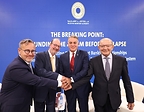
RAMALLAH, Palestine, July 24, 2026 /PRNewswire/ — The PMA Governor, Mr. Yahya Shunnar, warned during a high-level meeting convened by the Palestinian Monetary Authority, with the participation of several ambassadors and representatives of international financial institutions, of the grave consequences of the severance of correspondent banking relationships (CBR). He stressed that the continuation of the Israeli measures is driving the Palestinian economy toward collapse, threatening food security and the provision of essential services.
The PMA convened the session under the title “The Breaking Point: Sounding the Alarm Before the Collapse.” Featuring remarks by the Governor of the Central Bank of Jordan, Dr. Adel Al Sharkas; the Director General and Chairman of the Arab Monetary Fund, Dr. Fahad Al Turki, via videoconference; the IMF’s Resident Representative, Mr. Tobias Roy; the Senior Adviser UNSCO, Mr. Hansjoerg Strohmeyer; and the Chairman of the Association of Banks in Palestine, H.E. Mr. Maher Al-Masri.
Governor Shunnar urged the international community to act immediately to preserve CBRs — Palestine’s only gateway to goods and services worldwide under the Paris Economic Protocol — and to secure reliable, sustainable arrangements ensuring the uninterrupted flow of trade with Israel and the wider world.
Any disruption or termination of these relationships, he warned, would reach far beyond the financial sector and could rapidly escalate into an economic and humanitarian crisis. Broken supply chains could trigger shortages of fuel, energy, and essential food commodities, alongside rising prices, unemployment, and poverty — all amid a worsening fiscal crisis driven by Israel’s continued withholding of clearance revenues, which further limits the Palestinian government’s ability to meet its obligations and deliver essential services.
Shunnar noted that 90% of Palestinian exports go to Israel, while 100% of imports originate from or pass through it, some 60% directly. Israeli correspondent banks processed roughly NIS 51 billion in transactions during 2025, underscoring how critical these channels are to sustaining economic activity.
He added that nearly NIS 18 billion (about USD 6 billion) sits idle in bank vaults, sharply constraining the banking sector.
Participants acknowledged that the window for effective action is narrowing rapidly, and that averting this scenario requires urgent, coordinated intervention to secure stable, sustainable arrangements that keep the Palestinian banking sector connected to the global financial system.
Contact:
hshehadeh@pma.ps
+972594202078
View original content to download multimedia:https://www.prnewswire.co.uk/news-releases/the-pma-rallies-the-international-community-to-act-before-the-breaking-point-the-severance-of-correspondent-banking-relationships-threatens-the-economy-and-life-302834083.html
Technology
Charter Announces Second Quarter 2026 Results
Published
29 minutes agoon
July 24, 2026By

STAMFORD, Conn., July 24, 2026 /PRNewswire/ — Charter Communications, Inc. (along with its subsidiaries, the “Company” or “Charter”), which operates the Spectrum brand, today reported financial and operating results for the three and six months ended June 30, 2026.
Second quarter Spectrum MobileTM lines increased by 406,000 and by 1.7 million over the last twelve months. As of June 30, 2026, Charter served 12.5 million mobile lines.During the second quarter, Spectrum Internet® customers declined by 172,000. As of June 30, 2026, Charter served 29.4 million Internet customers.Video customers decreased by 21,000 in the second quarter and declined by 107,000, or 0.8%, over the last twelve months. As of June 30, 2026, Charter served 12.5 million video customers.As of June 30, 2026, customer relationships totaled 31.5 million and connectivity customers totaled 30.4 million.Second quarter revenue of $13.5 billion declined 1.7% year-over-year, primarily driven by lower residential video revenue.Net income attributable to Charter shareholders totaled $1.3 billion in the second quarter.Second quarter Adjusted EBITDA1 of $5.4 billion declined 4.3% year-over-year and by 3.2% excluding transition expenses.Second quarter capital expenditures totaled $2.9 billion.Second quarter net cash flows from operating activities of $3.9 billion vs. $3.6 billion in the prior year.Second quarter free cash flow1 of $969 million declined $77 million versus the prior year, primarily due to an unfavorable change in accrued expenses related to capital expenditures, partly offset by higher operating cash flow.During the second quarter, Charter purchased 4.0 million shares of Charter Class A common stock for $838 million and $1.2 billion in aggregate principal amount of Charter Communications Operating, LLC and CCO Holdings, LLC notes under an open market repurchase program for $1.0 billion in cash.
“We operate in a competitive environment across all of our products, and our strategy for growing connectivity services is simple — deliver the best products, at the best overall value, with the best service,” said Chris Winfrey, President and CEO of Charter. “We look forward to delivering the benefits of that strategy to Cox’s customers and communities after the transaction closes. As the nation’s leading provider of converged connectivity services, Spectrum will have additional scale to develop new products with industry and technology partners. And by saving customers money with Spectrum products, serviced by 100% US-based employees — we will drive customer and shareholder value for years to come.”
1.
Adjusted EBITDA and free cash flow are non-GAAP measures defined in the “Use of Adjusted EBITDA and Free Cash Flow Information” section and are reconciled to net income attributable to Charter shareholders and net cash flows from operating activities, respectively, in the addendum of this news release.
Key Operating Results
Approximate as of
June 30, 2026 (d)
June 30, 2025 (d)
Y/Y Change
Footprint
Estimated Passings (e)
58,981
57,540
2.5 %
Customer Relationships (f)
Residential
29,276
29,819
(1.8) %
Small Business
2,223
2,241
(0.8) %
Total Customer Relationships
31,499
32,060
(1.7) %
Residential
(176)
(95)
(81)
Small Business
(8)
(5)
(3)
Total Customer Relationships Quarterly Net Additions
(184)
(100)
(84)
Total Customer Relationship Penetration of Estimated Passings (g)
53.4 %
55.7 %
(2.3) ppts
Monthly Residential Revenue per Residential Customer (h)
$ 117.52
$ 119.70
(1.8) %
Monthly Small Business Revenue per Small Business Customer (i)
$ 165.27
$ 162.91
1.4 %
Residential Customer Relationships Penetration (j)
One Product Penetration
47.4 %
48.7 %
(1.3) ppts
Two Product Penetration
35.1 %
33.8 %
1.3 ppts
Three or More Product Penetration
17.6 %
17.5 %
0.1 ppts
Connectivity (k)
Residential
28,306
28,705
(1.4) %
Small Business
2,069
2,076
(0.4) %
Total Connectivity Customers
30,375
30,781
(1.3) %
Residential
(140)
(53)
(87)
Small Business
(5)
(4)
(1)
Total Connectivity Quarterly Net Additions
(145)
(57)
(88)
Internet
Residential
27,358
27,868
(1.8) %
Small Business
2,030
2,040
(0.5) %
Total Internet Customers
29,388
29,908
(1.7) %
Residential
(166)
(111)
(55)
Small Business
(6)
(5)
(1)
Total Internet Quarterly Net Additions
(172)
(116)
(56)
Mobile Lines (l)
Residential
12,099
10,502
15.2 %
Small Business
441
354
24.4 %
Total Mobile Lines
12,540
10,856
15.5 %
Residential
385
471
(86)
Small Business
21
20
1
Total Mobile Lines Quarterly Net Additions
406
491
(85)
Video (m)
Residential
12,010
12,087
(0.6) %
Small Business
514
544
(5.4) %
Total Video Customers
12,524
12,631
(0.8) %
Residential
(11)
(73)
62
Small Business
(10)
(7)
(3)
Total Video Quarterly Net Additions
(21)
(80)
59
Voice
Residential
4,494
5,161
(12.9) %
Small Business
1,200
1,225
(2.1) %
Total Voice Customers
5,694
6,386
(10.8) %
Mid-Market & Large Business (n)
Mid-Market & Large Business Primary Service Units (“PSUs”)
364
350
3.9 %
Mid-Market & Large Business Quarterly Net Additions
4
6
(2)
In thousands, except per customer and penetration data. See footnotes to unaudited summary of operating statistics on page 7 of the addendum of this news release. The footnotes contain important disclosures regarding the definitions used for these operating statistics. All percentages are calculated using whole numbers. Minor differences may exist due to rounding.
Second quarter total Internet customers decreased by 172,000, compared to a decline of 116,000 during the second quarter of 2025. Spectrum Internet delivers the most reliable Internet1, and the Company is evolving its connectivity network to offer symmetrical and multi-gigabit Internet speeds across its entire footprint and has launched symmetrical Internet service in several markets. Spectrum expects to complete its network evolution initiative in 2027. In February 2026, Spectrum launched its Invincible WiFiTM product, a tri-band advanced WiFi 7 router that integrates 5G cellular and battery backup to keep customers seamlessly and fully connected during a power outage or network disruption. In the first quarter, Spectrum launched its $1,000 savings guarantee; new or existing Spectrum Internet customers switching two or more mobile lines from Verizon, AT&T or T-Mobile are now guaranteed $1,000 of savings in their first year, or Spectrum will cover the difference.
During the second quarter of 2026, Charter added 406,000 total mobile lines, compared to growth of 491,000 during the second quarter of 2025. Spectrum Mobile has faster wireless speeds than the competition (AT&T, T-Mobile, Verizon).2 Spectrum Mobile is central to Charter’s converged network strategy to provide customers a differentiated connectivity experience with highly competitive, simple data plans and pricing.
Total video customers decreased by 21,000 in the second quarter of 2026, compared to a decline of 80,000 in the second quarter of 2025, with the improvement driven by simplified pricing and packaging and benefits from the inclusion of programmers’ streaming applications in Spectrum’s expanded basic video packages. As of June 30, 2026, Charter had 12.5 million total video customers.
Spectrum TV Select video customers now receive up to approximately $127 per month of programmers’ streaming application retail value at no extra cost, including the ad-supported versions of Disney+, Hulu, ESPN Unlimited, HBO Max, Paramount+, Peacock, AMC+, ViX, Tennis Channel, Fox One and Discovery+. Beginning in June 2026, Spectrum customers can purchase ad-supported and ad-free versions of Netflix through the Spectrum App Store. The Spectrum App Store is an innovative digital marketplace where Spectrum TV customers can activate, manage and upgrade the streaming apps included with their video plans. The Spectrum App Store also allows Spectrum customers without a traditional TV package to purchase and manage streaming apps à la carte.
During the second quarter of 2026, total wireline voice customers declined by 178,000, compared to a decline of 220,000 in the second quarter of 2025. As of June 30, 2026, Charter had 5.7 million total wireline voice customers.
Charter continues to work with federal, state and local governments to bring Spectrum Internet to unserved and underserved communities. During the second quarter of 2026, Charter activated 127,000 subsidized rural passings. Within Charter’s subsidized rural footprint, total customer relationships increased by 47,000 in the second quarter of 2026.
1.
Most reliable Internet claim based on Broadband Reliability Experience among top 5 national providers in Opensignal USA: Fixed Broadband Experience Report – May 2026. Based on Opensignal independent analysis of Internet connectivity, completion, and sufficiency.
2.
Based on Download Speeds among top 5 national providers in Opensignal USA, Converged Experience, April 2026.
Second Quarter Financial Results
(in millions)
Three Months Ended June 30,
2026
2025
% Change
Revenues:
Internet
$ 5,776
$ 5,969
(3.2) %
Mobile service
1,095
921
18.9 %
Connectivity
6,871
6,890
(0.3) %
Video
3,149
3,488
(9.7) %
Voice
331
346
(4.5) %
Residential revenue
10,351
10,724
(3.5) %
Small business
1,104
1,096
0.7 %
Mid-market & large business
761
740
2.8 %
Commercial revenue
1,865
1,836
1.5 %
Advertising sales
416
371
12.3 %
Other
894
835
7.1 %
Total Revenues
$ 13,526
$ 13,766
(1.7) %
Net income attributable to Charter shareholders
$ 1,292
$ 1,301
(0.7) %
Net income attributable to Charter shareholders margin
9.6 %
9.4 %
Adjusted EBITDA1
$ 5,449
$ 5,693
(4.3) %
Adjusted EBITDA margin
40.3 %
41.4 %
Capital expenditures
$ 2,871
$ 2,874
(0.1) %
Net cash flows from operating activities
$ 3,925
$ 3,600
9.0 %
Free cash flow1
$ 969
$ 1,046
(7.4) %
All percentages are calculated using whole numbers. Minor differences may exist due to rounding.
1.
Adjusted EBITDA and free cash flow are non-GAAP measures defined in the “Use of Adjusted EBITDA and Free Cash Flow Information” section and are reconciled to net income attributable to Charter shareholders and net cash flows from operating activities, respectively, in the addendum of this news release.
Revenues
Second quarter revenue decreased by 1.7% year-over-year to $13.5 billion, driven by lower residential video revenue mostly due to higher costs allocated to programmer streaming applications and netted within video revenue and lower residential Internet revenue, partly offset by an increase in residential mobile service revenue, higher mobile device revenue and higher advertising sales revenue. Excluding advertising sales revenue and costs allocated to programmer streaming applications and netted within video revenue, second quarter total revenue declined by 0.8% year-over-year.
Residential revenue totaled $10.4 billion in the second quarter, a decrease of 3.5% year-over-year, driven by a year-over-year decline in residential customers of 1.8% and a decrease in monthly residential revenue per residential customer of 1.8%. Excluding costs allocated to programmer streaming applications and netted within video revenue, residential revenue declined by 1.8%.
Second quarter 2026 monthly residential revenue per residential customer totaled $117.52, a decrease of 1.8% compared to the prior year period. The decline was driven by $251 million of costs allocated to programmer streaming applications and netted within video revenue versus $67 million in the prior year period, pricing and packaging mix within Charter’s customer base and a decline in video customers during the last year, partly offset by the growth of Spectrum Mobile. Excluding costs allocated to programmer streaming applications and netted within video revenue, monthly residential revenue per residential customer decreased 0.1% compared to the prior year period.
Internet revenue declined 3.2% year-over-year to $5.8 billion, driven by a decline in Internet customers year-over year and pricing and packaging mix within Charter’s customer base, partly offset by more favorable bundled revenue allocation year-over-year.
Second quarter mobile service revenue totaled $1.1 billion, an increase of 18.9% year-over-year, driven by mobile line growth and rate adjustments.
Video revenue totaled $3.1 billion in the second quarter, a decrease of 9.7% compared to the prior year period, driven by a higher mix of lower priced video packages within Charter’s video customer base, $251 million of costs allocated to programmer streaming applications and netted within video revenue versus $67 million in the prior year period, more unfavorable bundled revenue allocation year-over-year and a decline in video customers during the last year, partly offset by promotional rate step-ups and video rate adjustments that pass through programmer rate increases.
Voice revenue decreased by 4.5% year-over-year to $331 million, driven by a decline in wireline voice customers, partly offset by voice rate adjustments.
Commercial revenue increased by 1.5% year-over-year to $1.9 billion, driven by mid-market and large business revenue growth of 2.8% year-over-year and an increase in small business revenue of 0.7%. Mid-market and large business revenue excluding wholesale increased by 3.5% year-over-year, mostly reflecting PSU growth. The year-over-year increase in second quarter 2026 small business revenue was driven by a 1.4% increase year-over-year in monthly small business revenue per small business customer, partly offset by a decline of 0.8% in small business customer relationships year-over-year.
Second quarter advertising sales revenue of $416 million increased by 12.3% compared to the year-ago quarter, primarily driven by higher political revenue. Excluding political revenue in both periods, advertising sales revenue decreased by 4.6% year-over-year driven by lower linear advertising revenue, partly offset by higher streaming advertising revenue.
Other revenue totaled $894 million in the second quarter, an increase of 7.1% compared to the second quarter of 2025, primarily driven by higher mobile device sales, partly offset by a $45 million one-time benefit in the prior year period.
Operating Costs and Expenses
Second quarter total operating costs and expenses were flat year-over-year at $8.1 billion, primarily driven by lower programming costs, offset by higher other costs of revenue and higher transition expenses.
Second quarter programming costs decreased by $218 million, or 9.7% as compared to the second quarter of 2025, reflecting $251 million of costs allocated to programmer streaming applications and netted within video revenue versus $67 million in the prior year period, a higher mix of lower cost packages within Charter’s video customer base and fewer video customers, partly offset by contractual programming rate increases and renewals.
Other costs of revenue increased by $186 million, or 11.3% year-over-year, primarily driven by higher mobile device sales, higher mobile service direct costs and higher advertising sales costs given higher political revenue.
Field and technology operations expenses increased by $21 million, or 1.6% year-over-year, primarily driven by higher vehicle fuel costs and medical expenses.
Customer operations expenses increased by $8 million, or 1.1% year-over-year, driven by medical expenses.
Marketing and residential sales expenses decreased by $31 million or 3.1% year-over-year, due to lower marketing expenses from cost savings, despite higher marketing activity.
Transition expenses represent incremental costs incurred to prepare for the integration of the previously announced Cox transaction.
Other expenses decreased by $27 million, or 2.5% as compared to the second quarter of 2025, primarily driven by lower professional services expense.
Net Income Attributable to Charter Shareholders
Net income attributable to Charter shareholders totaled $1.3 billion in the second quarter of 2026 and 2025, with lower Adjusted EBITDA offset by a gain on extinguishment of debt related to open market debt repurchases in the second quarter of 2026.
Net income per basic common share attributable to Charter shareholders totaled $10.76 in the second quarter of 2026 compared to $9.41 during the same period last year. The increase was primarily the result of a 13.1% decrease in basic weighted average common shares outstanding versus the prior year period.
Adjusted EBITDA
Second quarter Adjusted EBITDA of $5.4 billion declined by 4.3% year-over-year, reflecting a decline in revenue of 1.7%, while operating costs and expenses remained flat. Excluding transition expenses, Adjusted EBITDA declined 3.2% year-over-year.
Capital Expenditures
Capital expenditures totaled $2.9 billion in the second quarter of 2026, in-line with the prior year period, with lower line extension spend offset by higher upgrade/rebuild (primarily network evolution).
Charter continues to expect full year 2026 capital expenditures, excluding impacts from the previously announced Cox transaction, to total approximately $11.4 billion. The actual amount of capital expenditures in 2026 will depend on a number of factors including, but not limited to, the pace of Charter’s network evolution and expansion initiatives, supply chain timing and growth rates in Charter’s residential and commercial businesses.
Cash Flow and Free Cash Flow
During the second quarter of 2026, net cash flows from operating activities totaled $3.9 billion, an increase from $3.6 billion in the prior year. The year-over-year increase was primarily due to lower cash taxes, partly offset by lower Adjusted EBITDA.
Free cash flow in the second quarter of 2026 totaled $969 million, a decrease of $77 million compared to the second quarter of 2025. The year-over-year decrease in free cash flow was driven by an unfavorable change in accrued expenses related to capital expenditures, partly offset by higher net cash flows from operating activities.
Liquidity & Financing
As of June 30, 2026, total principal amount of debt was $93.8 billion and Charter’s credit facilities provided approximately $3.7 billion of additional liquidity in excess of Charter’s $509 million cash position.
During the three months ended June 30, 2026, Charter purchased $1.2 billion in aggregate principal amount of various Charter Communications Operating, LLC and CCO Holdings, LLC notes under an open market repurchase program for $1.0 billion in cash.
Share Repurchases
During the three months ended June 30, 2026, Charter purchased 4.0 million shares of Charter Class A common stock for $838 million.
Webcast
Charter will host a webcast on Friday, July 24, 2026 at 8:00 a.m. Eastern Time (ET) related to the contents of this release.
The webcast can be accessed live via the Company’s investor relations website at ir.charter.com. Participants should go to the webcast link no later than 10 minutes prior to the start time to register. The webcast will be archived at ir.charter.com two hours after completion of the webcast.
Additional Information Available on Website
The information in this press release should be read in conjunction with the financial statements and footnotes contained in the Company’s Quarterly Report on Form 10-Q for the three and six months ended June 30, 2026, which will be posted on the “Results & SEC Filings” section of the Company’s investor relations website at ir.charter.com, when it is filed with the Securities and Exchange Commission (the “SEC”). A slide presentation to accompany the conference call and a trending schedule containing historical customer and financial data will also be available in the “Results & SEC Filings” section.
Use of Adjusted EBITDA and Free Cash Flow Information
The Company uses certain measures that are not defined by U.S. generally accepted accounting principles (“GAAP”) to evaluate various aspects of its business. Adjusted EBITDA and free cash flow are non-GAAP financial measures and should be considered in addition to, not as a substitute for, net income attributable to Charter shareholders and net cash flows from operating activities reported in accordance with GAAP. These terms, as defined by Charter, may not be comparable to similarly titled measures used by other companies. Adjusted EBITDA and free cash flow are reconciled to net income attributable to Charter shareholders and net cash flows from operating activities, respectively, in the Addendum to this release.
Adjusted EBITDA is defined as net income attributable to Charter shareholders plus net income attributable to noncontrolling interest, net interest expense, income taxes, depreciation and amortization, stock compensation expense, other income (expenses), net and other operating (income) expenses, net, such as special charges, merger and acquisition costs and (gain) loss on sale or retirement of assets. As such, it eliminates the significant non-cash depreciation and amortization expense that results from the capital-intensive nature of the Company’s businesses as well as other non-cash or special items, and is unaffected by the Company’s capital structure or investment activities. However, this measure is limited in that it does not reflect the periodic costs of certain capitalized tangible and intangible assets used in generating revenues and the cash cost of financing. These costs are evaluated through other financial measures.
Free cash flow is defined as net cash flows from operating activities, less capital expenditures and changes in accrued expenses related to capital expenditures.
Management and Charter’s board of directors use Adjusted EBITDA and free cash flow to assess Charter’s performance and its ability to service its debt, fund operations and make additional investments with internally generated funds. In addition, Adjusted EBITDA generally correlates to the leverage ratio calculation under the Company’s credit facilities or outstanding notes to determine compliance with the covenants contained in the facilities and notes (all such documents have been previously filed with the SEC). For the purpose of calculating compliance with leverage covenants, the Company uses Adjusted EBITDA, as presented, excluding certain expenses paid by its operating subsidiaries to other Charter entities. The Company’s debt covenants refer to these expenses as management fees, which were $336 million and $702 million for the three and six months ended June 30, 2026, respectively, and $366 million and $732 million for the three and six months ended June 30, 2025, respectively.
About Charter
Charter Communications, Inc. (NASDAQ:CHTR) is a leading broadband connectivity company with services available to nearly 59 million homes and small to large businesses across 41 states through its Spectrum brand. Founded in 1993, Charter has evolved from providing cable TV to streaming, and from high-speed Internet to a converged broadband, WiFi and mobile experience. Over the Spectrum Fiber Broadband Network and supported by our 100% U.S.-based employees, the Company offers Seamless Connectivity and Entertainment with Spectrum Internet®, Mobile, TV and Voice products.
More information about Charter can be found at corporate.charter.com.
CAUTIONARY STATEMENT REGARDING FORWARD-LOOKING STATEMENTS
This communication includes forward-looking statements within the meaning of Section 27A of the Securities Act of 1933, as amended, and Section 21E of the Securities Exchange Act of 1934, as amended, regarding, among other things, our plans, strategies and prospects, both business and financial. Although we believe that our plans, intentions and expectations as reflected in or suggested by these forward-looking statements are reasonable, we cannot assure you that we will achieve or realize these plans, intentions or expectations. Forward-looking statements are inherently subject to risks, uncertainties and assumptions including, without limitation, the factors described under “Risk Factors” from time to time in our filings with the SEC. Many of the forward-looking statements contained in this communication may be identified by the use of forward-looking words such as “believe,” “future,” “expect,” “anticipate,” “should,” “planned,” “will,” “may,” “intend,” “estimated,” “aim,” “on track,” “target,” “opportunity,” “tentative,” “positioning,” “designed,” “create,” “predict,” “project,” “initiatives,” “seek,” “would,” “could,” “continue,” “ongoing,” “upside,” “increases,” “grow,” “focused on” and “potential,” among others. Important factors that could cause actual results to differ materially from the forward-looking statements we make in this communication are set forth in our annual report on Form 10-K, and in other reports or documents that we file from time to time with the SEC, and include, but are not limited to:
our ability to sustain and grow revenues and cash flow from operations by offering Internet, mobile, video, voice, advertising and other services to residential and commercial customers, to adequately meet the customer experience demands in our service areas and to maintain and grow our customer base, particularly in the face of increasingly aggressive competition, the need for innovation and the related capital expenditures;the impact of competition from other market participants, including but not limited to incumbent telephone companies, direct broadcast satellite (“DBS”) operators, wireless and satellite broadband and telephone providers, digital subscriber line (“DSL”) providers, fiber to the home providers and providers of video content over broadband Internet connections;general business conditions, unemployment levels and the level of activity in the housing sector and economic uncertainty or downturn;our ability to develop and deploy new products and technologies including consumer services and service platforms;any events that disrupt our networks, information systems or properties and impair our operating activities or our reputation;the effects of governmental regulation on our business including subsidies to consumers, subsidies and incentives for competitors, costs, disruptions and possible limitations on operating flexibility related to, and our ability to comply with, regulatory conditions applicable to us;our ability to procure necessary services and equipment from our vendors in a timely manner and at reasonable costs including in connection with our network evolution and rural construction initiatives;our ability to obtain programming at reasonable prices or to raise prices to offset, in whole or in part, the effects of higher programming costs (including retransmission consents and distribution requirements);the ability to hire and retain key personnel;the availability and access, in general, of funds to meet our debt obligations prior to or when they become due and to fund our operations and necessary capital expenditures, either through (i) cash on hand, (ii) free cash flow, or (iii) access to the capital or credit markets;our ability to comply with all covenants in our indentures and credit facilities, any violation of which, if not cured in a timely manner, could trigger a default of our other obligations under cross-default provisions;our ability to satisfy the conditions to consummate the Liberty Broadband Combination and/or the Cox Transactions and/or to consummate the Liberty Broadband Combination and/or the Cox Transactions in a timely manner or at all;the risks related to us being restricted in the operation of our business while the Liberty Broadband Merger Agreement and the Cox Communications Transaction Agreement are in effect;other risks related to the Liberty Broadband Combination as described in the definitive joint proxy statement/prospectus with respect to the Liberty Broadband Combination, filed by Charter on January 22, 2025, including the sections entitled “Risk Factors” and “Where You Can Find More Information” included therein; andother risks related to the Cox Transactions as described in the definitive proxy statement with respect to the Cox Transactions, filed by Charter on July 2, 2025, including the sections entitled “Risk Factors” and “Where You Can Find More Information” included therein.
All forward-looking statements attributable to us or any person acting on our behalf are expressly qualified in their entirety by this cautionary statement. We are under no duty or obligation to update any of the forward-looking statements after the date of this communication.
CHARTER COMMUNICATIONS, INC. AND SUBSIDIARIES
UNAUDITED RECONCILIATION OF NON-GAAP MEASURES TO GAAP MEASURES
(dollars in millions)
Three Months Ended
June 30,
Six Months Ended
June 30,
Last Twelve Months
Ended June 30,
2026
2025
2026
2025
2026
2025
Net income attributable to Charter shareholders
$ 1,292
$ 1,301
$ 2,455
$ 2,518
$ 4,924
$ 5,264
Plus: Net income attributable to noncontrolling interest
232
194
432
386
825
790
Interest expense, net
1,276
1,263
2,532
2,504
5,070
5,089
Income tax expense
475
414
940
859
1,773
1,635
Depreciation and amortization
2,197
2,176
4,408
4,357
8,762
8,670
Stock compensation expense
138
157
341
379
635
663
Other, net
(161)
188
(22)
453
349
752
Adjusted EBITDA (a)
$ 5,449
$ 5,693
$ 11,086
$ 11,456
$ 22,338
$ 22,863
Net cash flows from operating activities
$ 3,925
$ 3,600
$ 8,229
$ 7,836
$ 16,470
$ 15,201
Less: Purchases of property, plant and equipment
(2,871)
(2,874)
(5,726)
(5,273)
(12,112)
(10,898)
Change in accrued expenses related to capital expenditures
(85)
320
(162)
47
377
910
Free cash flow (a)
$ 969
$ 1,046
$ 2,341
$ 2,610
$ 4,735
$ 5,213
The above schedule is presented in order to reconcile Adjusted EBITDA and free cash flow, non-GAAP measures, to the most directly comparable GAAP measures in accordance with Section 401(b) of the Sarbanes-Oxley Act.
UNAUDITED ALTERNATIVE PRESENTATION OF ADJUSTED EBITDA
(dollars in millions)
Three Months Ended June 30,
Six Months Ended June 30,
2026
2025
% Change
2026
2025
% Change
REVENUES:
Internet
$ 5,776
$ 5,969
(3.2) %
$ 11,628
$ 11,899
(2.3) %
Mobile service
1,095
921
18.9 %
2,147
1,835
17.0 %
Connectivity
6,871
6,890
(0.3) %
13,775
13,734
0.3 %
Video
3,149
3,488
(9.7) %
6,401
7,068
(9.4) %
Voice
331
346
(4.5) %
669
702
(4.7) %
Residential revenue
10,351
10,724
(3.5) %
20,845
21,504
(3.1) %
Small business
1,104
1,096
0.7 %
2,194
2,184
0.4 %
Mid-market & large business
761
740
2.8 %
1,510
1,474
2.4 %
Commercial revenue
1,865
1,836
1.5 %
3,704
3,658
1.2 %
Advertising sales
416
371
12.3 %
774
711
9.0 %
Other
894
835
7.1 %
1,800
1,628
10.6 %
Total Revenues
13,526
13,766
(1.7) %
27,123
27,501
(1.4) %
COSTS AND EXPENSES:
Programming
2,035
2,253
(9.7) %
4,123
4,555
(9.5) %
Other costs of revenue
1,837
1,651
11.3 %
3,602
3,235
11.3 %
Field and technology operations
1,313
1,292
1.6 %
2,571
2,574
(0.1) %
Customer operations
785
777
1.1 %
1,551
1,549
0.2 %
Marketing and residential sales
927
958
(3.1) %
1,846
1,907
(3.2) %
Transition expenses (b)
65
—
n/a
89
—
n/a
Other expense (c)
1,115
1,142
(2.5) %
2,255
2,225
1.3 %
Total operating costs and expenses (c)
8,077
8,073
— %
16,037
16,045
(0.1) %
Adjusted EBITDA (a)
$ 5,449
$ 5,693
(4.3) %
$ 11,086
$ 11,456
(3.2) %
All percentages are calculated using whole numbers. Minor differences may exist due to rounding. See footnotes on page 7.
CHARTER COMMUNICATIONS, INC. AND SUBSIDIARIES
UNAUDITED CONSOLIDATED STATEMENTS OF OPERATIONS
(dollars in millions, except per share data)
Three Months Ended June 30,
Six Months Ended June 30,
2026
2025
2026
2025
REVENUES
$ 13,526
$ 13,766
$ 27,123
$ 27,501
COSTS AND EXPENSES:
Operating costs and expenses (exclusive of items shown separately below)
8,215
8,230
16,378
16,424
Depreciation and amortization
2,197
2,176
4,408
4,357
Other operating expenses, net
51
81
66
204
10,463
10,487
20,852
20,985
Income from operations
3,063
3,279
6,271
6,516
OTHER INCOME (EXPENSES):
Interest expense, net
(1,276)
(1,263)
(2,532)
(2,504)
Other income (expenses), net
212
(107)
88
(249)
(1,064)
(1,370)
(2,444)
(2,753)
Income before income taxes
1,999
1,909
3,827
3,763
Income tax expense
(475)
(414)
(940)
(859)
Consolidated net income
1,524
1,495
2,887
2,904
Less: Net income attributable to noncontrolling interests
(232)
(194)
(432)
(386)
Net income attributable to Charter shareholders
$ 1,292
$ 1,301
$ 2,455
$ 2,518
EARNINGS PER COMMON SHARE ATTRIBUTABLE TO CHARTER SHAREHOLDERS:
Basic
$ 10.76
$ 9.41
$ 20.00
$ 18.00
Diluted
$ 10.66
$ 9.18
$ 19.81
$ 17.59
Weighted average common shares outstanding, basic
120,121,017
138,205,810
122,789,924
139,889,251
Weighted average common shares outstanding, diluted
121,255,667
141,684,415
123,969,262
143,098,493
CHARTER COMMUNICATIONS, INC. AND SUBSIDIARIES
CONDENSED CONSOLIDATED BALANCE SHEETS
(dollars in millions)
June 30,
December 31
2026
2025
ASSETS
(unaudited)
CURRENT ASSETS:
Cash and cash equivalents
$ 509
$ 477
Accounts receivable, net
3,651
3,680
Prepaid expenses and other current assets
813
987
Total current assets
4,973
5,144
INVESTMENT IN CABLE PROPERTIES:
Property, plant and equipment, net
47,955
46,444
Customer relationships, net
238
440
Franchises
67,471
67,471
Goodwill
29,710
29,710
Total investment in cable properties, net
145,374
144,065
OTHER NONCURRENT ASSETS
5,271
5,004
Total assets
$ 155,618
$ 154,213
LIABILITIES AND SHAREHOLDERS’ EQUITY
CURRENT LIABILITIES:
Accounts payable, accrued and other current liabilities
$ 12,779
$ 12,556
Current portion of long-term debt
999
750
Total current liabilities
13,778
13,306
LONG-TERM DEBT
92,960
94,006
EQUIPMENT INSTALLMENT PLAN FINANCING FACILITY
1,596
1,447
DEFERRED INCOME TAXES
20,237
19,841
OTHER LONG-TERM LIABILITIES
5,146
5,094
SHAREHOLDERS’ EQUITY:
Controlling interest
16,952
16,054
Noncontrolling interests
4,949
4,465
Total shareholders’ equity
21,901
20,519
Total liabilities and shareholders’ equity
$ 155,618
$ 154,213
CHARTER COMMUNICATIONS, INC. AND SUBSIDIARIES
UNAUDITED CONSOLIDATED STATEMENTS OF CASH FLOWS
(dollars in millions)
Three Months Ended June 30,
Six Months Ended June 30,
2026
2025
2026
2025
CASH FLOWS FROM OPERATING ACTIVITIES:
Consolidated net income
$ 1,524
$ 1,495
$ 2,887
$ 2,904
Adjustments to reconcile consolidated net income to net cash flows from operating activities:
Depreciation and amortization
2,197
2,176
4,408
4,357
Stock compensation expense
138
157
341
379
Noncash interest, net
6
7
12
15
Deferred income taxes
203
(53)
417
(80)
Other, net
(212)
117
(86)
350
Changes in operating assets and liabilities, net of effects from acquisitions and dispositions:
Accounts receivable
(141)
(238)
(136)
(286)
Prepaid expenses and other assets
(3)
66
4
(169)
Accounts payable, accrued liabilities and other
213
(127)
382
366
Net cash flows from operating activities
3,925
3,600
8,229
7,836
CASH FLOWS FROM INVESTING ACTIVITIES:
Purchases of property, plant and equipment
(2,871)
(2,874)
(5,726)
(5,273)
Change in accrued expenses related to capital expenditures
(85)
320
(162)
47
Other, net
(243)
(67)
(285)
(199)
Net cash flows from investing activities
(3,199)
(2,621)
(6,173)
(5,425)
CASH FLOWS FROM FINANCING ACTIVITIES:
Borrowings of long-term debt
4,394
3,723
11,610
5,116
Borrowings of equipment installment plan financing facility
—
112
148
233
Repayments of long-term debt
(4,609)
(3,184)
(12,108)
(4,793)
Payments for debt issuance costs
—
(1)
(30)
(1)
Purchase of treasury stock
(852)
(1,451)
(1,878)
(2,253)
Proceeds from exercise of stock options
11
2
13
19
Purchase of noncontrolling interest
—
(232)
—
(252)
Distributions to noncontrolling interest
(20)
(121)
(22)
(124)
Other, net
327
(44)
212
(213)
Net cash flows from financing activities
(749)
(1,196)
(2,055)
(2,268)
NET INCREASE (DECREASE) IN CASH, CASH EQUIVALENTS AND RESTRICTED CASH
(23)
(217)
1
143
CASH, CASH EQUIVALENTS AND RESTRICTED CASH, beginning of period
622
866
598
506
CASH, CASH EQUIVALENTS AND RESTRICTED CASH, end of period
$ 599
$ 649
$ 599
$ 649
CASH PAID FOR INTEREST
$ 1,439
$ 1,444
$ 2,506
$ 2,439
As of June 30, 2026, March 31, 2026, December 31, 2025, June 30, 2025, March 31, 2025 and December 31, 2024, cash, cash equivalents and restricted cash includes $90 million, $105 million, $121 million, $43 million, $70 million and $47 million of restricted cash included in prepaid expenses and other current assets in the consolidated balance sheets, respectively.
CHARTER COMMUNICATIONS, INC. AND SUBSIDIARIES
UNAUDITED SUMMARY OF OPERATING STATISTICS
(in thousands, except per customer and penetration data)
Approximate as of
June 30,
2026 (d)
March 31,
2026 (d)
December 31,
2025 (d)
June 30,
2025 (d)
Footprint
Estimated Passings (e)
58,981
58,661
58,399
57,540
Customer Relationships (f)
Residential
29,276
29,452
29,609
29,819
Small Business
2,223
2,231
2,237
2,241
Total Customer Relationships
31,499
31,683
31,846
32,060
Residential
(176)
(157)
(125)
(95)
Small Business
(8)
(6)
(2)
(5)
Total Customer Relationships Quarterly Net Additions
(184)
(163)
(127)
(100)
Total Customer Relationship Penetration of Estimated Passings (g)
53.4 %
54.0 %
54.5 %
55.7 %
Monthly Residential Revenue per Residential Customer (h)
$ 117.52
$ 118.44
$ 117.19
$ 119.70
Monthly Small Business Revenue per Small Business Customer (i)
$ 165.27
$ 162.71
$ 159.85
$ 162.91
Residential Customer Relationships Penetration (j)
One Product Penetration
47.4 %
47.7 %
48.0 %
48.7 %
Two Product Penetration
35.1 %
34.8 %
34.5 %
33.8 %
Three or More Product Penetration
17.6 %
17.5 %
17.5 %
17.5 %
Connectivity (k)
Residential
28,306
28,446
28,563
28,705
Small Business
2,069
2,074
2,077
2,076
Total Connectivity Customers
30,375
30,520
30,640
30,781
Residential
(140)
(117)
(95)
(53)
Small Business
(5)
(3)
—
(4)
Total Connectivity Quarterly Net Additions
(145)
(120)
(95)
(57)
Internet
Residential
27,358
27,524
27,641
27,868
Small Business
2,030
2,036
2,039
2,040
Total Internet Customers
29,388
29,560
29,680
29,908
Residential
(166)
(117)
(119)
(111)
Small Business
(6)
(3)
—
(5)
Total Internet Quarterly Net Additions
(172)
(120)
(119)
(116)
Mobile Lines (l)
Residential
12,099
11,714
11,370
10,502
Small Business
441
420
396
354
Total Mobile Lines
12,540
12,134
11,766
10,856
Residential
385
344
406
471
Small Business
21
24
22
20
Total Mobile Lines Quarterly Net Additions
406
368
428
491
Video (m)
Residential
12,010
12,021
12,072
12,087
Small Business
514
524
533
544
Total Video Customers
12,524
12,545
12,605
12,631
Residential
(11)
(51)
49
(73)
Small Business
(10)
(9)
(5)
(7)
Total Video Quarterly Net Additions
(21)
(60)
44
(80)
Voice
Residential
4,494
4,665
4,832
5,161
Small Business
1,200
1,207
1,214
1,225
Total Voice Customers
5,694
5,872
6,046
6,386
Mid-Market & Large Business (n)
Mid-Market & Large Business Primary Service Units (“PSUs”)
364
360
357
350
Mid-Market & Large Business Quarterly Net Additions
4
3
3
6
See footnotes on page 7.
CHARTER COMMUNICATIONS, INC. AND SUBSIDIARIES
UNAUDITED CAPITAL EXPENDITURES
(dollars in millions)
Three Months Ended June 30,
Six Months Ended June 30,
2026
2025
2026
2025
Customer premise equipment (o)
$ 654
$ 593
$ 1,322
$ 1,066
Scalable infrastructure (p)
336
371
646
664
Upgrade/rebuild (q)
657
457
1,332
852
Support capital (r)
494
425
884
785
Capital expenditures, excluding line extensions
2,141
1,846
4,184
3,367
Subsidized rural construction line extensions
390
543
816
1,010
Other line extensions
340
485
726
896
Total line extensions (s)
730
1,028
1,542
1,906
Total capital expenditures
$ 2,871
$ 2,874
$ 5,726
$ 5,273
Capital expenditures included in total related to:
Commercial services
$ 293
$ 324
$ 579
$ 597
Subsidized rural construction initiative (t)
$ 391
$ 545
$ 818
$ 1,013
Mobile
$ 70
$ 59
$ 129
$ 112
Transition (b)
$ 34
$ —
$ 37
$ —
See footnotes on page 7.
CHARTER COMMUNICATIONS, INC. AND SUBSIDIARIES
FOOTNOTES
(a)
Adjusted EBITDA is defined as net income attributable to Charter shareholders plus net income attributable to noncontrolling interest, net interest expense, income taxes, depreciation and amortization, stock compensation expense, other (income) expenses, net and other operating (income) expenses, net such as special charges, merger and acquisition costs and (gain) loss on sale or retirement of assets. As such, it eliminates the significant non-cash depreciation and amortization expense that results from the capital-intensive nature of our businesses as well as other non-cash or special items, and is unaffected by our capital structure or investment activities. Free cash flow is defined as net cash flows from operating activities, less capital expenditures and changes in accrued expenses related to capital expenditures.
(b)
Transition represents incremental costs incurred to prepare for the integration of Cox Communications’ operations and to bring systems and processes into a uniform operating structure.
(c)
Other expense excludes stock compensation expense. Total operating costs and expenses excludes stock compensation expense, depreciation and amortization and other operating (income) expenses, net.
(d)
We calculate the aging of customer accounts based on the monthly billing cycle for each account in accordance with our collection policies. On that basis, at June 30, 2026, March 31, 2026, December 31, 2025 and June 30, 2025, customers included approximately 84,000, 87,600, 82,300 and 99,400 customers, respectively, whose accounts were over 60 days past due, approximately 10,100, 7,800, 9,700 and 11,600 customers, respectively, whose accounts were over 90 days past due and approximately 13,400, 13,600, 13,600 and 18,900 customers, respectively, whose accounts were over 120 days past due.
(e)
Passings represent our estimate of the number of units, such as single family homes, apartment and condominium units and small business and mid-market & large business sites passed by our cable distribution network in the areas where we offer the service indicated. These estimates are based upon the information available at this time and are updated for all periods presented when new information becomes available.
(f)
Customer relationships include the number of customers that receive one or more levels of service, encompassing Internet, mobile, video and voice services, without regard to which service(s) such customers receive. Customers who reside in residential multiple dwelling units (“MDUs”) and that are billed under bulk contracts are counted based on the number of billed units within each bulk MDU. Total customer relationships exclude mid-market & large business customer relationships.
(g)
Penetration represents residential and small business customers as a percentage of estimated passings.
(h)
Monthly residential revenue per residential customer is calculated as total residential quarterly revenue divided by three divided by average residential customer relationships during the respective quarter.
(i)
Monthly small business revenue per small business customer is calculated as total small business quarterly revenue divided by three divided by average small business customer relationships during the respective quarter.
(j)
One product, two product and three or more product penetration represents the number of residential customers that subscribe to one product, two products or three or more products, respectively, as a percentage of residential customer relationships.
(k)
Connectivity customers represent all customers receiving our Internet and/or mobile connectivity services.
(l)
Mobile lines include phones and tablets which require one of our standard rate plans (e.g., “Unlimited” or “By the Gig”). Mobile lines exclude wearables and other devices that do not require standard phone rate plans.
(m)
Video customers only include customers that purchase Spectrum traditional or streaming linear video packages and exclude customers that only purchase streaming applications.
(n)
Mid-market & large business PSUs represents the aggregate number of fiber service offerings counting each separate service offering at each customer location as an individual PSU.
(o)
Customer premise equipment includes equipment and devices located at the customer’s premise used to deliver our Internet, video and voice services (e.g., modems, routers and set-top boxes), as well as installation costs.
(p)
Scalable infrastructure includes costs, not related to customer premise equipment or our network, to secure growth of new customers or provide service enhancements (e.g., headend equipment).
(q)
Upgrade/rebuild includes costs to modify or replace existing fiber/coaxial cable networks, including our network evolution initiative.
(r)
Support capital includes costs associated with the replacement or enhancement of non-network assets (e.g., back-office systems, non-network equipment, land and buildings, vehicles, tools and test equipment).
(s)
Line extensions include network costs associated with entering new service areas (e.g., fiber/coaxial cable, amplifiers, electronic equipment, make-ready and design engineering).
(t)
The subsidized rural construction initiative subcategory includes projects for which we are receiving subsidies from federal, state and local governments, excluding customer premise equipment and installation.
View original content to download multimedia:https://www.prnewswire.com/news-releases/charter-announces-second-quarter-2026-results-302833892.html
SOURCE Charter Communications, Inc.


Siris to Acquire Equiniti’s Retirement Solutions, Customer Resolutions and Lenvi Businesses

The PMA Rallies the International Community to Act Before the Breaking Point: The Severance of Correspondent Banking Relationships Threatens the Economy and Life

Charter Announces Second Quarter 2026 Results

Send Rakhi to UK swiftly with UK Gifts Portal

Whiteboard Series with NEAR | Ep: 45 Joel Thorstensson from ceramic.network

New Gooseneck Omni Antennas Offer Enhanced Signals in a Durable Package

Why You Should Build on #NEAR – Co-founder Illia Polosukhin at CV Labs
Whiteboard Series with NEAR | Ep: 45 Joel Thorstensson from ceramic.network

NEAR End of Year Town Hall 2021: The Open Web World, MetaBUILD 2 Hackathon and 2021 recap
Trending
-

 Technology4 days ago
“Every Day CO₂ Challenge”: More Than a Game, A New Way of Learning
-

 Coin Market5 days ago
Saylor turns up heat with ‘110 reasons’ why BIP-110 is a bad idea
-
Technology5 days ago
China-Europe Youth Exchange Campaign: When Fashion Meets Football — A Green Pitch Appointment for Cross-Cultural Dialogue
-

 Coin Market4 days ago
Will the US get CLARITY this week? Bitcoin’s new $80K target: Hodler’s Digest, July 19
-

 Technology4 days ago
Trakka Systems to Demonstrate Advanced ISR Capabilities at Farnborough International Airshow 2026
-

 Technology4 days ago
Powering ASEAN’s Manufacturing Transformation: IME 2026 Connects Technology, Industry and Opportunity
-
 Technology4 days ago
DBS named Asia’s Best Digital Bank by Euromoney, recognised for its AI leadership and responsible innovation
-

 Technology4 days ago
Signeasy expands beyond eSignatures with Intelligent Contract Management for growing businesses