Connect with us

Technology

Game Development Software Market size is set to grow by USD 62.8 million from 2024-2028, growth in demand for pc games and gaming consoles to boost the market growth, Technavio

Published

on

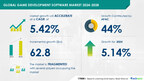
NEW YORK, June 19, 2024 /PRNewswire/ — The global game development software market  size is estimated to grow by USD 62.8 million from 2024-2028, according to Technavio. The market is estimated to grow at a CAGR of almost 5.42%  during the forecast period.  growth in demand for PC games and gaming consoles is driving market growth, with a trend towards growing popularity of ar/vr games. However, availability of open-source game development software  poses a challenge. Key market players include Adobe Inc., Amazon.com Inc., Apricot Investments Ltd., Audiokinetic Inc., Autodesk Inc., Bandicam Co., Degica Co. Ltd., Electronic Arts Inc., Epic Games Inc., Firelight Technologies Pty Ltd., GameSalad Inc., Microsoft Corp., NVIDIA Corp., Perforce Software Inc., Playtech Plc, Scirra Ltd., Silicon Studio Corp., The Game Creators Ltd., Unity Software Inc., and ZeniMax Media Inc..

Get a detailed analysis on regions, market segments, customer landscape, and companies – Click for the snapshot of this report

Forecast period

2024-2028

Base Year

2023

Historic Data

2018 – 2022

Segment Covered

Component (Game engine and Audio engine), End-user (Enterprises and Individual), and Geography (North America, APAC, Europe, South America, and Middle East and Africa)

Region Covered

North America, APAC, Europe, South America, and Middle East and Africa

Key companies profiled

Adobe Inc., Amazon.com Inc., Apricot Investments Ltd., Audiokinetic Inc., Autodesk Inc., Bandicam Co., Degica Co. Ltd., Electronic Arts Inc., Epic Games Inc., Firelight Technologies Pty Ltd., GameSalad Inc., Microsoft Corp., NVIDIA Corp., Perforce Software Inc., Playtech Plc, Scirra Ltd., Silicon Studio Corp., The Game Creators Ltd., Unity Software Inc., and ZeniMax Media Inc.

Key Market Trends Fueling Growth

The integration of augmented reality and virtual reality (AR/VR) technology in gaming is driving the demand for advanced game development software. With the increasing popularity of AR/VR devices, game developers are shifting their focus towards these platforms. This trend is motivating enterprises to launch new AR/VR games and invest in game development software to meet the growing demand. For instance, Apple’s planned launch of a VR/AR headset and AR glasses is expected to boost the market. Recent acquisitions, such as Facebook’s purchase of BigBox VR, further underscore this trend. Overall, the adoption of AR/VR technology in gaming is fueling the growth of the game development software market. 

The game development software market is experiencing significant growth with various tools and technologies in use. Cross platform development is a trending approach, allowing the creation of games for multiple devices. Devopsment, such as Dependency Management and Continuous Integration, is essential for efficient game development. Tools like Unity and Unreal Engine are popular choices for game developers due to their versatility and features. Markets like Mobile, PC, and Console continue to dominate the industry, with Augmented Reality and Virtual Reality gaining traction. The use of Artificial Intelligence and Machine Learning in game development is also on the rise, enhancing player experience. Overall, the game development software market is dynamic and innovative, with new technologies and trends emerging regularly. 

Research report provides comprehensive data on impact of trend. For more details- Download a Sample Report

Market Challenges

Open-source game development software is gaining popularity in economies like India and China due to its affordability and cross-platform compatibility. SMEs and individual developers prefer this option for its low upfront costs and high flexibility. Notable open-source game development frameworks include Cocos2d-x from Xiamen Yaji Software Co. Ltd., Blender, Box2D, Delta Engine, Panda3D, PlayCanvas, and Starling. The widespread use of these tools is expected to impact the global game development software market by increasing competition and reducing demand for proprietary solutions.The game development software market faces several challenges. Costs are a significant issue, with high development costs for advanced graphics and features. Technical challenges include ensuring compatibility across various platforms and devices. The market is also competitive, with numerous players offering similar solutions. Additionally, keeping up with the latest technologies and trends is essential to remain competitive. Licenses and maintenance costs are ongoing expenses that add to the overall cost of using game development software. Furthermore, the need for continuous updates and improvements can be time-consuming and resource-intensive. Overall, the game development software market requires innovative solutions to address these challenges and provide cost-effective, efficient, and user-friendly software for developers.

For more insights on driver and challenges – Download a Sample Report

Segment Overview 

This game development software market report extensively covers market segmentation by

Component 1.1 Game engine1.2 Audio engineEnd-user 2.1 Enterprises2.2 IndividualGeography 3.1 North America3.2 APAC3.3 Europe3.4 South America3.5 Middle East and Africa

1.1 Game engine-  The Game Development Software Market is a significant business sector, with numerous companies offering solutions for creating and publishing video games. These tools enable developers to design, build, and test games across various platforms. The market’s growth is driven by increasing consumer demand for high-quality games and the continuous advancement of technology. Companies invest in research and development to enhance their offerings, catering to diverse gaming genres and user needs. The market’s competition is fierce, with firms focusing on providing efficient, user-friendly, and cost-effective software to gain a competitive edge.

For more information on market segmentation with geographical analysis including forecast (2024-2028) and historic data (2018 – 2022)  – Download a Sample Report

Research Analysis

The Game Development Software market is a dynamic and innovative sector in the Gaming Industry, offering various tools for creating immersive experiences using technologies like Augmented Reality (AR) and Virtual Reality (VR), powered by Artificial Intelligence (AI). User-friendly software is essential for Mobile Gaming on Smartphones and Tablets, with Cloud-Based Solutions enabling Cross Platform Development and reducing Development Costs. Unity and Unreal Engine are popular Game Development Tools, while Online Gaming, eSports, and Funding opportunities drive the market. Technical Changes, Open Source Tools, and Intellectual Property concerns are significant factors. Platform Dependency and Market Dispersion require Skills Access for successful development projects.

Market Research Overview

The Game Development Software Market encompasses a wide range of tools and technologies utilized for creating engaging and immersive video games. These solutions enable developers to design, build, and deploy games across various platforms, including PC, console, mobile, and virtual reality. Key features of game development software include real-time rendering, physics engines, animation tools, and integrated development environments. Additionally, these solutions support programming languages such as C++, C#, and Unity Script. The market is driven by the growing demand for advanced gaming experiences and the increasing popularity of esports and mobile gaming. Furthermore, the integration of artificial intelligence and machine learning technologies is expected to fuel market growth.

Table of Contents:

1 Executive Summary
2 Market Landscape
3 Market Sizing
4 Historic Market Size
5 Five Forces Analysis
6 Market Segmentation

ComponentGame EngineAudio EngineEnd-userEnterprisesIndividualGeographyNorth AmericaAPACEuropeSouth AmericaMiddle East And Africa

7 Customer Landscape
8 Geographic Landscape
9 Drivers, Challenges, and Trends
10 Company Landscape
11 Company Analysis
12 Appendix

About Technavio

Technavio is a leading global technology research and advisory company. Their research and analysis focuses on emerging market trends and provides actionable insights to help businesses identify market opportunities and develop effective strategies to optimize their market positions.

With over 500 specialized analysts, Technavio’s report library consists of more than 17,000 reports and counting, covering 800 technologies, spanning across 50 countries. Their client base consists of enterprises of all sizes, including more than 100 Fortune 500 companies. This growing client base relies on Technavio’s comprehensive coverage, extensive research, and actionable market insights to identify opportunities in existing and potential markets and assess their competitive positions within changing market scenarios.

Contacts

Technavio Research
Jesse Maida
Media & Marketing Executive
US: +1 844 364 1100
UK: +44 203 893 3200
Email: media@technavio.com
Website: www.technavio.com/

View original content to download multimedia:https://www.prnewswire.com/news-releases/game-development-software-market-size-is-set-to-grow-by-usd-62-8-million-from-2024-2028–growth-in-demand-for-pc-games-and-gaming-consoles-to-boost-the-market-growth-technavio-302176459.html

SOURCE Technavio

Continue Reading
Click to comment

Leave a Reply

Your email address will not be published. Required fields are marked *

Technology

Mixx Technologies Acquires Sophic Silicon Technologies and Announces Manufacturing Collaboration with Kaynes Semicon

Published

on

By

A landmark dual announcement signals India’s emergence as a vertically integrated force in global AI semiconductor infrastructure, spanning design to deployment

BENGALURU, India, July 23, 2026 /PRNewswire/ — Mixx Technologies, Inc., a US based venture-backed deep-tech company building the interconnect layer for hyperscale AI infrastructure, today announced two simultaneous strategic moves that together mark a defining moment in India’s semiconductor journey. First, the acquisition of Sophic Silicon Technologies, a Bengaluru-based semiconductor IP design firm, beneficiary of India’s DLI and whose analog mixed-signal design expertise is now integral to Mixx’s co-packaged optics platform. Second, a manufacturing collaboration with Kaynes Semicon Private Limited, an Outsourced Semiconductor Assembly and Test (OSAT) specialist and beneficiary of India’s Production Linked Incentive (PLI) scheme, to establish a test and assembly facility that will support Mixx’s optical IC packaging roadmap. Taken together, the two announcements represent the first time an international deep-tech company has anchored both the design and manufacturing layers of a next-generation AI silicon platform in India, turning the country’s policy ambition into commercial reality.

The Acquisition: Completing the Full-Stack Foundation for Co-Packaged Optics
Every major cloud provider is deploying GPUs at a pace and scale that would have seemed implausible three years ago. But raw compute density is only half the equation. The harder problem is making sure those GPUs are working to its full potential and not waiting. In large AI clusters, accelerators spend a significant fraction of their time stalled on data waiting to move between chips fast enough to keep compute fed. The interconnect, not the GPU itself, is increasingly the binding constraint on utilization. And utilization directly determines the cost of a token and the energy burned to produce it. For hyperscalers running inference at billions of queries a day, the economics are unforgiving: every percentage point of GPU idle time is waste at scale. Introducing optics to declutter the data path improves efficiency. Co-packaged optics (CPO), the most effective solution to the interconnect bottleneck, integrates photonic engines directly alongside ASICs and accelerators, moving data at optical speeds and at a fraction of the power of conventional electrical interconnects. It unlocks the bandwidth density required to keep GPUs utilized efficiently and sustainably, bringing down both the cost of a token and the energy consumed to produce it.

The industry is focused, the demand is now, and Mixx is ready for real-world deployments.

Delivering CPO at hyperscale, however, requires precision across the full electronic-photonic stack; the hardest layer to design is the analog mixed-signal interface between the photonics and the digital system. That is precisely what Sophic Silicon Technologies has designed using advanced CMOS process nodes. Their IP now forms the electronic IC foundation of Mixx’s HBxIO™ platform – a multi-terabit, ultra-high-radix optical interconnect architecture purpose-built for large-scale AI inference and training. The acquisition brings Sophic Silicon’s full team and IP portfolio into Mixx, effective immediately.

“Our vision has always been to build the complete electronic-photonic stack. Sophic Silicon brings critical analog mixed-signal expertise that reinforces HBxIO and moves us closer to deploying optical connectivity at hyperscale.”

        — Vivek Raghuraman, CEO, Mixx Technologies

Sophic Silicon’s founders and core engineers, with backgrounds spanning advanced CMOS process design, EDA and IP development, and high-speed networking, will join Mixx’s core product development organization and continue expanding R&D operations in India.

“Sophic Silicon exists because optical connectivity at hyperscale demands more – lower power, higher bandwidth, seamless multi-protocol integration, and latency that lets networks perform at their absolute best. Mixx gives us the platform, the ecosystem, and the global reach to take that work where it was always meant to go. What we built in Bengaluru is now part of the infrastructure that the world’s largest computing deployments will run on.”

         — Deepak Pancholi, Founder, Sophic Silicon Technologies

The Collaboration: From Design to Deployment with Kaynes Semicon
Designing world-class semiconductor IP in India is a milestone. Manufacturing and testing it there is a transformation. Mixx Technologies’ collaboration with Kaynes Semicon Private Limited, a leading Indian OSAT provider and PLI beneficiary, is precisely that second step.

The collaboration brings together Kaynes Semicon’s advanced OSAT capabilities and Mixx’s optical IC design expertise to build a dedicated test and assembly capability for next-generation optical integrated circuits. Kaynes Semicon brings deep process knowledge in semiconductor assembly, packaging, and test, backed by the capital investment and institutional credibility of a PLI-supported program. For Mixx, the partnership creates a tightly integrated domestic manufacturing pathway for components of the HBxIO™ platform, enabling faster development cycles, closer collaboration between design and production teams, and the kind of end-to-end control that is essential when pushing the limits of optical IC performance.

“This multi-year collaboration with Mixx Technologies is a strong signal of where India’s semiconductor manufacturing ecosystem is headed. We have built the infrastructure and the process depth to support advanced optical IC packaging. Working with Mixx brings a world-class design partner into that ecosystem, demonstrating that PLI-backed Indian manufacturers can play at the leading edge of the global AI hardware supply chain.”

          — Raghu Panicker, CEO, Kaynes Semicon Private Limited

From India, for the World: A New Model for Semiconductor Globalization
Mixx Technologies has maintained R&D operations in India since its founding, alongside its San Jose headquarters and Taiwan facilities. The acquisition of Sophic Silicon deepens that presence significantly, embedding a team with leading-edge analog mixed-signal and photonics design experience into Mixx’s core product organization. The collaboration with Kaynes Semicon adds a manufacturing dimension: for the first time, a next-generation optical interconnect platform will have both its design and its assembly and test operations anchored in India. This is not an offshoring story. It is a story about India becoming a primary node in the global AI semiconductor value chain, with design, manufacturing, and IP origination happening here, at global scale.

“Mixx Technologies is committed to developing next-generation silicon photonics IP and system designs in India, contributing to the country’s ambition of becoming a global hub for semiconductor design and advanced manufacturing. The talent here is exceptional. The policy environment has matured to support it. And today’s announcements are what happens when both come together.”

           — Vivek Raghuraman, CEO, Mixx Technologies

The Road Ahead: Building the AI Interconnect Layer, in India
Sophic Silicon’s mixed-signal IPs is now being integrated across the HBxIO™ platform stack. Mixx is actively engaged with cloud service providers to qualify the platform across both scale-up and scale-out network, connecting servers and clusters across data center fabric.

The Kaynes Semicon collaboration is underway, focused on qualifying advanced optical IC assembly and test processes that meet the stringent performance and reliability standards hyperscale deployments demand. Mixx continues to expand its India R&D organization, with Bengaluru at the center of its global analog mixed-signal and photonics IC development.

The global AI chip market is projected to exceed $400 billion by 2030. The interconnect layer, tracking how data moves between chips, between accelerators and between clusters, is where the next wave of differentiation will be won. Mixx Technologies is building that layer. And it is building it in India.

About Mixx Technologies
Mixx Technologies, Inc. is venture-backed deep-tech company founded by the team that commercialized many zero-to-one silicon photonics products. The company is solving the data-movement bottleneck for AI compute infrastructure through its HBxIO™ platform, a multi-terabit, ultra-high-radix co-packaged optical interconnect architecture enabling cloud service providers to deploy large-scale AI inference at the speed and efficiency hyperscale demands. Headquartered in San Jose, California, with R&D operations in India and Taiwan. Visit: www.mixxtech.io.

About Sophic Silicon Technologies
Sophic Silicon Technologies is a Bengaluru-based semiconductor IP design firm specializing in analog mixed-signal, wireless and photonics ICs for AI-scale infrastructure. A beneficiary of India’s Design Linked Incentive (DLI) Scheme under the India Semiconductor Mission, the company developed its IP at leading-edge CMOS process nodes to address the electro-optic interface challenges central to co-packaged optics and next-generation AI scale-up interconnects. Sophic Silicon Technologies is now part of Mixx Technologies.

About Kaynes Semicon Private Limited
Kaynes Semicon Private Limited is an Indian OSAT (Outsourced Semiconductor Assembly and Test) company and beneficiary of the Government of India’s Production Linked Incentive (PLI) scheme for semiconductors. With infrastructure and advanced assembly capabilities at its Sanand, Gujarat facility, Kaynes Semicon is building India’s domestic semiconductor manufacturing ecosystem for next-generation packaging and test requirements.

Media Contact
Ramya Barna
Marketing and Investor Relations, Mixx Technologies, Inc
info@mixxtech.io

Photo – https://mma.prnewswire.com/media/3007336/Mixx_Technologies_System_Level_Solution.jpg
Logo – https://mma.prnewswire.com/media/2834697/Mixxblack_Logo.jpg

View original content:https://www.prnewswire.com/in/news-releases/mixx-technologies-acquires-sophic-silicon-technologies-and-announces-manufacturing-collaboration-with-kaynes-semicon-302832530.html

Continue Reading

Technology

Hydra X Launches HX Gateway API to Advance Institutional Adoption on the Canton Network

Published

on

By

The HX Gateway API supports financial institutions and developers building on Canton, reducing go-to-market timelines by up to 80% and deployment time by 50%.

SINGAPORE, July 23, 2026 /PRNewswire/ — Hydra X, a regulated market infrastructure operator for tokenised capital markets, today announced the launch of HX Gateway API, a REST API layer that supports financial institutions and application developers building on the Canton Network without requiring specialised expertise in Daml, Canton’s underlying programming language.

The API provides a straightforward integration layer that maps directly to familiar business workflows – onboarding participants, issuing and managing assets, and executing transfers. Now, institutions can go from decision to deployment without needing to build infrastructure from the ground up.

Built on Production Experience on the Canton Network

The HX Gateway API is built on Hydra X’s own production experience operating on the Canton Network. The firm has tokenised over US$100 million in assets for institutional clients across multiple regulatory frameworks on Canton through DA Registry – a secure tokenisation solution with regulatory-grade compliance built by Digital Asset, creators of the Canton Network.

That operational depth informed the design of the API, resulting in measurable gains for institutional deployments:

Rapid Go-to-Market: Up to an 80% acceleration in go-to-market timelines.Faster Path-to-Production: A 50% reduction in deployment time.Flexible Integration: Available as a hosted service or as an external deployment for clients with existing validator infrastructure.

“The HX Gateway API was designed to advance institutional adoption on the Canton Network.  It is built on the same infrastructure we run in production for regulated clients, and it means that banks, asset managers and exchanges no longer need to treat Canton integration as a specialist engineering project. It is a business decision now, and the timelines reflect that,” said Mark Tang, VP of Client Solutions, Hydra X.

A Broader Shift in Tokenised Capital Markets

The launch marks a broader shift in how regulated financial institutions can engage with the Canton Network. As tokenised capital markets around the world move from pilot programmes to production deployments, the ability to integrate quickly and reliably into shared network infrastructure is becoming a competitive differentiator. The HX Gateway API is designed to meet that moment, providing institutional-grade tooling that significantly accelerates the path from deciding to build on the Canton Network to achieving a live deployment.

About Hydra X

Hydra X is a regulated market infrastructure operator for tokenised capital markets, with live deployments across Asia-Pacific. The firm builds and operates the full lifecycle of digital capital market infrastructure, spanning tokenisation, distribution, trading, custody and settlement. Hydra X serves financial institutions seeking to issue, trade and custodise digital assets on regulated, institutional-grade infrastructure.

www.hydrax.io

View original content:https://www.prnewswire.com/apac/news-releases/hydra-x-launches-hx-gateway-api-to-advance-institutional-adoption-on-the-canton-network-302832706.html

SOURCE Hydra X

Continue Reading

Technology

Unfold Your Passions with a $0 Galaxy on StarHub 5G Unlimited+ Plans

Published

on

By

Pre-order the new Samsung Galaxy Z Fold8 Ultra, Galaxy Z Fold8 and Galaxy Z Flip8 with StarHub to unlock exclusive perks

SINGAPORE, 23 July 2026 /PRNewswire/ — Your next Galaxy upgrade just got easier. Whether it’s streaming Premier League action on the go, multi-tasking on a larger foldable display or enjoying immersive entertainment, StarHub is making it easier than ever to own Samsung’s latest Galaxy foldables.

From today, customers can pre-order the new Samsung Galaxy Z Fold8 Ultra, Galaxy Z Fold8, and Galaxy Z Flip8 on StarHub’s 5G Unlimited+ Plans, enjoying up to $1,688 in device savings, up to $2,880 in DeviceDollars (over 36 months) to offset interest-free device instalments, bringing the cost of owning Samsung’s latest foldables down to as low as $0.

More Value with Every Upgrade

Designed to make upgrading easier and more rewarding, StarHub’s 5G Unlimited+ Plans combine exclusive pre-order offers with perks, so customers get even more from Samsung’s latest Galaxy foldables:

Up to $2,880 in DeviceDollars (over 36 months) to offset interest-free instalments, with flexible payment options across 12, 24 or 36 monthsUpfront pay later device discounts with 5G Unlimited+ PlansUp to $350 off device for new lines and port-insGuaranteed $300 trade-in bonus on top of device’s base trade-in valueComplimentary Premier League Annual Pass worth $380 with Galaxy Z Fold8 Ultra or Fold8Complimentary storage upgrade to 512GB at the price of 256GB worth $300, with 5G Unlimited+ Plus Plans and aboveComplimentary 3 months SmartSupport (worth $42.78) to lock in the 50% trade-in guarantee on your new Galaxy Z Foldable[1]$38 e-voucher for customers who registered their interestWatch add-on savings of up $250 off Galaxy Watch Ultra2 and $100 off Galaxy Watch9

More Freedom with 5G Unlimited+ Plans

Beyond the device, StarHub’s 5G Unlimited+ Plans include unlimited data, built-in global roaming across 165 destinations, and unlimited calls and SMS, giving customers greater peace of mind whether they’re staying connected at home or travelling overseas.

Pre-Order Details

Customers can pre-order the new Samsung Galaxy Z Series, Galaxy Watch Ultra2 and Galaxy Watch9 on StarHub’s 5G Unlimited+ Plans from 23 July 2026, 9am to 13 August 2026, 11.59pm via the StarHub App and online at starhub.com/samsung. Customers who prefer to pre-order in person can do so at StarHub Shops from 4 August 2026, during operating hours.

The Samsung Galaxy Z Series will be available for walk-in purchase at StarHub shops from 14 August 2026, 11am, and online via the StarHub eShop from 14 August 2026, 12am, while stocks last.

For more information, visit: starhub.com/samsung.

[1] Terms and conditions apply, please refer to starhub.com/samsung

View original content to download multimedia:https://www.prnewswire.com/apac/news-releases/unfold-your-passions-with-a-0-galaxy-on-starhub-5g-unlimited-plans-302832777.html

SOURCE StarHub

Continue Reading

Trending