Connect with us

Technology

INRIX: Remote and Hybrid Work Shift Can’t Curb Congestion

Published

on

New York City (101 hours) topped the 2023 Global Traffic Scorecard, followed by Mexico City and London.Americans lost an average of 42 hours to congestion, up 11% from 2022, costing $733 per driver.Midday trips in the U.S. have increased 23% compared to 2019, with nearly as many trips taken at 12:00 PM as there are at 5:00 PM.Trip analysis indicates 10:00 AM to 4:00 PM is the new ‘9-to-5.’The most congested road in America was Orlando’s I-4 Westbound from Beachline Expressway to Western Beltway, followed LA’s I-5, I-95 in Stamford, and New York’s I-278.

KIRKLAND, Wash., June 25, 2024 /PRNewswire/ — Today, INRIX, Inc., a global leader in transportation data and analytics, released the 2023 Global Traffic Scorecard that identified and ranked congestion and commuting trends in nearly 1,000 cities, across 37 countries. New York City once again topped the global ranking, followed by Mexico City and London. U.S. cities held two spots in the top five and four in the top 10.

“Traffic congestion is both a bane and a barometer of economic health; it symbolizes bustling activity yet simultaneously hampers it,” said Bob Pishue, transportation analyst at INRIX. “Reflecting on 2023 and early 2024, the surge in traffic congestion in urban areas indicated a revival of economic hubbub post-COVID, but it also led to billions of dollars in lost time for drivers.” Despite signs of recovery, though, some aspects of the pandemic are sticking around. Pishue continued, “Although congestion is returning to pre-COVID levels, we’re seeing interesting changes in congestion patterns due to the lingering effects of the pandemic. The continuation of hybrid and remote work is creating new travel peaks from what we’ve seen previously.”

America’s Gridlock is Worse Than Ever
New York City is followed by Chicago (96 hours) and Los Angeles (89 hours) as the most congested cities in the United States. This is New York City’s second year in the top spot, despite a 4% reduction in overall congestion. The typical U.S. driver lost 42 hours to traffic congestion and lost $733 worth of time, up nearly $100 from last year.

Table 1: 10 Most Congested Urban Areas in the U.S.

2023 US
Rank
(2022
Rank)

Urban Area

2023
Delay
(2022)

Compared
to
Pre-
COVID

2023
Cost per
Driver

2023
Cost
per
City

Downtown
Speed 
(mph)

Q1 2024
vs Q1
2023

1 (1)

New York City, NY

101 (105)

11 %

$1,762

$9.1 B

11

-11 %

2 (2)

Chicago, IL

96 (87)

18 %

$1,672

$6.1 B

11

-8 %

3 (3)

Los Angeles, CA

89 (78)

-4 %

$1,545

$8.3 B

19

-5 %

4 (4)

Boston, MA

88 (78)

-1 %

$1,543

$2.9 B

10

-10 %

5 (6)

Miami, FL

70 (66)

18 %

$1,219

$3.1 B

14

-1 %

6 (5)

Philadelphia, PA

69 (67)

2 %

$1,209

$2.9 B

11

-9 %

7 (8)

Washington, DC

63 (52)

-9 %

$1,095

$2.7 B

11

-4 %

8 (7)

Houston, TX

62 (55)

1 %

$1,082

$3.2 B

17

-1 %

9 (9)

Atlanta, GA

61 (51)

-3 %

$1,066

$2.6 B

16

-4 %

10 (12)

Seattle, WA

58 (46)

-11 %

$1,010

$1.6 B

17

-1 %

In addition to being the most congested urban area, New York City saw a staggering 13% increase in downtown trips in 2023 compared to 2022, followed by Atlanta, Philadelphia, and Washington D.C. (7%). Nine out of 10 of the United States’ largest metros saw a year-over-year increase in downtown trips. Trip analysis also revealed the traditional 9-to-5 workday has transformed into to a new 10-to-4 schedule. The shift in off-peak commuting and workday hours are likely fueled by the continued prevalence of remote and hybrid work.

A New Midday Rush Hour
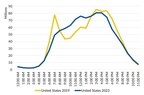
The uptick in congestion comes alongside the emergence of a new phenomenon: the midday rush hour. As Graph 1 illustrates, morning hourly commute trips in 2023 were down about 12% compared to 2019 and the PM peak (3-6 PM) was down just 9%. However, average hourly traffic during the midday was up an astonishing 23%, a trend that has continued to remain since 2020.

Overall, the data shows that per hour, nearly the same number of trips start during the midday as the evening commute period, typically the most congested period of the day.

The Most Congested Corridors in the U.S.
Across the United States, traffic delays on the busiest corridors have generally improved since 2022. Notably, the highest peak delay in 2023 was 2.5 hours less than the peak delay in 2022. A striking example of changing patterns is the I-4 in Orlando, Florida, which surged from 10th place in 2022 to the top in 2023. During peak hours, drivers lost 31 minutes on the I-4 westbound, on par with Los Angeles’ notorious I-5 congestion.

In Stamford, Connecticut, the I-95 corridor demonstrated significant congestion in both directions, earning it the third and fourth spots on the list of most congested U.S. corridors. Northbound travelers on the 30-mile stretch of I-95 lost an average of 29 minutes daily, while those heading southbound faced a slightly lower but still substantial delay of 28 minutes each day.

Table 1: 10 Most Congested U.S. Roads in 2023

Rank

Urban Area

Road Name

From

To

Peak Hour

2023 Peak
Minutes
Lost

2023
Hours
Lost

1

Orlando, FL

I-4 W

Beachline Expy

Western Bltwy

5:00 PM

31

124

2

Los Angeles, CA

I-5 S

I-10

I-605

5:00 PM

31

122

3

Stamford, CT

I-95 N

Sherwood Isl Conn

Warren St

4:00 PM

29

116

4

Stamford, CT

I-95 S

Compo Road S

Indian Field Rd

8:00 AM

28

111

5

New York, NY

I-278 W

I-495

Tillary St

4:00 PM

21

82

6

Miami, FL

I-95 N

NW 46th St

NW 151st St

5:00 PM

20

82

7

Boston, MA

I-93 S

Zakim Bridge

Pilgrim’s Hwy

3:00 PM

20

81

8

Baton Rouge, LA

I-10 E

N Lobdell Hwy

I-12

4:00 PM

17

70

9

Stamford, CT

I-95 N

Indian Field Rd

Compo Road S

5:00 PM

17

68

10

Chicago, IL

I-94 E

I-290

I-57

4:00 PM

17

66

Congestion Climbs Worldwide
New York, Mexico City, London, Paris, and Chicago were the top five most congested urban areas in the Global Congestion Impact Ranking. Out of the top 100 ranked urban areas, 98 experienced more delay than in 2022, and in 71 areas, that delay grew by more than 10%. Just under half, however, have reached their 2019, pre-COVID level of delay.

Table 2: 10 Most Congested Cities in the World in 2023

 2023
 Impact
Rank 
(2022 Rank)

Urban Area

Country

2023 Delay
 per Driver
 (hours)

Change from
2022

Change
from Pre-
COVID

Downtown
Speed (mph)

Q1
2024
Change

1 (1)

New York City,
NY

USA

101

-4 %

11 %

11

-11 %

2 (4)

Mexico City

MEX

96

13 %

-11 %

12

-5 %

3 (2)

London

UK

99

2 %

3 %

10

-10 %

4 (3)

Paris

FRA

97

4 %

1 %

10

-3 %

5 (5)

Chicago IL

USA

96

10 %

18 %

11

-8 %

6 (6)

Istanbul

TUR

91

12 %

20 %

13

5 %

7 (7)

Los Angeles CA

USA

89

13 %

-4 %

19

-5 %

8 (8)

Boston MA

USA

88

14 %

-1 %

10

-10 %

9 (13)

Cape Town

ZAF

83

32 %

-10 %

12

7 %

10 (16)

Jakarta

IDN

65

33 %

-24 %

13

16 %

The Road to Combatting Congestion
Access to reliable data is the first step in tackling congestion. Applying big data to create intelligent transportation systems is key to solving urban mobility problems. INRIX data and analytics on mobility, traffic signals, parking and population movement help city planners and engineers make data-based decisions to prioritize spending to maximize benefits and reduce costs now and into the future.

The key findings of the INRIX 2023 Global Traffic Scorecard provide a quantifiable benchmark for governments and cities across the world to measure progress to improve urban mobility and track the impact of spending on smart city initiatives.

Please visit www.inrix.com/scorecard for:

Full 2023 Global Traffic Scorecard reportInteractive webpage with data and information for nearly 1,000 cities and 37 countriesComplete methodology

Notes to Editors:
Data Sources
INRIX aggregates anonymous data from diverse datasets – such as phones, cars, trucks and cities – that leads to robust and accurate insights. The data used in the 2023 Global Traffic Scorecard is the congested or uncongested status of every segment of road for every minute of the day, as used by millions of drivers around the world that rely on INRIX-based traffic services.

Data used to complete the 2023 Scorecard and Q1 Update spans more than 15 months. The Scorecard incorporated three years of historical data to provide a complete year-over-year comparison of congestion and mobility. A multi-year approach enables the identification of trends in the world’s largest urban areas and provides a basis for comparison.

Research Methodology
The 2023 Global Traffic Scorecard provides the most up-to-date methodology to better understand movement in urban areas across the world. The 2023 Scorecard continues to include travel delay comparisons, collision trends and last-mile speeds based on the unique commuting patterns within each metro area, yet the latest origin-and-destination patterns accommodate the latest commuting behavior shifts.

Commute times were calculated by looking exclusively at the time it takes to get to and from major employment centers within an urban area from surrounding commuting neighborhoods. Our newest methodology, updated for this Scorecard, more accurately estimates commute distance using actual, observed trips. In general, this has placed downward pressure on commuting delays versus prior Scorecards, as observed trips tended to be shorter than previously estimated.

These changes were run for the years 2019, 2022 and 2023, along with the Q1 Update provided in this document. Q1 update is a special update for this version of the Global Traffic Scorecard and measures the change in average peak period travel times between January-March 2024 and January-March 2023.
Economic costs are calculated based on the following hourly values of time, which were based on U.S. Federal Highway Administration’s Revised Departmental Guidance on Valuation of Travel Time for Economic Analysis, 2016.  Adjusted for inflation, the rates are the following: $17.45 per hour in the U.S., £9.12 per hour in the U.K. and 10.67 € per hour in Germany. Individual urban areas may have higher, or lower, values of time depending on local economic conditions.

The 2023 Scorecard values time lost by analyzing peak speed and free-flow speed data for the busiest commuting corridors and sub areas as identified by origin and destination patterns unique to that area. Total time lost is the difference in travel times experienced during the peak periods compared to free-flow conditions on a per driver basis. In other words, it is the difference between driving during commute hours versus driving at night with little traffic.

About INRIX
Founded in 2004, INRIX pioneered intelligent mobility solutions by transforming big data from connected devices and vehicles into mobility insights. For nearly two decades, INRIX has harnessed machine learning and artificial intelligence to deliver precise and actionable mobility data. This revolutionary approach enabled INRIX to become one of the leading providers of data and analytics into how people move. By empowering cities, businesses, and people with valuable insights, INRIX is helping to make the world smarter, safer, and greener. With partners and solutions spanning across the entire mobility ecosystem, INRIX is uniquely positioned at the intersection of technology and transportation – whether its keeping road users safe, improving traffic signal timing to reduce delay and greenhouse gasses, optimizing last-mile delivery, or helping uncover market insights. Learn more at INRIX.com.

View original content to download multimedia:https://www.prnewswire.com/news-releases/inrix-remote-and-hybrid-work-shift-cant-curb-congestion-302181067.html

SOURCE INRIX, Inc.

Continue Reading
Click to comment

Leave a Reply

Your email address will not be published. Required fields are marked *

Technology

EcoFlow Reveals OCEAN 2 at Solar & Storage Live London 2026 as Demand Grows for Smarter, Scalable Home Energy

Published

on

By

Top lines:

Next-generation EcoFlow OCEAN 2 Plus Single-Phase system unveiled, designed for a new era of scalable, whole-home energy, supporting up to 12kw AC outputStorage capacity expandable up to 300 kWh, with 10,000 cell-cycle battery lifespanEngineered for faster installation and lower ongoing energy lossAdvanced solar optimisation with triple MPPT architecture for complex UK rooftopsExclusive preview of upcoming OCEAN 2 products and EcoFlow STREAM technology at the event

BIRMINGHAM, United Kingdom, April 28, 2026 /PRNewswire/ — EcoFlow is set to unveil OCEAN 2 Plus, its next-generation home battery system, at Solar & Storage Live London 2026, taking place at ExCeL London from 29–30 April.

Positioned at the intersection of performance, scalability and intelligent energy management, OCEAN 2 represents a significant step forward for residential energy systems in the UK – designed not just to meet today’s demand, but to evolve alongside it. As the market shifts towards more flexible, decentralised energy models, EcoFlow is delivering systems that scale from everyday households through to high-demand, fully electrified homes.

At the event, EcoFlow will also offer attendees an exclusive first look at upcoming additions to the OCEAN 2 series, alongside a showcase of its STREAM technology, reflecting growing momentum behind small-scale and emerging solar solutions in the UK.

EcoFlow OCEAN 2 Plus Single-Phase has been designed with long-term flexibility at its core. A single system can start small and expand over time, supporting up to 300 kWh of storage capacity when configured in parallel. This enables the system to move beyond traditional residential use cases, supporting larger homes with electric vehicles, heat pumps, and increasing electrification demands. With a 10,000-cycle battery lifespan, the system is built to deliver consistent performance and savings over many years of operation.

Performance has also been optimised for real-world UK conditions. With three independent MPPTs, OCEAN 2 is able to maximise solar generation across rooftops with multiple orientations or partial shading, ensuring more consistent energy capture throughout the day. Each string supports high input capacity, enabling installers to design more efficient, higher-yield systems without compromise.

Efficiency extends beyond generation. OCEAN 2 has been engineered to minimise its own energy consumption, operating at just 50W during light-load discharge. While often overlooked, this reduction in baseline energy use contributes to meaningful long-term savings, with estimated lifetime energy savings reaching up to 6,000 kWh over a 15-year period.

Installation has been streamlined throughout. With a compact form factor, integrated components and reduced on-site complexity, OCEAN 2 is designed to save time at every stage, from handling and positioning through to commissioning. At 46kg per battery pack, and with support for both indoor and outdoor installation, the system provides practical flexibility for installers working across a wide range of property types.

Whole-home backup functionality is built in as standard, with seamless switching designed to maintain power continuity across essential systems. This is complemented by a multi-layered safety architecture, combining both passive and active protection mechanisms across the battery system, alongside a 15-year warranty designed to support long-term peace of mind.

At the system level, OCEAN 2 integrates into EcoFlow’s wider Home Energy Ecosystem, connecting solar generation, storage, and smart home technologies into a single intelligent platform. Through its Home Energy Management System, the system can automatically optimise when to store and use energy based on demand and dynamic electricity tariffs, helping households reduce reliance on the grid while improving overall energy efficiency.

Craig Bilboe, Head of Residential UK&ANZ for EcoFlow said:

“UK homes are changing quickly. We’re seeing more electric vehicles, more heat pumps, and more people wanting to use their own solar more effectively. OCEAN 2 Plus Single-Phase has been built for that reality. It gives installers a system that’s quicker to work with, and gives households the ability to store more, use more, and expand over time without replacing what they already have. Alongside that, technologies like STREAM are opening the door for people who want to start smaller, making solar more accessible in a way we haven’t really seen in the UK before.”

Visitors to the EcoFlow stand will be able to experience live demonstrations of OCEAN 2 Plus Single-Phase, explore upcoming product developments, and speak directly with EcoFlow’s technical and commercial teams.

To register or learn more, visit: https://lnkd.in/g6RxBPmB

Photo – https://mma.prnewswire.com/media/2966057/EcoFlow.jpg

View original content:https://www.prnewswire.co.uk/news-releases/ecoflow-reveals-ocean-2-at-solar–storage-live-london-2026-as-demand-grows-for-smarter-scalable-home-energy-302754188.html

Continue Reading

Technology

XTM International Appoints New CMO and VP of Engineering to Accelerate AI-Driven Growth

Published

on

By

Niki Sotiropoulou joins as Chief Marketing Officer and Sean Mooney as Vice President of Engineering, reinforcing XTM’s commitment to AI-driven product innovation and global enterprise growth.

LONDON, April 28, 2026 /PRNewswire/ — XTM International, a global leader in AI-driven localisation technology, today announced two strategic additions to its executive leadership team. Niki Sotiropoulou has been appointed Chief Marketing Officer (CMO), and Sean Mooney joins as Vice President of Engineering, leading engineering execution across XTM’s expanded product portfolio.

“Adding leaders of Niki’s and Sean’s calibre is a clear signal of XTM’s ambitions for the next phase of growth,” said Lorcan Malone, Chief Executive Officer of XTM International. “Niki brings the strategic marketing leadership to amplify the value our platform delivers to enterprise customers, while Sean brings the engineering depth to accelerate how quickly we ship that innovation. Together, they will help us extend our lead in AI-driven localisation.”

Niki Sotiropoulou — Chief Marketing Officer

Niki Sotiropoulou is a marketing leader focused on the intersection of AI, data and enterprise growth. Across more than two decades in both B2B and B2C, including pivotal roles at market-leading companies such as viva.com and eSHARE, she has built a reputation for aligning marketing strategy with overarching business objectives, and for using data and modern marketing technology to deliver measurable commercial impact. Her contribution to the field has been recognised through her inclusion among the industry’s top marketing influencers.

As CMO, Niki will lead XTM’s global marketing organisation, embedding AI and data across brand strategy, demand generation and customer-facing communications as the company delivers on its composable, AI platform mission.

“Marketing is most effective when it is grounded in data and amplified by AI,” said Sotiropoulou. “XTM is doing genuinely category-defining work in AI-driven globalisation platform, and my focus is on bringing the same rigour to how we tell that story, by building a marketing organisation that is data-driven, AI-augmented, and clearly tied to the outcomes our customers care about.”

Sean Mooney — Vice President of Engineering

Sean Mooney is a highly experienced technology leader specialising in cloud, connected services, technical architecture, systems integration and product modernisation. He brings 25 years of industry experience and a proven track record of delivering complex, concurrent strategic programmes on time, on budget and to specification. Sean will lead engineering execution across XTM’s R&D function, including development, QA, support and architecture teams in Ireland and across XTM’s global hubs.

“Great products are built by great teams,” said Mooney. “XTM has a clear AI-driven product vision, an exceptional engineering culture, and a customer base that depends on us to deliver. My role is to make sure our R&D organisation operates at the standard our customers expect : combining engineering excellence, modern architecture and a culture of continuous improvement so we can ship innovation at the pace this market demands.”

About XTM International

XTM International is your AI globalisation platform that transforms language from a barrier into an opportunity. We bring translation management, business management, software localisation, and video creation together into a composable system, giving enterprises the flexibility to adopt the solutions they need, when they need them. Trusted by over 1,300 global companies, supporting more than 880 languages and over 80 ready-to-go integrations, XTM enables teams to scale global content with accuracy, speed, and absolute trust.

Photo – https://mma.prnewswire.com/media/2966641/XTM_International_New_CMO_and_VP_of_Engineering.jpg
Logo – https://mma.prnewswire.com/media/2680664/5939325/XTM_International_Logo.jpg


View original content:https://www.prnewswire.co.uk/news-releases/xtm-international-appoints-new-cmo-and-vp-of-engineering-to-accelerate-ai-driven-growth-302754951.html

Continue Reading

Technology

Loftie Launches Loftie+ Habit System to Help People Put Their Phones Down

Published

on

By

LONDON, April 28, 2026 /PRNewswire/ — Loftie, maker of the award-winning alarm clock that replaces the smartphone on the nightstand, today launches Loftie+ — a behaviour-change system built to change habits, not track data.

Over half of UK and Irish adults stay up later than planned because of their phones — rising to 73% of 18- to 24-year-olds in the UK (Deloitte, 2024). The sleep industry’s answer: sell people a tracker and a score.

“The sleep industry is obsessed with measurement,” said Matt Hassett, founder and CEO of Loftie. “People are staring at a dozen numbers every morning trying to figure out why they feel terrible — while the phone that’s wrecking their sleep is the same device giving them the score. We’re not interested in adding more data. We’re interested in helping you put the phone down.”

Loftie+ is a mobile app (£9.99/€9.99 monthly or £59.99/€59.99 yearly) that works on its own — no Loftie hardware required. It combines nightly app blocking, daytime focus tools, and screen-time challenges, plus a credit card-sized Loftie Card for your wallet and a free browser extension.

At night: the app schedules blocking around sleep in three phases — Relax, Sleep, and Rise — guiding users from wind-down to wake-up with minimal phone interference.

During the day: the Loftie Card triggers Focus mode with a single tap — at your desk, before a meeting, when the kids get home. Unlike screen-time apps that stay on a shelf at home, the Card lives in your wallet, with you wherever you need to focus.

A free home screen widget, Flip, replaces your phone’s app grid with just the apps you choose — no icons, no distractions.

Loftie+ builds on a platform serving over 15,000 members across curated audio, personalised bedtime stories, and wind-down routines. For Loftie hardware owners, an optional feature called Loftie Drift blocks selected apps automatically when you enter the bedroom, using Bluetooth from your Clock or Lamp.

Loftie+ is available now on iOS and Android across the UK and EU. The browser extension and Flip are free.

About Loftie

Loftie is a sleep wellness brand designing products that help people put their phones down — for deeper sleep at night and better focus by day. The line includes the Loftie Clock, Loftie Lamp, and Loftie+. The Loftie Clock has been named a TIME Best Invention, recommended by Wirecutter five years running, and is carried at MoMA Design Store, Goop, and URBN.

Website: loftie.com

Logo – https://mma.prnewswire.com/media/2963308/LOFTIE_Logo.jpg

Photo – https://mma.prnewswire.com/media/2963309/Loftie__includes_a_Loftie_Card.jpg

View original content:https://www.prnewswire.co.uk/news-releases/loftie-launches-loftie-habit-system-to-help-people-put-their-phones-down-302753395.html

Continue Reading

Trending