Connect with us

Technology

Smart Home Market size is set to grow by USD 188.3 billion from 2024-2028, Growing consumer interest in home automation boost the market, Technavio

Published

on

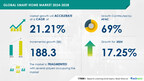
NEW YORK, July 3, 2024 /PRNewswire/ — The global smart home market size is estimated to grow by USD 188.3 billion from 2024-2028, according to Technavio. The market is estimated to grow at a CAGR of almost 21.21%  during the forecast period. Growing consumer interest in home automation is driving market growth, with a trend towards rising number of strategic partnerships and alliances. However, increase in issues related to interoperability  poses a challenge. Key market players include ABB Ltd., Allegion Public Ltd. Co., Alphabet Inc., Amazon.com Inc., Apple Inc., ASSA ABLOY AB, Comcast Corp., Honeywell International Inc., Hubbell Inc., Johnson Controls, Legrand SA, LG Corp., Lutron Electronics Co. Inc., Panasonic Holdings Corp., RTX Corp., Robert Bosch GmbH, Samsung Electronics Co. Ltd., Schneider Electric SE, Snap One LLC, and Vivint Inc..

Get a detailed analysis on regions, market segments, customer landscape, and companies- View the snapshot of this report

Smart Home Market Scope

Report Coverage

Details

Base year

2023

Historic period

2018 – 2022

Forecast period

2024-2028

Growth momentum & CAGR

Accelerate at a CAGR of 21.21%

Market growth 2024-2028

USD 188.3 billion

Market structure

Fragmented

YoY growth 2022-2023 (%)

17.25

Regional analysis

North America, Europe, APAC, Middle East and Africa, and South America

Performing market contribution

APAC at 69%

Key countries

US, Germany, China, UK, and Canada

Key companies profiled

ABB Ltd., Allegion Public Ltd. Co., Alphabet Inc., Amazon.com Inc., Apple Inc., ASSA ABLOY AB, Comcast Corp., Honeywell International Inc., Hubbell Inc., Johnson Controls, Legrand SA, LG Corp., Lutron Electronics Co. Inc., Panasonic Holdings Corp., RTX Corp., Robert Bosch GmbH, Samsung Electronics Co. Ltd., Schneider Electric SE, Snap One LLC, and Vivint Inc.

Market Driver

The global smart home market is witnessing an increase in strategic partnerships among vendors, with a focus on product development to capitalize on growth opportunities. Smart home product and system manufacturers are collaborating with technology providers, home automation platform providers, and other market participants to ensure interoperability. Notable partnerships include Samsung with ABB Group, Google with ADT, and Amazon with iRobot. These alliances are expected to accelerate growth in segments such as energy management, light control systems, home entertainment, HVAC, smart appliances, safety, and security systems. 

The smart home market is experiencing significant growth with various technologies taking center stage. Speakers, thermostats, and security systems are popular trends. These devices can be controlled through apps or voice commands, providing convenience and efficiency. Smart bulbs and closets are also gaining traction, offering energy savings and improved organization. The use of voice assistants like Siri and Alexa is driving innovation, allowing users to control multiple devices with simple voice commands. The future of smart homes lies in connectivity and automation, making daily life easier and more efficient. 

Research report provides comprehensive data on impact of trend. For more details- Download a Sample Report

Market Challenges

The smart home market is expanding, with vendors focusing on creating dependable home automation solutions for applications like energy management, lighting, home entertainment, HVAC, smart appliances, and safety and security systems. However, the market’s growth may be hindered by interoperability issues. These problems occur when smart home devices cannot work together seamlessly through various interfaces in real-time. For instance, smart security cameras may not be compatible with all smart devices and platforms. To address these challenges, vendors must invest in research and development and acquire the necessary expertise in smart home automation solutions. The prevalence of interoperability issues may negatively impact the growth of the smart home market during the forecast period.The smart home market is experiencing significant growth, with various technologies and devices in use. However, challenges persist in ensuring seamless integration and interoperability among different systems. One major challenge is the fragmentation of the market, with numerous players and proprietary technologies. Another issue is security concerns, as the increasing use of IoT devices in homes raises privacy and data protection risks. Additionally, cost remains a barrier for many consumers, as the initial investment for a fully-equipped smart home can be high. To address these challenges, industry players must focus on developing open standards and collaborating to create interoperable solutions. They should also prioritize security features and affordability to make smart homes accessible to a wider audience.

For more insights on driver and challenges – Request a sample report!

Segment Overview 

This smart home market report extensively covers market segmentation by  

Application 1.1 Home entertainment1.2 Smart appliances1.3 Energy management1.4 Lighting control system and HVAC1.5 Safety and security systemTechnology 2.1 Wireless2.2 WiredGeography 3.1 North America3.2 Europe3.3 APAC3.4 Middle East and Africa3.5 South America

1.1 Home entertainment-  The Smart Home Market is experiencing significant growth, driven by increasing consumer demand for convenience and security. Smart home devices, such as thermostats, lighting systems, and security cameras, are becoming increasingly popular. Retailers and manufacturers are responding by expanding their offerings and improving product functionality. This trend is expected to continue, with the global market size projected to reach USD151.4 billion by 2023. Smart home technology is making homes more efficient and comfortable, providing homeowners with peace of mind and added value.

For more information on market segmentation with geographical analysis including forecast (2024-2028) and historic data (2017-2021) – Download a Sample Report

Research Analysis

The Smart Home Market is experiencing significant growth due to the increasing demand for home monitoring, energy-saving solutions, and the integration of advanced technologies such as 5G, IoT platforms, and Machine Learning. The industry caters to the safety and security needs of Internet users by offering smart home systems that include intrusion detection, cameras, and AI-powered virtual assistants. These systems provide convenience through the control of lighting, temperature, audio/video systems, and smart appliances like dishwashers, all accessible via smartphones and digital assistance. However, with the increasing number of IoT connections and devices, cyberattacks and security threats are becoming a major concern. AI and Machine Learning are being employed to enhance the functionality and security of these systems. Smart homes are transforming into intelligent living spaces, integrating Bluetooth speakers and other entertainment devices to create a more comfortable and connected living experience.

Market Research Overview

The Smart Home Market encompasses a range of technologies and devices designed to enhance convenience, security, and energy efficiency in residential spaces. These solutions include voice-activated assistants, thermostats, lighting systems, security cameras, and appliances, among others. Smart homes utilize various connectivity protocols such as Wi-Fi, Bluetooth, and Zigbee to facilitate seamless communication between devices. The market is driven by factors like increasing consumer awareness, technological advancements, and the growing preference for energy-efficient solutions. Smart homes offer numerous benefits, such as remote monitoring and control, automation, and improved comfort and safety. The market is expected to witness significant growth in the coming years due to these factors and the ongoing digital transformation.

Table of Contents:

1 Executive Summary
2 Market Landscape
3 Market Sizing
4 Historic Market Size
5 Five Forces Analysis
6 Market Segmentation

ApplicationHome EntertainmentSmart AppliancesEnergy ManagementLighting Control System And HVACSafety And Security SystemTechnologyWirelessWiredGeographyNorth AmericaEuropeAPACMiddle East And AfricaSouth America

7 Customer Landscape
8 Geographic Landscape
9 Drivers, Challenges, and Trends
10 Company Landscape
11 Company Analysis
12 Appendix

About Technavio

Technavio is a leading global technology research and advisory company. Their research and analysis focuses on emerging market trends and provides actionable insights to help businesses identify market opportunities and develop effective strategies to optimize their market positions.

With over 500 specialized analysts, Technavio’s report library consists of more than 17,000 reports and counting, covering 800 technologies, spanning across 50 countries. Their client base consists of enterprises of all sizes, including more than 100 Fortune 500 companies. This growing client base relies on Technavio’s comprehensive coverage, extensive research, and actionable market insights to identify opportunities in existing and potential markets and assess their competitive positions within changing market scenarios.

Contacts

Technavio Research
Jesse Maida
Media & Marketing Executive
US: +1 844 364 1100
UK: +44 203 893 3200
Email: media@technavio.com
Website: www.technavio.com/


View original content to download multimedia:https://www.prnewswire.com/news-releases/smart-home-market-size-is-set-to-grow-by-usd-188-3-billion-from-2024-2028–growing-consumer-interest-in-home-automation-boost-the-market-technavio-302188061.html

SOURCE Technavio

Continue Reading
Click to comment

Leave a Reply

Your email address will not be published. Required fields are marked *

Technology

HelloNation Features “Mr. Debt Relief” Tony Hernandez On How Long Debt Settlement Takes

Published

on

By

Readers Learn What to Expect From Month One Through Completion, Including How Savings, Creditor Timing, and Account Size Shape Results

CAMARILLO, Calif., June 18, 2026 /PRNewswire/ — How long does debt settlement really take to complete? That question is answered in a HelloNation article that explains the process and helps readers understand why most settlement programs follow a steady and predictable timeline. The article from HelloNation shows how patience, consistency, and planning lead to meaningful results that can often arrive faster than continuing to make minimum payments month after month.

The HelloNation feature opens by explaining that debt settlement may appear complicated from the outside, but most programs share similar timelines. While not instant, the process is often shorter than years of traditional payments that do little to reduce balances. The article notes that most settlement plans last between two and four years, depending on the total amount of debt, monthly payment ability, and the amounts each account is settled for. By understanding how the process unfolds, individuals can stay motivated and committed throughout the program.

People who begin debt settlement often do so after months or even years of financial strain. They may have tried to keep up with minimum payments only to see high interest charges erase any progress. According to the HelloNation article, settlement provides a structured alternative that allows them to direct funds into a dedicated account used for negotiation. The rate at which this account grows directly affects the timeline. Some individuals save quickly, while others need more time to build up funds due to tight budgets or irregular income.

Most settlement programs are designed to move at a steady pace that reflects the participant’s situation. The HelloNation article explains that the first settlements often occur within the first year. Creditors respond differently based on factors such as the size of the debt, the age of the account, and the payment history. Larger balances may take longer to resolve because they require more negotiation, while smaller accounts can be settled sooner. Early progress provides reassurance and creates momentum that helps people remain focused on completing the process.

Consistency plays a major role in how long debt settlement takes. Regular monthly deposits into the settlement fund allow negotiators to plan ahead and move efficiently. When individuals contribute more than the expected amount, the process can shorten because funds become available sooner. When contributions meet only the minimum level, the plan still works, though it takes longer. The flexibility of settlement is one of its strengths, giving people control over the pace and helping them stay within realistic limits. While many programs fall within a two-to-four-year range, some may resolve sooner or take longer, depending on how much the individual can contribute each month.

The HelloNation article also highlights how creditors influence the timeline. Some creditors are willing to negotiate once accounts become several months past due, while others prefer to wait until they have completed internal collection efforts. This variation may seem unpredictable, but it is a normal part of the process. Over time, most creditors choose to settle because it guarantees partial repayment rather than continued uncertainty. Once funds reach an acceptable level, settlements can be finalized quickly.

One of the encouraging points from the HelloNation coverage is that improvement often begins before the entire process is complete. Each resolved account represents a step forward and reduces stress. Many individuals feel emotional relief when even one or two accounts close, especially after years of carrying heavy financial pressure. Debt settlement works by breaking a large challenge into smaller, achievable goals. This structure allows people to track visible progress and regain confidence in their financial management.

The article also compares settlement timelines to the alternative of long-term minimum payments. When people continue to pay only the minimum due, high interest rates can stretch repayment to ten years or more. In many cases, balances hardly decrease. Debt settlement compresses the timeline by focusing on negotiation instead of extended interest payments. This shorter timeframe is one of the main reasons settlement becomes the more practical choice for many households.

The long-term outcome of completing debt settlement can be equally important. Once the final account is closed, individuals often redirect their money toward savings, emergency funds, or personal goals. The HelloNation article notes that even though the program requires patience, it ends with a clear and satisfying finish line. Participants often describe the conclusion as a turning point that restores stability and confidence. By seeing their efforts pay off, they gain a sense of control that encourages healthier financial habits moving forward.

HelloNation concludes that debt settlement works best when participants understand the process from the beginning. The two-to-three-year period can seem lengthy at first, but it is short compared to the time it would take to eliminate debt through minimum payments. Each deposit, each negotiation, and each completed account moves the plan closer to completion. For many families, the timeline is not a limitation but a roadmap toward financial relief and long-term stability.

How Long Does Debt Settlement Take features insights from “Mr. Debt Relief” Tony Hernandez, Debt Solutions Expert of Camarillo, CA, in HelloNation.

About HelloNation
HelloNation is America’s Good News Network, a premier media platform built on the idea that good news travels faster when real people tell real stories. Through its community-focused publications and innovative “edvertising” approach, HelloNation delivers content that informs, inspires, and spotlights the leaders making a meaningful impact in their communities.

www.hellonation.com

View original content to download multimedia:https://www.prnewswire.com/news-releases/hellonation-features-mr-debt-relief-tony-hernandez-on-how-long-debt-settlement-takes-302804760.html

SOURCE HelloNation

Continue Reading

Technology

In HelloNation, Senior Moving Expert Angela Mae Schlagel Shares Guidance on Choosing a Senior Move Manager

Published

on

By

The article reviews experience, communication, and planning factors families should evaluate when selecting senior move management support in Nampa or Boise.

NAMPA, Idaho, June 18, 2026 /PRNewswire/ — What should families consider when choosing a professional to guide a senior relocation? HelloNation answers this question in an article that explains how to evaluate a senior move manager in Nampa or Boise.

The HelloNation article features insights from Angela Mae Schlagel of Idaho Senior Transitions. It explains that selecting the right senior move manager can significantly reduce stress for families managing downsizing, assisted living transitions, and the complex logistics of moving services.

Experience is one of the most important factors highlighted in the article. The article explains that a qualified senior move manager should have hands-on experience with downsizing projects, estate cleanout coordination, and assisted living transitions. Professionals who have managed many moves are often better prepared to address challenges such as fragile belongings, sentimental items, and decades of accumulated possessions.

Local knowledge also plays an important role in the selection process. The article notes that a senior move manager familiar with Nampa and Boise can provide guidance on logistics, timelines, and local service providers. Experience with local senior housing communities can also help families navigate assisted living transitions more smoothly.

Understanding the process of moving services is another key consideration. The article explains that a professional senior move manager often coordinates packing, transportation, and scheduling for the relocation. Having one professional oversee these tasks helps reduce confusion while ensuring the moving services process stays organized and efficient.

The article also emphasizes the importance of communication and transparency. Families working with a senior move manager should receive clear timelines, documented plans, and detailed estimates. Open communication helps families understand how belongings will be sorted, transported, and organized during the moving process.

Organizational skills are another essential quality discussed in the article. A senior move manager often coordinates many tasks at once, including packing schedules, donation deliveries, and estate cleanout arrangements. Careful documentation and planning help ensure that every stage of downsizing and moving services is tracked and completed efficiently.

Compassion and patience are also highlighted as valuable qualities. Downsizing and assisted living transitions can be emotionally challenging for many seniors. The article explains that an experienced senior move manager approaches these situations with empathy, helping clients make thoughtful decisions while respecting their attachments to personal belongings.

The scope of services offered should also be clearly defined. Some professionals provide full-service support that includes packing, moving services coordination, estate cleanout management, and unpacking in the new home. Others offer more limited support depending on the family’s needs. Understanding which services are included helps families determine whether a senior move manager is the right fit.

Client feedback and references can also provide valuable insight. The article notes that families should ask about previous projects involving downsizing, assisted living transitions, or estate cleanout coordination. Positive feedback from past clients in Nampa or Boise can indicate reliability, professionalism, and attention to detail.

Cost transparency is another important topic discussed in the article. Senior move manager services may be priced hourly or as a flat fee depending on the type of project. The article recommends that families request written estimates and review which moving services, coordination tasks, or estate cleanout services are included.

The article concludes that choosing the right senior move manager requires evaluating experience, organization, communication, and familiarity with local senior housing communities. Families who take time to review qualifications and services are more likely to experience a smooth relocation process when managing downsizing and assisted living transitions.

What to Look for When Choosing a Senior Move Manager in Nampa or Boise features insights from Angela Mae Schlagel, Senior Moving Expert of Nampa, ID, in HelloNation.

About HelloNation
HelloNation is a premier media platform that connects readers with trusted professionals and businesses across various industries. Through its innovative “edvertising” approach that blends educational content and storytelling, HelloNation delivers expert-driven articles that inform, inspire, and empower. Covering topics from home improvement and health to business strategy and lifestyle, HelloNation highlights leaders making a meaningful impact in their communities.

View original content to download multimedia:https://www.prnewswire.com/news-releases/in-hellonation-senior-moving-expert-angela-mae-schlagel-shares-guidance-on-choosing-a-senior-move-manager-302804771.html

SOURCE HelloNation

Continue Reading

Technology

Hood College Launches STEM MBA

Published

on

By

STEM-focused master’s program in business administration offers opportunities in new sectors

FREDERICK, Md., June 18, 2026 /PRNewswire/ — Hood College has rolled out a new graduate-level degree in STEM business administration. Building off Hood’s popular business programs, the STEM MBA combines coursework in data analytics, finance, operations and information management to offer a cross-disciplinary business education with a focus on building analytical skills.

The program is currently open for enrollment, with courses officially starting in the fall 2026 semester.

Accredited by the Accreditation Council for Business Schools and Programs (ACBSP), the STEM MBA is a flexible online program. Students with a business background may even complete the degree in as few as 36 credits.

Students in the program will hone their analytical, managerial and organizational skills to bridge the business sector with evolving technology, such as artificial intelligence. Although courses are offered online (both synchronously and asynchronously), students can also opt to complete up to six credits of internships with regional businesses.

“The STEM MBA at Hood College develops forward-thinking leaders who combine technical expertise with strategic vision to solve real-world business challenge,” said David Gurzick, Ph.D., professor of management and STEM MBA program director.

The STEM MBA will be offered under The George B. Delaplaine Jr. School of Business, which already offers a traditional MBA at the graduate level and degrees in business administration, economics, finance and more at the undergraduate level.

About Hood College
Hood College is an independent, liberal arts college, offering 30 bachelor’s degrees, four pre-professional programs, 20 master’s degree programs, four doctorates and 11 post-baccalaureate certificates. Located in historic Frederick, near Washington, D.C., Baltimore and the I-270 technology corridor, Hood gives students access to countless internships and research opportunities.

View original content to download multimedia:https://www.prnewswire.com/news-releases/hood-college-launches-stem-mba-302802045.html

SOURCE Hood College

Continue Reading

Trending