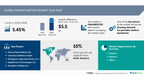
NEW YORK, Aug. 23, 2024 /PRNewswire/ — The global primary battery market size is estimated to grow by USD 5.5 billion from 2024-2028, according to Technavio. The market is estimated to grow at a CAGR of about 5.45% during the forecast period. Growing demand for portable medical equipment is driving market growth, with a trend towards legislative support for battery recycling. However, threat from rechargeable hearing aid solutions poses a challenge. Key market players include Amara Raja Batteries Ltd., Camelion Batteries GmbH, Dongguan Large electronics Co. Ltd., EaglePicher Technologies LLC, Energizer Holdings Inc., EnerSys, EVE Energy Co. Ltd., Fujitsu Ltd., GP Industries Ltd., Hitachi Ltd., Integer Holdings Corp., Panasonic Holdings Corp., Samsung SDI Co. Ltd., Sony Group Corp., The Duracell Co., Toshiba Corp., TotalEnergies SE, Ultralife Corp., VARTA AG, and Zhejiang Mustang Battery Co Ltd..
Get a detailed analysis on regions, market segments, customer landscape, and companies- View the snapshot of this report
Primary Battery Market Scope
Report Coverage
Details
Base year
2023
Historic period
2018 – 2022
Forecast period
2024-2028
Growth momentum & CAGR
Accelerate at a CAGR of 5.45%
Market growth 2024-2028
USD 5.5 billion
Market structure
Fragmented
YoY growth 2022-2023 (%)
4.97
Regional analysis
APAC, North America, Europe, South America, and Middle East and Africa
Performing market contribution
North America at 55%
Key countries
US, China, Germany, Japan, and UK
Key companies profiled
Amara Raja Batteries Ltd., Camelion Batteries GmbH, Dongguan Large electronics Co. Ltd., EaglePicher Technologies LLC, Energizer Holdings Inc., EnerSys, EVE Energy Co. Ltd., Fujitsu Ltd., GP Industries Ltd., Hitachi Ltd., Integer Holdings Corp., Panasonic Holdings Corp., Samsung SDI Co. Ltd., Sony Group Corp., The Duracell Co., Toshiba Corp., TotalEnergies SE, Ultralife Corp., VARTA AG, and Zhejiang Mustang Battery Co Ltd.
Market Driver
Primary batteries are widely used in various applications, and governments worldwide are implementing regulations to recycle them to prevent environmental contamination from harmful materials like alkaline cells. Recycling allows manufacturers to mitigate production costs and extract useful metals, such as manganese and zinc, which can be utilized in industries. Companies like Retriev Technologies and Raw Materials Company focus on primary battery recycling. The EU’s Directive 2006/66/EC mandates collection rates and post-consumer conversion for battery recycling, while the UK and Canada have established networks for consumers to drop used batteries for recycling. These legislations foster environmentally friendly and economically sustainable business models, ensuring recycling efficiency. Efficient primary battery recycling leads to ecological sustainability by reducing the need for metal mining and promoting sustainable agriculture. The growth of end-user segments, such as hearing aids and consumer electronics, will drive the global primary battery market during the forecast period.
The primary battery market is experiencing significant growth due to the increasing demand for electronic devices, remote controls, and portable electronic devices like watches, medical equipment such as glucose monitors and blood pressure monitors, and household appliances like color TV sets and household appliances. Non-rechargeable batteries, including zinc-carbon and lithium primary batteries, are in high demand for battery-powered toys, portable media players, flashlights, and smoke alarms. The defense industry also relies heavily on primary batteries for various applications. Electrochemical reactions, specifically oxidation-reduction reactions, power these batteries through the interaction between the cathode, anode, and electrolytes. Annual disposable income continues to drive demand for these batteries in various sectors. However, the shift towards rechargeable batteries, or secondary batteries, is expected to impact the primary battery market in the long run. Smart device users, dry cells, and galvanic cells are also part of this market. Primary batteries are used in various industries like industrial electronics, cardiac pacemakers, door locks, home smoke detectors, tire pressure gauges, smart meters, intelligent drill bits, animal-tracking devices, remote light beacons, wristwatches, electric keys, and mobile consumer units. Alkaline primary batteries offer high voltage deliverability, making them a popular choice for many applications.
Explore a 360° Analysis of the Market: Unveil the Impact of AI. For complete insights- Request Sample!
Market Challenges
The hearing aid industry’s shift towards rechargeable devices poses a significant challenge to the primary battery market. With the phase-out of mercury-based batteries in 1996, zinc-air batteries became the preferred choice for hearing aids due to their high energy output in compact sizes. However, manufacturing rechargeable batteries for hearing aids is complex due to their unique power requirements. Although rechargeable hearing instruments are yet to be commercially successful, they are available in the market but are expensive. Consumers prioritize battery life, pricing, and ease of use when selecting hearing aid batteries. Developing new battery designs that cater to these concerns could increase the adoption of rechargeable hearing instruments, leading to a decrease in demand for primary batteries. Consequently, the global primary battery market growth may be impacted during the forecast period due to the emergence of rechargeable hearing aid solutions.The Primary Battery Market encompasses various sectors, including Medical devices, Hearing aids, Surgical tools, and Medical defibrillators. These industries require batteries with high leak-proof properties and long shelf life. Primary Alkaline and Primary Lithium batteries, such as Carbon-zinc batteries, are popular choices due to their reliability and non-hazardous nature. However, challenges exist in the Defense and Aerospace industries, where high voltage and energy density are essential. Defense applications, including weapons, missiles, and military vehicles, require batteries with specific chemistries and leak-proof designs. In contrast, the Medical, Aviation, Consumer electronics, and Healthcare sectors prioritize low energy demand and mercury-free batteries. Additionally, the Agriculture sector relies on primary batteries for irrigation systems, sensors, and wind-powered generators. Environmental concerns and the push for sustainable energy sources also impact the market, with a focus on recycling and the development of non-toxic battery chemistries, such as Sodium hydroxide and Potassium based batteries. The industry faces challenges in balancing the demand for primary batteries with the need to reduce their environmental impact and transition to more sustainable energy sources.
For more insights on driver and challenges – Request a sample report!
Segment Overview
This primary battery market report extensively covers market segmentation by
End-user 1.1 Defense1.2 Medical1.3 OthersType 2.1 Alkaline battery2.2 Lithium battery2.3 OthersGeography 3.1 APAC3.2 North America3.3 Europe3.4 South America3.5 Middle East and Africa
1.1 Defense- The primary battery market is a significant sector in the energy storage industry. Companies manufacture and sell primary batteries for various applications, including portable electronics, remote controls, and medical devices. Demand for these batteries remains consistent due to the increasing use of electronic devices. Key players in the market include Energizer Holdings, Duracell, and Panasonic. They focus on innovation and quality to meet customer needs and maintain market share.
For more information on market segmentation with geographical analysis including forecast (2024-2028) and historic data (2017-2021) – Download a Sample Report
Research Analysis
The primary battery market encompasses a wide range of applications, from consumer electronics and healthcare devices to security systems and industrial equipment. Dry cells and galvanic cells are the two main types of primary batteries, with the former using a porous separator to allow the electrolytes to come into contact with both the cathode and anode. Primary batteries are non-rechargeable, making them ideal for devices that require a consistent power source without the need for frequent charging. Some common applications include cardiac pacemakers, door locks, home smoke detectors, tire pressure gauges, smart meters, intelligent drill bits, animal-tracking devices, remote light beacons, and wristwatches. Primary batteries come in various chemistries, such as alkaline, lithium, and zinc-carbon. Alkaline batteries, which use an alkaline electrolyte, are the most commonly used type due to their long shelf life and high energy density. Primary lithium batteries, on the other hand, offer a higher energy density and longer shelf life but are more expensive. The primary battery market caters to various industries, including healthcare, consumer electronics, and portable devices. Some of the most common applications include medical devices like cardiac pacemakers and hearing aids, battery-powered toys, and portable media players. Primary batteries operate through an oxidation-reduction reaction, where the anode undergoes oxidation, releasing electrons, and the cathode undergoes reduction, accepting electrons. The electrolytes facilitate the flow of ions between the anode and cathode, allowing the battery to generate electricity. The cathode and anode are essential components of a primary battery. The cathode is the positive electrode, while the anode is the negative electrode. In an alkaline battery, the cathode is typically made of manganese dioxide, while the anode is made of zinc. In a lithium battery, the cathode is typically made of lithium manganese oxide, while the anode is made of lithium metal. Overall, the primary battery market is a diverse and essential industry that caters to various applications and industries, providing consistent and reliable power sources for devices that require them.
Market Research Overview
The primary battery market encompasses a wide range of applications, from consumer electronics and medical devices to defense and aerospace industries. Dry cells and galvanic cells are the two primary types of batteries, with alkaline primary batteries being the most commonly used due to their high voltage deliverability and long shelf life. Alkaline primary batteries power various devices such as cardiac pacemakers, door locks, home smoke detectors, tire pressure gauges, smart meters, intelligent drill bits, animal-tracking devices, remote light beacons, wristwatches, electric keys, and mobile consumer units. Primary batteries come in different chemistries, including alkaline, lithium, and zinc-carbon. Alkaline batteries use an alkaline electrolyte, such as potassium or sodium hydroxide, while lithium primary batteries offer higher energy density and leakage resistance. The primary battery market caters to diverse industries, including defense, aerospace, medical, aviation, consumer electronics, and healthcare applications. The market’s growth is driven by the increasing demand for portable devices, battery chemistries, and the need for non-rechargeable batteries in specific applications. The environmental impact of primary batteries is a concern, and efforts are being made to develop sustainable energy sources, such as wind-powered generators and water pumps, to reduce the reliance on primary batteries. The recycling of primary batteries is also gaining importance to minimize the hazardous waste generated by their disposal. The annual disposable income of consumers and the availability of household appliances, color TV sets, industrial electronics, and portable batteries further fuel the demand for primary batteries. The market’s future growth is expected to be influenced by the development of mercury-free batteries, advancements in battery technologies, and the increasing demand for non-rechargeable batteries in various industries.
Table of Contents:
1 Executive Summary
2 Market Landscape
3 Market Sizing
4 Historic Market Size
5 Five Forces Analysis
6 Market Segmentation
End-userDefenseMedicalOthersTypeAlkaline BatteryLithium BatteryOthersGeographyAPACNorth AmericaEuropeSouth AmericaMiddle East And Africa
7 Customer Landscape
8 Geographic Landscape
9 Drivers, Challenges, and Trends
10 Company Landscape
11 Company Analysis
12 Appendix
About Technavio
Technavio is a leading global technology research and advisory company. Their research and analysis focuses on emerging market trends and provides actionable insights to help businesses identify market opportunities and develop effective strategies to optimize their market positions.
With over 500 specialized analysts, Technavio’s report library consists of more than 17,000 reports and counting, covering 800 technologies, spanning across 50 countries. Their client base consists of enterprises of all sizes, including more than 100 Fortune 500 companies. This growing client base relies on Technavio’s comprehensive coverage, extensive research, and actionable market insights to identify opportunities in existing and potential markets and assess their competitive positions within changing market scenarios.
Contacts
Technavio Research
Jesse Maida
Media & Marketing Executive
US: +1 844 364 1100
UK: +44 203 893 3200
Email: media@technavio.com
Website: www.technavio.com/
View original content to download multimedia:https://www.prnewswire.com/news-releases/primary-battery-market-to-grow-by-usd-5-5-billion-2024-2028-driven-by-rising-demand-for-portable-medical-devices-ai-powered-market-insights–technavio-302229627.html
SOURCE Technavio









 Technology4 days ago
 Technology4 days ago
 Technology4 days ago
 Technology1 day ago
 Technology4 days ago
 Coin Market4 days ago

 Technology5 days ago