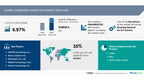
NEW YORK, Aug. 27, 2024 /PRNewswire/ — Report on how AI is driving market transformation- The global embedded computer market size is estimated to grow by USD 18.02 billion from 2024-2028, according to Technavio. The market is estimated to grow at a CAGR of almost 6.97% during the forecast period. Growing demand for iot devices is driving market growth, with a trend towards increasing implementation of robotics. However, high lead time poses a challenge. Key market players include AAEON Technology Inc., Abaco Systems Inc., Advantech Co. Ltd., ARBOR Technology Corp., Avalue Technology Inc., Axiomtek Co. Ltd., congatec GmbH, Curtiss Wright Corp., Digi International Inc., EUROTECH Spa, Fujitsu Ltd., Intel Corp., Kontron AG, NVIDIA Corp., NXP Semiconductors N.V., Qualcomm Inc., Radisys Corp., SMART Global Holdings Inc., Super Micro Computer Inc., TechNexion Ltd., Texas Instruments Inc., and Toradex AG.
Get a detailed analysis on regions, market segments, customer landscape, and companies- View the snapshot of this report
Embedded Computer Market Scope
Report Coverage
Details
Base year
2023
Historic period
2018 – 2022
Forecast period
2024-2028
Growth momentum & CAGR
Accelerate at a CAGR of 6.97%
Market growth 2024-2028
USD 18028.4 million
Market structure
Fragmented
YoY growth 2022-2023 (%)
6.4
Regional analysis
Europe, APAC, North America, Middle East and Africa, and South America
Performing market contribution
Europe at 35%
Key countries
US, China, UK, Germany, and India
Key companies profiled
AAEON Technology Inc., Abaco Systems Inc., Advantech Co. Ltd., ARBOR Technology Corp., Avalue Technology Inc., Axiomtek Co. Ltd., congatec GmbH, Curtiss Wright Corp., Digi International Inc., EUROTECH Spa, Fujitsu Ltd., Intel Corp., Kontron AG, NVIDIA Corp., NXP Semiconductors N.V., Qualcomm Inc., Radisys Corp., SMART Global Holdings Inc., Super Micro Computer Inc., TechNexion Ltd., Texas Instruments Inc., and Toradex AG
Market Driver
The robotics market has witnessed significant growth in various industries, including automotive, military, defense, healthcare, electronics, and e-commerce. Robots are increasingly being used for complex tasks due to their flexibility and ability to handle different applications. General Motors pioneered the use of robots for heavy manufacturing tasks, while e-commerce companies like Amazon employ them for fragile jobs like order picking. Foxconn Electronics utilizes robots for assembling iPhone parts. Robots are also utilized by doctors as surgical assistants. To meet the rising demand for robots, governments and private companies are investing in robotics research. Affordability and ease of programming are driving factors for the increasing adoption of robots. Key robot vendors, such as Yaskawa, Fanuc, and KUKA, are investing heavily in research and development to improve robotic software. The integration of advanced embedded computers is making robots smarter, more networked, and versatile for multiple applications. This trend is expected to positively impact the global embedded computer market in the coming years.
Embedded computing systems have become essential components in various industries, from consumer electronics to automobiles and healthcare. The market for embedded systems is driven by trends in CPU technology, sensors, and the Internet of Things (IoT). In consumer electronics, TVs, telephones, digital cameras, washing machines, microwaves, and dishwashers incorporate embedded systems for enhanced functionality. Industrial development activities, government reforms, and digitalization are key growth areas. Industrial automation, healthcare digitization, defence industry, and IoT services market are major sectors driving the demand. Hardware limitations and high initial investments remain challenges. Technological developments in artificial intelligence (AI), connectivity, and wireless communications infrastructure are shaping the future. Robots, automation computers, and real-time operating systems (RTOS) are essential components. Sensors in speed sensors, medical equipment like ultrasounds and X-rays, and remote patient monitoring systems are critical applications. R&D investments, product improvements, and shortening lead times are crucial for staying competitive. Emerging economies offer significant growth opportunities. Telecommunications, utilities, and transportation sectors, including ADAS technology in hybrid and electric vehicles, are adopting embedded systems for automation and efficiency.
Explore a 360° Analysis of the Market: Unveil the Impact of AI. For complete insights- Request Sample!
Market Challenges
Embedded computer manufacturing involves creating customized solutions for Original Equipment Manufacturers (OEMs) using the latest core components, such as processors and memory modules. However, this requirement results in a longer lead time due to the need for close partnerships with chip and processor manufacturers. The use of the latest technology also increases the product’s obsolescence rate, as new optimized processors and fast data/address buses enter the market. To meet OEM demands for the latest hardware and support solutions, embedded computer manufacturers design and configure boards according to specific requirements, leading to a longer time-to-market.The embedded computer market is experiencing significant growth in various industries, particularly in the communication and automotive sectors. Challenges include ensuring secure communication and microcontroller and microprocessor protection in these sectors. Digital signal processors play a crucial role in edge controls for industrial ecosystems and vehicle electronic systems. Embedded security solutions are essential for microcontrollers in applications like airbags and navigation systems. Open controller platforms offer flexibility, while Equipment Insight 2018 highlights the importance of adapting to new technologies like adaptive cruise control and biomedical sensors. The standard of living is improving, driving demand for devices like electronic stethoscopes, imaging systems, and medical equipment. Falling prices and awareness are boosting the adoption of IoT devices, mobile phones, laptops, and personal computers. Microprocessors, such as ARM Cortex M4, offer low power consumption and high power-processing performances for mobile devices and IoT connections. The future of embedded computing lies in smartphone and IoT connections, enabling new applications and improving our daily lives.
For more insights on driver and challenges – Request a sample report!
Segment Overview
This embedded computer market report extensively covers market segmentation by
Product 1.1 COMs1.2 SBCs1.3 Stand-alone boardsEnd-user 2.1 Industrial automation2.2 Military and defense2.3 Medical2.4 Communication2.5 OthersCPU Architecture 3.1 x863.2 ARM3.3 PowerPC3.4 OthersGeography 4.1 Europe4.2 APAC4.3 North America4.4 Middle East and Africa4.5 South America
1.1 COMs- Embedded Computer Market: COMs Segment Overview The Embedded Computer Market’s COM segment, also known as System-on-Modules (SOMs), is a subtype of Single-Board Computers (SBCs) that offers a compact, customizable, and low-power solution for various applications. COMs consist of a microprocessor, RAM, and several features, but lack standard connectors for I/O peripherals, requiring a carrier board for connection. COM Express, SMARC, Qseven, and ETX/XTX are the major COM standards, each offering unique features and sizes. The PCI Industrial Computer Manufacturers Group (PICMG) regulates the COM Express standard, while SMARC, Qseven, and ETX/XTX are governed by the Standardization Group for Embedded Technologies (SGeT) and various industry consortiums. The COM segment’s growth is driven by the increasing demand for miniaturization, low power consumption, and customizability. The need for dense computer systems, FPGA components, and Industry 4.0 implementation are significant factors. Vendors like Portwell, Avalue, Kontron S and T, Emac, and Adlink dominate the ETX-based market. The COM segment’s advantages include dense computer systems, low power consumption, customizability, compact size, and low costs. Replacing or swapping COMs without changing the carrier board offers cost savings and faster go-to-market strategies for vendors. Advances in processor technologies, bus architectures, and the growing implementation of automation technologies are major growth factors. The COM segment is expected to witness substantial growth in the global embedded computer market due to its versatility and ability to meet the demands of various industries.
For more information on market segmentation with geographical analysis including forecast (2024-2028) and historic data (2017-2021) – Download a Sample Report
Research Analysis
The embedded computer market is experiencing significant growth in various sectors, including the communication and automotive industries. In the communication sector, embedded computers are used for edge controls in telecom networks, enabling real-time processing and data transfer. In the automotive sector, microcontrollers and microprocessors power vital systems such as embedded airbag systems, embedded navigation systems, adaptive cruise control, and vehicle electronic systems. Digital signal processors play a crucial role in processing data from biomedical sensors in applications like vital signs monitoring, electronic stethoscopes, imaging systems, and medical devices such as PET scans, CT scans, MRIs, glucose monitors, pacemakers, and CPAP machines. Open controllers are gaining popularity in the industrial ecosystem, offering flexibility and customization. Microcontrollers continue to be the backbone of these applications, driving innovation in areas like biomedical devices and consumer electronics, including mobile phones, laptops, and personal computers.
Market Research Overview
The embedded computer market is experiencing significant growth in various sectors, including communication and automotive. Microcontrollers and microprocessors are the backbone of this market, with digital signal processors playing a crucial role in enhancing performance and efficiency. Embedded security solutions are increasingly important, especially in the automotive sector for vehicle electronic systems, microcontroller security solutions, and open controller systems. The industrial ecosystem is witnessing a surge in edge controls, with applications ranging from vital signs monitoring in healthcare to adaptive cruise control in automobiles. Biomedical sensors, electronic stethoscopes, imaging systems like PET scans, CT scans, and MRIs, glucose monitors, pacemakers, and CPAP machines are all benefiting from embedded computing systems. Consumer electronics, including mobile phones, laptops, personal computers, gaming consoles, and smart home appliances, are driving the market due to the standard of living improvement and awareness. Falling prices and the Internet of Things (IoT) devices, such as smartphones and smart home appliances, are contributing to the market’s growth. Microprocessors like ARM Cortex M4 with low power consumption and high power-processing performances are enabling mobile devices’ connections and IoT connections. Televisions (TVs), automobiles, telephones, digital cameras, washing machines, microwaves, and dishwashers are some of the consumer electronics that are being transformed by embedded computing systems. Artificial intelligence and emerging economies are also fueling the market’s growth, with technological developments in areas like robots, automation computers, real-time operating systems (RTOS), and sensors. Industrial development activities, government reforms, and the defense industry are also significant contributors to the embedded computing systems market. The IoT services market, digitalization, and connectivity are also driving the market’s growth, with applications in areas like ultrasounds, X-rays, remote patient monitoring, and technological developments in various industries. However, hardware limitations and high initial investments remain challenges for the market.
Table of Contents:
1 Executive Summary
2 Market Landscape
3 Market Sizing
4 Historic Market Size
5 Five Forces Analysis
6 Market Segmentation
ProductCOMsSBCsStand-alone BoardsEnd-userIndustrial AutomationMilitary And DefenseMedicalCommunicationOthersCPU ArchitectureX86ARMPowerPCOthersGeographyEuropeAPACNorth AmericaMiddle East And AfricaSouth America
7 Customer Landscape
8 Geographic Landscape
9 Drivers, Challenges, and Trends
10 Company Landscape
11 Company Analysis
12 Appendix
About Technavio
Technavio is a leading global technology research and advisory company. Their research and analysis focuses on emerging market trends and provides actionable insights to help businesses identify market opportunities and develop effective strategies to optimize their market positions.
With over 500 specialized analysts, Technavio’s report library consists of more than 17,000 reports and counting, covering 800 technologies, spanning across 50 countries. Their client base consists of enterprises of all sizes, including more than 100 Fortune 500 companies. This growing client base relies on Technavio’s comprehensive coverage, extensive research, and actionable market insights to identify opportunities in existing and potential markets and assess their competitive positions within changing market scenarios.
Contacts
Technavio Research
Jesse Maida
Media & Marketing Executive
US: +1 844 364 1100
UK: +44 203 893 3200
Email: media@technavio.com
Website: www.technavio.com/
View original content to download multimedia:https://www.prnewswire.com/news-releases/the-embedded-computer-market-is-projected-to-grow-by-usd-18-03-billion-from-2024-to-2028–driven-by-rising-demand-for-iot-devices-ai-powered-report–technavio-302231842.html
SOURCE Technavio









 Technology4 days ago
 Technology4 days ago
 Technology4 days ago
 Coin Market4 days ago
 Technology1 day ago
 Technology4 days ago

 Technology5 days ago