Connect with us

Technology

Micro Programmable Logic Controller (PLC) Market to Grow by USD 2.37 Billion from 2024-2028, Driven by Demand for Compact Automation and AI Trends

Published

on

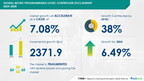
NEW YORK, Sept. 30, 2024 /PRNewswire/ — Report on how AI is redefining market landscape- The global micro programmable logic controller (PLC) market size is estimated to grow by USD 2.37 billion from 2024-2028, according to Technavio. The market is estimated to grow at a CAGR of almost 7.08%  during the forecast period. Increasing demand for compact automation solutions is driving market growth, with a trend towards expanding capabilities of micro PLCs  However, growing cybersecurity concerns  poses a challenge. Key market players include ABB Ltd., Advantech Co. Ltd., Beckhoff Automation, Beijer Electronics Group AB, Eaton Corp. Plc, Festo SE and Co. KG, Fuji Electric Co. Ltd., Hitachi Ltd., Honeywell International Inc., IDEC Corp., Lenze SE, Mitsubishi Electric Corp., OMRON Corp., Parker Hannifin Corp., Robert Bosch Stiftung GmbH, Rockwell Automation Inc., Schneider Electric SE, Siemens AG, Toshiba Corp., and Yaskawa Electric Corp..

Key insights into market evolution with AI-powered analysis. Explore trends, segmentation, and growth drivers- View the snapshot of this report

Micro Programmable Logic Controller (Plc) Market Scope

Report Coverage

Details

Base year

2023

Historic period

Forecast period

2024-2028

Growth momentum & CAGR

Accelerate at a CAGR of 7.08%

Market growth 2024-2028

USD 2371.9 million

Market structure

Fragmented

YoY growth 2022-2023 (%)

6.49

Regional analysis

APAC, North America, Europe, South America, and Middle East and Africa

Performing market contribution

APAC at 38%

Key countries

US, China, Japan, Germany, and UK

Key companies profiled

ABB Ltd., Advantech Co. Ltd., Beckhoff Automation, Beijer Electronics Group AB, Eaton Corp. Plc, Festo SE and Co. KG, Fuji Electric Co. Ltd., Hitachi Ltd., Honeywell International Inc., IDEC Corp., Lenze SE, Mitsubishi Electric Corp., OMRON Corp., Parker Hannifin Corp., Robert Bosch Stiftung GmbH, Rockwell Automation Inc., Schneider Electric SE, Siemens AG, Toshiba Corp., and Yaskawa Electric Corp.

Market Driver

Micro Programmable Logic Controllers (PLCs) have gained significant traction in process and discrete industries due to their flexibility, ease of use, communication capabilities, and cost-effectiveness compared to traditional PLCs. Initially designed for controlling small machinery with basic serial communication, micro PLCs have evolved with technological advances to manage large machines and support multiple communication protocols. Vendors have expanded micro PLC offerings with high-speed communication capabilities, larger program memory, and additional features to enhance their functionality. These developments position micro PLCs as a cost-effective option for various process control applications, including data logging, in both process and discrete industries. The market for micro PLCs is expected to grow substantially due to these product enhancements and the increasing demand for compact, efficient, and affordable automation solutions. 

The Programmable Logic Controller (PLC) market is thriving, with key trends including Micro PLC and Nano PLC for miniaturization in various industries. Fixed, Modular PLCs cater to industrial purposes in sectors like Oil & Gas, Power, and Steel. Programming tools, simulation, and motion control are essential for efficient operation. Redundancy software ensures reliability in Robotics and Assembly lines. Input devices, Human Machine Interface, and IIoT-connected devices enhance productivity. The Automotive, Technology, and Energy sectors leverage PLCs for Industrial Automation. Hardware, Services, and Software segments offer solutions for Industrial processes, AI, IoT, Edge computing, and Energy-efficient solutions. Building automation, HVAC systems, and lighting systems also benefit from PLC technology. The Offering segment continues to grow, driven by the demand for advanced PLCs in diverse industries. 

Request Sample of our comprehensive report now to stay ahead in the AI-driven market evolution!

Market Challenges

Micro Programmable Logic Controllers (PLCs) are essential components of automation solutions in various industries, enhancing productivity and efficiency. However, the increasing use of connected devices and web-based communication in industrial processes has heightened the risk of cyberattacks. Critical infrastructure sectors, such as oil and gas, power, and water and wastewater, are particularly vulnerable. Cybercriminals can exploit these networks to gain unauthorized access to sensitive data, leading to operational failures or data manipulation. The oil and gas industry, for instance, faces significant risks as data breaches can halt operations and result in financial or intellectual losses. Vendors offer defensive measures, such as anti-malware, to secure data. However, these solutions may not be foolproof. An attack on one system can compromise the entire network, potentially affecting multiple interlinked systems. Therefore, the growing cybersecurity threats pose a significant challenge to the growth of the global micro PLC market.The Micro Programmable Logic Controller (PLC) market is witnessing significant growth in various industries, including automotives, technology, steel, power, food and beverages, and oil & gas. Industrial automation is a key driver, with PLCs playing a crucial role in managing industrial processes. The automotive sector is adopting PLCs for engine control, transmission control, and fuel injection systems. In the technology sector, the integration of artificial intelligence and Internet of Things (IoT) is driving demand for PLCs in IoT-connected devices, edge computing, and energy-efficient solutions. The hardware segment, particularly miniaturized PLCs, is gaining popularity due to their compact size and energy efficiency. The offering segment includes services, software, and hardware, with software solutions providing human machine interface and programming capabilities. The power industry, building automation, home automation, and lighting, HVAC, and security systems are other major applications.

Discover how AI is revolutionizing market trends- Get your access now!

Segment Overview

This micro programmable logic controller (plc) market report extensively covers market segmentation by

End-user 1.1 Automotive industry1.2 Oil and gas industry1.3 Power industry1.4 Food and beverage industry1.5 OthersProduct 2.1 Hardware2.2 Software2.3 ServicesGeography 3.1 APAC3.2 North America3.3 Europe3.4 South America3.5 Middle East and Africa

1.1 Automotive industry-  The automotive industry is a significant market for micro programmable logic controllers (PLCs), as they facilitate the control of multiple machinery used in manufacturing processes. Micro PLCs serve as a crucial link between various manufacturing stages, including design, analysis, inventory management, and distribution. In the automotive sector, micro PLCs ensure precise control over manufacturing processes, optimizing process parameters and device functionality. Despite a decline in the automotive industry’s growth due to the COVID-19 pandemic and reduced capital expenditure (CAPEX) in 2020, the market for micro PLCs in this sector is poised for recovery. Technavio anticipates that the shift towards smart factories and increased investments, particularly in APAC countries like India, Indonesia, and Japan, will drive substantial growth in the micro PLC market for the automotive industry during the forecast period.

Download a Sample of our comprehensive report today to discover how AI-driven innovations are reshaping competitive dynamics

Research Analysis

Micro Programmable Logic Controllers (PLCs), also known as Nano PLCs, are compact automation solutions designed for industrial purposes. These advanced devices offer functionality similar to traditional Fixed, Modular PLCs but in a smaller form factor. Micro PLCs are gaining popularity in various sectors including automotives, technology, steel, power, oil & gas, energy, and more. With the integration of Artificial Intelligence (AI) and Internet of Things (IoT), Micro PLCs have become smarter, enabling predictive maintenance and real-time data analysis. The hardware segment of the Micro PLC market is witnessing significant growth due to miniaturization and increasing demand for compact automation solutions. Industrial automation applications, Human Machine Interface (HMI) integration, and ease of programming are other key factors driving the market growth.

Market Research Overview

Micro Programmable Logic Controllers (PLCs), also known as Nano PLCs, are compact and cost-effective automation solutions for industrial applications. They offer the functionality of traditional Fixed, Modular PLCs in a smaller form factor, making them ideal for space-constrained environments. Micro PLCs are widely used in various sectors including Oil and Gas, Power, and Automotive, among others. They support programming tools, simulation, motion control, redundancy software, robotics, and various input devices. Industries like Steel, Power, Food and Beverages, and Energy rely on Micro PLCs for automating assembly lines, industrial robots, and various industrial processes. With the advent of technology, Micro PLCs are being integrated with Artificial Intelligence, Internet of Things (IoT), and Edge Computing to offer energy-efficient solutions and real-time monitoring capabilities. The market for Micro PLCs includes hardware, services, and software offerings, catering to the needs of diverse industries. Applications range from HVAC systems, lighting systems, security systems, engine control, transmission control, fuel injection, and more. The Miniaturization trend in PLCs is leading to the development of IoT-connected devices and IIoT solutions, further expanding their application base.

Table of Contents:

1 Executive Summary
2 Market Landscape
3 Market Sizing
4 Historic Market Size
5 Five Forces Analysis
6 Market Segmentation

End-userAutomotive IndustryOil And Gas IndustryPower IndustryFood And Beverage IndustryOthersProductHardwareSoftwareServicesGeographyAPACNorth AmericaEuropeSouth AmericaMiddle East And Africa

7 Customer Landscape
8 Geographic Landscape
9 Drivers, Challenges, and Trends
10 Company Landscape
11 Company Analysis
12 Appendix

About Technavio

Technavio is a leading global technology research and advisory company. Their research and analysis focuses on emerging market trends and provides actionable insights to help businesses identify market opportunities and develop effective strategies to optimize their market positions.

With over 500 specialized analysts, Technavio’s report library consists of more than 17,000 reports and counting, covering 800 technologies, spanning across 50 countries. Their client base consists of enterprises of all sizes, including more than 100 Fortune 500 companies. This growing client base relies on Technavio’s comprehensive coverage, extensive research, and actionable market insights to identify opportunities in existing and potential markets and assess their competitive positions within changing market scenarios.

Contacts

Technavio Research
Jesse Maida
Media & Marketing Executive
US: +1 844 364 1100
UK: +44 203 893 3200
Email: media@technavio.com
Website: www.technavio.com/

View original content to download multimedia:https://www.prnewswire.com/news-releases/micro-programmable-logic-controller-plc-market-to-grow-by-usd-2-37-billion-from-2024-2028–driven-by-demand-for-compact-automation-and-ai-trends-302261053.html

SOURCE Technavio

Continue Reading
Click to comment

Leave a Reply

Your email address will not be published. Required fields are marked *

Technology

Pepperstone Appoints Andrew Turnbull to Lead Africa Strategy as Trading Markets Mature

Published

on

By

Nairobi-based appointment strengthens Pepperstone’s investment in Africa as mobile trading grows and regulators across the continent raise standards.

MELBOURNE, Australia, Sept. 1, 2026 /PRNewswire/ — Pepperstone, a global online trading provider serving clients in more than 160 countries, has appointed Andrew Turnbull as Head of Africa, strengthening its focus on one of the world’s fastest-evolving online trading regions. Based in Nairobi, Turnbull will lead Pepperstone’s strategy across the continent as traders increasingly turn to mobile-first platforms and regulators move to strengthen oversight of the sector.

Turnbull brings more than 20 years of experience in financial services, including senior roles at ODL Securities and FXCM Europe, where he led institutional sales and partnerships. His experience spans regulated FX and CFD markets, institutional relationships and business development across international markets.

The appointment also comes as Pepperstone invests in owning more of its technology, giving the business greater control over the trading experience and allowing it to respond more closely to the different needs of clients across individual markets.

“Africa is dozens of distinct regulatory environments and trader profiles,” said Marc Boever, Head of EMEA at Pepperstone. “That is why we are putting more resources on the ground and investing in people who understand the region. Andrew’s experience across regulated financial services and institutional partnerships, combined with his growing first-hand understanding of markets like Kenya, makes him the right person to lead our growth across the continent.”

Kenya, where Pepperstone is licensed under the Capital Markets Authority (CMA)*, was one of the first African countries to introduce a formal regulatory framework for online forex trading. That early move has helped create a more mature market, with regulated, licensed brokers increasingly trusted by traders, while Kenya’s experience offers a model for other African regulators looking to bring greater oversight to the sector.

“Kenya’s traders were among the first in Africa to get a properly regulated market to trade in, and that head start shows,” said Andrew Turnbull, Head of Africa at Pepperstone. “There is a growing appetite for online trading across the continent, but every market is different. I’m looking forward to building on Pepperstone’s presence here and working with our teams and partners to better understand and serve the different trading communities across Africa.” 

Ends

* Pepperstone Markets Kenya Limited is licensed and regulated by Kenya’s Capital Markets Authority under licence number 128.

About Pepperstone: Pepperstone is a global fintech and CFD broker serving traders in more than 160 countries. The company provides access to forex, indices, commodities, shares, ETFs and digital asset markets through industry-leading platforms, competitive pricing and a strong regulatory framework.

View original content to download multimedia:https://www.prnewswire.co.uk/news-releases/pepperstone-appoints-andrew-turnbull-to-lead-africa-strategy-as-trading-markets-mature-302865758.html

Continue Reading

Technology

Cherubic Ventures Closes $68.88 Million Fund VI as AUM Surpasses $500 Million

Published

on

By

Early Investment Sudo AI Valued at Nearly $2B

TAIPEI, Sept. 1, 2026 /PRNewswire/ — Cherubic Ventures today announced the close of its sixth fund (Fund VI) at $68.88 million. The fund size reflects the auspicious meaning of the number eight in East Asian cultures, where it is traditionally associated with prosperity and good fortune. With this close, assets under management across the firm’s six funds have surpassed US$500 million.

Investors across all six funds include leading global institutional investors and foundations, as well as publicly listed companies, family offices, successful entrepreneurs and high-net-worth individuals.

Fund VI maintains the firm’s early-stage focus, investing in AI-native companies across infrastructure, developer tools, enterprise software, healthcare, physical AI and robotics. Sudo AI, a robotics startup in the portfolio, has reached a valuation of nearly $2 billion two years after its founding, joining the ranks of unicorns.

“After ten years, I am more certain than ever about why I chose to invest at the earliest stages,” said Matt Cheng, Founder & Solo GP of Cherubic Ventures. “Working alongside exceptional founders, finding a path through uncertainty, and ultimately changing an industry is what keeps driving me.”

Investing Across AI, From Infrastructure to Industry Applications

As AI reshapes industries, Cherubic Ventures continues to look for founders using the technology to build new products and redefine markets. Since 2024, the firm’s AI-native investments have spanned infrastructure, developer tools, enterprise software, healthcare, physical AI and robotics.

In robotics, Sudo AI was co-founded by Hao Su, a leading researcher in embodied AI and 3D vision and co-author of PointNet, and serial entrepreneur Robin Han. Its sudo R1 robotic system is trained through virtual simulation and can reliably handle objects it has never encountered without relying on real-world manipulation data. This addresses a key bottleneck to deploying robotics at scale. Cherubic Ventures was its earliest institutional investor.

Cherubic Ventures is also an early investor in Entire, the developer platform founded by former GitHub CEO Thomas Dohmke. The company raised US$60 million earlier this year, the largest seed round ever for a developer tools startup.

While Fund VI is still at an early stage, its portfolio companies have already raised more than $500 million in subsequent funding. Other notable investments include AI-powered patent technology platform Patlytics, along with healthcare and drug development companies Max AI, Generation Lab and therapiAI.

A Decade Alongside Founders, Supporting the Next Generation

Founded in 2015, Cherubic Ventures was among the first venture firms in the world to adopt the solo GP model. It has invested in more than 200 companies globally, with early investments including Hims & Hers, Flexport, Calm, Paidy, 91APP and Astranis

Across its portfolio, Cherubic Ventures has been the earliest institutional investors in dozens of companies that went on to become unicorns. Hims & Hers is listed on the New York Stock Exchange and 91APP on the Taipei Exchange, while Paidy was acquired by PayPal for US$2.7 billion.

Fund VI marks the beginning of Cherubic Ventures’ second decade. “The past ten years have made me more certain that believing in founders before the answers are clear, and backing them through uncertainty, is at the heart of early-stage investing,” Cheng said. “In the next decade, we will continue to ‘Stay Early’ and work with the most exceptional founders to build the future we want to see.”

About Cherubic Ventures
Founded in 2015, Cherubic Ventures is a global early-stage venture capital firm that started in Taipei and has built a strong presence in the U.S. market. The firm backs outstanding founders from day one and was among the first venture firms in the world to adopt the solo GP model. Notable investments include Hims & Hers, Calm, Flexport, 91APP, Paidy, Formation Bio and Astranis. To date, Cherubic Ventures has invested in more than 200 startups and brings together more than 500 founders and investors in a distinctive global community.

View original content to download multimedia:https://www.prnewswire.com/news-releases/cherubic-ventures-closes-68-88-million-fund-vi-as-aum-surpasses-500-million-302865789.html

SOURCE Cherubic Ventures

Continue Reading

Technology

Agentic AI Has Arrived. Is Your Workforce Ready to Leverage It?

Published

on

By

Enterprises are deploying AI agents faster than they are building the certified talent to run them. Closing that gap is now the real differentiator.

Authored by, Vikas Mathur, Vice President, Trainocate India

MUMBAI, India, Sept. 1, 2026 /PRNewswire/ — Across the enterprise programs we run every week at Trainocate, the conversation has changed. A year ago, leaders asked us what generative AI could do. Today they ask why their agentic pilot has not reached production. Agentic AI has arrived — the question is no longer whether it works, but whether the workforce is ready to leverage it.

The platforms have done their part. AWS, Microsoft, Google Cloud, Databricks and others have moved agent frameworks, orchestration layers and governance tooling into general availability. What has not kept pace is the workforce. Adoption forecasts keep climbing; the cancellation forecasts climb with them, and for reasons that have little to do with the models themselves.

40%+

of agentic AI projects are forecast to be scrapped by the end of 2027 — on escalating cost, unclear business value and inadequate risk controls.

Source: Gartner

Our own view, formed across thousands of enterprise learners, is simpler than any forecast: Technology is not the constraint. The certified, deployment-ready workforce is.

India’s AI Talent Equation: One Million Roles, One in Six Skilled

India has the demand and the ambition. The constraint is supply. Estimates put the national AI talent pool at 1.25 million by 2027 — real growth, but well short of a market compounding at 25–35% a year. On current trajectories the gap widens before it closes.

We see the consequence directly in client conversations. Skills mismatch, not headcount, is what delays deployment — and on most enterprise shortlists, demonstrable and certified capability now outranks the degree.

Figure: The agentic readiness gap — adoption is outpacing certified capability.

From Prompt Engineering to Agent Orchestration: Three Capability Shifts

From operator to orchestrator. Every prior automation wave asked people to use a tool. Agentic AI asks them to direct one. The working skill is decomposition — mapping a process into the steps an agent may own, the tool-calling boundaries it must respect and the human-in-the-loop checkpoints between them. That is delegation and process design before it is programming, which makes it teachable well beyond the engineering bench.

From reviewing output to governing outcomes. When AI drafts an email, a human reads it before it goes. When an agent provisions infrastructure or triggers a payment, reading it afterwards is too late. Enterprises need people fluent in least-privilege identity, data lineage and governance, evaluation harnesses, escalation thresholds, observability and cost control. In our experience, this is where most agentic programs are thinnest.

From individual courses to cross-functional readiness. One production agentic workflow touches data engineering, application development, identity and security, LLMOps and the business function it serves. Certifying one persona while the rest stand still guarantees the pilot dies at handover. The unit of skilling must become the team.

What we see

Agentic pilots rarely stall on model quality. They stall because too few people can scope what an agent may own, design its guardrails, and stay accountable when it acts alone.

Trainocate enterprise delivery experience

Why Vendor-Authorized Certification Is the New Deployment Prerequisite

Credentials are often said to date quickly in a field moving this fast. We find the opposite. Agentic concepts are universal; implementation is not. Identity and access design, data governance, retrieval and grounding, model selection, evaluation and cost management behave differently on AWS, Microsoft Azure, Google Cloud and Databricks — and those differences decide whether an agent survives production.

Vendor-authorized certification remains the only independently verifiable proof that an engineer can build and operate on a given stack. Foundational credentials also give HR, finance, risk and procurement a shared vocabulary with engineering — and agentic decisions are risk decisions as much as technical ones.

2 in 5

Employers now prefer demonstrable AI skills and certifications over academic degrees. Skills-based hiring is no longer emerging — it is the default.

Source: NASSCOM–Indeed India AI Talent Report, 2026

Experiential Learning: Turning Training Investment into Production Capability

Nobody learns to supervise an autonomous system from a slide. Trainocate’s Experiential Learning Model was built on that premise — one continuous journey rather than a catalog of courses:

Learn from practitioners. Instructor-led and virtual instructor-led training delivered by vendor-authorized, actively certified instructors.Reinforce on demand. Self-paced digital learning and curated learning paths that keep pace with quarterly platform releases.Build in live environments. Hands-on labs in real cloud sandboxes — agents, tool-calling, guardrails and failure modes, not screenshots.Prove it on real work. Capstone projects mapped to the organization’s own agentic and cloud use cases.Certify the capability. Structured exam preparation and readiness checks that convert learning into a verifiable credential.Measure the outcome. Governance dashboards tracking completion, certification attainment and skill progression for L&D and business sponsors.

That model now runs through our AI Mastery Program, which spans foundational to advanced tracks for both business and technical roles across AWS, Microsoft, Google Cloud, Databricks and vendor-neutral content — with agentic system design, multi-agent orchestration and AI governance sitting in the advanced tiers, and sandbox labs and industry capstones throughout.

The results hold up: Close to 80% certification attainment across enterprise programs and a 4.90/5.00 delivery CSAT. As an authorized training partner for AWS, Microsoft, Google Cloud, Databricks and more, operating across 24 countries, we have run this model at scale — over one lakh professionals certified within a single global enterprise account, and agentic AI labs delivered across six Indian cities this year. Four consecutive AWS Global Training Partner of the Year awards and six appearances on the Training Industry Top 20 suggest the model travels.

30%

of enterprise application software revenue will be driven by agentic AI by 2035 — up from 2% in 2025.

Source: Gartner

A Twelve-Month Skilling Blueprint for CHROs and L&D Leaders

Assess against use cases, not catalogs. Benchmark capability against the specific agentic workflows the business intends to run.Build a spine, not a stack. Foundational AI and cloud fluency organization-wide; certified specialization for those who will design, secure and govern agents.Skill the workflow, not the individual. Move cross-functional cohorts together — data, application, security, business — so nothing stalls at handover.Instrument on outcomes. Track certification attainment, time-to-productivity and pilot-to-production conversion. Seat-hours measure activity, not readiness.

Two Budget Cycles: The Window for Workforce Readiness

15%

of day-to-day work decisions will be made autonomously by 2028 — up from effectively zero in 2024.

Source: Gartner

That is not a distant horizon. It is two budget cycles away.

Models are becoming a commodity; every enterprise buys them at roughly the same price. The durable differentiator is the depth of certified talent that can point those models at the right problems and stay accountable for what they do. Treat skilling as infrastructure — continuous, measured, certified — and your agents scale. Treat it as an event and the pilot stays a pilot.

Agentic AI has arrived. The question every board should be asking is whether its workforce is ready to leverage it.

Build a Certified, Agent-Ready Workforce

Trainocate partners with enterprises to build agentic AI and cloud capability at scale — from foundational fluency to certified specialization across AWS, Microsoft, Google Cloud, Databricks and more, delivered through our Experiential Learning Model and AI Mastery Program. To design a skilling roadmap for your workforce, write to cloudacademy@trainocate.com or call +91 9223361686.

About Trainocate

Trainocate is a global IT training and workforce skilling organization and an authorized training partner for AWS, Microsoft, Google Cloud, Databricks and more, operating across 24 countries. Trainocate delivers cloud, data and AI capability to enterprises through its Experiential Learning Model and AI Mastery Program, combining instructor-led training, self-paced digital learning, hands-on sandbox labs, industry capstones and vendor-authorized certification. The company is a four-time consecutive AWS Global Training Partner of the Year and has appeared six times on the Training Industry Top 20. Trainocate India operates as Networks India Pvt Ltd. For more information, visit www.trainocate.com/in.

About the Author

Vikas Mathur is Vice President at Trainocate India, where he leads the Cloud, Data & AI competency business. He works with enterprise L&D and technology leaders across India and Asia on cloud and AI workforce readiness, and can be reached at cloudacademy@trainocate.com or +91 9223361686.

Data sources referenced: Gartner (agentic AI adoption, project cancellation, governance maturity, autonomous-decision and market-share forecasts, 2025–26); McKinsey (State of AI, agent pilot-to-production); NASSCOM and MeitY (India AI job demand and AI-skilled share); NASSCOM–Deloitte (AI talent pool projection); NASSCOM–Indeed India AI Talent Report 2026 (skills-based hiring). Trainocate figures are from our own enterprise delivery data.

Contact: cloudacademy@trainocate.com | +91 9223361686

View original content to download multimedia:https://www.prnewswire.com/in/news-releases/agentic-ai-has-arrived-is-your-workforce-ready-to-leverage-it-302865800.html

Continue Reading

Trending