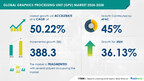
NEW YORK, Oct. 4, 2024 /PRNewswire/ — Report with the AI impact on market trends – The Global Graphics Processing Unit (GPU) market size is estimated to grow by USD 388.3 billion from 2024-2028, according to Technavio. The market is estimated to grow at a CAGR of 50.22% during the forecast period.Increase in demand for advanced gaming and VR experiences is driving market growth, with a trend towards rise in demand for high-performance computing (HPC). However, issues with graphics processing unit upgrading in notebooks poses a challenge – Key market players include Advanced Micro Devices Inc., Alphabet Inc., Apple Inc., Arm Ltd., ASUSTeK Computer Inc., Broadcom Inc., Fujitsu Ltd., Galaxy Microsystems Ltd., Gigabyte Technology Co. Ltd., Imagination Technologies Ltd., Intel Corp., International Business Machines Corp., NVIDIA Corp., Qualcomm Inc., Samsung Electronics Co. Ltd., SAPPHIRE Technology Ltd., Sony Group Corp., Taiwan Semiconductor Manufacturing Co. Ltd., Zebra Technologies Corp., and Zotac Technology Ltd..
AI-Powered Market Evolution Insights. Our comprehensive market report ready with the latest trends, growth opportunities, and strategic analysis- View your snapshot now
Forecast period
2024-2028
Base Year
2023
Historic Data
2017 – 2021
Segment Covered
Type (Integrated GPUs and Discrete GPUs), Application (Computers, Tablets and smartphones, Television, and Gaming consoles), and Geography (APAC, North America, Europe, South America, and Middle East and Africa)
Region Covered
APAC, North America, Europe, South America, and Middle East and Africa
Key companies profiled
Advanced Micro Devices Inc., Alphabet Inc., Apple Inc., Arm Ltd., ASUSTeK Computer Inc., Broadcom Inc., Fujitsu Ltd., Galaxy Microsystems Ltd., Gigabyte Technology Co. Ltd., Imagination Technologies Ltd., Intel Corp., International Business Machines Corp., NVIDIA Corp., Qualcomm Inc., Samsung Electronics Co. Ltd., SAPPHIRE Technology Ltd., Sony Group Corp., Taiwan Semiconductor Manufacturing Co. Ltd., Zebra Technologies Corp., and Zotac Technology Ltd.
Key Market Trends Fueling Growth
The global Graphics Processing Unit (GPU) market is experiencing a notable growth in demand for High Performance Computing (HPC) applications. This trend can be attributed to several factors, including the expanding need for advanced graphics capabilities in industries such as gaming, Virtual Reality (VR), and animation. The increasing intricacy of video games and the escalating popularity of VR experiences necessitate graphics processing units that can deliver high-resolution graphics and seamless performance. In response, manufacturers have developed specialized graphics processing units for HPC, empowering game developers and content creators to elevate visual quality and realism. Another significant driver of this trend is the burgeoning adoption of Artificial Intelligence (AI) and Machine Learning (ML) applications. AI and ML algorithms necessitate substantial computational power for tasks like image and speech recognition, natural language processing, and data analysis. Graphics processing units, with their parallel processing capabilities, are a preferred choice for AI and ML developers. Moreover, industries such as finance, scientific research, and healthcare are increasingly relying on HPC using graphics processing units. In finance, graphics processing units are employed for intricate calculations and simulations in areas like risk analysis, portfolio optimization, and algorithmic trading. In scientific research, they are utilized for data-intensive calculations in fields like genomics, climate modeling, and particle physics. In healthcare, graphics processing units are leveraged for medical imaging, drug discovery, and personalized medicine applications. The escalating demand for HPC in the GPU market is also fueled by advancements in cloud computing and the proliferation of data centers. As businesses shift their workloads to the cloud, there is a requirement for graphics processing units in data centers to manage tasks like rendering, video transcoding, and real-time analytics. Consequently, cloud-based GPU services have emerged, enabling organizations to access high-performance computing resources on demand. These factors are anticipated to amplify the demand for graphics processing units, driving the growth of the market during the forecast period.
The GPU market is thriving in the digital world, driven by trends in graphics, video rendering, and gaming platforms. According to a recent PwC report, global spending in the gaming industry is projected to reach USD159.3 billion by 2023. GPUs play a crucial role in delivering visuals and fluid gameplay in video games, 3D designs, and virtual reality (VR) and augmented reality (AR) applications. In the mainstream business sector, GPUs are used for AI applications like fraud detection, conversational AI solutions, and cryptocurrency mining. The rapid evolution of AI, machine learning, and computing technologies is increasing the demand for GPUs in areas like design, development, optimization, and data processing. However, ethical concerns around user data, GDPR, and biased algorithms are creating regulatory scrutiny. Skilled engineers, developers, data scientists, AI researchers, and machine learning experts are in high demand to address these challenges and optimize the use of GPUs in this complex technology landscape. The market for GPUs is expected to continue growing as the technology becomes more integrated into our daily lives through wearable technologies, computing technologies, and other emerging applications.
Insights on how AI is driving innovation, efficiency, and market growth- Request Sample!
Market Challenges
The global graphics processing unit (GPU) market in notebooks is facing a persistent challenge with the limitation of GPU upgrades. This issue is a concern for both manufacturers and consumers due to the compact design of notebooks. Notebooks prioritize portability and compactness, leading to thermal and space constraints, making it challenging to accommodate upgrades. In contrast, desktop computers offer more room for expansion and can easily accommodate larger, more powerful GPUs. Another reason for this issue is the proprietary nature of notebook designs. Many manufacturers restrict users from upgrading key components, including GPUs, creating a dependency on the manufacturer for future upgrades. The lack of standardized GPU form factors for notebooks further complicates matters. Unlike desktop GPUs, which follow standard form factors like PCI Express, notebook GPUs come in various shapes and sizes, making it difficult for consumers to find compatible upgrades for their specific notebook models. This issue becomes more significant as the demand for high-performance gaming and professional-grade graphics applications increases. With technology advancing at a rapid pace, users find themselves unable to fully utilize new features and enhancements due to outdated GPU capabilities. These factors are expected to hinder the growth of the GPU market for notebooks during the forecast period.The GPU market is experiencing significant growth due to increasing demand from gaming and data center industries. Gaming applications, online gaming, and e-gaming are major drivers, with compatibility and multiple device support being key challenges. Location independence and low-cost high-quality experience are crucial for organizations in the on-premises deployment mode. Data procurement, storage, and machine-learning applications in sectors like AI and online learning/entertainment also fuel demand. Gaming companies like Steam and DirectX 12 GPU manufacturers such as AMD and NVIDIA’s RTX gaming servers are leading the charge. New entrants like Fenghua GPU and SenseTime, using GPUs in Exynos SoCs and P5 instances, are also making waves. The HPC sector’s demand for GPUs in AI and machine learning is also noteworthy. Despite these opportunities, compatibility across platforms and devices remains a challenge. Overall, the GPU market’s future looks bright, with continued innovation and advancements in frame buffer technology.
Insights into how AI is reshaping industries and driving growth- Download a Sample Report
Segment Overview
This graphics processing unit (gpu) market report extensively covers market segmentation by
Type 1.1 Integrated GPUs1.2 Discrete GPUsApplication 2.1 Computers2.2 Tablets and smartphones2.3 Television2.4 Gaming consolesGeography 3.1 APAC3.2 North America3.3 Europe3.4 South America3.5 Middle East and Africa
1.1 Integrated GPUs- The Global GPU Market experienced steady growth in 2020, driven by increasing demand for advanced graphics in gaming, virtual reality, and artificial intelligence applications. Major players like NVIDIA, AMD, and Intel dominated the market, offering high-performance GPUs for various industries. The market is expected to continue expanding due to rising adoption in data centers and automotive sectors. Companies invest in research and development to improve energy efficiency and enhance computing capabilities.
Download complimentary Sample Report to gain insights into AI’s impact on market dynamics, emerging trends, and future opportunities- including forecast (2024-2028) and historic data (2017 – 2021)
Research Analysis
The GPU market is experiencing significant growth due to the increasing demand for artificial intelligence (AI) and machine learning (ML) applications. GPUs, or Graphics Processing Units, are specialized processors designed for handling complex mathematical calculations, making them ideal for AI and ML development. The adoption of GPUs in AI-powered solutions is driving innovation in various industries, including gaming, graphics, virtual reality (VR), healthcare, manufacturing, real estate, and data centers. In the gaming industry, the latest RTX gaming servers and DirectX 12 GPUs offer enhanced graphics processing capabilities for gaming experiences. For creative technologies, GPUs are essential for rendering high-definition 3D content and optimizing design workflows. In the field of HPC (High Performance Computing), GPUs are used for scientific simulations and big data analytics. Cloud-based analytics applications and AI-powered solutions are also driving the demand for GPU as a Service (GPUaaS), enabling businesses to access powerful GPU resources on-demand. The use of GPUs in VR, healthcare, and real estate industries is also on the rise, as they offer faster processing times and improved accuracy for complex mathematical calculations. Overall, the GPU market is poised for continued growth as more industries discover the benefits of these powerful processing units.
Market Research Overview
The Graphics Processing Unit (GPU) market is experiencing rapid growth due to the increasing demand for AI, RTX gaming servers, GPUaaS, HPC, and other advanced technologies. GPUs, as electronic processors specialized in graphics and video rendering, play a crucial role in the digital world, powering video games, 3D designs, virtual reality (VR), and augmented reality (AR) on gaming platforms and wearable technologies. The global spending on the gaming industry is projected to reach new heights, with mainstream businesses adopting GPUs for various applications, including fraud detection, conversational AI solutions, and visuals. The emergence of AI, machine learning, and big data technology is driving the industry expansion, with GPUs providing the computational power needed for complex mathematical calculations and analyzing large databases. The use of GPUs in AI applications, such as image recognition and interference times, is also leading to design and development optimizations. However, the use of GPUs in AI and other emerging technologies raises ethical concerns, including GDPR, user data, and biased algorithms. Regulatory scrutiny is increasing, and skilled engineers and developers are in high demand to address these challenges and ensure the responsible use of this rapidly evolving technology. Meanwhile, GPUs continue to be a key component in the digital world, from PC games and mobile titles to specialized processors and display enhancements. Companies like Imagination Technology and its GPU IP and API system are leading the way in this field, while the adoption of GPUs in industries such as healthcare, manufacturing, and supply chain is set to accelerate. In summary, the GPU market is a dynamic and complex technology landscape, driven by the demands of AI, gaming, HPC, and other emerging applications. The role of GPUs in powering the digital world and enabling new innovations is undeniable, but the challenges of ethical use and regulatory compliance must also be addressed to ensure a sustainable and responsible future for this rapidly evolving technology.
Table of Contents:
1 Executive Summary
2 Market Landscape
3 Market Sizing
4 Historic Market Size
5 Five Forces Analysis
6 Market Segmentation
TypeIntegrated GPUsDiscrete GPUsApplicationComputersTablets And SmartphonesTelevisionGaming ConsolesGeographyAPACNorth AmericaEuropeSouth AmericaMiddle East And Africa
7 Customer Landscape
8 Geographic Landscape
9 Drivers, Challenges, and Trends
10 Company Landscape
11 Company Analysis
12 Appendix
About Technavio
Technavio is a leading global technology research and advisory company. Their research and analysis focuses on emerging market trends and provides actionable insights to help businesses identify market opportunities and develop effective strategies to optimize their market positions.
With over 500 specialized analysts, Technavio’s report library consists of more than 17,000 reports and counting, covering 800 technologies, spanning across 50 countries. Their client base consists of enterprises of all sizes, including more than 100 Fortune 500 companies. This growing client base relies on Technavio’s comprehensive coverage, extensive research, and actionable market insights to identify opportunities in existing and potential markets and assess their competitive positions within changing market scenarios.
Contacts
Technavio Research
Jesse Maida
Media & Marketing Executive
US: +1 844 364 1100
UK: +44 203 893 3200
Email: media@technavio.com
Website: www.technavio.com/
View original content to download multimedia:https://www.prnewswire.com/news-releases/graphics-processing-unit-gpu-market-to-grow-by-usd-388-3-billion-2024-2028-with-ai-driven-insights-on-rising-demand-for-advanced-gaming-and-vr—technavio-302267044.html
SOURCE Technavio










 Technology5 days ago
 Technology4 days ago
 Technology5 days ago
 Coin Market5 days ago
 Technology4 days ago
 Technology2 days ago
 Technology5 days ago