Connect with us

Technology

NACD BLUE RIBBON COMMISSION REPORT TO HELP BOARDS LEAD IN AN ERA OF PROFOUND DIGITAL AND DATA-DRIVEN TRANSFORMATION

Published

on

Report brings together expertise from 24-member Commission, led by AMD Lead Independent Director Nora Denzel and Best Buy Board Chair David Kenny

WASHINGTON, Oct. 7, 2024 /PRNewswire/ — Today, the National Association of Corporate Directors (NACD) released its 2024 NACD Blue Ribbon Commission report, “Technology Leadership in the Boardroom: Driving Trust and Value” , to help corporate boards navigate the promise of technology and data-driven innovation—as well as the blistering pace of change – that are central to companies’ growth strategies.

This report comes at a critical moment in time as boards are challenged with capturing the opportunities presented by rapidly evolving technologies while also managing new risks. In fact, NACD’s 2024 Public Company Board Practices Oversight Survey reported that only 34% of directors say the board and management are “strongly aligned” on the company’s vulnerability to the impact of transformative technologies.

The Report reflects the expertise and insights of a 24-member Commission – governance leaders, investors, and subject-matter experts representing more than 70 boards – that explored how the board’s oversight of technology and data can drive both trust and value.  Launched today at the NACD Directors Summit™, the report includes specific recommendations for strengthening technology leadership in the boardroom, tools boards can apply immediately to address the challenges and opportunities posed by rapid technological advances, including AI, clean energy, robotics, and quantum computing.

“The rapid pace of change and rising trust concerns are complicating board governance around transformative technologies. This year’s NACD Blue Ribbon Commission Report highlights critical risks for boards: irrelevancy, compressed timelines, innovation versus expertise, stakeholder trust, and fragmented regulation,” said Nora Denzel, co-chair of the NACD Blue Ribbon Commission. “Boards must strengthen oversight, deepen insight and develop foresight along with adopting a strategy-centered approach that balances risk and opportunity.”

Boards can enhance their technology governance not through a dramatic overhaul of their own workings, but by adapting their fundamentals, including their structure, composition, agenda setting and reporting metrics. The 2024 Blue Ribbon Commission encourages boards to implement the recommended actions in this report, regardless of their maturity level, to improve technology governance. Directors are urged to adopt a “learn-it-all” mindset.

“While many companies are managing the risks of macro-level uncertainty, the biggest technology risk now is failing to adopt emerging technology. To make informed decisions for the future, we must challenge management’s core assumptions about customers, competitors, and our own capabilities,” said David Kenny, co-chair of the NACD Blue Ribbon Commission. “Boards face a tough balancing act: they need to encourage management to innovate quickly while also acting as a steward of hard-earned trust with both customers and shareholders.”

The report toolkits include contributions from NACD, KPMG, Russell Reynolds Associates, Pearl Meyer and Sidley Austin LLP.  An executive overview of the Report is available here (LINK).

NACD President and CEO Peter Gleason added, “This report is a continuation of NACD’s deep expertise in technology, including AI and cybersecurity. It provides a practical blueprint with detailed recommendations focused on three core imperatives, along with a toolkit to support implementation. This moment demands greater technology focus and strategic leadership from every director.”

More information on all the 2024 Commissioners can be found on the Blue Ribbon Commission website.

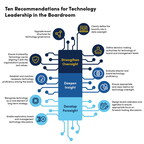
10 Recommendations for Technology Leadership in the Boardroom

Strengthen Oversight

Upgrade board structures for technology governance.Clearly define the board’s role in data oversight.Define decision-making authorities for technology at board and management levels.Ensure trustworthy technology use by aligning it with the organization’s purpose and values.

Deepen Insight

Establish and maintain necessary technology proficiency among the board.Evaluate director and board technology proficiency.Ensure appropriate and clear metrics for technology oversight.

Develop Foresight

Recognize technology as a core element of long-term strategy.Design board calendars and agendas to ensure appropriate focus on forward-looking discussions.Enable exploratory board and management technology discussions.

About NACD
The National Association of Corporate Directors® (NACD®) is the leading member organization for corporate directors who want to expand their knowledge, grow their network and maximize their potential. For more than 47 years, NACD has helped boards and the business community elevate their performance and create long-term value. Our leadership continues to raise standards of excellence and advance board effectiveness at thousands of member companies.

NACD’s value insights, professional development events and resources, such as the NACD Directors Summit™ and the NACD Directorship Certification® program, support boards in navigating complex challenges. With a growing network of more than 24,000 members across more than 20 Chapters, boards are better equipped to make well-informed decisions on the critical, strategic issues facing their businesses today. Learn more at www.nacdonline.org.    

Press Contacts
Shannon Bernauer
NACD
sbernauer@nacdonline.org
571-367-3688

Jackie Hart
G&S Business Communications
Jhart@gscommunications.com
929-390-5431

View original content to download multimedia:https://www.prnewswire.com/news-releases/nacd-blue-ribbon-commission-report-to-help-boards-lead-in-an-era-of-profound-digital-and-data-driven-transformation-302268995.html

SOURCE National Association of Corporate Directors

Continue Reading
Click to comment

Leave a Reply

Your email address will not be published. Required fields are marked *

Technology

Monport MEGAS Brings Advanced LightBurn Features to Desktop CO2 Laser Engraving

Published

on

By

New 70W desktop CO2 laser engraver brings LightBurn’s advanced feature set — autofocus, wireless connectivity and live camera placement — directly into the software, closing a gap most “LightBurn compatible” machines leave open.

SEATTLE, July 27, 2026 /PRNewswire/ — As LightBurn continues to be the preferred software for makers, educators, and small manufacturing businesses, Monport is emphasizing the advanced workflow capabilities of its MEGAS 70W desktop CO2 laser engraver. The system enables users to perform autofocus, wireless connectivity, and live camera positioning directly inside LightBurn, creating a more streamlined production workflow than the basic compatibility offered by many desktop laser systems.

The integration allows users to complete nearly every production step directly inside LightBurn rather than switching between multiple software applications.

The announcement positions the MEGAS as a candidate for best CO2 laser engraver among software-focused buyers: makers, Etsy and Shopify sellers, and small production shops who run LightBurn daily and have grown frustrated switching between a manufacturer’s app and the software they actually use to build and send jobs. The feature announcement coincides with Monport’s Summer Sale, which drops the MEGAS to $2,799.99 for a limited time.

Why “LightBurn Compatible” Doesn’t Always Mean Full Support

LightBurn is the industry-standard control software for hobbyist and small-business laser systems, but compatibility varies widely between machines. Many desktop CO2 laser engravers can send basic cut and engrave jobs to LightBurn, yet require a separate manufacturer app for autofocus, camera alignment or wireless setup—breaking the workflow and adding extra steps every time a job changes materials or needs repositioning.

Industry buyers researching a 70W laser engraver often discover this gap only after purchase: a listing says “LightBurn compatible,” but autofocus still means picking up a manual gauge, and camera alignment means opening a second piece of software just to preview where a design will land.

Going Beyond Basic LightBurn Compatibility

Many competing desktop laser systems support basic LightBurn functions for cutting and engraving. Advanced features such as autofocus, wireless camera positioning and complete wireless workflow integration, however, are often limited, and may require proprietary software, or are unavailable inside LightBurn itself.

The Monport MEGAS was engineered to provide these advanced functions directly within LightBurn, helping users spend less time switching between applications and more time producing finished products— one of the reasons Monport designed the MEGAS specifically for LightBurn power users.

Autofocus Without Leaving LightBurn

On the MEGAS, autofocus is triggered and confirmed directly inside LightBurn, so operators can set material height and start a job without switching to a separate focusing tool or app. For a 70W laser engraver running frequent material changes—from thin acrylic sheet to thicker basswood board—that single-window workflow removes one of the more repetitive steps in a typical production day.

Wireless Connectivity Simplifies Shop Workflow

The wireless connection also enables operators to send jobs to the machine without repeatedly reconnecting USB cables, making the workflow especially useful in classrooms, shared makerspaces and production environments where multiple computers may access the laser.

The MEGAS connects to LightBurn over Wi-Fi, removing the tethered USB connection many desktop CO2 laser engravers still require. That means the machine can be positioned away from a workstation and run jobs sent wirelessly, a common request among small-shop and classroom users managing limited floor space or shared equipment.

Live Camera Placement Inside LightBurn

An onboard wireless camera streams a live view of the work surface into LightBurn, letting users position and align artwork on pre-printed or irregular material directly on screen instead of manually measuring and test-firing the laser.

From Design File to Finished Product

For many laser users, efficiency is measured by how quickly a design becomes a finished product. With the MEGAS, users can import artwork into LightBurn, position the design using the live wireless camera, activate autofocus with a single click, and begin engraving without leaving the software.

By keeping every major production step inside one interface, the workflow reduces setup time, minimizes alignment errors, and simplifies repeat production for businesses engraving dozens—or even hundreds—of personalized products each day on their desktop CO2 laser engraver.

Real-World Material Performance

To demonstrate production versatility, during internal testing, Monport evaluated the MEGAS across several materials commonly used by Etsy sellers, gift businesses and production workshops:

Plywood — crisp engraved wooden signs with clean edgesAcrylic — polished awards and plaques with sharp detailLeather — high-contrast wallet engraving with minimal scorching

The testing demonstrates that a single desktop CO2 laser engraver can handle multiple product categories without requiring significant workflow changes.

Better ROI for Small Businesses

Monport also compared estimated material costs with typical retail pricing across four popular product categories:

Engraved plywood sign: Approximately $35 retail price with about $5 in material costs.Engraved acrylic award: Approximately $45 retail price with about $8 in material costs.Engraved leather wallet: Approximately $55 retail price with about $12 in material costs.

Based on estimated material costs alone, these products show potential material-cost margins of approximately 75% to 85%, before accounting for labor, packaging, shipping, platform fees and other operating expenses. Monport says the combination of higher-margin products, intelligent batch engraving, and a streamlined LightBurn workflow can help small businesses, Etsy sellers, and Shopify merchants recover their investment more quickly as production scales.

Built for Professional LightBurn Users

While M-Design Hub, Monport’s free Windows and macOS software, offers AI-powered image processing, one-click material settings and intelligent batch engraving, Monport says the MEGAS was equally designed for experienced LightBurn users who prefer complete control over every project.

Supporting both software environments gives creators the flexibility to choose an automated workflow for everyday production or LightBurn’s advanced tools for more complex engraving jobs—a combination Monport believes makes the case for the MEGAS as a best CO2 laser engraver choice regardless of skill level.

“LightBurn has become the workflow that thousands of makers and small businesses rely on every day,” said Monport CEO.

“Our goal with the MEGAS was to eliminate unnecessary software switching by bringing advanced features like autofocus, wireless connectivity and live camera positioning directly into LightBurn. That lets users focus on production instead of setup.”

Explore Advanced LightBurn Features on the MEGAS

Monport is positioning the MEGAS as an entry point for LightBurn users who want to explore the software’s advanced feature set without adding a second app to their workflow. Full setup guides and LightBurn configuration walkthroughs for the MEGAS are available on Monport’s website.

Summer Sale Pricing

As part of Monport’s Summer Sale this July, the MEGAS desktop CO2 laser engraver is available at a special offer price of $2,799.99—the limited-time promotional price on the machine to date. The discount is applied automatically at checkout; no promo code is required. The offer runs for a limited time or while supplies last and includes two complimentary laser marking spray bottles, used to prepare bare metal surfaces such as stainless steel for laser marking.

Availability

The Monport MEGAS 70W desktop CO2 laser engraver is available through Monport’s official website.

About Monport

Founded in 2020 and headquartered in Seattle, Monport designs desktop and industrial CO2 and fiber laser engraving and cutting machines for makers, small businesses and workshops, backed by U.S.-based technical support.

Media Contact:

Monport Laser
Email: official@monportlaser.com
Website: https://monportlaser.com

View original content:https://www.prnewswire.com/news-releases/monport-megas-brings-advanced-lightburn-features-to-desktop-co2-laser-engraving-302835013.html

SOURCE Monport

Continue Reading

Technology

Tredence Launches Domain Native Forward Deployed Engineering to Close the Last Mile of Enterprise AI

Published

on

By

The FDE practice builds an elite class of engineers at the intersection of domain expertise and data & AI, solving enterprises’ hardest business problems.

BENGALURU, India and SAN JOSE, Calif., July 27, 2026 /PRNewswire/ — Tredence, the world’s leading data & AI services company, today announced the launch of its Forward Deployed Engineering (FDE) practice, committing to build a dedicated pool of 200 FDEs over the next 12-18 months. Through this practice, the company intends to build the most domain-native engineering capability in the market, helping clients move faster from problem to impact.

Built to tackle high-impact challenges for Fortune 100 enterprises, Tredence’s FDEs are domain specialists first and engineers second. A Retail FDE understands markdown cycles and assortment planning. A supply chain FDE understands network constraints and demand volatility. A revenue growth management (RGM) FDE understands trade spend and price elasticity.

Each Tredence FDE brings that depth to the work of building and scaling agentic systems, applying deep engineering expertise to the business decisions that matter most, from pricing and promotions to the data and semantic foundations that power enterprise operations. They are platform agnostic by design, working across clients’ existing technology stack, including Databricks, Google Cloud, Microsoft, Snowflake, AWS, and leading frontier model providers.

Enterprise AI often struggles at the last mile, where data, systems, and business decisions must come together to create measurable value. Tredence’s Forward Deployed Engineers combine speed, powered by deep AI, data, and engineering expertise, with depth, built through years of domain experience, to turn AI into business outcomes faster.

“Enterprise AI is at an inflection point, and success now depends on combining AI-native engineering with industry depth to turn technology into real business outcomes. Our FDEs are designed to solve the hardest business problems, lead end-to-end AI transformations, and take ownership all the way from business problems to enterprise-scale deployment. That’s the level of accountability enterprise AI needs today,” said Shub Bhowmick, Co-founder and CEO, Tredence.

Why Tredence’s FDE Model Is Different-

More than a decade of deep domain expertise across industries
FDEs bring years of experience in supply chain, customer analytics, built through work with 100+ Fortune 500 clients.AI native engineering as the default way of working
FDEs build with AI from the start, reinforced by Tredence’s AI Forge program, which is centered on AI-first problem solving.Frontline ownership, powered by specialized teams
Tredence FDEs lead from the front, anchoring small, elite teams and owning everything from business problems to enterprise-scale deployment.Hands on depth across hyperscaler, frontier AI, and data platforms
Tredence FDEs help shape the very platforms they build on, with seats on the product advisory teams of leading hyperscalers and ISVs.

About Tredence

Tredence is a global AI and data science solutions provider focused on solving the last-mile problem in AI, the gap between insight creation and value realization. Tredence leverages deep domain expertise, advanced data platforms and accelerators, and strategic partnerships to provide tailored, cutting-edge solutions to its clients. The company has 4,200+ employees across the San Francisco Bay Area, Chicago, Riyadh, Dubai, London, Toronto, and Bengaluru, serving top brands in Retail, CPG, Hi-tech, Telecom, Healthcare, Travel, and Industrials. For more information, please visit www.tredence.com and follow us on LinkedIn.

View original content to download multimedia:https://www.prnewswire.com/in/news-releases/tredence-launches-domain-native-forward-deployed-engineering-to-close-the-last-mile-of-enterprise-ai-302835000.html

Continue Reading

Technology

Fractus and Geotab settle U.S. patent litigation

Published

on

By

Additional agreements reinforce Fractus’ role in the IoT technologies ecosystem

BARCELONA, Spain, July 27, 2026 /PRNewswire/ — Fractus, a pioneer in antenna technology and patent licensing, today announced that it has reached a settlement with Geotab, resolving the patent infringement litigation filed in the United States District Court for the Eastern District of Texas. The terms of the agreement are confidential.

The settlement is an important milestone for Fractus in the connected fleet and transportation market. It brings an end to the dispute with Geotab and confirms the relevance of Fractus’ patented antenna technology in IoT applications where reliable wireless performance is essential.

Fractus also welcomes the growing list of its IoT licensees, which further strengthens Fractus’ position in the IoT ecosystem and demonstrates the growing value of its technology in fleet management, cargo visibility, and mobile asset monitoring.

Fleet telematics and cargo tracking are expanding quickly as transportation and logistics companies look for better visibility, safety, compliance and efficiency. According to Berg Insight, fleet management systems in active use in North America are forecast to grow from 19.2 million units at the end of 2024 to 33.2 million units by 2029. Berg Insight also expects the global installed base of tracking devices for trailers, containers and other cargo-carrying units to grow from 13.8 million units in 2024 to 26.9 million units by 2029.

In these markets, antenna performance is more than a technical specification. Connected devices must communicate across networks, frequency bands, countries and difficult operating conditions, often within space-constrained designs installed on vehicles or other mobile assets. Fractus’ patented antenna innovations help enable the compact, high-performance, multiband connectivity that these IoT devices require.

“We are very pleased to have reached this resolution with Geotab and to see Fractus’ technology gaining further recognition in the IoT market,” said Jordi Ilario, CEO of Fractus. “Fleet management, trailer monitoring and asset tracking are clear examples of how wireless connectivity is transforming transportation. These recent agreements are an important validation of our innovation, and they encourage us to keep building constructive licensing relationships with companies that value strong technology and intellectual property.”

About Fractus

Fractus is an early pioneer in the application of advanced geometry and mathematics to antenna design. The company’s patented innovations enable compact, high-performance, multiband antennas used across smartphones, IoT devices, network infrastructure, connected health and transportation applications. Fractus holds a portfolio covering more than 40 inventions and licenses its technology to leading companies across the wireless ecosystem.

Logo: https://mma.prnewswire.com/media/1896932/Fractus_Logo.jpg 

View original content:https://www.prnewswire.co.uk/news-releases/fractus-and-geotab-settle-us-patent-litigation-302834075.html

Continue Reading

Trending