Technology
The Orthopedic Prosthetics Market is projected to grow by USD 871.9 Million (2024-2028), driven by rising trauma cases, accidents, and birth defects, with AI-powered market evolution – Technavio
Published
2 years agoon
By
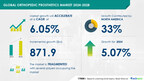
NEW YORK, Oct. 8, 2024 /PRNewswire/ — Report on how AI is driving market transformation – The Global Orthopedic Prosthetics Market size is estimated to grow by USD 871.9 million from 2024-2028, according to Technavio. The market is estimated to grow at a CAGR of over 6.05% during the forecast period. Growing number of trauma, accident cases, and birth defects is driving market growth, with a trend towards growing focus on customized orthopedic prosthetics. However, high cost of prosthetics poses a challenge – Key market players include Advanced Arm Dynamics Inc., Arthrex Inc., Artificial Limbs Manufacturing Corp. Of India, B.Braun SE, Blatchford Ltd., Exactech Inc., Fillauer LLC, Globus Medical Inc., Hanger Inc, Johnson and Johnson Services Inc., LeTourneau Prosthetics and Orthotics, Orthotic and Prosthetic Lab Inc, Ossur hf, Ottobock SE and Co. KGaA, RTI Surgical Inc., Smith and Nephew plc, Steeper Inc., Stryker Corp., WillowWood LLC, and Zimmer Biomet Holdings Inc..
Key insights into market evolution with AI-powered analysis. Explore trends, segmentation, and growth drivers- View the snapshot of this report
Orthopedic Prosthetics Market Scope
Report Coverage
Details
Base year
2023
Historic period
2017 – 2021
Forecast period
2024-2028
Growth momentum & CAGR
Accelerate at a CAGR of 6.05%
Market growth 2024-2028
USD 871.9 million
Market structure
Fragmented
YoY growth 2022-2023 (%)
5.07
Regional analysis
North America, Europe, Asia, and Rest of World (ROW)
Performing market contribution
North America at 33%
Key countries
US, Germany, China, UK, and Canada
Key companies profiled
Advanced Arm Dynamics Inc., Arthrex Inc., Artificial Limbs Manufacturing Corp. Of India, B.Braun SE, Blatchford Ltd., Exactech Inc., Fillauer LLC, Globus Medical Inc., Hanger Inc, Johnson and Johnson Services Inc., LeTourneau Prosthetics and Orthotics, Orthotic and Prosthetic Lab Inc, Ossur hf, Ottobock SE and Co. KGaA, RTI Surgical Inc., Smith and Nephew plc, Steeper Inc., Stryker Corp., WillowWood Global LLC, and Zimmer Biomet Holdings Inc.
Customized orthopedic prosthetics have gained significant attention in the market due to their superior functionality and increasing demand from end-users, particularly athletes and accident victims. Leading companies like Ossur and Ohio Willow Wood are focusing on providing customized prosthetics using advanced technologies such as CAD/CAM and lasers. These technologies enable vendors to manufacture prosthetics that perfectly match the shape of the amputee’s limb, ensuring a better fit and improved performance. Innovations like computer-aided shape modification, 3D scanners, 3D printer integration, and automated carvers further enhance the customization process. Companies such as Vorum offer integrated CAD/CAM solutions to develop customized orthopedic prosthetics, increasing productivity by up to 600%. With over 700 vendors using their CAD/CAM solution, the trend towards customized prosthetics is expected to drive market growth during the forecast period.
The Orthopedic Prosthetics Market is experiencing significant growth due to increasing trends in accidental injuries and the aging population. Demand for artificial limbs is on the rise as chronic illnesses such as diabetes, osteoarthritis, and obesity become more prevalent. Product innovations in electric prostheses, myoelectric prostheses, and Cheetah sports prosthesis are improving patient comfort and functionality. The burden of osteosarcoma and other bone diseases is driving research and development in material science. Distribution networks are expanding to reach individual patients in remote areas, with public-private funding and regulatory authorities playing crucial roles. Healthcare facilities are integrating Internet of Things technology, including Bluetooth and smartphone connectivity, to enhance patient care and reduce the risk of deep vein thrombosis. However, challenges such as limited infrastructural facilities, hesitation to adopt new technologies, and infection risks remain. The market’s economic well-being is influenced by healthcare budgets, per capita expenditure, and the overweight population. Product innovations and regulatory approvals are essential to address the unique needs of the geriatric population. The reimbursement scenario is evolving, with statistics showing a growing number of orthopedic surgeries and road accidents. The market’s future looks promising as medical science continues to advance, and the Internet penetration rate increases.
Request Sample of our comprehensive report now to stay ahead in the AI-driven market evolution!
The global orthopedic prosthetics market is experiencing steady growth, yet the high cost of prosthetics poses a significant challenge. A basic prosthetic leg can cost up to USD10,000, with advanced prosthetic legs reaching over USD100,000. Electricity-powered prosthetics range between USD40,000 and USD60,000, making them a significant investment. For instance, the Genium X3 prosthetic leg costs approximately USD120,000, while the Michelangelo electronic hand costs around USD60,000. Some companies offer expensive prosthetics to select patients, such as Ottobock Healthcare’s bionic leg for military personnel, priced at USD150,000. Post-surgery care and maintenance, including rehabilitation, further increase the overall cost. Physical therapy sessions cost between USD50 and USD350, while occupational therapy sessions range from USD50 to USD400. The high cost of orthopedic prosthetics can significantly impact the growth of the global market during the forecast period.The Orthopedic Prosthetics Market faces several challenges in the healthcare sector. Healthcare budgets and facilities limit the accessibility of prosthetic devices for individual patients. Hesitation and stigma surrounding their use persist. Infections and injuries require continuous innovation in material science, such as the use of polymer materials. Regulatory authorities and public-private funding play a crucial role in the reimbursement scenario. The obesity and overweight population pose challenges due to the increased demand for Lower Extremity Prosthetics. Trauma cases and road accidents lead to a higher usage of orthopedic prosthetic devices. Product innovations, including Myoelectric prostheses and smartphone connectivity, are essential to meet the evolving needs of patients. Limited infrastructural facilities and the Internet penetration rate impact the distribution and availability of medical equipment. Infections and injuries from vehicles add to the market size. Strategic movements by professionals and product innovations are essential to address the challenges posed by the increasing statistics of Osteoarthritis and orthopedic surgeries. The Internet of Things and smartphone connectivity offer opportunities for remote monitoring and upgrading lifestyles. However, concerns regarding the security of data and potential infections remain. The challenges in the orthopedic prosthetics market require continuous innovation and collaboration between medical science, regulatory authorities, and industry professionals.
Discover how AI is revolutionizing market trends- Get your access now!
This orthopedic prosthetics market report extensively covers market segmentation by
Product 1.1 Lower extremity orthopedic prosthetics1.2 Upper extremity orthopedic prostheticsTechnology 2.1 Conventional2.2 Electric-powered2.3 HybridGeography 3.1 North America3.2 Europe3.3 Asia3.4 Rest of World (ROW)
1.1 Lower extremity orthopedic prosthetics- The Orthopedic Prosthetics Market refers to the industry that produces and distributes artificial limbs and other orthopedic devices. These products cater to individuals with limb loss or limb differences due to various reasons such as trauma, birth defects, or diseases. The market is growing due to an aging population, increasing road accidents, and advancements in technology leading to improved functionality and design of prosthetics. Key players in this market include Otto Bock Healthcare, Hanger Inc., and Ossur. Companies focus on research and development to offer innovative solutions, enhancing user experience and mobility.
Download a Sample of our comprehensive report today to discover how AI-driven innovations are reshaping competitive dynamics
The Orthopedic Prosthetics Market encompasses the production and distribution of orthopedic prosthetic devices, including artificial limbs, used to replace missing body parts due to various conditions such as Orthopedic surgeries, trauma cases from road accidents or vehicle incidents, and accidental injuries. The burden of diseases like osteosarcoma and osteoarthritis fuels the demand for these devices. The usage of prosthetics is increasingly common among individual patients, especially in the aging population and those with low bone density, diabetes, or obesity. Medical science continues to advance, leading to innovations like Cheetah sports prosthesis and electric prostheses. The world population’s increasing size and the resulting rise in the number of patients needing prosthetic devices further boost market growth. Lower Extremity Prosthetics, a significant segment, is expected to witness significant demand due to the high prevalence of injuries affecting the lower limbs.
The Orthopedic Prosthetics Market encompasses the production, distribution, and usage of artificial limbs and orthopedic devices designed to replace or support missing or damaged body parts. Factors driving market growth include the increasing burden of chronic illnesses such as diabetes, osteoarthritis, and obesity, as well as accidental injuries and road accidents. The geriatric population and the overweight population are also significant contributors, with the aging population experiencing age-related conditions like bone density loss and the need for orthopedic surgeries. Product innovations in material science, including the use of polymer materials and Bluetooth and smartphone connectivity, are enhancing the comfort and functionality of orthopedic prosthetics. However, challenges such as limited infrastructural facilities, regulatory hurdles, and the stigma surrounding prosthetics usage remain. Market growth is also influenced by economic well-being, healthcare budgets, and the distribution network, with public-private funding playing a crucial role in expanding access to these essential medical devices. The market includes various types of prosthetics, including Lower Extremity Prosthetics, Myoelectric prostheses, and Electric prostheses, catering to individual patient needs. Strategic movements by professionals and regulatory authorities, as well as the impact of healthcare facilities and reimbursement scenarios, are shaping the market landscape. The usage of prosthetics is also influenced by factors such as deep vein thrombosis, infections, and upgrading lifestyles. The Internet of Things and Internet penetration rate are also transforming the market, with Cheetah sports prosthesis and other smart prosthetics offering enhanced functionality and convenience. Despite these opportunities, challenges such as hesitation and the burden of osteosarcoma remain. Overall, the Orthopedic Prosthetics Market is poised for significant growth, driven by the increasing need for these devices to improve patient health and enhance mobility.
1 Executive Summary
2 Market Landscape
3 Market Sizing
4 Historic Market Size
5 Five Forces Analysis
6 Market Segmentation
ProductLower Extremity Orthopedic ProstheticsUpper Extremity Orthopedic ProstheticsTechnologyConventionalElectric-poweredHybridGeographyNorth AmericaEuropeAsiaRest Of World (ROW)
7 Customer Landscape
8 Geographic Landscape
9 Drivers, Challenges, and Trends
10 Company Landscape
11 Company Analysis
12 Appendix
Technavio is a leading global technology research and advisory company. Their research and analysis focuses on emerging market trends and provides actionable insights to help businesses identify market opportunities and develop effective strategies to optimize their market positions.
With over 500 specialized analysts, Technavio’s report library consists of more than 17,000 reports and counting, covering 800 technologies, spanning across 50 countries. Their client base consists of enterprises of all sizes, including more than 100 Fortune 500 companies. This growing client base relies on Technavio’s comprehensive coverage, extensive research, and actionable market insights to identify opportunities in existing and potential markets and assess their competitive positions within changing market scenarios.
Technavio Research
Jesse Maida
Media & Marketing Executive
US: +1 844 364 1100
UK: +44 203 893 3200
Email: media@technavio.com
Website: www.technavio.com/
View original content to download multimedia:https://www.prnewswire.com/news-releases/the-orthopedic-prosthetics-market-is-projected-to-grow-by-usd-871-9-million-2024-2028-driven-by-rising-trauma-cases-accidents-and-birth-defects-with-ai-powered-market-evolution–technavio-302269667.html
SOURCE Technavio
You may like
Technology
Aolani and Rafay Collaborate on One of the Industry’s First NVIDIA DSX OS Deployments on NVIDIA GB200 NVL72 Infrastructure
Published
40 minutes agoon
July 27, 2026By
The collaboration demonstrates how next-generation AI infrastructure can be transformed into production-ready AI platforms for enterprise and cloud providers.
SUNNYVALE, Calif. and SINGAPORE, July 26, 2026 /PRNewswire/ — Rafay Systems, a leading platform provider for modern infrastructure and AI workloads and a member of NVIDIA Inception, today announced a strategic collaboration with Aolani to deliver one of the industry’s first deployments of NVIDIA DSX OS running on NVIDIA GB200 NVL72 infrastructure, helping demonstrate how next-generation AI infrastructure can move from installation to production-ready AI services.
As organizations continue investing in accelerated computing, the competitive advantage is shifting beyond acquiring GPUs. Success increasingly depends on how quickly providers can operationalize infrastructure, onboard customers, govern multi-tenant environments, and deliver AI services that developers and enterprises can consume immediately.
The collaboration between Aolani and Rafay addresses that challenge by combining Aolani’s next-generation AI infrastructure with Rafay Platform’s orchestration, automation, multi-tenancy, and lifecycle management capabilities to create a production-ready AI platform built on NVIDIA AI infrastructure.
Rather than delivering raw GPU infrastructure alone, the solution enables organizations to provision Kubernetes clusters, virtual machines, AI workspaces, and inference environments through a secure self-service experience while maintaining centralized governance, policy enforcement, and operational visibility.
“Aolani has always been committed to delivering faster time-to-value for our customers,” said Nicholas Chia, CEO of Aolani. “Our customers are at the bleeding edge of AI development, and they need to provision, govern, and scale from day one in an industry that moves at lightning speed. Building the next generation of AI cloud means solving for more than just compute capacity, but also production-grade platforms that enable operational readiness from the get go. That’s why we are so excited about this partnership with Rafay.”
The announcement reflects a broader transition taking place across the AI infrastructure industry. As cloud providers, enterprises, and sovereign AI operators deploy increasingly powerful GPU infrastructure, attention is moving toward the software layer that enables those investments to become secure, scalable, and commercially viable AI platforms.
“AI infrastructure has entered a new phase,” said Haseeb Budhani, CEO and co-founder of Rafay Systems. “The question is no longer how quickly organizations can deploy GPUs. It’s how quickly they can transform that infrastructure into a governed, self-service platform that developers can use and operators can manage at scale. We’re excited to collaborate with Aolani to help demonstrate what’s possible with NVIDIA AI infrastructure and accelerate the path from hardware deployment to production AI services.”
The deployment combines Aolani’s AI cloud infrastructure with the Rafay Platform to simplify infrastructure bring-up, automate lifecycle management, enforce enterprise governance, and provide developers with immediate access to production-ready AI environments. The result is a platform designed to support model development, training, inference, and future AI service delivery without requiring organizations to assemble the operational software stack themselves.
As next-generation AI infrastructure continues to scale globally, Aolani and Rafay are demonstrating how infrastructure providers can move beyond deploying GPU capacity to operating modern AI platforms that accelerate customer adoption, improve infrastructure utilization, and shorten time to value.
About Aolani
Where AI gets built in Asia. Founded in 2023, Aolani’s AI factories enable enterprises, AI natives, and sovereigns to build with confidence, scale ambitiously, and move at hyper-speed in the world’s fastest-growing AI market. Founded in Singapore and backed by compliant and purpose-built neocloud infrastructure, Aolani delivers the performance capabilities for next-generation AI. For more information, visit www.aolanicloud.com and follow @AolaniCloud on LinkedIn.
About Rafay Systems
Rafay Systems is a leading software provider powering the operators building the AI cloud, including neoclouds, telecommunications providers, enterprises, and sovereign AI operators. The Rafay Platform lets these organizations operationalize GPU and compute infrastructure with self-service automation, governance, and multi-tenancy, spanning bare metal provisioning, infrastructure lifecycle management, virtual machines, Kubernetes, GPU PaaS, AI development environments, and Token Factory for publishing AI models as token-metered inference services. By simplifying orchestration and operations across this stack, Rafay helps operators increase GPU utilization and turn raw infrastructure into monetizable, production-ready AI services, all while maintaining security, consistency, and control. For more information, visit rafay.co.
Media Contact
H/Advisors on behalf of Aolani Cloud
klareco-aolani@h-advisors.global
Angela Shugarts
Rafay Systems
angela@rafay.co
View original content to download multimedia:https://www.prnewswire.com/news-releases/aolani-and-rafay-collaborate-on-one-of-the-industrys-first-nvidia-dsx-os-deployments-on-nvidia-gb200-nvl72-infrastructure-302834434.html
SOURCE Rafay Systems
Technology
Lianlian DigiTech and UnionPay International Partner to Deploy AI-Agent Payments for Global Procurement
Published
40 minutes agoon
July 27, 2026By
HANGZHOU, China, July 27, 2026 /PRNewswire/ — Lianlian DigiTech and UnionPay International signed a strategic cooperation agreement on July 18 to develop AI-agent payment applications for cross-border commerce. Sun Dali, Co-President of Lianlian DigiTech, attended and signed on behalf of the company.
The partnership combines Lianlian DigiTech’s AI-agent platform with UnionPay International’s global payment network. Initial focus areas include global procurement and AI Token replenishment, with AI-assisted procurement workflows connecting directly to cross-border payment infrastructure. The broader collaboration will also encompass overseas merchant acceptance expansion and joint AI technology R&D.
Launching Deployment Global Procurement
Building on the existing B2B payment business cooperation between Lianlian DigiTech and Union Pay International, the partnership will be further extended into AI-Agent payment Scenarios. The inaugural application introduces a Human-in-the-Loop AI-agent payment solution for global procurement, which will effectively address enterprises’ pain points in cross-border B2B payments.
Cross-border purchasing has long suffered from structural inefficiencies—protracted settlement cycles, exchange-rate volatility, layered compliance demands, and manual reconciliation.
The partners will integrate AI-agent capabilities throughout the procurement workflow—from supplier matching and product selection to payment execution. Under the Human-in-the-Loop model, the AI agent executes procurement tasks autonomously while users retain final approval authority, marrying AI-driven efficiency with human judgment.
The partners will use global procurement as the initial deployment, refining the experience and architecture based on real-world feedback, with a longer-term ambition to drive industry-wide standardization and broader adoption of AI-agent payment solutions across additional business verticals.
Long-Term Technology Collaboration
Beyond expanding AI-agent payment applications internationally, the two companies will collaborate on AI technologies for financial services through ongoing technical exchanges and joint development, advancing innovation and broader industry adoption.
Lianlian DigiTech said the partnership reflects its long-term commitment to integrating AI with cross-border payments. As an AI-native company building global financial infrastructure, it views this collaboration as an important step in bringing AI-agent payment technologies into commercial use, and will continue working with industry partners to provide businesses with more intelligent global payment services.
UnionPay International noted that as AI reshapes financial services, intelligent and digital transformation have become essential to sustainable industry growth. Drawing on its global payment network and seamless B2B digital payment solutions, including Virtual Commercial Card Program, it will work with Lianlian DigiTech to promote standardization and scaled adoption of AI-agent payments, ensuring AI-driven financial innovation supports the real economy.
View original content:https://www.prnewswire.com/apac/news-releases/lianlian-digitech-and-unionpay-international-partner-to-deploy-ai-agent-payments-for-global-procurement-302834571.html
SOURCE Lianlian DigiTech
Technology
Siemens advances self-verifying agentic AI workflows for semiconductor and PCB design
Published
40 minutes agoon
July 27, 2026By
Combines Siemens’ EDA expertise and software with NVIDIA AI infrastructure and software to improve result quality, time-to-results, tool-calling reliability and token efficiency for long-running engineering workloadsEnables agentic AI workflows that help engineers improve productivity and design quality across the electronic design automation (EDA) lifecycleDelivers more predictable, trusted outcomes through physics-based EDA software validationIntegrates with Siemens’ Intelligence Center X, supporting agent creation and orchestration, and intelligence into broader enterprise reasoning across design, manufacturing and supply chain operations
PLANO, Texas, July 26, 2026 /PRNewswire/ — Siemens today announced an expansion of its strategic partnership with NVIDIA to deliver self-verifying agentic AI workflows to EDA, helping semiconductor and printed circuit board (PCB) engineering teams move from autonomous task orchestration toward more trusted, continuously validated engineering outcomes. The new capabilities build on Siemens’ recently introduced Fuse™ EDA AI Agent system and add new NVIDIA AI technology to help long-running, domain scoped, AI agents reason, act and continuously validate decisions against deterministic, physics-based EDA engines.
The updates to Siemens’ Fuse EDA AI Agent are designed to help the semiconductor and PCB industry move beyond simple automation and deliver trusted and verifiable outcomes that improve result quality, time-to-results, tool-calling reliability and token efficiency across long-running engineering workloads. The Fuse EDA AI Agent system is now integrated into Siemens’ recently launched Intelligence Center X, supporting agent creation and orchestration in Siemens’ enterprise industrial AI environment. Intelligence Center X delivers AI-driven, coordinated processes across design, manufacturing and supply chain – enhancing the comprehensive Digital Twin to support smarter execution and more trusted outcomes.
“Our expanded collaboration with NVIDIA enhances our domain-specific industrial AI, physics-based EDA engines and accelerated computing to create trusted, self-verifying AI workflows,” said Amit Gupta, senior vice president and chief AI strategy officer, Siemens EDA, Siemens Digital Industries Software. “By enabling autonomous and long-running EDA AI agents to continuously validate their decisions against proven engineering tools accurately and efficiently, we help customers accelerate development, improve design quality and increase confidence in trusted engineering outcomes.”
“Semiconductor and PCB design are among the most complex engineering challenges in the world, and AI agents need trusted tools to reason, act and verify their work,” said Timothy Costa, vice president and general manager of computational engineering at NVIDIA. “Siemens is combining its EDA software with NVIDIA accelerated computing, AI software and Nemotron open models to create self-verifying agentic workflows that improve design quality, speed up results and give engineering teams greater confidence in every step of the process.”
Enabling trusted self-verifying AI agents for semiconductor and PCB design
The Fuse EDA AI Agent solution now combines Siemens engineering intelligence and trusted verification capabilities with NVIDIA AI infrastructure technologies to execute complex semiconductor design tasks with enhanced speed and precision:
Optimized EDA agents built with NVIDIA NeMo Gym open library for agentic environments improve result quality, speed and token efficiency for semiconductor and PCB design. This empowers customers with EDA design flows that get smarter over time with self-verifying agents which learn from every project to automatically improve execution strategies, optimize workflows and make better use of accumulated context.The NVIDIA OpenShell secure runtime enables enterprise scale design teams to run autonomous agents across their entire EDA environment with enterprise-grade security, access controls and audit trails within governed runtime environments.Advanced reasoning with the latest NVIDIA Nemotron models and Switchyard accelerates design with AI agents that understand complex engineering trade-offs at the speed of AI reasoning and supports complex engineering workflows with improved performance and token efficiency.NVIDIA accelerated computing and CUDA-X libraries helps design teams achieve signoff-quality results in hours instead of days, powering both AI reasoning and EDA engines for dramatic speedups without sacrificing accuracy.
Together, these capabilities enable secure and token-efficient multi-agent coordination, real-time feedback and improved convergence across semiconductor and PCB design and verification flows, helping customers achieve trusted engineering outcomes.
Comprehensive end-to-end design automation
Building on these capabilities, Siemens’ Fuse EDA AI Agent orchestrates workflows across the semiconductor and PCB lifecycle. Domain-specific agents collaborate across synthesis, verification, implementation and validation processes to optimize outcomes holistically.
The new offering spans Siemens’ EDA technologies across the full semiconductor and electronics lifecycles, from high-level synthesis with Catapult, verification with Questa One and Veloce, and custom IC design and verification with Solido, through to physical implementation with Aprisa, signoff verification with Calibre and design-for-test with Tessent. It also supports advanced 3D IC integration using Innovator3D IC and PCB design with Xpedition.
Accelerating custom integrated circuit (IC) design with agentic AI
The expanded collaboration enhances Siemens’ Solido Characterization Suite with agentic AI capabilities. These agentic workflows automate library characterization by automatically generating and verifying Liberty files by running Solido Characterizer with Solido LibSPICE, Solido Generator and Solido Analytics. The solution delivers production-proven results for advanced-node standard cell, memory and custom IP libraries while reducing characterization turnaround times by more than 10X and achieving over a 5X to 10X reduction in token costs.
These agentic capabilities extend further into the custom IC design flow with the new Solido Layout Analyzer, an AI-powered measurement-aware solution for visualizing, exploring and analyzing parasitic and layout-dependent effects in post-layout designs. Integrated with Fuse EDA AI Agent, Solido Layout Analyzer dramatically boosts design quality and engineering productivity by enabling natural language prompting with results analysis, fixing recommendations, and report generation.
“For STMicroelectronics’ non-volatile memory team, the ability to relate layout insight directly to electrical behavior is critical. Rather than discovering layout dependent effects late in the process, Solido Layout Analyzer brings this analysis earlier into the flow, improving design confidence and helping cut down the time we spend debugging complex design blocks by weeks. We are planning to test and validate the advantages in our on-going design activity,” said Gianbattista Lo Giudice, Non-Volatile Memory Design manager, STMicroelectronics.
Accelerating digital verification with agentic AI
With verification consuming up to 70 percent of design time and complexity, the industry faces an unprecedented productivity crisis. Building on the recently announced Questa One Agentic Toolkit, Siemens is extending these domain-scoped agentic AI workflows with NVIDIA’s Nemotron 3 Ultra reasoning model, designed for complex, long-running agents. In agentic RTL benchmarking with the ACE-RTL agent, Nemotron 3 Ultra leads among open models. Its reasoning and efficiency help autonomous agents evaluate engineering trade-offs while continuously validating designs against golden test harness. This enables teams to identify issues earlier, accelerate verification closure, and deliver trusted outcomes faster.
“We’re at an inflection point where the complexity of AI chips, chiplets, and 3D ICs has outpaced traditional verification methodologies,” said Abhi Kolpekwar, senior vice president and general manager Digital Verification Technologies, Siemens EDA, Siemens Digital Industries Software, “agentic AI is the natural path forward that scales with this complexity—agents that can orchestrate multi-domain verification, reason across billions of test scenarios, and deliver production-quality results in timeframes that were impossible just two years ago.” path forward that scales with this complexity—agents that can orchestrate multi-domain verification, reason across billions of test scenarios, and deliver production-quality results in timeframes that were impossible just two years ago.”
Availability
Siemens’ expanded AI-driven EDA capabilities will be available in forthcoming releases of Siemens’ AI-native EDA portfolio. To learn more about how Siemens is bringing the power of Agentic AI to the EDA industry, visit https://www.siemens.com/en-us/products/fuse-eda-ai-system/agent/
Siemens Digital Industries Software helps organizations of all sizes digitally transform using software, hardware and services from the Siemens Xcelerator business platform. Siemens’ software and the comprehensive digital twin enable companies to optimize their design, engineering and manufacturing processes to turn today’s ideas into the sustainable products of the future. From chips to entire systems, from product to process, across all industries. Siemens Digital Industries Software – Accelerating transformation.
Siemens Digital Industries (DI) empowers companies of all sizes within the process and discrete manufacturing industries to accelerate their digital and sustainability transformation across the entire value chain. Siemens’ cutting-edge automation and software portfolio revolutionizes the design, realization and optimization of products and production. And with Siemens Xcelerator – the open digital business platform – this process is made even easier, faster, and scalable. Together with our partners and ecosystem, Siemens Digital Industries enables customers to become a sustainable Digital Enterprise. Siemens Digital Industries has a workforce of around 70,000 people worldwide.
Siemens AG (Berlin and Munich) is a leading technology company focused on industry, infrastructure, mobility, and healthcare. The company’s purpose is to create technology to transform the everyday, for everyone. By combining the real and the digital worlds, Siemens empowers customers to accelerate their digital and sustainability transformations, making factories more efficient, cities more livable, and transportation more sustainable. A leader in industrial AI, Siemens leverages its deep domain know-how to apply AI – including generative AI – to real-world applications, making AI accessible and impactful for customers across diverse industries. Siemens also owns a majority stake in the publicly listed company Siemens Healthineers, a leading global medical technology provider pioneering breakthroughs in healthcare. For everyone. Everywhere. Sustainably.
In fiscal 2025, which ended on September 30, 2025, the Siemens Group generated revenue of €78.9 billion and net income of €10.4 billion. As of September 30, 2025, the company employed around 318,000 people worldwide on the basis of continuing operations. Further information is available on the Internet at www.siemens.com.
Note: A list of relevant Siemens trademarks can be found here. Other trademarks belong to their respective owners.
View original content to download multimedia:https://www.prnewswire.com/news-releases/siemens-advances-self-verifying-agentic-ai-workflows-for-semiconductor-and-pcb-design-302834767.html
SOURCE Siemens Industry Software
Aolani and Rafay Collaborate on One of the Industry’s First NVIDIA DSX OS Deployments on NVIDIA GB200 NVL72 Infrastructure
Lianlian DigiTech and UnionPay International Partner to Deploy AI-Agent Payments for Global Procurement
Siemens advances self-verifying agentic AI workflows for semiconductor and PCB design
Send Rakhi to UK swiftly with UK Gifts Portal
Whiteboard Series with NEAR | Ep: 45 Joel Thorstensson from ceramic.network
New Gooseneck Omni Antennas Offer Enhanced Signals in a Durable Package
Why You Should Build on #NEAR – Co-founder Illia Polosukhin at CV Labs
Whiteboard Series with NEAR | Ep: 45 Joel Thorstensson from ceramic.network
NEAR End of Year Town Hall 2021: The Open Web World, MetaBUILD 2 Hackathon and 2021 recap
Trending
-
Technology5 days agoEnKash Introduces India’s First Meal Card with UPI Payments
-
Technology5 days agoVision Marine Technologies Files U.S. Patent Application Covering Marine Low-Voltage Power Management
-
Technology5 days agoRedington Limited and AutomationEdge Announce Strategic Partnership to Accelerate Enterprise Automation and Agentic AI Adoption
-
Technology5 days agoChina Southern Power Grid Showcases AI Innovations at World AI Conference
-
Technology5 days agoSTARTRADER Introduces 24/7 US Stock CFDs Across NVIDIA, Apple, Meta, and Leading Global Equities
-
Technology5 days agoAir Products to Expand Integrated Gas Supply Network for Semiconductor Manufacturer in Taiwan
-
Technology4 days agoAlibaba’s Amap Unveils Full-Stack ABot Upgrade for Embodied AI Robots
-
Technology4 days agoAcrab Unveils GΞLIX 1 SoC and Agent Box, Bringing State-of-the-Art AI to the Edge