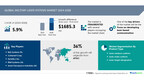
NEW YORK, Oct. 17, 2024 /PRNewswire/ — Report on how AI is driving market transformation – The Global Military Laser Systems market size is estimated to grow by USD 1.69 billion from 2024-2028, according to Technavio. The market is estimated to grow at a CAGR of over 5.9% during the forecast period. Focus on developing laser-based communication is driving market growth, with a trend towards emergence of directed-energy atmospheric lens concept. However, project terminations due to failure of prototypes poses a challenge – Key market players include BAE Systems Plc, Coherent Corp., Dynetics Inc., Elbit Systems Ltd., Israel Aerospace Industries Ltd., Lockheed Martin Corp., MBDA, MKS Instruments Inc., Newport Corp., Northrop Grumman Corp., Rafael Advanced Defense Systems Ltd., Rheinmetall AG, RTX Corp., Saab AB, Safran SA, Thales Group, and The Boeing Co..
AI-Powered Market Evolution Insights. Our comprehensive market report ready with the latest trends, growth opportunities, and strategic analysis- View your snapshot now
Forecast period
2024-2028
Base Year
2023
Historic Data
2018 – 2022
Segment Covered
Product Type (Laser weapon systems, Laser radar systems, and Laser target designators) and Geography (North America, APAC, Europe, Middle East and Africa, and South America)
Region Covered
North America, APAC, Europe, Middle East and Africa, and South America
Key companies profiled
BAE Systems Plc, Coherent Corp., Dynetics Inc., Elbit Systems Ltd., Israel Aerospace Industries Ltd., Lockheed Martin Corp., MBDA, MKS Instruments Inc., Newport Corp., Northrop Grumman Corp., Rafael Advanced Defense Systems Ltd., Rheinmetall AG, RTX Corp., Saab AB, Safran SA, Thales Group, and The Boeing Co.
Key Market Trends Fueling Growth
In January 2017, BAE Systems unveiled the Laser Developed Atmospheric Lens (LDAL) concept at their military facility in Warton, Lancashire. The Rutherford Appleton Laboratory and optical sensors specialist LumOptica have evaluated this innovative technology. LDAL works by temporarily ionizing or heating a small region of the ionosphere, creating lens-like structures that magnify the path of electromagnetic waves. This system mimics natural phenomena, such as the reflective properties of the ionosphere and desert mirages. LDAL can enhance observation capabilities by enabling the detection of enemy activities over greater distances. Additionally, it can function as a protective shield against high-power laser weapon attacks. The global defense industry is focusing on the development of this technology to enhance surveillance and security. Therefore, the growing demand for advanced sensing and protection systems is expected to drive the growth of the military laser systems market during the forecast period.
The Military Laser Systems market is experiencing significant growth due to increasing defense spending and military modernization. High-powered microwave and AI-enabled beam control are trending technologies in this sector. Military platforms are being integrated with advanced laser-based solutions for offensive and defensive operations. Next-gen laser weapons are being developed for target designation, guided munitions, and directed energy weapons. High-speed lasers, fiber lasers, and CO2 lasers are key technologies driving the market. Solid-state and chemical lasers are also gaining popularity. LIDAR, 3D scanning, and laser designator are essential for military applications, including combat systems, homeland security, and electronic warfare. Defensive countermeasures against terrorism activities are a major focus area. Military spending on laser weapon systems is expected to increase due to the need for precise weapons and communication networks. The market also includes laser altimeters and communication systems for military applications. Overall, the Military Laser Systems market is a dynamic and innovative sector that offers significant opportunities for growth.
Insights on how AI is driving innovation, efficiency, and market growth- Request Sample!
Market Challenges
• The military laser systems market is an emerging sector, with laser technology being a long-established yet continually evolving field. The development of laser weapons for military applications necessitates significant time and financial resources. Unfortunately, the failure of high-profile projects, such as the Boeing YAL-1 Airborne Laser, can significantly impact progress. This project, which aimed to create a megawatt-class laser weapons system using a chemical oxygen-iodine laser (COIL) inside a modified Boeing 747-400F for missile defense, ended in a USD5 billion investment after more than five years of research and testing. Such setbacks may hinder the growth of the military laser systems market during the forecast period.
• The Military Laser Systems Market is experiencing significant growth due to the increasing demand for advanced technology in defense and national security. Two primary types of military laser systems are Chemical Lasers and CO2 Lasers, each with unique capabilities for Target Designation, Guided Munitions, and Directed Energy Weapons. Challenges include the development of Defensive Countermeasures against enemy lasers and Electronic Warfare. Military applications include Combat Systems, Homeland Security, and Communication Networks. High-Speed Lasers, Fiber Lasers, and High-Power Solid-State Lasers offer Precise Weapons and Operational Efficiency, while Laser Altimeter and Laser technology advancements enhance Military Spending in Defense. Cost-efficiency and Sustainability are crucial factors, with High-Intensity Laser Weapons and Unmanned Aerial Vehicles leading the way. Collaboration between Defense Suppliers and advancements in Directed Energy Weapons, Laser Precision, and High-Energy Lasers continue to shape this dynamic market.
Insights into how AI is reshaping industries and driving growth- Download a Sample Report
Segment Overview
This military laser systems market report extensively covers market segmentation by
Product Type1.1 Laser weapon systems1.2 Laser radar systems1.3 Laser target designatorsGeography 2.1 North America2.2 APAC2.3 Europe2.4 Middle East and Africa2.5 South America
1.1 Laser weapon systems- The military laser systems market is witnessing significant growth due to the prioritization of laser weapon systems by defense departments worldwide. Notable countries, including the US and Russia, have already developed and deployed laser weapon systems for live operations. In 2015, Lockheed Martin unveiled a 30-kW mobile laser weapon system capable of disabling a truck, while in 2017, they set a record with a 58 kW laser beam. These systems consist of fiber laser modules, which can be scaled up by adding more fiber bundles. China is developing a powerful laser weapon for space-based attacks on satellites, with a chemical laser weighing less than five tons planned for low-earth orbit. The Russian defense ministry is also reportedly developing laser, electromagnetic, and plasma weapons for their armed forces, capable of hypersonic speeds. These advancements underscore the potential growth of the laser weapon system segment during the forecast period.
Download complimentary Sample Report to gain insights into AI’s impact on market dynamics, emerging trends, and future opportunities- including forecast (2024-2028) and historic data (2018 – 2022)
Research Analysis
The Military Laser Systems market is experiencing significant growth due to advancements in laser technology, which is revolutionizing national defense with high-intensity laser weapons. Unmanned aerial vehicles (UAVs) are increasingly integrating laser systems for enhanced capabilities. Defense suppliers are investing in directed energy weapons for operational efficiency and cost-efficiency. Solid-state lasers and high-power lasers are at the forefront of this technology, offering sustainability and infrastructure challenges. High-powered microwave and AI-enabled beam control are also gaining traction. Defense spending, military modernization, terrorism activities, and geopolitical conflicts are key drivers for the market. Advanced laser-based solutions are being explored for offensive and defensive operations, including LIDAR, 3D scanning, laser weapon systems, laser range finders, and solid-state lasers. Chemical lasers are also being considered for their unique capabilities. The market is expected to continue growing as laser technology continues to evolve and find new applications in military applications.
Market Research Overview
The Military Laser Systems market is experiencing significant growth due to advancements in laser technology and the increasing demand for high-intensity laser weapons in national defense. These systems offer numerous benefits, including precision, operational efficiency, and cost-efficiency. High-power solid-state lasers, high-energy lasers, high-powered radiofrequency, and high-powered microwave are some of the technologies driving this market. Military laser systems find applications in various sectors, including defense suppliers, unmanned aerial vehicles, directed energy weapons, and military platforms integration. The integration of artificial intelligence (AI) in beam control further enhances the capabilities of these systems. Military modernization, defense spending, and military applications in offensive and defensive operations are significant factors driving the market. Advanced laser-based solutions are being used for target designation, LIDAR, 3D scanning, and laser weapon systems. Moreover, the market is witnessing the development of next-gen laser weapons, such as fiber lasers, high-speed lasers, and chemical lasers, for combat systems, homeland security, electronic warfare, and communication networks. The market is also witnessing the integration of laser technology in precise weapons, laser altimeters, and guided munitions, among others. The increasing threat of terrorism activities and the need for defensive countermeasures are further boosting the demand for military laser systems. Overall, the market is expected to continue its growth trajectory due to the numerous advantages offered by laser technology in military applications.
Table of Contents:
1 Executive Summary
2 Market Landscape
3 Market Sizing
4 Historic Market Size
5 Five Forces Analysis
6 Market Segmentation
Product TypeLaser Weapon SystemsLaser Radar SystemsLaser Target DesignatorsGeographyNorth AmericaAPACEuropeMiddle East And AfricaSouth America
7 Customer Landscape
8 Geographic Landscape
9 Drivers, Challenges, and Trends
10 Company Landscape
11 Company Analysis
12 Appendix
About Technavio
Technavio is a leading global technology research and advisory company. Their research and analysis focuses on emerging market trends and provides actionable insights to help businesses identify market opportunities and develop effective strategies to optimize their market positions.
With over 500 specialized analysts, Technavio’s report library consists of more than 17,000 reports and counting, covering 800 technologies, spanning across 50 countries. Their client base consists of enterprises of all sizes, including more than 100 Fortune 500 companies. This growing client base relies on Technavio’s comprehensive coverage, extensive research, and actionable market insights to identify opportunities in existing and potential markets and assess their competitive positions within changing market scenarios.
Contacts
Technavio Research
Jesse Maida
Media & Marketing Executive
US: +1 844 364 1100
UK: +44 203 893 3200
Email: media@technavio.com
Website: www.technavio.com/
View original content to download multimedia:https://www.prnewswire.com/news-releases/military-laser-systems-market-to-grow-by-usd-1-69-billion-from-2024-2028–driven-by-advancements-in-laser-based-communication-ai-powered-market-evolution—technavio-302278813.html
SOURCE Technavio










 Technology5 days ago

 Near Videos4 days ago
 Technology5 days ago
 Technology5 days ago
 Technology4 days ago
 Near Videos5 days ago
 Coin Market4 days ago