Connect with us

Technology

Software Testing Services Market in Australia to Grow by USD 1.42 Billion (2024-2028), Driven by Cost Reduction and Faster Time-to-Market, with AI Redefining Market Landscape – Technavio

Published

on

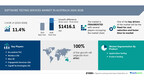
NEW YORK, Dec. 2, 2024 /PRNewswire/ — Report with market evolution powered by AI – The software testing services market in australia size is estimated to grow by USD 1.42 billion from 2024-2028, according to Technavio. The market is estimated to grow at a CAGR of over 11.4%  during the forecast period. Need for cost reduction and faster time-to-market is driving market growth, with a trend towards evolution of software testing labs. However, availability of open-source and free testing tools  poses a challenge. Key market players include Accenture PLC, Amdocs Ltd., Atos SE, Capgemini Services SAS, Cigniti Technologies Ltd., Cognizant Technology Solutions Corp., Deloitte Touche Tohmatsu Ltd., DXC Technology Co., Expleo Group SAS, HCL Technologies Ltd., Hexaware Technologies Ltd., Infosys Ltd., International Business Machines Corp., LogiGear Corp., Nippon Telegraph and Telephone Corp., Planit Test Management Solutions Pty Ltd., QualiTest Group, QualityLogic Inc., Tata Consultancy Services Ltd., and Wipro Ltd..

Key insights into market evolution with AI-powered analysis. Explore trends, segmentation, and growth drivers- View Free Sample PDF

Software Testing Services Market In Australia Scope

Report Coverage

Details

Base year

2023

Historic period

2018 – 2022

Forecast period

2024-2028

Growth momentum & CAGR

Accelerate at a CAGR of 11.4%

Market growth 2024-2028

USD 1416.1 million

Market structure

Fragmented

YoY growth 2022-2023 (%)

10.1

Regional analysis

Australia

Performing market contribution

APAC at 100%

Key countries

Australia

Key companies profiled

Accenture PLC, Amdocs Ltd., Atos SE, Capgemini Services SAS, Cigniti Technologies Ltd., Cognizant Technology Solutions Corp., Deloitte Touche Tohmatsu Ltd., DXC Technology Co., Expleo Group SAS, HCL Technologies Ltd., Hexaware Technologies Ltd., Infosys Ltd., International Business Machines Corp., LogiGear Corp., Nippon Telegraph and Telephone Corp., Planit Test Management Solutions Pty Ltd., QualiTest Group, QualityLogic Inc., Tata Consultancy Services Ltd., and Wipro Ltd.

Market Driver

The Software Testing Services market is thriving, with a focus on ensuring quality and dependability in the Software Development Lifecycle. Companies prioritize testing for various software applications, including mobile apps, to enhance functionality and user experience. Trending testing methodologies and techniques include QA (Quality Assurance), Functional Testing, Manual Testing, Component Testing, Unit Testing, and various lifecycles like JUnit, Pytest, and NUnit for code correctness. Bug detection is crucial, leading to code refactoring and documentation. Continuous Integration (CI) is essential for evaluating and verifying software products throughout the development process. Black Box, White Box, and Gray Box Testing, Integration Testing, and various strategies like Big-Bang Integration are employed for comprehensive testing. Performance, design, deployment, and acceptance testing are critical aspects, with a shift towards shift-left and shift-right testing strategies for faster delivery. Strategic app modernization and digital transformation drive transformational success, necessitating testing for various aspects like security, usability, and exploratory testing. Vulnerabilities and stress testing are vital for ensuring software reliability and user satisfaction. 

On-demand testing services have emerged as a cost-effective solution for managing the software testing life cycle (STLC) in organizations. Previously, companies invested heavily in establishing software test labs to handle testing operations. These labs required significant upfront costs for setting up test environment management. On-demand test labs offer a more affordable alternative, providing test environments for software testers based on their specific requirements. Testers pay for these services only when they use the test lab, making it an ideal choice for collaborative software testing in a multiplatform environment. This model ensures high-quality software development while reducing the financial burden associated with maintaining a permanent test lab. 

Request Sample of our comprehensive report now to stay ahead in the AI-driven market evolution!

 Market Challenges

The Software Testing Services Market faces numerous challenges in ensuring the quality and dependability of Software Applications in today’s fast-paced business environment. The Software Development Lifecycle (SDLC) requires testing at various stages, including unit testing (JUnit, Pytest, NUnit), functional testing, manual testing, component testing, and acceptance testing. Quality assurance (QA) teams must verify code correctness, detect bugs, and perform code refactoring and documentation. Testing methodologies and techniques like black box, white box, and gray box testing are essential. Performance, design, deployment, and integration testing strategies are crucial for evaluating software products. Continuous Integration (CI) and shift-left testing help improve delivery speed and transformational success. However, challenges persist in areas like bug detection, security testing, and usability testing. Vulnerabilities and performance issues must be addressed through rigorous testing and integration strategies like big-bang integration. QA teams must adapt to digital transformation and strategic app modernization, employing test automation and exploring new testing methodologies.Open-source software testing tools, which provide accessible and freely available source codes, have become increasingly popular among testers worldwide. These tools, often developed by a community of software engineers, offer several advantages, such as no licensing fees and free technical support. The use of open-source tools prevents vendor lock-in and allows testing on various software development methodologies. Popular open-source testing tools include Selenium, Appium, Cucumber, and Katalon Studio. While these tools may negatively impact the revenue of proprietary testing tool providers, they offer significant cost savings and flexibility for businesses.

Discover how AI is revolutionizing market trends- Get your access now!

Segment Overview 

This software testing services market in Australia report extensively covers market segmentation by  

Product 1.1 Application testing1.2 Product testingEnd-user 2.1 BFSI2.2 Telecom and media2.3 Manufacturing2.4 Retail2.5 OthersGeography 3.1 APAC

1.1 Application testing-  The application testing segment of the software testing services market in Australia is projected to expand due to the rising number of applications being developed and the increasing usage of smartphones. According to the Australian Competition and Consumer Commission, the number of apps available to consumers from approximately 130 million in 2016 to 1.1 billion in 2023. The top three apps used daily by Australians, across both the Google Play Store and Apple App Store (for iPhone), were Facebook, Facebook Messenger, and Instagram in January 2022. Factors such as the growth in e-commerce spending, the widespread adoption of smartphones, a preference for mobile applications in daily life, and the development of mobile applications for the banking sector are expected to primarily fuel the expansion of the application testing segment in Australia during the forecast period. Application testing involves assessing the functionality, consistency, and usability of desktop, mobile, and web applications. For web application testing, factors like business logic, application integrity, functionality, data flow, and hardware and software compatibility are evaluated. Web applications undergo testing for performance, security, and load, as well as cross-browser testing, beta testing, compatibility testing, exploratory testing, regression testing, multilanguage support testing, and stress testing. Mobile application software testing includes UI testing, security testing, functionality and compatibility testing, and regression testing. Three application testing methodologies exist: black box, white box, and grey box. In black box testing, the software is assessed for the expected output given a specific input, regardless of the internal workings. White box testing evaluates an application based on the logic within it. Grey box testing combines elements of both black box and white box testing.

Download a Sample of our comprehensive report today to discover how AI-driven innovations are reshaping competitive dynamics

Research Analysis

The Software Testing Services market focuses on ensuring the quality, dependability, and functionality of Software Applications throughout the Software Development Lifecycle. Testing plays a crucial role in identifying and resolving issues, improving code correctness, and enhancing the user experience. Various testing methodologies and techniques are employed, including Manual Testing, Functional Testing, Component Testing, Unit Testing, and Integration Testing. QA (Quality Assurance) teams utilize testing strategies like Black Box Testing, White Box Testing, and Gray Box Testing. Techniques like JUnit, Pytest, and NUnit are used for Unit Testing, while Integration Testing and Integration Strategies ensure seamless interaction between components. Bug Detection and Code Refactoring are essential parts of the process, with Continuous Integration (CI) facilitating regular testing and documentation maintaining transparency.

Market Research Overview

The Software Testing Services market plays a crucial role in ensuring the quality, dependability, and functionality of Software Applications throughout the Software Development Lifecycle. Testing is an essential part of the SDLC, focusing on evaluating and verifying the software product’s performance, design, and compliance with requirements. Testing methodologies include Manual Testing, Functional Testing, Component Testing, Unit Testing, and various types like Black Box Testing, White Box Testing, and Gray Box Testing. Techniques include Code Correctness, Bug Detection, Code Refactoring, and Documentation. Quality Assurance (QA) practices employ testing techniques to identify and address issues before deployment. Unit Testing Lifecycle, with frameworks like JUnit, Pytest, and NUnit, ensures code correctness. Integration Testing, with strategies like Big-Bang Integration, addresses interoperability between components. Performance, design, and security testing are crucial for ensuring software reliability and user experience. Continuous Integration (CI) and Shift-left/right testing strategies help streamline the testing process and improve delivery speed. Strategic app modernization and digital transformation initiatives also require testing services for transformational success.

Table of Contents:

1 Executive Summary
2 Market Landscape
3 Market Sizing
4 Historic Market Size
5 Five Forces Analysis
6 Market Segmentation

ProductApplication TestingProduct TestingEnd-userBFSITelecom And MediaManufacturingRetailOthersGeographyAPAC

7 Customer Landscape
8 Geographic Landscape
9 Drivers, Challenges, and Trends
10 Company Landscape
11 Company Analysis
12 Appendix

About Technavio

Technavio is a leading global technology research and advisory company. Their research and analysis focuses on emerging market trends and provides actionable insights to help businesses identify market opportunities and develop effective strategies to optimize their market positions.

With over 500 specialized analysts, Technavio’s report library consists of more than 17,000 reports and counting, covering 800 technologies, spanning across 50 countries. Their client base consists of enterprises of all sizes, including more than 100 Fortune 500 companies. This growing client base relies on Technavio’s comprehensive coverage, extensive research, and actionable market insights to identify opportunities in existing and potential markets and assess their competitive positions within changing market scenarios.

Contacts

Technavio Research
Jesse Maida
Media & Marketing Executive
US: +1 844 364 1100
UK: +44 203 893 3200
Email: media@technavio.com
Website: www.technavio.com/

View original content to download multimedia:https://www.prnewswire.com/news-releases/software-testing-services-market-in-australia-to-grow-by-usd-1-42-billion-2024-2028-driven-by-cost-reduction-and-faster-time-to-market-with-ai-redefining-market-landscape—technavio-302319421.html

SOURCE Technavio

Continue Reading
Click to comment

Leave a Reply

Your email address will not be published. Required fields are marked *

Technology

Emdoor Launches “Ailyn” AI Hub at WAIC 2026: Unifying Intelligence Across Every Device

Published

on

By

SHANGHAI, July 18, 2026 /PRNewswire/ — Emdoor, a leading provider of intelligent computing devices, unveiled its latest innovation — Ailyn, an integrated software-hardware AI hub — at the World Artificial Intelligence Conference (WAIC) 2026. Under the theme “Intelligence in All Things, Boundless Edge Intelligence”, Emdoor’s Booth X1B-804 showcases four immersive scenarios spanning personal, home, enterprise, and industrial use cases, demonstrating how AI can flow seamlessly across devices.

With decades of experience across cloud, edge, device, and wearable form factors, Emdoor has established one of the industry’s most comprehensive intelligent hardware portfolios. Yet the company recognized a critical gap: while individual devices grow smarter, they often operate in isolation.

Ailyn is Emdoor’s answer to this challenge. Introduced on the WAIC Magic Box stage, Ailyn serves as a unified intelligence layer that orchestrates storage, computing power, AI models, and data across PCs, NAS systems, computing boxes, and IoT devices. The result is a scalable, centrally managed intelligence platform that delivers seamless cross-device collaboration, data privacy, and AI capabilities that improve with use.

At its core, Ailyn follows a device-first, multi-device connected philosophy. By prioritizing on-device model deployment, it reduces costs while preserving privacy, minimizing latency, and enabling offline functionality. Key capabilities include unified data access, uninterrupted task handoff between devices, intelligent multi-model routing, and dynamic compute scaling — plus built-in features for knowledge accumulation, skill expansion, persona customization, and automated task execution.

Four Scenarios, One Intelligent Ecosystem

The enterprise lineup features high-performance AI workstations, AI servers, AI NAS, Mini PCs, and motherboards. Workstations support up to 96-core processors and four double-width GPUs with integrated BMC remote management. AI servers run dual Intel Xeon scalable processors with up to eight mainstream AI accelerators. The single-GPU workstation series offers dual-platform compatibility with both Intel and AMD, featuring a PCIe 5.0 ×16 slot and up to 128GB DDR5 memory. Available in two form factors — a 23.9L tower chassis and a 15.3L compact chassis with tempered glass side panel — it delivers balanced performance for both creative workloads and local AI inference. The AI NAS unifies storage and AI computing power in one device, with192GB of octa-channel LPDDR5X memory to support local large model deployment. Ailyn unifies these resources into a private computing backbone, intelligently offloading heavy workloads so users get instant on-device responsiveness with datacenter-grade power on demand.

For individual users, the showcase includes Mini PCs, AI PCs, AI tablets, and multimodal wearables. The AP16, powered by Intel’s 3rd Generation Core™ Ultra processor, delivers 180 TOPS of AI performance with sustained 54W output — capable of running large models locally. Multimodal wearable solutions built on Qualcomm and BES chips offer faster time-to-market for brand partners. Within the Ailyn ecosystem, PCs handle heavy computing while wearables provide continuous environmental awareness, each device strengthening the whole.

Industrial visitors will find AI BOX units, rugged AI notebooks, handheld terminals, and industrial PCs. AI BOX devices come preloaded with industry-specific models for production line visual inspection. Rugged notebooks deliver reliable performance for mobile field operations. Industrial PCs feature industrial-grade architecture for 24/7 uptime. Through Ailyn, these connected devices break down traditional data silos, enabling intelligent resource orchestration and a closed-loop perception-decision-execution system that accelerates industrial digital transformation.

At the center of the home scenario are AI tablets and home NAS, connected to a full-house AIoT network. The NAS acts as the family’s private data and computing hub, while the tablet serves as the primary interface for senior health reminders and children’s learning support. Ailyn weaves these devices into a cohesive system covering family memories, health care, companionship, and home security — bringing intelligence into daily life without intruding on it.

The launch of Ailyn marks a significant evolution for Emdoor — shifting from a hardware manufacturer to a builder of intelligent infrastructure. It represents the convergence of the company’s deep hardware heritage and its AI innovation roadmap. Moving forward, Emdoor will continue investing in edge AI technology and expanding the Ailyn ecosystem alongside partners, bringing distributed intelligence from the showroom into everyday life.

Company: Emdoor Digital Technology Co.,Ltd.
Contact Person: Yao Zhou
Email: marketing.digi@emdoor.com
Website: http://www.emdoordigi.com/
City: Shenzhen, China

View original content to download multimedia:https://www.prnewswire.com/news-releases/emdoor-launches-ailyn-ai-hub-at-waic-2026-unifying-intelligence-across-every-device-302829098.html

SOURCE Emdoor Digital

Continue Reading

Technology

AI-Powered Connectivity: APAC Charts a Path to a Smarter Digital Future

Published

on

By

Asia-Pacific’s first Broadband Development Summit brings regulators and operators to Bangkok to set the agenda

BANGKOK, July 19, 2026 /PRNewswire/ — Government officials, standards bodies and telecom operators gathered in Bangkok on 14 July for the inaugural Broadband Development Summit APAC 2026, convened by the World Broadband Association (WBBA) to build consensus on AI-era networks.

Participants included the ITU, Thailand’s National Board of the Digital Economy and Society, WBBA, IAB, FNCAP, WAA, NIDA and the IPv6 Council, alongside operators Telkomsel, XLSmart, Surge, Globe, AIS, CMI and HKT and Huawei.

Denny Deng, President of Huawei Asia Pacific Carrier Business, envisions a “faster, smarter, greener” Asia-Pacific.

VOICES FROM THE SUMMIT

“To seize the opportunities of the AI era, we call on the industry to accelerate broadband evolution, advance computing-network synergy, and strengthen the cross-border connectivity. Together, let us build faster, smarter, and greener digital infrastructure for Asia-Pacific.”
— Denny Deng, President of Asia Pacific Carrier Business, Huawei

“High-speed broadband is no longer just about ‘getting online’ — it is the vital infrastructure upon which the entire AI revolution is being built. We view AI not merely as a tool, but as a primary engine for national competitiveness and a catalyst for improving the quality of life for all.”
— Wetang Phuangsup, Ph.D., Secretary-General, the National Board of the Digital Economy and Society, Thailand

“Three initiatives define the road to 2030. We must close the quality divide so the value of broadband reaches everyone. We must build AI-ready networks — 10G access, 800GE cores, intelligence end to end. And we must do it together, through shared standards.”
— Martin Creaner, Director General of WBBA

“Moving towards next-generation networks, network architectures must continue to evolve to deliver broader connectivity, superior quality, enhanced security, and greater intelligence. This evolution is essential for Net5.5G, positioning the network not simply as infrastructure, but as the foundation that enables AI, strengthens resilience and efficiency, and supports digital transformation across industries.”
— Dhruv Dhody, Industry Standardization Expert at Huawei, Chair of the IAB, IETF

“Across Asia-Pacific, fibre is extending beyond homes and offices into rooms, devices, and machines. By working together, we can accelerate fibre innovation and adoption to build truly AI-ready infrastructure.”
— Ilham Nandana, Chair of the Market Intelligence Committee, Fiber Network Council APAC (FNCAP)

“We fixed it before you feel it!  AIS is redefining premium home broadband by combining ultra-fast connectivity with AI-driven network intelligence and smart home ecosystem — delivering proactive, invisible service excellence that transforms connectivity into differentiated customer value and sustainable ARPU growth.”
— Thanit Chaiyaboonthanit, Head of Technology Department, Broadband Business, AIS

“Connecting the Unconnected: Affordable Broadband at Scale. Create equal access to global information and empower Indonesia’s digital society.”
— Shannedy Ong, CTO of Surge Indonesia

“Beyond Connectivity: Telkomsel is transforming into a true value creator. By leveraging our FBB market-leading footprint, we power growth through service excellence, customer loyalty, and a next-generation home ecosystem.”
— Stanislaus Susatyo, Director of Sales, Telkomsel Indonesia

“We stopped treating AI as an add-on feature. Instead, our approach at Globe starts with architecture, embedding intelligence into the very core of how we build, how we sell, and how we operate.
AI continuously monitors network health, customer behavior and service quality. Rather than waiting for failures, the system predicts degradation and initiates corrective actions. By maintaining minute-level awareness of network health, our systems automatically resolve 30% of all Wi-Fi issues without any human intervention.”
— Danny Theseira, Head of Broadband Business Group at Globe Telecom

“Huawei is driving the Optics-AI Synergy to foster their collaborative growth. Through AI-ON, operators could build an AI-centric all-optical target network and establish 1-5-20ms latency circles across the Asia Pacific region. AI-ON also supports efficient computing access and usage while delivering an ultimate network experience through gigabit/ultra-gigabit home broadband, accelerating the widespread adoption of AI services.”
— Kim Jin, Vice President & Chief Marketing Officer Optical Business Product Line, Huawei

“Connectivity is not just about technology. It is a lifeline, a platform for opportunity, and a driver of sustainable development. I believe the intersection of connectivity and artificial intelligence will shape the future of smarter, more resilient networks.”
— Dr. Cosmas Zavazava, Director of the Telecommunication Development Bureau, ITU

“Performance and user experience are the essential path to the next-generation WLAN. Based on standards and AI-driven innovation, let’s jointly explore the path to the future autonomous WLAN with all the stakeholders.”
— Dr. Crane H. Yang, Secretary-General, World WLAN Application Alliance (WAA)

“At the summit, NIDA and WBBA signed an MOU to accelerate next-generation network evolution and establish pioneering smart city benchmarks through the co-development of industry standards, the harmonization of global regulations, and the sharing of vertical industry insights.
NIDA focuses on advancing network architecture standards, while WBBA drives global consensus on broadband evolution. This natural strategic complementarity creates vast opportunities for future collaboration.”
— Joey Deng, Secretary-General of NIDA

“ION-2030 develops the global standard for next generation optical networks in the AI era. It provides exceptional AI application and service experience. The WBBA and ITU will jointly accelerate its development, and this is a unique opportunity for Asia-Pacific stakeholders to actively influence the future of optical broadband networks.”
— Dr. Marcus Brunner, Chief Expert Standardization, WBBA WG1 Chair and Vice-Chair of ETSI ISG F5G

“The transition into the AI era demands a high-quality, deterministic digital foundation. By releasing Net5.5G policy guidelines, Malaysia is accelerating the evolution of next-generation network standards based on IPv6, establishing an innovative infrastructure to unleash AI’s value and drive a prosperous digital economy for 2030.”
— Prof. Sureswaran Ramadass, Chair of APAC at IPv6 Council, Industry Partner of WBBA

“The digital economy is thriving across the Asia-Pacific region, with AI emerging as a core catalyst for intelligent transformation. China Mobile International (CMI) is driving regional growth by integrating China’s advanced AI capabilities with comprehensive communications, computing, and AI services. Moving forward, CMI will collaborate closely with industry partners to foster a shared, AI-driven future for the region.”
— Paul Lin, Managing Director of Commercial and Technology, Asia Pacific, China Mobile International

“Next-generation network infrastructure is the oxygen of the intelligent economy. By integrating cutting-edge 800G connectivity with quantum-safe security, HKT is laying the essential foundations to keep Hong Kong’s enterprises highly competitive, secure, and ready for the computing paradigm shifts of tomorrow.”
— Wilson Cheung, Vice President, Broadband Design & Cyber Security, HKT

“The evolution toward Net5.5G AI WAN is an important step in strengthening XLSMART’s transport network for the future. By progressively adopting AI-assisted operations, SRv6, SDN, service differentiation, and higher-capacity transport infrastructure, we are enhancing network intelligence, operational efficiency, and service resilience while supporting long-term sustainability. This transformation is a continuous journey that aligns with the industry’s vision of AI-native broadband networks. Through collaboration with our technology partners and the broader ecosystem, we will continue to develop capabilities that deliver better network performance and support Indonesia’s growing digital connectivity needs.”
— Regie Ginanjar, Head of Transport Autonomy & Orchestration, Transport Network Transformation, XLSMART

“For the AI era, Huawei upgrades the IP bearer network via security resilience, multi-dimensional awareness, and network autonomy. This empowers carriers to guarantee service experience, accelerate monetization, and enhance efficiency, ushering in a new chapter of intelligent connectivity.”
— Arthur Wang, Vice President of Data Communication Product Line, Huawei

A CONVERGING VIEW

Speakers agreed AI is shifting networks from connectivity to intelligent connectivity, as broadband, IP, computing and cross-border infrastructure converge to support innovation and coordination.

WBBA launched the AI-Net Certification, a global benchmark for national policy, industrial ecosystems and network intelligence. XLSmart was named first AI-Net Champion, and Indonesia was among the first with a certified operator, backed by its Net5.5G roadmap.

In another high-profile segment, WBBA Director General Martin Creaner presented the Gigacity Certification to KOMDIGI, SURGE, Telkomsel, AIS, TRUE, HKT and Globe, recognizing regional broadband pioneers.


View original content to download multimedia:https://www.prnewswire.com/apac/news-releases/ai-powered-connectivity-apac-charts-a-path-to-a-smarter-digital-future-302829032.html

SOURCE HUAWEI

Continue Reading

Technology

Laifen Expands U.S. Retail Footprint with Costco Launch of Best-Selling SE Hair Dryer

Published

on

By

Starting July 18, Costco Members Can Shop Laifen’s Award-Winning Hair Dryer in Select Warehouse Locations Across the U.S.

NEW YORK, July 18, 2026 /PRNewswire/ — Laifen, ranked the world’s No.1 high-speed hair dryer brand, today announced the launch of its best-selling SE High-Speed Hair Dryer at select Costco warehouse locations, marking the brand’s largest U.S. retail expansion to date and bringing its award-winning haircare technology to Costco members across select U.S. markets.

The launch brings Laifen’s award-winning haircare technology to Costco, making it easier for consumers to experience the brand through one of the nation’s leading membership retailers. Laifen joins Costco’s growing portfolio of premium beauty and personal care brands. The initial rollout includes select Costco warehouse locations across the United States, with a strong presence across the Western U.S., including California, the Pacific Northwest and the Southwest.

Costco’s reputation for quality and its highly selective merchandising approach make this partnership especially meaningful. The Costco launch reflects Laifen’s continued expansion beyond direct-to-consumer channels as the brand accelerates its U.S. omnichannel retail strategy. “Costco represents an important milestone in our U.S. retail strategy,” said Romeo, General Manager of International Business of Laifen. “As more consumers seek salon-quality performance at an accessible price, we’re excited to make Laifen available through one of America’s most trusted retailers.”

Engineered to deliver professional-level performance in a sleek, lightweight design, the Laifen SE is powered by the brand’s proprietary high-speed brushless motor, delivering fast drying, reduced heat damage and smoother styling. An intelligent temperature control system continuously monitors airflow to help minimize frizz while protecting hair from excessive heat.

The Costco launch represents the next phase of Laifen’s U.S. retail expansion as the brand continues to grow beyond its direct-to-consumer and online channels. By expanding into one of the nation’s most trusted retailers, Laifen aims to broaden access to its category-disrupting haircare solutions while advancing its mission to bring more thoughtful design and everyday excellence into more homes.

The Laifen SE High-Speed Hair Dryer in White will be available at select Costco locations, while Costco.com shoppers will have access to additional color options including Purple and Pink, alongside the White model.

For more information on Laifen, please visit LaifenTech.com.

About Laifen: 

Founded in 2019, Laifen is a global personal care technology brand combining high-performance engineering with modern design across hair care, oral care, and grooming categories. Ranked the world’s No. 1 high-speed hair dryer brand by Euromonitor International, Laifen first gained recognition for its self-developed 110,000 RPM high-speed brushless motor, the proprietary technology behind its award-winning hair dryers.

Building on this innovation, Laifen has expanded its portfolio to include electric toothbrushes and shavers, delivering premium technology and elevated everyday experiences to consumers worldwide. Today, Laifen products and accessories are used by over 22 million households across more than 60 countries, supported by more than 600 patents and recognized with over 50 international design and innovation awards. Driven by continuous technological breakthroughs, Laifen is committed to making cutting-edge personal care technology more accessible to consumers around the world.

View original content to download multimedia:https://www.prnewswire.com/news-releases/laifen-expands-us-retail-footprint-with-costco-launch-of-best-selling-se-hair-dryer-302828573.html

SOURCE Laifen

Continue Reading

Trending