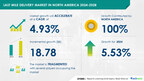
NEW YORK, Dec. 10, 2024 /PRNewswire/ — Report on how AI is driving market transformation – The last mile delivery market in north america size is estimated to grow by USD 18.78 billion from 2024-2028, according to Technavio. The market is estimated to grow at a CAGR of 4.93% during the forecast period. Growing B2C e-commerce industry in the US is driving market growth, with a trend towards strong focus on technological advances. However, operational challenges for last mile delivery companies poses a challenge. Key market players include ArcBest Corp., Averitt Express Inc., AxleHire, C H Robinson Worldwide Inc., CMA CGM SA Group, CRST The Transportation Solution Inc., DDC Logistics Inc., Deutsche Bahn AG, DSV AS, FarEye Technologies Inc., FedEx Corp., GEODIS, J B Hunt Transport Services Inc., Llama Logisol Pvt. Ltd., Ryder System Inc., SEKO Logistics, SF Express Co. Ltd., Washington Express LLC, Werner Enterprises Inc., XPO Inc., and JungleWorks Inc..
Key insights into market evolution with AI-powered analysis. Explore trends, segmentation, and growth drivers- View Free Sample PDF
Last Mile Delivery Market In North America Scope
Report Coverage
Details
Base year
2023
Historic period
2018 – 2022
Forecast period
2024-2028
Growth momentum & CAGR
Accelerate at a CAGR of 4.93%
Market growth 2024-2028
USD 18.78 billion
Market structure
Fragmented
YoY growth 2022-2023 (%)
5.53
Regional analysis
North America
Performing market contribution
North America at 100%
Key countries
US, Canada, and Mexico
Key companies profiled
ArcBest Corp., Averitt Express Inc., AxleHire, C H Robinson Worldwide Inc., CMA CGM SA Group, CRST The Transportation Solution Inc., DDC Logistics Inc., Deutsche Bahn AG, DSV AS, FarEye Technologies Inc., FedEx Corp., GEODIS, J B Hunt Transport Services Inc., Llama Logisol Pvt. Ltd., Ryder System Inc., SEKO Logistics, SF Express Co. Ltd., Washington Express LLC, Werner Enterprises Inc., XPO Inc., and JungleWorks Inc.
Market Driver
Last mile delivery and logistics in North America are experiencing significant trends. The transportation hub and warehouse sectors are key players, managing the movement of goods from shipping activities to customers’ doorsteps. Weak infrastructure and logistics costs remain challenges, but technology adoption is paradigm-shifting. Autonomous delivery via motorcycles, LCVs, HCVs, drones, and delivery robots is on the rise. B2C deliveries dominate, with regular, same day, and express options for FMCG, healthcare, mails and packages, and cosmetic and international destinations. Technology, including cloud platforms, advanced sensors, and autonomous vehicles, is transforming the delivery process. Logistics professionals coordinate timely, satisfactory deliveries using cutting-edge systems, robotics, artificial intelligence, and advanced sensors. The shift to contactless delivery services and autonomous mobility, including 5G technology and unmanned vehicles, is shaping the future of last mile delivery. The supply chain, including warehousing, distribution, and fulfillment services, is adapting to these advancements, ensuring supply chain reliability and enhanced safety. The aviation industry, including fun flights, helicopters, and airplanes, is exploring aerial delivery drones for cargo and medications. The future of last mile delivery is an exciting blend of advanced technologies and human intervention.
In the North American last mile delivery market, there is a significant trend toward utilizing technological advancements for real-time package tracking. Consumers can now manage and modify retail deliveries using accessible online tools, ensuring transparency and control over their package deliveries. However, for large or high-value packages, customers must collect these directly during delivery due to security concerns. This presents a challenge for delivery providers, leading them to offer web and mobile applications for managing the scheduling of such deliveries. These tools streamline the process and enhance the overall customer experience.
Request Sample of our comprehensive report now to stay ahead in the AI-driven market evolution!
Market Challenges
Last mile delivery in North America faces several challenges in the logistics sector. Weak infrastructure and high logistics costs are major hurdles for transportation hubs and warehouses looking to deliver goods to their destination. Shipping expenses are a significant concern for trade activities, especially for B2C deliveries of FMCG, healthcare, mails and packages, and online grocery stores. The postal address system can be complex, leading to delays and errors in delivery. Autonomous delivery and a multi-modal system are being explored to improve efficiency and reduce costs. Regular, same day, and express deliveries require different delivery modes and vehicles, including motorcycles, LCVs, HCVs, drones, and delivery robots. Technology adoption, such as cloud platforms, advanced sensors, and autonomous vehicles, is a paradigm shift in the last mile delivery process. Delivery robots and autonomous guided vehicles are being used for contactless delivery services. The use of advanced electronics, power sources, and data gathering and processing technologies is essential for timely and satisfactory deliveries. The logistics industry is adapting to traffic management, environmental friendliness, and safety concerns, using technologies like LiDAR, radar, and cameras. The aviation industry is exploring the use of drones for aerial delivery and safety drones. The use of autonomous mobility, such as self-driving trucks and unmanned vehicles, is also increasing. However, there are challenges with restricted airspace and the need for Unmanned Traffic Management. The logistics professionals are focusing on supply chain reliability, technology adoption, and coordination to ensure efficient and cost-effective last mile delivery. The use of advanced sensors, passive and active, and traffic intensity data is essential for optimizing delivery routes and reducing shipping costs. Shopping behavior and environmental concerns are also driving the adoption of more environmentally friendly delivery vehicles and technologies.Last mile delivery in North America faces the challenge of maintaining profitability while ensuring transparency and enhancing efficiency. Unlike long-distance transportation, last mile delivery involves individual deliveries to numerous locations within a region, leading to significant labor and fuel costs. Intense competition among last mile delivery companies primarily revolves around pricing and delivery time. Efficiently managing these costs and optimizing delivery routes can help companies stay competitive in this market.
Discover how AI is revolutionizing market trends- Get your access now!
Segment Overview
This last mile delivery market in North America report extensively covers market segmentation by
Product 1.1 B2C1.2 B2BVehicle Type2.1 Large OEMs2.2 Custom vehicle OEMsGeography 3.1 North America
1.1 B2C- Last mile delivery in North America for Business-to-Consumer (B2C) transactions refers to transporting goods from distribution centers or retail stores directly to consumers’ locations. Consumers increasingly demand faster and more convenient delivery options, leading to the popularity of same-day or next-day deliveries with specific delivery windows or locations. B2C last mile delivery poses challenges for operators due to the individual delivery requirements compared to Business-to-Business (B2B) deliveries. However, the B2C segment of the last mile delivery market has experienced significant growth in recent years, driven by the increasing popularity of B2C services. To meet consumer expectations, last mile delivery operators offer new services like next-day delivery, same-day delivery, and package returns. Real-time shipment tracking and package delivery status updates are also available for B2C customers. Vendors utilize big data and consumer analytics to optimize delivery times and enhance the consumer experience. DHL, for instance, uses big data along with real-time road, weather, and traffic information to optimize delivery routes for faster deliveries. Additionally, historical purchase data is used to dispatch forward inventory, reducing pre-last mile logistics time and improving delivery efficiency. These factors contribute to the growth of the B2C segment of the North American last mile delivery market.
Download a Sample of our comprehensive report today to discover how AI-driven innovations are reshaping competitive dynamics
Research Analysis
Last Mile Delivery, also known as the final leg of the supply chain, refers to the transportation of goods from a transportation hub or warehouse to the end customer. This critical stage of the logistics process is often the most costly and complex due to the increasing volume of e-commerce sales and customer expectations for fast and affordable shipping. The last mile delivery market in North America is witnessing significant innovation, with companies exploring various solutions to reduce shipping expenses. These include the use of drones for aerial delivery, ground delivery vehicles equipped with advanced sensors and self-driving capabilities, and humanoid robots for contactless delivery services. Additionally, cloud platforms and artificial intelligence are being utilized to optimize routes and improve delivery accuracy. Enhanced safety features, such as cameras, radar, and LiDAR, are also being integrated to ensure secure and efficient last mile delivery. Overall, the last mile delivery market in North America is undergoing a technological revolution to meet the growing demands of online shopping and product delivery services.
Market Research Overview
Last mile delivery refers to the final leg of the supply chain journey, transporting goods from a transportation hub or warehouse to their final destination, typically a consumer’s doorstep. This critical phase of logistics involves managing delivery vehicles, coordinating timely and satisfactory deliveries, and ensuring efficient distribution and fulfillment services. Weak infrastructure and high logistics costs are challenges in last mile delivery, particularly in North America. However, advancements in technology, such as autonomous delivery systems and multi-modal transportation, are transforming the last mile landscape. B2C deliveries, including mails and packages, FMCG, healthcare, and online shopping, dominate last mile delivery activities. Regular, same day, and express delivery modes cater to various customer needs. Delivery vehicles, from motorcycles and light commercial vehicles (LCVs) to heavy commercial vehicles (HCVs) and drones, are used for last mile delivery. Autonomous delivery technologies, such as delivery robots and drones, are gaining popularity for their efficiency and environmental friendliness. The rise of online shopping and the increasing importance of supply chain reliability have led to the adoption of cutting-edge systems, including cloud platforms, advanced sensors, and robotics, to optimize the last mile delivery process. Logistics professionals are leveraging technology, such as autonomous vehicles, autonomous guided vehicles, and unmanned traffic management systems, to enhance safety, reduce shipping costs, and improve delivery process coordination. The last mile delivery market in North America is undergoing a paradigm shift, with a focus on advanced sensors, artificial intelligence, and self-driving vehicles to streamline the delivery process and meet the evolving needs of consumers and businesses.
Table of Contents:
1 Executive Summary
2 Market Landscape
3 Market Sizing
4 Historic Market Size
5 Five Forces Analysis
6 Market Segmentation
ProductB2CB2BVehicle TypeLarge OEMsCustom Vehicle OEMsGeographyNorth America
7 Customer Landscape
8 Geographic Landscape
9 Drivers, Challenges, and Trends
10 Company Landscape
11 Company Analysis
12 Appendix
About Technavio
Technavio is a leading global technology research and advisory company. Their research and analysis focuses on emerging market trends and provides actionable insights to help businesses identify market opportunities and develop effective strategies to optimize their market positions.
With over 500 specialized analysts, Technavio’s report library consists of more than 17,000 reports and counting, covering 800 technologies, spanning across 50 countries. Their client base consists of enterprises of all sizes, including more than 100 Fortune 500 companies. This growing client base relies on Technavio’s comprehensive coverage, extensive research, and actionable market insights to identify opportunities in existing and potential markets and assess their competitive positions within changing market scenarios.
Contacts
Technavio Research
Jesse Maida
Media & Marketing Executive
US: +1 844 364 1100
UK: +44 203 893 3200
Email: media@technavio.com
Website: www.technavio.com/
View original content to download multimedia:https://www.prnewswire.com/news-releases/last-mile-delivery-market-in-north-america-to-grow-by-usd-18-78-billion-2024-2028-driven-by-us-b2c-e-commerce-and-ai-powered-market-evolution—technavio-302326193.html
SOURCE Technavio










 Technology4 days ago
 Coin Market4 days ago
 Coin Market4 days ago
 Coin Market4 days ago
 Coin Market4 days ago
 Technology4 days ago
 Coin Market5 days ago
 Technology5 days ago