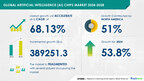
NEW YORK, Dec. 12, 2024 /PRNewswire/ — Report on how AI is redefining market landscape – The global artificial intelligence (AI) chips market size is estimated to grow by USD 389.25 billion from 2024 to 2028, according to Technavio. The market is estimated to grow at a CAGR of over 68.13% during the forecast period.
For comprehensive forecast and historic data on regions,market segments, customer landscape, and companies- Click for the snapshot of this report
Report Attribute
Details
Base Year
2023
Forecast period
2024-2028
Historic Data for
2018 – 2022
Segments Covered
Product (ASICs, GPUs, CPUs, and FPGAs), End-user (Media and advertising, BFSI, IT and telecommunication, and Others), and Geography (North America, Europe, APAC, South America, and Middle East and Africa)
Key Companies Covered
Advanced Micro Devices Inc., Alphabet Inc., Baidu Inc., Broadcom Inc., Cerebras, Fujitsu Ltd., Graphcore Ltd., Huawei Technologies Co. Ltd., Intel Corp., International Business Machines Corp., MediaTek Inc., Microchip Technology Inc., NVIDIA Corp., NXP Semiconductors NV, Qualcomm Inc., SambaNova Systems Inc., Samsung Electronics Co. Ltd., SenseTime Group Inc., Taiwan Semiconductor Manufacturing Co. Ltd., and Tesla Inc, NVIDIA Corporation, Advanced Micro Devices, Inc., Intel Corporation, Micron Technology, Inc., Google, SK HYNIX INC., Qualcomm Technologies, Inc., Samsung, Huawei Technologies Co., Ltd., Apple Inc., Imagination Technologies, Graphcore, Cerebras, Mythic, Kalray, Blaize, Groq, Inc., HAILO TECHNOLOGIES LTD., GreenWaves Technologies, SiMa Technologies, Inc
Regions Covered
North America, Europe, APAC, South America, and Middle East and Africa
Region Outlook
North AmericaEuropeAsiaRest of World
1. North America – North America is estimated to contribute 51%. To the growth of the global market. The Artificial Intelligence (Ai) Chips Market report forecasts market growth by revenue at global, regional & country levels from 2017 to 2027.
The AI chip market in North America is experiencing significant growth due to increasing investments in autonomous vehicle technology. Advanced systems such as ADAS, HUD, LiDAR, and RADAR, integrated into these vehicles, generate and process vast amounts of real-time data. In response, chip manufacturers are heavily investing in research and development of AI chips tailored for autonomous vehicles. Major automotive original equipment manufacturers (OEMs) are working on commercializing autonomous vehicles, creating lucrative opportunities for AI chip manufacturers to capitalize on this emerging market.
For more insights on North America’s significant contribution along with the market share of rest of the regions and countries – Download a FREE Sample
Segmentation Overview
Product 1.1 ASICs1.2 GPUs1.3 CPUs1.4 FPGAsEnd-user 2.1 Media and advertising2.2 BFSI2.3 IT and telecommunication2.4 OthersGeography 3.1 North America3.2 Europe3.3 APAC3.4 South America3.5 Middle East and Africa
Get a glance at the market contribution of rest of the segments – Download a FREE Sample Report in minutes!
1.1 Fastest growing segment:
Artificial Intelligence (AI) chips, specifically Application-Specific Integrated Circuits (ASICs), are becoming increasingly popular in data center applications due to their superior performance and speed. ASICs are customized, non-configurable chips that offer an instruction set and libraries for local data processing, acting as an accelerator for parallel algorithms. Google’s Tensor Processing Unit (TPU) is a prime example, designed for deep neural networks and already in use for Google Search and Google Street View. ASICs provide faster performance than GPUs, FPGAs, and CPUs, making them a preferred choice for data centers. TPUs have an instruction set that allows TensorFlow programs to be modified and new algorithms to be developed, making them a valuable asset for managing data effectively. The use of ASIC-based AI chips is expected to witness significant growth in the forecast period.
Research Analysis
Artificial Intelligence (AI) Chips Market: The global AI Chips Market is experiencing significant growth due to the increasing adoption of AI technologies in various industries. Deep learning and machine learning algorithms are driving the demand for AI chips, which are specialized hardware components designed to accelerate AI computations. These chips are essential for robotics, quantum computing, and advanced AI applications. The market includes CPU, FPGA, GPU, System on Chip (SoC), and Multichip Module (MCM) solutions. AI chips are finding applications in sectors like healthcare, retail, finance, automotive, autonomous vehicles, IoT devices, and more. High-performance AI chips are crucial for training generative AI models and powering supercomputers. Ethical concerns surrounding AI are also fueling the development of specific integrated circuits. Key technologies include highbandwidth memory and Trainium2 chip. The market is evolving with the shift from cloud to edge computing.
Market Overview
Artificial Intelligence (AI) Chips Market: Overview The AI Chips Market is witnessing significant growth due to the increasing demand for advanced AI technologies such as deep learning and machine learning in various industries. AI chips are specialized hardware components designed to accelerate AI algorithms and technologies, including neural networks, quantum computing, and cognitive computing. These chips are essential for powering AI applications in robotics, computer vision, natural language processing, and other fields. The market for AI chips includes various types of hardware components, such as CPUs, GPUs, FPGAs, ASICs, DSPs, and microcontrollers. Companies are investing heavily in the development of AI chip lines, including Nvidia’s A100 chip, Ascend 910B chipset, and H200 chipset, to meet the growing demand for energy-efficient and high-performance AI solutions. AI applications are widespread across industries, including healthcare, retail, finance, automotive, and manufacturing. The use of AI in healthcare for health monitoring, health information access, personalized health, and treatment devices is gaining popularity, especially for the elderly population. In retail, AI is used for customer behavior analysis, inventory management, and personalized marketing. In finance, AI is used for fraud detection, risk assessment, and algorithmic trading. The automotive industry is also adopting AI technologies for autonomous vehicles, advanced driver assistance systems, and connected cars. The use of AI in manufacturing machines, smart homes, and IoT devices is increasing, leading to the growth of AI data centers and edge computing. However, ethical concerns surrounding AI and the potential for system failure or malfunctioning are major challenges for the market. The development of specific integrated chips and multichip modules is a potential solution to address these challenges. The AI Chips Market is expected to continue growing due to the increasing demand for real-time applications, low latency, and big data processing. The market is also being driven by the development of generative AI, large language models, and other advanced AI technologies. The use of AI in mobile applications, gaming consoles, and personal computers is also expected to drive market growth. In conclusion, the AI Chips Market is a rapidly growing market, driven by the increasing demand for advanced AI technologies and applications across various industries. The market is expected to continue growing due to the development of energy-efficient and high-performance AI solutions, the increasing use of AI in various industries, and the growing demand for real-time applications and low latency. However, ethical concerns and the potential for system failure or malfunctioning are major challenges that need to be addressed.
Start exploring market insights by Download a FREE Sample Report in minutes!
Key Topics Covered:
1 Executive Summary
2 Market Landscape
3 Market Sizing
4 Historic Market Size
5 Five Forces Analysis
6 Market Segmentation
7 Customer Landscape
8 Geographic Landscape
9 Drivers, Challenges, and Trends
10 Venodr Landscape
11 Vendor Analysis
11.1 NVIDIA Corporation
11.2 Advanced Micro Devices, Inc
11.3 Intel Corporation
11.4 Micron Technology, Inc
11.5 Google, SK HYNIX INC
11.6 Qualcomm Technologies, Inc
11.7 Samsung, Huawei Technologies Co., Ltd
11.8 Apple Inc
11.9 Imagination Technologies
11.10 Graphcore
11.11 Cerebras
11.12 Mythic
11.13 Kalray
11.14 Blaize
11.15 Groq, Inc
11.16 HAILO TECHNOLOGIES LTD
11.17 GreenWaves Technologies
11.18 SiMa Technologies, Inc
12 Appendix
About Technavio
Technavio is a leading global technology research and advisory company. Their research and analysis focuses on emerging market trends and provides actionable insights to help businesses identify market opportunities and develop effective strategies to optimize their market positions.
With over 500 specialized analysts, Technavio’s report library consists of more than 17,000 reports and counting, covering 800 technologies, spanning across 50 countries. Their client base consists of enterprises of all sizes, including more than 100 Fortune 500 companies. This growing client base relies on Technavio’s comprehensive coverage, extensive research, and actionable market insights to identify opportunities in existing and potential markets and assess their competitive positions within changing market scenarios.
Contacts
Technavio Research
Jesse Maida
Media & Marketing Executive
US: +1 844 364 1100
UK: +44 203 893 3200
Email: media@technavio.com
Website: www.technavio.com/
View original content to download multimedia:https://www.prnewswire.com/news-releases/artificial-intelligence-ai-chips-market-51-growth-from-north-america-report-on-ai-impact-on-market-trends—technavio-302330401.html
SOURCE Technavio









 Coin Market5 days ago
 Technology5 days ago
 Technology5 days ago
 Technology5 days ago
 Technology4 days ago


 Technology5 days ago