Connect with us

Technology

Info-Tech Research Group Publishes Strategies to Tackle IT Service Desk Inconsistencies and Improve Efficiency

Published

on

Global IT research and advisory firm Info-Tech Research Group has unveiled a comprehensive blueprint aimed at standardising IT service desks. This new resource equips IT leaders with actionable strategies to tackle outdated tools, operational inefficiencies, and inconsistencies in service delivery. The firm advises that by leveraging data-driven insights, organisations can enhance the maturity of their service desks, streamline operations, and elevate user experiences.

SYDNEY, Jan. 14, 2025 /PRNewswire/ — As organisations strive to keep pace with the growing demands of digital transformation, hybrid work environments, and challenges resulting from operational disruptions like the recent CrowdStrike incident, IT service desks are under increased pressure to deliver consistent support. However, many service desks continue to struggle with issues such as inconsistent service delivery, operational confusion, and redundancies, which lead to unnecessary costs and delays. In response to these ongoing challenges, Info-Tech Research Group has published a comprehensive blueprint titled Standardise the Service Desk. This resource provides a data-driven strategy to help IT leaders and their organisations overcome these obstacles, enhance service desk maturity, and improve the overall experience for both users and technicians.

By applying the strategies from Info-Tech’s newly published blueprint, organisations can transform their service desks from reactive firefighting operations into efficient, proactive service providers. The resource will equip IT leaders with actionable strategies to tackle outdated tools and inefficiencies, emphasising that standardisation extends beyond simply restructuring ticket categories.

“Customer service issues are rarely based on personality but are almost always a symptom of poor and inconsistent process,” says Emily Sugerman, senior research analyst at Info-Tech Research Group. “When service desk managers seek to resolve customer service issues through hiring and executives push back, it’s time to look at improving process and the support strategy to make the best use of technicians’ time, tools, and knowledge. Once improvements have been made, it’s easier to make the case to add people or introduce automation.”

The firm’s new resource details that many service desks face persistent challenges with outdated or misconfigured tools, making it difficult to implement effective solutions. Info-Tech’s insights emphasise that without standardised processes, organisations will continue to experience operational confusion, redundancies, and escalating costs. Standardisation is crucial to eliminating these inefficiencies and minimising recurring issues, empowering service desks to function more efficiently and enhance overall service delivery.

“Replacing service desk solutions will also highlight issues around poor processes. Without fixing the baseline services, the new solution will simply wrap your issues in a prettier package,” explains Sugerman.

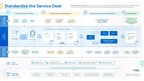
In its blueprint, Standardise the Service Desk, Info-Tech outlines a detailed five-step methodology for IT to streamline and enhance service desk performance:

Step 1: Identify the Current State and Goals

Assess the current state and define objectives: Conduct a thorough evaluation of existing processes and determine specific goals for improvement.Build a user experience-driven service desk: Focus on creating a service desk that prioritises user experience, ensuring that interactions are smooth and efficient.

Step 2: Define Service Desk Structure and Ticket Intake

Define service desk structure: Establish a clear organisational framework for the service desk to optimise workflow and accountability.Improve ticket intake: Streamline the process for receiving and logging requests to enhance responsiveness.Improve prioritisation: Implement effective prioritisation strategies to ensure critical issues are addressed promptly.

Step 3: Capture and Report on the Right Data

Improve ticket categories: Refine ticket categorisation to facilitate accurate tracking and reporting.Enable metrics and KPIs: Establish key performance indicators (KPIs) and metrics to measure service desk effectiveness.Ensure ticket data quality: Maintain high data quality standards to support informed decision-making.

Step 4: Improve Incident Resolution & Service Request Fulfillment

Resolve incidents: Focus on timely incident resolution to minimise disruption for users.Fulfil service requests: Enhance processes for fulfilling service requests to improve user satisfaction.Enable shift-left (knowledgebase): Develop a robust knowledgebase to empower service desk agents and users alike.Enable shift-left (self-service): Implement self-service options to allow users to resolve common issues independently.

Step 5: Implement the Service Desk Vision

Articulate a service desk vision: Clearly define the long-term vision for the service desk to guide its evolution.Make a communication plan: Develop a strategic communication plan to ensure all stakeholders are informed and engaged.Communicate the vision: Consistently share the service desk vision across the organisation to foster alignment and support.

Info-tech also highlights the importance of collaborating with managers from specialised IT groups responsible for root-cause analysis. This collaboration helps organisations develop a categorisation scheme that meets their specific needs. The firm advises that involving end users in this process ensures they comprehend the categories they encounter, improving overall clarity and efficiency.

By implementing these data-backed insights, organisations can reduce costs and empower their teams to deliver high-quality support in today’s dynamic digital environment.

For exclusive and timely commentary from Emily Sugerman, a service desk expert, and access to the complete Standardise the Service Desk blueprint, please contact pr@infotech.com.

Info-Tech LIVE 2025 in Australia IT Conference

Registration is now open for Info-Tech LIVE 2025 in Australia, taking place March 18 to 19, 2025, in Brisbane, Australia. This premier event offers journalists, podcasters, and media influencers access to exclusive content, the latest IT research and trends, and the opportunity to interview industry experts, analysts, and speakers. To apply for media passes to attend the event or gain access to research and expert insights on trending topics, please contact pr@infotech.com

About Info-Tech Research Group

Info-Tech Research Group is one of the world’s leading research and advisory firms, proudly serving over 30,000 IT and HR professionals. The company produces unbiased, highly relevant research and provides advisory services to help leaders make strategic, timely, and well-informed decisions. For nearly 30 years, Info-Tech has partnered closely with teams to provide them with everything they need, from actionable tools to analyst guidance, ensuring they deliver measurable results for their organisations.

To learn more about Info-Tech’s divisions, visit McLean & Company for HR research and advisory services and SoftwareReviews for software buying insights.

Media professionals can register for unrestricted access to research across IT, HR, and software and hundreds of industry analysts through the firm’s Media Insiders program. To gain access, contact pr@infotech.com.

For information about Info-Tech Research Group or to access the latest research, visit infotech.com and connect via LinkedIn and X.

Media Contact: Sufyan Al-Hassan, Senior PR Manager, Info-Tech Research Group, salhassan@infotech.com, +1 (888) 670-8889 x2418

Photo – https://mma.prnewswire.com/media/2596725/Info_Tech_Research_Group_Info_Tech_Research_Group_Publishes_Stra.jpg
Logo – https://mma.prnewswire.com/media/2596724/Info_Tech_Research_Group_Info_Tech_Research_Group_Publishes_Stra.jpg


View original content:https://www.prnewswire.com/apac/news-releases/info-tech-research-group-publishes-strategies-to-tackle-it-service-desk-inconsistencies-and-improve-efficiency-302349525.html

SOURCE Info-Tech Research Group

Continue Reading
Click to comment

Leave a Reply

Your email address will not be published. Required fields are marked *

Technology

JAMS Launches AI for Enterprise Job Scheduling: JAX and JAMS MCP, on the Model You Choose

Published

on

By

A new AI agent and an open-standard connector let IT teams query, diagnose, and manage automation in plain language, on the model they choose, with operational data staying inside their own network

LONDON, July 24, 2026 /PRNewswire/ — JAMS Software, an orchestration solution for scheduled and event-driven automation, today announced the general availability of two AI capabilities for enterprise job scheduling: JAX, an AI agent built into the JAMS Web Client, and JAMS MCP, a connector built on the open Model Context Protocol standard that brings JAMS into external AI coding tools. Both capabilities ship at no additional cost as part of JAMS Web.

Automation environments grow faster than the teams that run them. Jobs multiply across SQL Server, Azure Data Factory, Airflow, SAP, JDE, and Banner, and when one fails, finding the root cause often means searching several consoles at once, frequently outside business hours. At the same time, IT leaders carry pressure to adopt AI while staying accountable for where operational data goes. JAX and JAMS MCP close both gaps together.

Full details on how JAX and JAMS MCP work, including the control model behind every action, are available at jamsscheduler.com/product/ai.

JAX is an AI agent that runs inside the JAMS Web Client. It finds jobs, troubleshoots failures, and answers how-to questions in plain language, with each response grounded in the JAMS user guide and checked against a built-in glossary. JAX acts only when a user asks it to. Reads flow freely, and every write action pauses for the user’s explicit approval before it runs. JAX does not learn between sessions, and conversations are not retained on the server.

JAMS MCP is a connector, built on the open Model Context Protocol standard, that brings JAMS into the AI tools engineering teams already use, including Cursor, VS Code with Copilot, Claude Code, Claude Desktop, and Codex. Users query jobs, investigate failures, and manage runs in plain language without leaving their tool.

Both capabilities run inside the customer’s own network and act as the signed-in user, with that user’s exact JAMS permissions. There is no elevated AI account: whatever a user cannot do in the JAMS interface, JAX and JAMS MCP cannot do on that user’s behalf. Every JAX and MCP operation is recorded in its own dedicated log, and changes made through the JAMS API land in the JAMS audit trail like any other change. Customers choose their own AI model, whether a commercial provider such as OpenAI or Anthropic or a model running entirely on their own hardware, and JAMS never trains on customer data. In the current release, neither feature edits or deletes a job, folder, schedule, or agent definition. For teams that must keep operational data within a defined boundary, JAX runs on a local model entirely inside the customer’s own network, so nothing leaves at all.

“Adopting AI usually means giving something up, most often visibility into where your data goes,” said Pete Hegland, Chief Executive Officer of JAMS Software. “We built JAX and JAMS MCP so that trade does not have to happen. Every action runs as the signed-in user, every change waits for approval, and the model itself can run entirely inside your own network.”

“IT teams across the United Kingdom and EMEA tell us the same thing: they want the benefit of AI without losing sight of where their data goes,” said Greg McLaughlin, Account Executive for EMEA at JAMS Software. “JAX and JAMS MCP let them keep operational data inside their own network and still get answers in plain language. That combination is what makes this practical for the teams I work with.”

JAX and JAMS MCP are available now to all JAMS Web customers across the United Kingdom and EMEA, with no separate licence, SKU, or additional cost. AI-assisted creation of new jobs and workflows from a plain-language description is on the roadmap for a future release, gated by the same approvals and permissions as every other action.

Learn how JAX and JAMS MCP work at https://jamsscheduler.com/product/ai.

Fast facts

JAX is an AI agent built into the JAMS Web Client for job scheduling and workflow automation.JAMS MCP is a connector built on the open Model Context Protocol standard, for Cursor, VS Code with Copilot, Claude Code, Claude Desktop, and Codex.Both act as the signed-in user, with that user’s exact JAMS permissions, and there is no elevated AI account.Customers choose the AI model, including a local model that runs entirely inside their own network.JAMS never trains on customer data.Both are available now at no additional cost as part of JAMS Web.

About JAMS Software

Founded in 1987, JAMS Software is an orchestration solution that helps IT teams centralize, automate, and manage scheduled and event-driven jobs across complex, hybrid environments. Over 850 customers rely on JAMS to run their automated workloads. JAMS Software, LLC is headquartered at 108 Patriot Drive, Suite A, Middletown, DE 19709.

Media Contact
Bobby Schmidt, Vice President of Marketing
press@jamssoftware.com
800.261.4267


Logo – https://mma.prnewswire.com/media/3007577/JAMS_logo.jpg
Photo – https://mma.prnewswire.com/media/3007578/jams_jax_ai_agent_job_scheduling_1.jpg
Photo – https://mma.prnewswire.com/media/3007579/jams_jax_mcp_ai_control_model.jpg
Photo – https://mma.prnewswire.com/media/3007580/jams_mcp_ai_connector_claude_cursor.jpg

View original content:https://www.prnewswire.co.uk/news-releases/jams-launches-ai-for-enterprise-job-scheduling-jax-and-jams-mcp-on-the-model-you-choose-302833908.html

Continue Reading

Technology

Video: CNPC offers green chemical answer

Published

on

By

BEIJING, July 24, 2026 /PRNewswire/ — A news report from chinadaily.com.cn:

Located on the edge of the Taklamakan Desert in Northwest China’s Xinjiang Uygur autonomous region, the Tarim 1.2 MTA Phase II Ethylene Project and its supporting green and low-carbon demonstration facility of PetroChina Dushanzi Petrochemical Company, a subsidiary of China National Petroleum Corporation, are offering a new example of China’s low-carbon industrial transformation.

Watch the video to discover how CNPC is exploring a cleaner and more circular future for the industry.

View original content to download multimedia:https://www.prnewswire.com/apac/news-releases/video-cnpc-offers-green-chemical-answer-302834036.html

SOURCE chinadaily.com.cn

Continue Reading

Technology

Shanghai Electric showcases embodied intelligence robot matrix and AI-native smart factory solutions at WAIC 2026

Published

on

By

Featuring humanoid robots with 41 degrees of freedom, pipe‑inspection robots with ±1mm positioning accuracy, and 51 industrial‑grade AI agents

SHANGHAI, July 24, 2026 /PRNewswire/ — Operations in high-end equipment manufacturing often involve confined spaces, complex objects, and fine manipulation tasks that demand sustained and stable precision. At the recent 2026 World Artificial Intelligence Conference and High-Level Meeting on Global AI Governance (WAIC 2026), Shanghai Electric (SEHK: 02727, SSE: 601727) showcased its comprehensive portfolio of embodied intelligence solutions tailored to a range of industrial scenarios.

Themed “AI for All: Smart Squad, Shining Without Limits,” Shanghai Electric highlighted its capabilities across embodied AI robots, robot core components, and AI-native smart factory solutions, demonstrating end-to-end capabilities spanning complete robot systems, critical parts, industrial software, and smart factory architecture.

“The true value of embodied intelligence lies in understanding real industrial tasks: combining the strength, precision, and stability of machines with human experience and judgment to drive a genuine paradigm of ‘machine-assisted, human-machine collaboration,'” said Wang Chunlei, deputy general manager of the Robotics Business Unit at Shanghai Electric Automation Group.

Shanghai Electric’s robotics portfolio covers five key industrial scenarios: connector insertion, electrical operations, flexible sorting, intelligent assembly, and pipe processing. Highlights include:

“SUYUAN” bipedal humanoid robot: With 41 degrees of freedom for enhanced mobility, it is equipped with a multimodal visual sensing system on the head and torso, along with a dual-battery hot-swap system. It is well-suited for inspection, material handling, and assembly tasks.”TUOYUAN” industrial wheeled humanoid robot: Powered by an embodied intelligence foundation model and force-position hybrid control, it is capable of multi-spec connector insertion, material sorting, and loading/unloading of automotive sheet metal parts.”Mermaid” bionic wheeled humanoid robot: Capable of autonomously identifying buttons, knobs, and air switches, it generates real-time operation paths.Autonomous pipe inner-wall chamfering robot: Designed for confined spaces, it can position and process thousands of hole edges with accuracy within 1 millimeter while transmitting data in real time.

Shanghai Electric also showcased its portfolio of core components ranging from power-output to end effectors. Among them, the planetary roller screw offers more than three times the load capacity of traditional ball screws, while the DexHand dexterous hand is designed to meet diverse gripping and manipulation requirements.

Shanghai Electric launched 51 AI models and agents under its “StarCloud Intelligent Manufacturing” series across three domains: R&D and design, production and manufacturing, and operations and maintenance—covering critical equipment processes such as process optimization and wind power facility maintenance.

These industrial agents are embedded in robotic decision-making systems and the operational logic of AI-native smart factories, transforming industrial expertise into digitized, reusable capabilities. They support production-line scheduling, quality inspection, and predictive maintenance, driving the evolution of manufacturing systems from experience-driven to data-driven operations.

Shanghai Electric also released the “AI-Native Smart Factory Technology White Paper,” proposing an active evolution architecture that enables real‑time, closed‑loop optimization of production data, giving the factory self‑perception, self‑decision, and self‑execution capabilities. Built on First Principles, the AI‑native smart factory vertically integrates process flows, industrial software, agents, and smart equipment to dismantle traditional hierarchies while horizontally bridging data silos. The architecture features three core layers: the AI factory brain as the “control center,” industrial agents and embodied robots as the “execution network,” and the physical twin as the “digital mirror.”

Leveraging its deep industrial expertise and comprehensive solution capabilities, Shanghai Electric will continue to drive the implementation of AI in industrial settings, tackle technical challenges facing embodied intelligence in complex scenarios, accelerate the large‑scale deployment of AI‑native smart factories, and deliver replicable solutions across diverse manufacturing environments.

SOURCE Shanghai Electric

Continue Reading

Trending