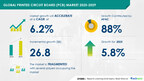
NEW YORK, Jan. 27, 2025 /PRNewswire/ — Report with market evolution powered by AI – The global printed circuit board (PCB) market size is estimated to grow by USD 26.8 billion from 2025-2029, according to Technavio. The market is estimated to grow at a CAGR of over 6.2% during the forecast period. Rising adoption of smartphones is driving market growth, with a trend towards increasing inclination toward flexibility and industry automation. However, environmental concerns regarding PCBs poses a challenge. Key market players include APCT, China Circuit Technology Shantou Corp., Compeq Manufacturing Co. Ltd., Daedeok Electronics Co. Ltd., Dynamic Electronics Co. Ltd., Ibiden Co. Ltd., Jabil Inc., Korea Circuit Co. Ltd., NOK Corp., RAYMING TECHNOLOGY, Shenzhen Kinwong Electronic Co. Ltd, Shenzhen SenYan Circuit Co. Ltd., ShenZhen Wonderful Technology Co. Ltd, Shenzhen Zhongxinhua Electronics Co. Ltd., Sumitomo Electric Industries Ltd., TTM Technologies Inc., Victory Giant Technology (Huizhou) Co. Ltd., Vishal International, and Zhen Ding Technology Holding Ltd..
Key insights into market evolution with AI-powered analysis. Explore trends, segmentation, and growth drivers- View Free Sample PDF
Printed Circuit Board (PCB) Market Scope
Report Coverage
Details
Base year
2024
Historic period
2019 – 2023
Forecast period
2025-2029
Growth momentum & CAGR
Accelerate at a CAGR of 6.2%
Market growth 2025-2029
USD 26.8 billion
Market structure
Fragmented
YoY growth 2022-2023 (%)
5.8
Regional analysis
APAC, North America, Europe, Middle East and Africa, and South America
Performing market contribution
APAC at 88%
Key countries
China, Taiwan, South Korea, Japan, and India
Key companies profiled
APCT, China Circuit Technology Shantou Corp., Compeq Manufacturing Co. Ltd., Daedeok Electronics Co. Ltd., Dynamic Electronics Co. Ltd., Ibiden Co. Ltd., Jabil Inc., Korea Circuit Co. Ltd., NOK Corp., RAYMING TECHNOLOGY, Shenzhen Kinwong Electronic Co. Ltd, Shenzhen SenYan Circuit Co. Ltd., ShenZhen Wonderful Technology Co. Ltd, Shenzhen Zhongxinhua Electronics Co. Ltd., Sumitomo Electric Industries Ltd., TTM Technologies Inc., Victory Giant Technology (Huizhou) Co. Ltd., Vishal International, and Zhen Ding Technology Holding Ltd.
Market Driver
The Printed Circuit Board (PCB) market is experiencing significant growth due to the increasing demand for electronic devices, particularly those related to 5G, Internet of Things (IoT), Internet of Vehicles, and artificial intelligence. Consumer electronics, including smartphones, cameras, PCs, tablets, and smart devices, are major consumers of PCBs. Semiconductor plants and IC substrate manufacturers are key players in the market, supplying components such as integrated circuits, resistors, electrolytic capacitors, PLCs, transistors, and composite epoxy materials. Automobile applications, including battery control systems, engine timing systems, digital displays, audio systems, power relays, antilock brake systems, and smart devices, are also driving demand for PCBs. PCBs are essential in various industries, including communications, industrial automation, medical devices, and government institutions. The market is shifting towards flexible circuits, rigid-flex, and high-temperature performance PCBs, made of materials like glass fabric, FR-4, epoxy resin, and fiberglass. Environmental concerns, including electronic waste, lead, mercury, cadmium, brominated flame retardants, and other hazardous substances, are prompting the development of more sustainable PCB production methods. 3D printing and high-reliability PCBs are emerging trends in the market. The market’s future looks bright, with major players like Quanta Computer and Apple supplier continuing to drive demand for rigid PCBs.
The automation of industries is a growing trend as businesses seek to enhance productivity and control costs. To maintain competitiveness, companies are adopting computers and machines for efficient control systems. Power consumption is a significant concern with the increasing power density of electric equipment. PCBs are essential in optimizing power usage within compact applications. Furthermore, the expanding use of cobots, industrial robots, and drones in automation will add value to this trend. PCBs enable optimal power consumption, contributing to overall efficiency and cost savings.
Request Sample of our comprehensive report now to stay ahead in the AI-driven market evolution!
Market Challenges
• The Printed Circuit Board (PCB) market faces significant challenges as the demand for electronic devices continues to grow in sectors like 5G, Internet of Things (IoT), Internet of Vehicles, and consumer electronics. The integration of artificial intelligence and semiconductor plants in manufacturing processes increases the need for PCBs in various applications. However, concerns over electronic waste, lead, mercury, cadmium, and brominated flame retardants pose environmental challenges. PCBs are essential components in industries like communications, computers, and consumer electronics, including smartphones, cameras, and tablets. The automotive sector also relies on PCBs for battery control systems, engine timing systems, digital displays, audio systems, power relays, antilock brake systems, and smart devices. Manufacturers of PCBs must ensure their products meet the demands of various industries while addressing challenges such as high temperatures, mechanical stress, and thermal stability. PCBs are used in industrial automation, medical devices, and military applications, requiring high structural integrity and flame-retardant nature. Government institutions and industries like Quanta Computer, an Apple supplier, require rigid PCBs made of materials like glass fabric, FR-4, and epoxy resin. The glass transition temperature, dielectric strength, dimensional stability, and electrical insulating qualities are crucial factors in PCB production. The emergence of 3D printing and flexible circuits, such as Rigid Flex, presents opportunities for innovation and growth in the PCB market. However, ensuring PCB reliability and addressing electrical property degradation remains a challenge.
• The Printed Circuit Board (PCB) market involves the production and disposal of boards made primarily of metal, plastic, ceramic, and copper. These components, particularly epoxy resins containing chlorine, can pose environmental concerns due to their non-biodegradable nature. The industry has shifted from lead solders to lead-free alternatives to minimize toxicity. Proper dismantling of components is necessary before disposing of PCBs. Recycling presents challenges such as temperature rises, mechanical shocks, and delamination. A standard PCB comprises 40% metal, 30% plastic, and 30% ceramic, with the board itself consisting of 28% copper, 33% resins, and 40% other materials.
Discover how AI is revolutionizing market trends- Get your access now!
Segment Overview
This printed circuit board (pcb) market report extensively covers market segmentation by
Type 1.1 Multi-layer1.2 HDI1.3 Single sided1.4 Double sidedEnd-user 2.1 Communication network infrastructure2.2 IT and peripherals2.3 Automotive2.4 Consumer electronics2.5 OthersGeography 3.1 APAC3.2 North America3.3 Europe3.4 Middle East and Africa3.5 South America
1.1 Multi-layer- Multi-layer Printed Circuit Boards (PCBs) hold a dominant position in the global market in 2024 due to their versatility and complexity. These boards consist of multiple layers of substrate material, interconnected by conductive channels. The rising demand for compact and high-performance electronic devices in sectors like telecommunications, automotive, and consumer electronics fuels the need for multi-layer PCBs. Notable applications include smartphones, which require space optimization and sophisticated electronics. Advanced networking equipment, such as routers and servers, also heavily utilize multi-layer PCBs to enhance functionality. Automotive Electronic Control Units (ECUs) benefit from their compact design, ensuring efficient performance in confined spaces. As technology advances, the demand for multi-layer PCBs is anticipated to escalate, solidifying their role as a key product in the PCB industry. Consequently, the multi-layer product segment is poised for growth, driving the expansion of the global PCB market throughout the forecast period.
Download a Sample of our comprehensive report today to discover how AI-driven innovations are reshaping competitive dynamics
Research Analysis
The Printed Circuit Board (PCB) market is experiencing significant growth due to the increasing demand for electronic devices in various industries. The advent of 5G technology and the Internet of Things (IoT) are driving the market, with PCBs playing a crucial role in the development of telecommunication infrastructure. The IoT and Internet of Vehicles are also fueling the demand for PCBs in consumer electronics, including smartphones, cameras, and tripods. PCBs are essential components in the production of integrated circuits, resistors, electrolytic capacitors, PLCs, transistors, and composite epoxy, among others. Flexible circuits and rigid-flex PCBs are gaining popularity due to their ability to provide greater design flexibility and improved reliability. Fiberglass and other materials are used in the manufacturing of PCBs to ensure their durability and strength. Overall, the PCB market is poised for continued growth as the demand for electronic devices and advanced technologies continues to soar.
Market Research Overview
The Printed Circuit Board (PCB) market is witnessing substantial growth driven by the rising demand for electronic devices across multiple industries. With the rollout of 5G technology and the expansion of the Internet of Things (IoT), IoT gadgets, smartphones, cameras, PCs, tablets, and consumer electronics are becoming more advanced and sophisticated, driving up the need for high-quality PCBs. However, the production of PCBs involves the use of materials like lead, mercury, cadmium, brominated flame retardants, and semiconductor plants, which raise environmental concerns. PCBs are essential components in various industries, including automotive applications, where they are used in battery control systems, engine timing systems, digital displays, audio systems, power relays, antilock brake systems, and smart devices. In industrial automation, PCBs are used in computer communications, PLCs, transistors, and other electronic equipment, ensuring structural integrity and mechanical strength, even under high temperatures and mechanical stress. PCBs are also used in medical devices, industrial robots, and automation machinery, making them indispensable in various sectors. The market for PCBs is expected to grow further as millennials’ demand for advanced technology continues to rise. The PCB foundation material, including composite epoxy, fiberglass, and FR-4 materials, is crucial in ensuring electrical insulating qualities, dimensional stability, and thermal insulation properties. The use of 3D printing technology in PCB production is also gaining popularity, offering benefits like reduced production time and cost. However, the reliability of PCBs is crucial, and electrical property degradation can lead to significant issues. Government institutions play a vital role in regulating the production and disposal of electronic waste, ensuring the safe disposal of materials like lead, mercury, cadmium, and brominated flame retardants.
Table of Contents:
1 Executive Summary
2 Market Landscape
3 Market Sizing
4 Historic Market Size
5 Five Forces Analysis
6 Market Segmentation
TypeMulti-layerHDISingle SidedDouble SidedEnd-userCommunication Network InfrastructureIT And PeripheralsAutomotiveConsumer ElectronicsOthersGeographyAPACNorth AmericaEuropeMiddle East And AfricaSouth America
7 Customer Landscape
8 Geographic Landscape
9 Drivers, Challenges, and Trends
10 Company Landscape
11 Company Analysis
12 Appendix
About Technavio
Technavio is a leading global technology research and advisory company. Their research and analysis focuses on emerging market trends and provides actionable insights to help businesses identify market opportunities and develop effective strategies to optimize their market positions.
With over 500 specialized analysts, Technavio’s report library consists of more than 17,000 reports and counting, covering 800 technologies, spanning across 50 countries. Their client base consists of enterprises of all sizes, including more than 100 Fortune 500 companies. This growing client base relies on Technavio’s comprehensive coverage, extensive research, and actionable market insights to identify opportunities in existing and potential markets and assess their competitive positions within changing market scenarios.
Contacts
Technavio Research
Jesse Maida
Media & Marketing Executive
US: +1 844 364 1100
UK: +44 203 893 3200
Email: media@technavio.com
Website: www.technavio.com/
View original content to download multimedia:https://www.prnewswire.com/news-releases/printed-circuit-board-pcb-market-to-grow-by-usd-26-8-billion-2025-2029-driven-by-smartphone-adoption-report-highlights-ais-redefining-role—technavio-302359555.html
SOURCE Technavio








 Technology4 days ago
 Technology4 days ago
 Coin Market4 days ago

 Technology4 days ago
 Technology4 days ago
 Technology4 days ago
 Technology4 days ago