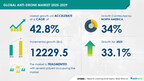
NEW YORK, Jan. 28, 2025 /PRNewswire/ — Report on how AI is redefining market landscape – The global anti-drone market size is estimated to grow by USD 12.23 billion from 2025-2029, according to Technavio. The market is estimated to grow at a CAGR of about 42.8% during the forecast period. Rising technological advancements in anti-drones is driving market growth, with a trend towards growing use of uavs in commercial and hobbyist activities. However, incidence of technological limitations and prevalence of regulatory challenges poses a challenge. Key market players include Advanced Radar Technology, Airbus SE, Autel Robotics Co. Ltd., Blighter Surveillance Systems Ltd., BSS Holland BV, Dedrone Holdings Inc., Department 13 International Ltd., DroneShield Ltd., Elbit Systems Ltd., Electro Optic Systems Pty Ltd., Israel Aerospace Industries Ltd., Lockheed Martin Corp., Northrop Grumman Corp., QinetiQ Ltd., Rafael Advanced Defense Systems Ltd., Rheinmetall AG, RTX Corp., Skydio Inc., Terma AS, and The Boeing Co..
Key insights into market evolution with AI-powered analysis. Explore trends, segmentation, and growth drivers- View Free Sample PDF
Anti-Drone Market Scope
Report Coverage
Details
Base year
2024
Historic period
2019 – 2023
Forecast period
2025-2029
Growth momentum & CAGR
Accelerate at a CAGR of 42.8%
Market growth 2025-2029
USD 12229.5 million
Market structure
Fragmented
YoY growth 2022-2023 (%)
33.1
Regional analysis
North America, APAC, Europe, Middle East and Africa, and South America
Performing market contribution
North America at 34%
Key countries
US, China, India, UK, Saudi Arabia, Canada, Germany, France, Brazil, and Japan
Key companies profiled
Advanced Radar Technology, Airbus SE, Autel Robotics Co. Ltd., Blighter Surveillance Systems Ltd., BSS Holland BV, Dedrone Holdings Inc., Department 13 International Ltd., DroneShield Ltd., Elbit Systems Ltd., Electro Optic Systems Pty Ltd., Israel Aerospace Industries Ltd., Lockheed Martin Corp., Northrop Grumman Corp., QinetiQ Ltd., Rafael Advanced Defense Systems Ltd., Rheinmetall AG, RTX Corp., Skydio Inc., Terma AS, and The Boeing Co.
Market Driver
The Anti-Drone market is experiencing significant growth due to the increasing number of drone activities that threaten public safety and security. Innovations in drone software and machine learning are key trends in the industry, enabling organizations to detect and identify unauthorized drone flights through real-time behavior analysis and pattern recognition. Anti-drone solutions are being installed at airports, military bases, and other sensitive areas to protect against potential drone incursions. These systems use diverse capabilities such as laser mechanisms, drone radar, and AI to detect and disable drones. Regulations are a major focus in the anti-drone industry, with governments investing in comprehensive counter-drone frameworks to ensure the safety of aviation and military infrastructure. Defensetech companies are developing multi-layered anti-drone systems that can detect, identify, and disable drones using jamming, net-based systems, and audio recognition. The anti-drone industry is not limited to military applications. Private organizations are also investing in anti-drone technology to protect their assets from drone attacks. The development of C-UAS technology is a priority for defense budgets, with research and development in the field advancing rapidly. Insurgent groups and armed forces are using drones for reconnaissance and attacks, making anti-drone technology essential for defense and security agencies. The anti-drone industry is diverse, with solutions ranging from ground-based systems to counter-drone capabilities for surface and naval vessels. Anti-drone technology is an essential component of modern defense and security operations, providing real-time protection against drone threats and ensuring the safety of collateral and public events. The anti-drone industry is constantly evolving, with new innovations and capabilities emerging to address the diverse challenges posed by drone technology.
The global anti-drone market is projected to expand due to the rising popularity of unmanned aerial vehicles (UAVs) in commercial and recreational applications. As drone usage becomes more prevalent, concerns over safety, security, and privacy have grown. Commercial establishments, including airports, stadiums, government buildings, industrial facilities, and public events, are increasingly worried about potential drone risks such as surveillance, espionage, smuggling, and terrorist attacks. Anti-drone systems offer a solution to mitigate these security concerns and protect sensitive areas and critical infrastructure from unauthorized drones. Additionally, the growing trend of hobbyist drone use for recreational flying and racing adds to the market’s growth.
Request Sample of our comprehensive report now to stay ahead in the AI-driven market evolution!
Market Challenges
The Anti-Drone market is witnessing significant growth due to the increasing number of drone activities that pose security threats. Drone software and innovations are key challenges, requiring comprehensive solutions to ensure real-time protection against unauthorized drone flights. Organizations in various sectors, including aviation and military, are investing in anti-drone systems to detect and disable drones using diverse capabilities such as laser, radio frequency jamming, and machine learning. Regulations continue to evolve, with governments focusing on multi-layered countermeasures against drone incursions. The anti-drone industry is developing advanced technologies, including AI and drone radar, to identify patterns and behaviors. Defense budgets are increasing to fund research and development of anti-drone frameworks and operations. Private entities are also investing in uav reduction technology to protect their assets from drone attacks. Counter-UAS technology is essential for securing military infrastructure, naval vessels, and surface vessels against drone threats. Anti-drone systems are vital for ensuring public safety at events and preventing collateral damage from drone attacks.Anti-drone technology aims to detect, monitor, and counteract unauthorized drones. Sensors, including optical/thermal cameras, radars, acoustic, and radio, are used for detection. However, these sensors have limitations. Their range is limited, connectivity is unreliable, and they are costly. Identifying drones is challenging as well. Radar may detect a drone, but it cannot distinguish between an enemy drone in a restricted area and a recreational one. Countermeasures include using laser guns or missiles to shoot down drones or jamming their communication networks with jammers. Despite these challenges, anti-drone technology remains a crucial investment for security and safety concerns.
Discover how AI is revolutionizing market trends- Get your access now!
Segment Overview
This anti-drone market report extensively covers market segmentation by
Application 1.1 Military and defense1.2 Government1.3 CommercialTechnology 2.1 Electronic system2.2 Laser system2.3 Kinetic systemGeography 3.1 North America3.2 APAC3.3 Europe3.4 Middle East and Africa3.5 South America
1.1 Military and defense- Anti-drone systems play a crucial role in enhancing defense capabilities against aerial threats. These systems are designed to integrate seamlessly with existing defense infrastructure, such as radar networks, air defense systems, and electronic warfare platforms. The military and defense sector represents a significant market for anti-drone technology due to the increasing use of unmanned aerial vehicles (UAVs) in military operations. Anti-drone systems can detect and neutralize hostile drones, safeguarding against potential threats, including surveillance, smuggling, or terrorist attacks. Technologies used in anti-drone systems include radar and radio frequency (RF) detection, electro-optical/infrared (EO/IR) detection, acoustic detection, and jamming systems. Some systems may employ kinetic solutions, such as nets, to capture and disable drones. In 2024, the US Army awarded a USD75 million contract to RTX Corp. For producing 600 Coyote Block 2C interceptors to counter enemy drones. Deploying advanced sensors, countermeasures, and command-and-control systems enables defense organizations to effectively detect, track, and neutralize hostile drones, thereby improving force protection and situational awareness. The demand for anti-drone technology in the military and defense sector is projected to increase during the forecast period, driven by the expanding use of drones in warfare and the continuous development of new drone technologies. This growth is expected to positively impact the market’s military and defense segment.
Download a Sample of our comprehensive report today to discover how AI-driven innovations are reshaping competitive dynamics
Research Analysis
The Anti-Drone market is a rapidly growing industry that focuses on developing technologies and solutions to mitigate the risks and disruptions caused by unwanted drone activity. This market encompasses various applications, including drone integration, analytics, law enforcement, border security, delivery, and agriculture. Drone breaches, misuse, and cybersecurity are major concerns, leading to the demand for advanced drone protection and defense systems. Drone management, hardware, and sensor technologies are essential components of this market, along with drone disruption and jamming systems. Investments in anti-drone technology are on the rise due to market trends in drone deployment, traffic management, and environmental monitoring. Additionally, drone AI, machine learning, and risk assessment are crucial for effective drone response and policy development. Anti-drone infrastructure and disaster response systems are also gaining importance, as drones are increasingly used in emergency situations. Overall, the anti-drone market is a dynamic and innovative space, driven by the growing use of drones in various industries and applications.
Market Research Overview
The Anti-Drone market is witnessing rapid growth due to the increasing number of drone incursions at sensitive locations, airports, and public events. Innovations in drone software and technology are leading to the development of comprehensive anti-drone solutions that utilize diverse capabilities such as machine learning, laser-based mechanisms, and AI for real-time drone detection and countermeasures. These systems are essential for governments and organizations to protect military infrastructure, military sector, and civilian areas from unauthorized drone activities. Anti-drone solutions are not limited to military applications but are also being adopted by private entities to secure their facilities from potential drone threats. These systems use multi-layered approaches, including drone detection, drone radar, and audio tracking, to identify and disable drones. Regulations and frameworks are being established to govern the use of anti-drone technology, ensuring its ethical and legal application. The anti-drone industry is continuously researching and developing new countermeasures to address the evolving threat landscape, including C-UAS technology, jamming systems, and net-based solutions. Anti-drone technology is not only used for defense but also for reducing UAV collateral damage in military operations. The development of anti-drone systems is a critical component of defense budgets, and their capabilities are continually expanding to counter diverse drone behaviors and attacks. Insurgent groups and armed forces are increasingly using drones for reconnaissance and even drone attacks. Anti-drone technology is essential for countering these threats and maintaining security and privacy in the face of evolving drone technology.
Table of Contents:
1 Executive Summary
2 Market Landscape
3 Market Sizing
4 Historic Market Size
5 Five Forces Analysis
6 Market Segmentation
ApplicationMilitary And DefenseGovernmentCommercialTechnologyElectronic SystemLaser SystemKinetic SystemGeographyNorth AmericaAPACEuropeMiddle East And AfricaSouth America
7 Customer Landscape
8 Geographic Landscape
9 Drivers, Challenges, and Trends
10 Company Landscape
11 Company Analysis
12 Appendix
About Technavio
Technavio is a leading global technology research and advisory company. Their research and analysis focuses on emerging market trends and provides actionable insights to help businesses identify market opportunities and develop effective strategies to optimize their market positions.
With over 500 specialized analysts, Technavio’s report library consists of more than 17,000 reports and counting, covering 800 technologies, spanning across 50 countries. Their client base consists of enterprises of all sizes, including more than 100 Fortune 500 companies. This growing client base relies on Technavio’s comprehensive coverage, extensive research, and actionable market insights to identify opportunities in existing and potential markets and assess their competitive positions within changing market scenarios.
Contacts
Technavio Research
Jesse Maida
Media & Marketing Executive
US: +1 844 364 1100
UK: +44 203 893 3200
Email: media@technavio.com
Website: www.technavio.com/
View original content to download multimedia:https://www.prnewswire.com/news-releases/anti-drone-market-to-grow-by-usd-12-23-billion-2025-2029-driven-by-advancements-in-anti-drone-technology-report-with-the-ai-impact-on-market-trends—technavio-302362415.html
SOURCE Technavio







 Technology5 days ago
 Technology5 days ago

 Coin Market4 days ago
 Coin Market5 days ago
 Technology4 days ago
 Coin Market4 days ago
 Technology4 days ago