Connect with us

Technology

Renewable Energy Investment Market to grow by USD 181.9 Billion (2024-2028), driven by supportive government policies, Report with the AI impact on market trends – Technavio

Published

on

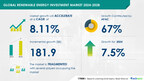
NEW YORK, Jan. 29, 2025 /PRNewswire/ — Report on how AI is redefining market landscape – The global renewable energy investment market size is estimated to grow by USD 181.9 billion from 2024-2028, according to Technavio. The market is estimated to grow at a CAGR of  8.11%  during the forecast period. Supportive government policies is driving market growth, with a trend towards increased spending on utility-scale renewable energy projects . However, competition from fossil fuels  poses a challenge. Key market players include AZORA CAPITAL SL, Bank of America Corp., Berkeley Partners LLP, BlackRock Inc., BNP Paribas SA, Capital Dynamics Holding AG, Centerbridge Partners LP, CHN ENERGY Investment Group Co. Ltd., Citigroup Inc., Deloitte Touche Tohmatsu Ltd., EKF, ESFC Investment Group, General Electric Co., KfW Bankengruppe, Macquarie Group Ltd., Mitsubishi UFJ Financial Group Inc., Nebras Power, Positive Energy Ltd., State Power Investment Corp., TerraForm Power Operating LLC, and The Goldman Sachs Group Inc..

Key insights into market evolution with AI-powered analysis. Explore trends, segmentation, and growth drivers- View Free Sample PDF

Renewable Energy Investment Market Scope

Report Coverage

Details

Base year

2023

Historic period

2018 – 2022

Forecast period

2024-2028

Growth momentum & CAGR

Accelerate at a CAGR of 8.11%

Market growth 2024-2028

USD 181.9 billion

Market structure

Fragmented

YoY growth 2022-2023 (%)

7.5

Regional analysis

APAC, North America, Europe, South America, and Middle East and Africa

Performing market contribution

APAC at 67%

Key countries

China, US, Japan, Germany, and Brazil

Key companies profiled

AZORA CAPITAL SL, Bank of America Corp., Berkeley Partners LLP, BlackRock Inc., BNP Paribas SA, Capital Dynamics Holding AG, Centerbridge Partners LP, CHN ENERGY Investment Group Co. Ltd., Citigroup Inc., Deloitte Touche Tohmatsu Ltd., EKF, ESFC Investment Group, General Electric Co., KfW Bankengruppe, Macquarie Group Ltd., Mitsubishi UFJ Financial Group Inc., Nebras Power, Positive Energy Ltd., State Power Investment Corp., TerraForm Power Operating LLC, and The Goldman Sachs Group Inc.

Market Driver

The renewable energy investment market is experiencing significant growth due to the energy crisis and increasing affordability concerns. The EU is leading the way in deployment with solar technology and wind technology seeing record capacity additions. Biofuels are also in demand due to energy security concerns and decarbonization efforts. Policy developments, such as renewable portfolio standards and clean energy laws, are driving investment in utility-scale solar and wind projects. However, challenges like labor costs, capital costs, interconnection and permitting delays, transmission limitations, and regulatory hurdles persist. Renewable energy sources, including hydrogen, are becoming more competitive as fossil fuel alternatives. Rising interest rates and electricity prices are impacting project economics, but federal investments and infrastructure spending offer opportunities for growth. Offshore wind is experiencing a rebound, but delayed projects and onshore wind growth remain strong. Workforce reskilling and regulatory boosts are essential for continued progress. Generative artificial intelligence is playing a role in optimizing renewable energy systems and reducing greenhouse gas emissions. The tax-credit transfer market and grid resilience are also key areas of focus. Overall, the market is facing numerous challenges and opportunities as it transitions to a clean energy future. 

Utility-scale renewable energy projects, those with a capacity exceeding 10 MW, are significant investments in the energy sector. These projects benefit from favorable state and local policies and initiatives worldwide. These measures aim to facilitate the implementation of renewable energy projects by addressing potential obstacles. Utility-scale renewable energy projects are customized undertakings, with effective states linking their renewable portfolio standards to financial incentives like tax breaks and clean energy incentives. However, determining the most cost-effective and efficient electricity supply source between renewable energy options and traditional electricity generation can be challenging for stakeholders, regulatory bodies, and investors alike. 

Request Sample of our comprehensive report now to stay ahead in the AI-driven market evolution!

 Market Challenges

The renewable energy investment market is facing several challenges in 2023. The energy crisis caused by fossil fuel price volatility and supply disruptions is pushing businesses and governments to invest in renewable energy for energy affordability and security. EU deployment of renewable energy is on the rise, with solar technology and wind technology leading the way. However, challenges persist in the form of biofuel demand outpacing supply, policy developments, and labor and capital costs. Wind technology faces challenges such as interconnection and permitting delays, transmission limitations, and rising interest rates. Renewable portfolio standards, clean energy laws, and carbon reduction targets are driving capacity additions in electricity generation. Generative artificial intelligence and tax-credit transfer markets are providing regulatory boosts and policy support. Hydrogen deployment and workforce reskilling are also key areas of focus. Despite these challenges, renewable energy remains a competitive fossil fuel alternative, with utility-scale solar, wind, and distributed systems driving growth in residential, commercial, and industrial sectors. However, delayed projects and offshore wind growth are causing capacity rebound and electricity price concerns. Infrastructure investments and federal support are essential to address these challenges and ensure a smooth transition to a decarbonized energy system.Renewable energy has seen consistent growth in the global electricity market, yet fossil fuels remain preferred in some countries due to their abundant availability and lower production costs. Establishing renewable energy facilities comes with a significant initial investment, and the power output from sources like solar and wind is intermittent, leading to variable electricity volumes. Solar Photovoltaic (PV) installations, for instance, require substantial capital expenditure despite a decline in material costs. The need to install solar PV panels over expansive areas to generate substantial electricity volumes further increases investment and costs.

Discover how AI is revolutionizing market trends- Get your access now!

Segment Overview 

This renewable energy investment market report extensively covers market segmentation by  

Type 1.1 Asset finance1.2 Small distributed capacityGeography 2.1 APAC2.2 North America2.3 Europe2.4 South America2.5 Middle East and Africa

1.1 Asset finance-  Renewable energy investment market witnesses significant contributions from financial service vendors, such as the Clean Energy Finance Corporation, which provides investments for small-scale clean energy projects in Australia. This assists businesses, manufacturers, commercial property owners, and farmers in implementing clean energy solutions for a sustainable future. Solar thermal projects, including concentrated solar power and solar heating systems, have seen a decline in investments, currently holding a 3% share. Offshore wind projects, accounting for 7% of investments, have surpassed solar thermal in terms of market share since 2014. Hydropower projects account for 4% of investments. Over the past decade, India’s energy policy has focused on market entry and cost reduction of renewable energy technologies. Asset financing, the largest segment, involves off-balance-sheet capital from power utility companies and a mix of equity and debt from infrastructure investors and banks. The International Energy Agency emphasizes the need for governments worldwide to accelerate their transition to sustainable energy to mitigate climate change risks and ensure access to clean and affordable energy for all. These factors are expected to fuel the growth of the asset finance segment in the global renewable energy investment market.

Download a Sample of our comprehensive report today to discover how AI-driven innovations are reshaping competitive dynamics

Research Analysis

The renewable energy investment market is experiencing significant growth as the world grapples with an energy crisis and the need to transition to cleaner sources. The EU has been at the forefront of deployment, with affordability and energy security driving the shift towards renewables. Solar technology and wind technology continue to lead the charge, with biofuels also playing a role in the energy mix. The IEA assesses that renewables will account for 95% of new electricity capacity additions by 2025. Policy developments, including the Paris Agreement, UN Climate Change, and the Energy Transitions Stocktake, are driving clean energy laws and renewable portfolio standards. Utility-scale solar, offshore wind, and electricity generation from renewables are all seeing capacity additions, contributing to decarbonization efforts. Federal investments and infrastructure investments are crucial for the expansion of renewable energy, with tax-credit transfer markets providing additional incentives. Generative artificial intelligence is also playing a role in optimizing renewable energy production, and grid resilience is a key consideration as the share of renewables in the energy mix increases. Greenhouse gas emissions are reducing as a result, helping to meet carbon reduction targets. Biofuel demand is also increasing as the transportation sector seeks to decarbonize.

Market Research Overview

The renewable energy investment market is experiencing significant growth as the world grapples with an energy crisis and the need to transition away from fossil fuels. The EU is leading the way in deployment, with a focus on energy affordability and security. Solar technology and wind technology are at the forefront of this transition, with biofuels also playing a role. Policy developments, including renewable portfolio standards and clean energy laws, are driving capacity additions in utility-scale solar, wind, and hydrogen deployment. However, challenges such as labor costs, capital costs, interconnection and permitting delays, transmission limitations, and regulatory hurdles continue to impact project inputs. The demand for biofuels is also increasing, driven by carbon reduction targets and the need for fossil fuel alternatives. Decarbonization efforts are receiving federal investments and infrastructure boosts, with offshore wind and utility-scale systems seeing significant growth. The rebound in renewable energy is expected to continue, despite delayed projects and rising interest rates. Generative artificial intelligence is playing a role in optimizing energy production and grid resilience, while regulatory support and workforce reskilling are essential for competitiveness. The tax-credit transfer market is also providing policy support for renewable energy projects. Overall, the renewable energy market is facing numerous challenges and opportunities as it strives to meet electricity generation demands and reduce greenhouse gas emissions.

Table of Contents:

1 Executive Summary
2 Market Landscape
3 Market Sizing
4 Historic Market Size
5 Five Forces Analysis
6 Market Segmentation

TypeAsset FinanceSmall Distributed CapacityGeographyAPACNorth AmericaEuropeSouth AmericaMiddle East And Africa

7 Customer Landscape
8 Geographic Landscape
9 Drivers, Challenges, and Trends
10 Company Landscape
11 Company Analysis
12 Appendix

About Technavio

Technavio is a leading global technology research and advisory company. Their research and analysis focuses on emerging market trends and provides actionable insights to help businesses identify market opportunities and develop effective strategies to optimize their market positions.

With over 500 specialized analysts, Technavio’s report library consists of more than 17,000 reports and counting, covering 800 technologies, spanning across 50 countries. Their client base consists of enterprises of all sizes, including more than 100 Fortune 500 companies. This growing client base relies on Technavio’s comprehensive coverage, extensive research, and actionable market insights to identify opportunities in existing and potential markets and assess their competitive positions within changing market scenarios.

Contacts

Technavio Research
Jesse Maida
Media & Marketing Executive
US: +1 844 364 1100
UK: +44 203 893 3200
Email: media@technavio.com
Website: www.technavio.com/

View original content to download multimedia:https://www.prnewswire.com/news-releases/renewable-energy-investment-market-to-grow-by-usd-181-9-billion-2024-2028-driven-by-supportive-government-policies-report-with-the-ai-impact-on-market-trends—technavio-302363179.html

SOURCE Technavio

Continue Reading

Technology

Trimble for Government Achieves ‘Initial Implementation’ Status for FedRAMP Class C (Moderate) Certification

Published

on

By

Milestone accelerates secure cloud adoption for federal, state and local entities managing infrastructure, spatial data and capital assets 

WESTMINSTER, Colo., Oct. 20, 2026 /PRNewswire/ — Trimble today announced that Trimble for Government is listed as ‘Initial Implementation’ status for Federal Risk and Authorization Management Program (FedRAMP®) Class C (Moderate) certification and is now listed on the FedRAMP Marketplace. In conjunction with seeking FedRAMP certification, Trimble is also pursuing GovRAMP authorization to support state, local and education (SLED) customers with reciprocal cybersecurity compliance standards.

This dual milestone marks a critical step forward in delivering a software as a service (SaaS) cloud environment built within a secure Government Community Cloud. Designed specifically for U.S. Federal Government departments, state and local agencies, and defense and civilian contractors, Trimble for Government provides a unified ecosystem for managing infrastructure, spatial data, capital projects, permitting and facility assets across their entire lifecycle.

Achieving FedRAMP Class C (Moderate) and GovRAMP alignment will enable public sector entities and Department of Defense (DoD) contractors to comply with stringent security mandates — including Cybersecurity Maturity Model Certification (CMMC) alignment — while modernizing digital engineering and asset management.

“Federal, state and local agencies face the dual challenge of modernizing critical infrastructure while maintaining uncompromising cybersecurity standards,” said Mark Schwartz, group president, AECO at Trimble. “Achieving ‘Initial Assessment’ status reflects our commitment to delivering mission-critical spatial, capital project and asset management capabilities inside a secure, audit-ready cloud boundary across all levels of government.”

Integrated cloud solutions built for government operations

The in-scope environment brings together Trimble’s proven field execution, asset, project and permitting software into four modular packages designed to support specific public sector outcomes:

Trimble® Field Collaboration: Delivers field data services using foundational spatial database infrastructure and GIS integration to support high-security field operations, map assets, and enable seamless field-to-cloud workflows across Trimble’s core Field Systems portfolio.Trimble Project Management powered by Trimble ProjectSight® software: Connects design-to-build workflows in the field, providing precision data layout, project tracking, collaboration and quality assurance across construction projects.Trimble Asset Management powered by Trimble Unity™ Maintain software: Serves as a centralized facilities data core for federal, state, and local government agencies, military installations, and public infrastructure — such as public buildings, utilities, and transportation networks — to optimize maintenance and long-term capital planning.Trimble Permit Management powered by Trimble Unity Permit software: Streamlines end-to-end management of permitting, licensing, land use and infrastructure rights-of-way in a fully compliant cloud environment.

The unifying in-scope element across all four packages is the Trimble Connect® platform, providing collaboration and a common data environment (CDE) across the Trimble for Government platform.

With assessment processes underway, Trimble continues to advance toward full FedRAMP and GovRAMP authorizations to ensure public sector customers can innovate with confidence.

About Trimble
Trimble is a global technology company that connects the physical and digital worlds, transforming the ways work gets done. With relentless innovation in precise positioning, modeling and data analytics, Trimble enables essential industries including construction, geospatial and transportation. Whether it’s helping customers build and maintain infrastructure, design and construct buildings, optimize global supply chains or map the world, Trimble is at the forefront, driving productivity and progress. For more information about Trimble, visit: www.trimble.com.

GTRMB

View original content to download multimedia:https://www.prnewswire.com/news-releases/trimble-for-government-achieves-initial-implementation-status-for-fedramp-class-c-moderate-certification-302913499.html

SOURCE Trimble

Continue Reading

Technology

Delta Development Team and The Good Drone Company Awarded U.S. Army Contract for Aerial Blood Delivery

Published

on

By

TUCSON, Ariz., Oct. 20, 2026 /PRNewswire/ — Delta Development Team (DDT), a leader in prehospital blood storage and cold chain technology, and The Good Drone Company (GDC) have been awarded a U.S. Army contract to develop a drone-based blood delivery capability for the Army Blood Link (ABL) program.

The program is part of the broader Armed Services Blood Program (ASBP), which supplies blood products to U.S. military forces worldwide. Army Blood Link is designed to support battlefield medical logistics through rapid, temperature-controlled delivery of lifesaving blood products to the field, providing an additional resupply option when traditional ground transportation is unavailable, delayed, or unsafe. Under the contract, The Good Drone Company will provide two U.S.-built prototypes of its hybrid vertical takeoff and landing (VTOL) cargo drone, each designed to transport up to six units of blood, while DDT will provide the temperature-controlled storage capability through its Delta ICE 2L Smart Blood Cooler.

The companies are combining commercial off-the-shelf (COTS) technologies to create a U.S.-sourced aerial blood delivery system capable of transporting blood directly to the point of need.

To meet ABL program requirements, DDT will supply six Delta ICE 2L Smart Blood Coolers, each designed to maintain two units of blood within the required temperature range for three hours of aerial delivery in high-humidity environments with ambient temperatures ranging from 15°F to 120°F. Built-in temperature monitoring and data recording, along with Bluetooth and cellular connectivity, support cold-chain oversight and blood accountability. The program extends DDT’s blood storage and monitoring capabilities into aerial delivery.

“Getting blood to the point of need is only part of the challenge. It must also remain within the required temperature range throughout the journey,” said Montgomery Leija, CEO of Delta Development Team. “This program brings DDT’s experience in blood storage and cold chain management into a new operational environment, taking the blood supply chain from the ground to the air.”

The prototype system is designed to deliver blood within 10 meters of a designated target during both day and night operations. It will feature a communications range of up to 30 miles and semi-autonomous waypoint navigation. It is intended for single-person operation with minimal training and is built on GDC’s existing commercial cargo drone technology to accelerate development and fielding while meeting U.S.-sourcing requirements.

“We have seen strong interest in middle-mile drones in emerging markets for some time, from both public and private sector customers spanning healthcare to third-party logistics,” said Jake Vander Ploeg, CEO of The Good Drone Company. “This program is a great example of how the military is adopting commercial technology like our cargo drones to quickly test new ideas in the field without starting a full aircraft development program.”

The collaboration combines GDC’s expertise in commercial drone platforms and aerial delivery with DDT’s temperature-controlled blood storage and transport capabilities to support:

Rapid resupply: Delivering blood when conventional ground transportation is unavailable or unsafe.Cold chain protection: Maintaining required blood temperatures during aerial transport.U.S.-sourced capability: Supporting domestic defense supply chain objectives.Accelerated development: Combining GDC’s existing commercial cargo drone technology with DDT’s established blood storage solutions.

The ABL effort addresses the challenge of delivering critical medical supplies in contested and austere environments. When terrain, damaged infrastructure, or tactical conditions prevent conventional resupply, aerial delivery combined with temperature-controlled storage can expand options for getting lifesaving blood products to service members when and where they are needed.

About Delta Development Team

Delta Development Team (DDT) is a U.S.-based medical technology company headquartered in Tucson, Arizona, specializing in blood storage, transport, monitoring, and logistics solutions for military and prehospital environments. DDT develops technology designed to keep blood available, traceable, and mission-ready from the blood bank to the point of injury. Its portfolio includes the APRU 6L, Delta ICE 2L, TBS 40L, and BloodCOMM® blood management platform.

Media Contact: info@deltadevteam.com | www.deltadevteam.com

About The Good Drone Company

The Good Drone Company (GDC) is an aerospace company headquartered in Tempe, Arizona, that designs and builds autonomous hybrid VTOL cargo drones for middle-mile logistics. GDC’s aircraft take off and land vertically without a runway, carry up to 55 lb (25 kg) of payload, and fly more than 300 miles (500 km) at speeds up to 93 mph (150 km/h). GDC is deploying in Kenya to close the middle-mile transportation gap for public and private sector customers, working closely with its local partner ThatcherX and the Kenyan government to change how goods move around the country.

Media Contact: info@thegooddronecompany.com | www.thegooddronecompany.com

View original content to download multimedia:https://www.prnewswire.com/news-releases/delta-development-team-and-the-good-drone-company-awarded-us-army-contract-for-aerial-blood-delivery-302913294.html

SOURCE Delta Development Team

Continue Reading

Trending