Connect with us

Technology

NAND Flash Market to Grow by USD 26.4 Billion (2025-2029), Boosted by Investments in Fabrication Facilities, with AI Impacting Market Trends – Technavio

Published

on

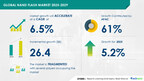
NEW YORK, Jan. 31, 2025 /PRNewswire/ — Report on how AI is redefining market landscape – The global nand flash market size is estimated to grow by USD 26.4 billion from 2025-2029, according to Technavio. The market is estimated to grow at a CAGR of almost 6.5% during the forecast period. Growing investments in fabrication facilities is driving market growth, with a trend towards rise in number of strategic partnerships and acquisitions. However, fluctuations in demand and supply poses a challenge. Key market players include ADATA Technology Co. Ltd., Berkshire Hathaway Inc., Flexxon Pte Ltd., Greenliant Systems, Hyperstone GmbH, Infineon Technologies AG, Innodisk Corp., Kingston Technology Co. Inc., Kioxia Corp., Macronix International Co. Ltd., Micron Technology Inc., Renesas Electronics Corp., Samsung Electronics Co. Ltd., Semiconductor Manufacturing International Corp., Shenzhen Longsys Electronics Co. Ltd., Silicon Motion Technology Corp., SK hynix Co. Ltd., Toshiba Corp., Transcend Information Inc., and UDISYS Ltd..

Key insights into market evolution with AI-powered analysis. Explore trends, segmentation, and growth drivers- View Free Sample PDF

NAND Flash Market Scope

Report Coverage

Details

Base year

2024

Historic period

2019 – 2023

Forecast period

2025-2029

Growth momentum & CAGR

Accelerate at a CAGR of 6.5%

Market growth 2025-2029

USD 26.4 billion

Market structure

Fragmented

YoY growth 2022-2023 (%)

5.2

Regional analysis

APAC, North America, Europe, South America, and Middle East and Africa

Performing market contribution

APAC at 61%

Key countries

China, US, Japan, South Korea, Taiwan, Germany, Singapore, India, France, and Italy

Key companies profiled

ADATA Technology Co. Ltd., Berkshire Hathaway Inc., Flexxon Pte Ltd., Greenliant Systems, Hyperstone GmbH, Infineon Technologies AG, Innodisk Corp., Kingston Technology Co. Inc., Kioxia Corp., Macronix International Co. Ltd., Micron Technology Inc., Renesas Electronics Corp., Samsung Electronics Co. Ltd., Semiconductor Manufacturing International Corp., Shenzhen Longsys Electronics Co. Ltd., Silicon Motion Technology Corp., SK hynix Co. Ltd., Toshiba Corp., Transcend Information Inc., and UDISYS Ltd.

Market Driver

The NAND flash market is experiencing significant trends in consumption, memory packaging, and fabrication facilities. High-density storage and 3D NAND technology are driving the demand for NAND flash in various industries such as tablets, cameras, sensors, automotive systems, medical devices, and electronics. NAND flash memory is essential for code, artificial intelligence, and machine learning applications in consumer electronics. NAND flash vendors are facing low supply and high demand, leading to supply shortages and rising costs. The industry chain is adapting to these challenges through purchase orders, optimized production strategies, and research and development. The growing demand for digital content, applications, and scalable storage capacities is making NAND flash memory an essential component in IoT ecosystems, handling massive datasets, and powering cloud service providers. The market is also diversifying into new markets such as AR/VR devices, 8K video recording, digital health records, and medical imaging. NAND manufacturers are focusing on longer development cycles, optimizing production, and strategic market positioning to adapt to cyclical market shifts and economic changes. The broader semiconductor industry is also impacted by raw materials, production delays, and environmental challenges, requiring a holistic approach to risk management and sustainable future measures. TrendForce reports that production capacity utilization is high, with chip makers and equipment manufacturers increasing production to meet demand. The semiconductor memory market is expected to grow, with NAND flash memory remaining a key player due to its speed, reliability, and flexibility. The market is also seeing advancements in high-capacity, fast data storage products, including SSDs, memory cards, and the high-performance Micron 3500 solid-state drive. These products cater to various industries, including automotive applications, cloud computing services, and 5G infrastructure. In conclusion, the NAND flash market is experiencing in demand due to technological advancements and the reliance on NAND flash for multifunctional communication, entertainment, productivity tools, and high-performance data processing. The industry is adapting to supply shortages and rising costs through strategic production strategies, research and development, and eco-friendly measures. The market is expected to remain a crucial component in the electronics sector, handling massive datasets, powering cloud computing infrastructure, and enabling diverse applications in various industries.

The NAND flash market is witnessing an increase in strategic partnerships and acquisitions, enabling vendors to expand their market presence. These collaborations allow companies to develop technological initiatives, such as the joint development of 3D NAND flash memory, and make capital investments according to market trends. For instance, Micron Technology’s partnership with seven industrial companies in February 2020 aims to deliver and innovative solutions for industrial applications, including factory automation, transportation, and defense systems, through the Micron IQ Partner Program. This collaboration strengthens the competitiveness of the involved parties and advances the development of high-quality, long-lasting NAND flash products.

Request Sample of our comprehensive report now to stay ahead in the AI-driven market evolution!

 Market Challenges

The NAND flash market is currently facing several challenges that are impacting both chip makers and equipment manufacturers. NAND flash consumption is growing rapidly due to the increasing demand for high-density storage in various industries such as tablets, cameras, sensors, automotive systems, medical devices, and electronics. This demand is driving the need for more advanced NAND technologies like 3D NAND and larger capacities in TLC segment, SLC, and MLC variants. However, the production capacity utilization is low due to supply shortages and rising costs. The industry chain is facing purchase orders that exceed supply, leading to price erosion and reduced profitability for NAND flash vendors. This situation is further complicated by cyclical market shifts, economic changes, and supply chain constraints. Moreover, technological advancements in areas like artificial intelligence, machine learning, and cloud computing infrastructure require faster, more reliable, and scalable storage capacities. Modern consumers rely on NAND flash memory for web browsing, email loading, games, social network sites, 5G wireless communication, and multifunctional communication devices. NAND flash memory is an essential component in diverse industries, including AR/VR devices, 8K video recording, digital health records, medical imaging, wearable devices, innovative city initiatives, and environmental monitoring systems. As a result, NAND flash memory vendors must diversify their products and optimize production strategies to meet the growing demand and handle massive datasets in data centers and cloud service providers. To address these challenges, NAND manufacturers need to adapt to the cyclical pattern of the semiconductor memory market, invest in research and development, and implement longer development cycles to stay competitive. They must also focus on optimizing production, reducing production costs, and managing risks through strategic market positioning and adaptive production strategies. The broader semiconductor industry is also facing challenges, including raw materials, production delays, increased costs, environmental challenges, and sustainability concerns. NAND flash memory vendors must address these challenges to ensure a sustainable future and eco-friendly measures in the industry. In summary, the NAND flash market is facing significant challenges due to growing demand, supply shortages, rising costs, and technological advancements. NAND flash vendors must adapt to these challenges through innovation, research and development, and strategic market positioning to maintain their global market dominance and meet the demands of enterprise use and storage solution providers.The NAND flash market experiences a significant challenge due to the widening demand-supply gap. This issue arises from the cyclical nature of the semiconductor industry, which affects the production and sales of NAND flash. The market relies on demand from industries such as smartphones, data centers, servers, cloud storage, and consumer electronics. Vendors attempt to align production with sales in these sectors, but unexpected changes in demand can result in oversupply or shortages. The dynamic semiconductor industry, influenced by consumer electronic demand fluctuations, emerging technologies, and manufacturing process changes, contributes to the persistent supply-demand imbalance.

Discover how AI is revolutionizing market trends- Get your access now!

Segment Overview

This nand flash market report extensively covers market segmentation by

Application 1.1 Smartphones1.2 SSDs1.3 Memory cards1.4 OthersType 2.1 3D NAND2.2 2D NANDTechnology 3.1 TLC3.2 MLC3.3 SLCGeography 4.1 APAC4.2 North America4.3 Europe4.4 South America4.5 Middle East and Africa

1.1 Smartphones- The global NAND flash market is experiencing growth due to several factors. The increasing penetration of the Internet and the widespread use of low-cost smartphones are driving the generation of large volumes of data, including audio, video, text, and encrypted blocks. Social media applications, such as Facebook, WhatsApp, and Instagram, are popular among users, leading to the storage of vast amounts of data by these companies. The adoption of high-resolution camera modules in smartphones for capturing selfies and recording videos is also contributing to the demand for NAND flash. The implementation of 4G and 5G networks and the use of AI in smartphone applications are further increasing the volume of data generated and stored in smartphones. Technavio expects smartphone manufacturers to incorporate multiple-lens camera systems, leading to an increased demand for high-capacity memory modules. All these factors are expected to fuel the growth of the NAND flash market during the forecast period.

Download a Sample of our comprehensive report today to discover how AI-driven innovations are reshaping competitive dynamics

Research Analysis

NAND flash consumption continues to soar, driven by the insatiable demand for high-density storage in consumer electronics. Memory packaging and fabrication facilities are working at full capacity to meet this demand, with a focus on 3D NAND technology to increase storage density. Edge storage and high-density data centers also contribute significantly to NAND flash market growth. Chip makers and equipment manufacturers collaborate to ensure a steady supply of NAND flash memory, but the industry faces a challenging balance between low supply and high demand. TrendForce reports that production capacity utilization remains high, reflecting the reliance on NAND flash memory in modern consumer devices such as tablets and cameras. Technological advancements in NAND flash memory are expected to further fuel demand, making it a key player in the semiconductor memory market.

Market Research Overview

NAND flash consumption continues to soar in the electronics device sector, fueled by the growing demand for high-density storage, edge storage, and 3D NAND. Memory packaging and fabrication facilities are working at full capacity to meet the insatiable appetite for flash memory. NAND flash is increasingly used in tablets, cameras, sensors, automotive systems, medical devices, processors, and various digital applications. Modern consumers rely on NAND flash memory for web browsing, email loading, games, social network sites, 5G wireless communication, and more. The semiconductor memory market, led by NAND flash, is expected to grow significantly due to technological advancements and the increasing importance of data storage in diverse industries. TrendForce reports that production capacity utilization is high, leading to supply shortages and rising costs for NAND flash. The industry chain is facing challenges due to low supply and high demand, which is impacting purchase orders and causing industry-wide disruptions. NAND flash memory is an essential component of cloud service providers, handling massive datasets and offering speed, reliability, and flexibility. Advancements in storage capacities and performance are driving innovation and development in the broader semiconductor industry. The NAND flash market is cyclical, with economic conditions, disposable incomes, and market demands influencing its pattern. NAND manufacturers are diversifying their products and optimizing production strategies to adapt to cyclical market shifts and economic changes. Despite challenges such as supply chain constraints, natural disasters, and global events, the future of NAND flash looks promising, with a focus on sustainability, eco-friendly measures, and longer development cycles. The market is expected to continue its growth trajectory, driven by the increasing importance of data storage in various industries and the need for scalable storage capacities.

Table of Contents:

1 Executive Summary
2 Market Landscape
3 Market Sizing
4 Historic Market Size
5 Five Forces Analysis
6 Market Segmentation

ApplicationSmartphonesSSDsMemory CardsOthersType3D NAND2D NANDTechnologyTLCMLCSLCGeographyAPACNorth AmericaEuropeSouth AmericaMiddle East And Africa

7 Customer Landscape
8 Geographic Landscape
9 Drivers, Challenges, and Trends
10 Company Landscape
11 Company Analysis
12 Appendix

About Technavio

Technavio is a leading global technology research and advisory company. Their research and analysis focuses on emerging market trends and provides actionable insights to help businesses identify market opportunities and develop effective strategies to optimize their market positions.

With over 500 specialized analysts, Technavio’s report library consists of more than 17,000 reports and counting, covering 800 technologies, spanning across 50 countries. Their client base consists of enterprises of all sizes, including more than 100 Fortune 500 companies. This growing client base relies on Technavio’s comprehensive coverage, extensive research, and actionable market insights to identify opportunities in existing and potential markets and assess their competitive positions within changing market scenarios.

Contacts

Technavio Research
Jesse Maida
Media & Marketing Executive
US: +1 844 364 1100
UK: +44 203 893 3200
Email: media@technavio.com
Website: www.technavio.com/

View original content to download multimedia:https://www.prnewswire.com/news-releases/nand-flash-market-to-grow-by-usd-26-4-billion-2025-2029-boosted-by-investments-in-fabrication-facilities-with-ai-impacting-market-trends—technavio-302364420.html

SOURCE Technavio

Continue Reading
Click to comment

Leave a Reply

Your email address will not be published. Required fields are marked *

Technology

KTGHR leverages AI-powered real-time transaction capabilities to expand its e-commerce infrastructure, reshaping the engine of enterprise growth.

Published

on

By

DALLAS, April 18, 2026 /PRNewswire-PRWeb/ — Against the backdrop of artificial intelligence continuously reshaping the global business landscape, KTGHR officially launched its new B2B AI-powered intelligent solution for enterprises, dedicated to helping them achieve comprehensive upgrades in cost reduction and efficiency improvement, precise customer acquisition, and intelligent operations.

KTGHR Launches New B2B AI Solution, Reshaping the Engine of Enterprise Growth

As an innovative platform focused on the deep integration of AI technology and business scenarios, KTGHR’s newly released system integrates core functions such as intelligent data analysis, AI-automated marketing, customer behavior prediction, and intelligent customer service. This enables enterprises to make rapid decisions in a complex and ever-changing market environment, achieving sustained business growth.

AI-Driven Precise Customer Acquisition, Comprehensively Improving Conversion Efficiency KTGHR uses advanced algorithm models to conduct in-depth analysis of global market data, helping enterprises accurately target potential customer groups. The system can automatically generate high-conversion marketing content and intelligently distribute it through multiple channels, significantly improving customer reach and conversion rates, enabling enterprises to truly achieve “automated customer acquisition.”

Intelligent Operation System, Relieving Pressure on Human Resource Costs With AI-automated processes, KTGHR can intelligently handle order management, customer follow-up, and data statistics, reducing manual intervention and improving overall operational efficiency. Enterprises can complete global business layouts without a large team.

Integrated B2B Ecosystem, Connecting the Global Supply Chain KTGHR is not just an AI tool platform, but a complete B2B ecosystem. By integrating supply chain resources and intelligent matching mechanisms, it achieves efficient connections between supply and demand, helping companies rapidly expand into international markets and build a borderless business network.

Technology Empowering the Future, Driving Enterprise Digital Transformation KTGHR states that it will continue to increase investment in artificial intelligence, promoting the implementation of more innovative functions to help companies seize opportunities in the digital economy era. With the continuous maturation of AI technology, the B2B industry is ushering in unprecedented development opportunities.

The launch of KTGHR is not only a technological upgrade but also a revolution in business models. For companies seeking breakthroughs and growth, this may be a key step towards the next stage of success.

KTGHR leverages advanced AI algorithms and big data analytics capabilities to achieve a leap from “information matching” to “intelligent decision-making.” The platform can automatically match supply and demand, accurately recommending high-potential partners, significantly reducing the time and cost for companies to find customers and supply chain resources.

By intelligently analyzing market trends and user behavior, KTGHR helps businesses anticipate opportunities, making every transaction more efficient and precise.

End-to-End Intelligent Management, Creating a Seamless Business Ecosystem

KTGHR is not just a transaction platform, but a complete AI business ecosystem. Its core functions include:

AI-powered Intelligent Customer Matching and RecommendationReal-time Data Analysis and Business ForecastingAutomated Order and Supply Chain ManagementSeamless Global Market Connection

Whether you are a small or medium-sized enterprise (SME) or a large multinational corporation, you can achieve digital transformation and global expansion through KTGHR.

Cost Reduction and Efficiency Improvement, Unleashing Business Growth Potential In the traditional B2B model, high communication costs, information asymmetry, and low conversion rates have long been problems. KTGHR, through AI-automated processes, significantly reduces human intervention, helping businesses: Reduce operating costs Increase conversion rates Shorten transaction cycles Enhance customer experience Allow businesses to truly focus on core business and strategic growth.

Seize the AI Business Opportunities and Win the Future As artificial intelligence technology matures, the B2B industry is entering a new era of “intelligent-driven” growth. KTGHR stands at the forefront of this transformation, providing businesses with a sustainable competitive advantage. Choosing KTGHR is not just choosing a platform, but choosing a high-speed gateway to the future of business. For more information, please visit the official KTGHR platform and begin your AI-powered business journey.

Media Contact

William, Ktghr.com, 1 +14255550100 99762, service@ktghr.it.com, Ktghr.com

View original content:https://www.prweb.com/releases/ktghr-leverages-ai-powered-real-time-transaction-capabilities-to-expand-its-e-commerce-infrastructure-reshaping-the-engine-of-enterprise-growth-302745582.html

SOURCE Ktghr.com

Continue Reading

Technology

Link Infinite: Hollyland Pyro Ultra Simplifies Multi-User Monitoring with 4K60 Wireless

Published

on

By

SHENZHEN, China, April 18, 2026 /PRNewswire/ — Hollyland, a global provider of professional wireless audio and video solutions, today announced the launch of Pyro Ultra, the new flagship in its Pyro series, featuring next-gen wireless video transmission technology that enables streamlined setup and uncompromised real-time performance. Engineered for professional creators and high-end production environments, Pyro Ultra balances high-performance transmission with practical on-set usability.

Building on Hollyland’s self-developed TWiFi technology, Pyro Ultra delivers one-to-many transmission, native 4K60 support, and a dedicated ultra-low-latency mode for focus pulling. Fully integrated into the Pyro ecosystem and equipped with DFS-ready operation, it is built to meet the demands of modern digital cinema workflows.

The New Standard for One-to-Many On-Set Transmission

In today’s production landscape, the video village is no longer confined to a single monitor. Directors, assistants, clients, and multiple departments require simultaneous, high-fidelity access to the live image across different positions on set.

While existing systems often force a choice between costly, over-engineered solutions and entry-level gear that struggles in demanding environments, Pyro Ultra offers a third approach. As one-to-many transmission becomes increasingly common across productions, it can introduce practical limits on device count and system stability in larger setups. Pyro Ultra’s Broadcast Mode addresses the issue by enabling a single transmitter to connect with an unlimited number of receivers, creating a fluid workflow. Every department, from lighting to hair and makeup, can monitor independently, which helps eliminate bottlenecks and accelerate decision-making.

Cinematic 4K60 Clarity Without Compromise

Image integrity is central to Pyro Ultra. With support for 4K60 transmission, the system delivers the detail and color accuracy required for high-end videography work. It also supports fractional frame rates, including 23.98 and 59.94 fps, commonly used in broadcast and professional pipelines. Its native compatibility enables direct connection to switchers and monitors without external converters, simplifying the signal path and reducing potential points of failure.

20ms Latency for Precise Focus Pulling

For first assistant camera operators and focus pullers, every millisecond counts. Pyro Ultra’s dedicated Focus Mode cuts latency to just 20ms, ensuring the real-time responsiveness needed for razor-sharp adjustments at any distance. The technical edge provides the freedom to navigate tight spaces or complex choreography with absolute confidence.

Powered by TWiFi Technology

At the core of Pyro Ultra is Hollyland’s TWiFi (dual-band wireless) technology. It leverages intelligent frequency management across the 2.4 GHz and 5 GHz bands to enable automatic hopping, ensuring a stable, high-bitrate connection even in congested RF environments. Pyro Ultra’s robust link supports a 1.5 km (4,900 ft) range and is fully DFS-ready, providing professional crews with reliable, globally compliant operation

Engineered for Modern Workflows & Seamless Integration

Pyro Ultra is built for today’s hybrid production workflows. With UVC (USB Video Class) support, it can connect directly to a computer for instant webcam functionality, removing the need for a capture card. Its RTMP support enables direct streaming to web platforms, simplifying remote collaboration. As part of the Pyro ecosystem, Ultra integrates seamlessly with existing Pyro devices. The modular design allows production teams to scale their setups based on project requirements, ensuring consistent performance across different production scenarios.

Pricing and Availability

Launched on April 18, 2026, Hollyland’s Pyro Ultra is now available through local distributors, the official Hollyland online store, and the Hollyland Amazon store.

The 1TX/1RX kit is priced at $1,199, and the 1TX/2RX kit at $1,699. Individual units can also be purchased separately, with transmitters starting at $699 and receivers at $579.

For more information, visit https://www.hollyland.com/product/pyro-ultra

About Hollyland

Hollyland is a leading provider of wireless products, specializing in wireless intercom systems, video transmission systems, monitors, wireless microphones, and live streaming cameras. Since 2013, Hollyland has been serving millions of users around the world in various sectors, including filmmaking, telecasting, video production, live events, exhibitions, theaters, houses of worship, and individual content creators. It has built a sales network covering approximately 150 countries and regions with support from dozens of localized operation offices worldwide. For more information, please visit https://www.hollyland.com/, Hollyland Facebook, and Hollyland Instagram.

View original content to download multimedia:https://www.prnewswire.com/news-releases/link-infinite-hollyland-pyro-ultra-simplifies-multi-user-monitoring-with-4k60-wireless-302742508.html

SOURCE Hollyland

Continue Reading

Technology

Three Papers Published Consecutively in Nature Energy: JinkoSolar’s Breakthroughs in TOPCon/Perovskite Tandem Technology Receive Authoritative Recognition

Published

on

By

SHANGHAI, April 18, 2026 /PRNewswire/ — JinkoSolar, the global leading PV and ESS supplier, recently published three research papers in succession within a single month in Nature Energy, one of the premier journals in the field of energy research. This series of papers showcases JinkoSolar’s multiple major breakthroughs in TOPCon and perovskite tandem cell technologies.

26.66%! Setting a New Record for Industrial-Scale TOPCon Cell Conversion Efficiency

JinkoSolar, in collaboration with the research team from the Ningbo Institute of Materials Technology and Engineering of the Chinese Academy of Sciences, successfully developed a dual-sided electrical synergy optimization strategy. This approach achieved a certified efficiency of up to 26.66% on M10-sized silicon wafers, setting a new efficiency record for industrial-scale TOPCon cells and significantly narrowing the gap between industrial-scale TOPCon cells and the theoretical efficiency of 29.4%.

Additionally, the research reduced carrier transport losses through a high-resistance boron emitter on the front side and an optimized fine-line grid design, while the back side employs an innovative double-layer tunneling silicon oxide/polysilicon structure on the rear side to effectively suppress performance degradation caused by silver paste puncture. Furthermore, by utilizing localized polysilicon thinning technology, the research achieved outstanding performance metrics, including an open-circuit voltage of 744.6 mV, a fill factor of 85.57%, and a bifaciality of 88.3%. This achievement provides a feasible and comprehensive solution for narrowing the efficiency gap between TOPCon cells and the theoretical limit, significantly enhancing the core competitiveness of TOPCon technology in the future photovoltaic market.

Reference link: Dual-side electrical refinement enables efficient industrial tunnel oxide passivating contact silicon solar cells:
https://www.nature.com/articles/s41560-026-01982-2

Certified Efficiency of 32.73%! Paving the Way for Scalable Compatibility of Perovskite/TOPCon Tandem Cells

JinkoSolar, in collaboration with the research team from Soochow University, has successfully developed a full-size bifacial TOPCon crystalline silicon solar cell with a certified photoconversion efficiency of 26.34%. This research abandons the traditional TOPCon cell design featuring a boron-diffused emitter on the front surface. Instead, it innovatively introduces patterned n-type TOPCon finger contacts on the front surface while retaining the full-area p-type TOPCon contact on the back. By localizing the polycrystalline silicon contact area, this structure significantly reduces parasitic absorption and recombination losses on the front surface, achieving a certified efficiency of 26.34% and significantly improving the open-circuit voltage.

Furthermore, to address the issues of poor contact performance and susceptibility to metal paste corrosion in P-type TOPCon, a “polysilicon/silicon dioxide/polysilicon” double-layer composite structure was designed. Combined with optimized rear-side polishing and a specially formulated silver paste, this structure not only achieves extremely low contact resistance and recombination current but, more importantly, the ultra-thin oxide layer in the middle effectively prevents silver crystal spikes from penetrating the silicon substrate, significantly enhancing the device’s reliability and high-temperature resistance. In the future, by improving the precision of laser patterning to further narrow the finger width and introducing localized contacts on the back side to reduce the polycrystalline silicon layer thickness, parasitic absorption can be reduced, and mass production efficiency is expected to approach 27%.

Using a high-efficiency bifacial TOPCon cell with a textured front surface as the bottom cell, the research team fabricated a monolithic perovskite/TOPCon tandem cell, achieving a certified efficiency of 32.73% and a high open-circuit voltage of 1.961 V. These results not only set a new performance record for this class of tandem cells but also demonstrated excellent long-term operational stability (maintaining 80% of the initial efficiency after 2,000 hours), proving the immense potential of this TOPCon technology route in tandem applications. They also provide a scalable and industrially compatible technical pathway for the development of higher-efficiency TOPCon and perovskite/TOPCon tandem photovoltaic modules.

Reference link: Bifacial tunnel oxide passivating contacts for silicon and perovskitesilicon tandem solar cells with improved efficiency: 
https://www.nature.com/articles/s41560-026-02007-8

32.76%! Breaking Through the Efficiency Barrier for Industrial TOPCon Silicon-Based Perovskite Tandem Cells

To address the critical challenge of rapid perovskite crystallization and film quality degradation caused by the high thermal conductivity of industrial thin silicon substrates, JinkoSolar, in collaboration with the National University of Singapore and other research institutions, innovatively proposed a strategy to regulate the major organic cation (FA⁺) using a dual-mode-coupled ligand (MBT), successfully achieving effective control over crystallization kinetics. A perovskite/TOPCon tandem solar cell fabricated using this strategy was certified by the National Photovoltaic Industry Metrology and Testing Center (NPVM) with a conversion efficiency of 32.76%, approaching the current efficiency record for tandem photovoltaic cells. Additionally, the cell maintained 91% of its initial efficiency after 1,700 hours of continuous operation, demonstrating excellent long-term operational reliability.

This research is of significant importance as it achieves high efficiency (certified at 32.76%) in TOPCon silicon-back-contact cells, which hold the greatest potential for market dominance. Not only does it elevate the efficiency of perovskite/TOPCon tandem cells to new heights, but more importantly, it provides critical scientific insights and a practical pathway for integrating high-performance perovskite materials from the laboratory with market-dominant TOPCon silicon technology, marking a solid step toward the mainstream industrialization of perovskite/ crystalline silicon tandem technology toward mainstream industrialization. In the future, this strategy is expected to be combined with solution-based production processes — which offer the potential for large-scale fabrication and low costs — to drive the industrial application of these research findings.

Reference link: Additive-assisted perovskite crystallization on industrial TOPCon silicon for tandem solar cells with improved efficiency: 
https://www.nature.com/articles/s41560-026-02010-z

View original content to download multimedia:https://www.prnewswire.com/news-releases/three-papers-published-consecutively-in-nature-energy-jinkosolars-breakthroughs-in-topconperovskite-tandem-technology-receive-authoritative-recognition-302746483.html

SOURCE JinkoSolar

Continue Reading

Trending