Connect with us

Technology

Digital Signage Market to Grow by USD 11.14 Billion from 2025-2029, Boosted by Retail Space Growth, with AI Impact on Market Transformation – Technavio

Published

on

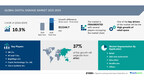
NEW YORK, Feb. 7, 2025 /PRNewswire/ — Report with the AI impact on market trends – The global digital signage market  size is estimated to grow by USD 11.14 billion from 2025-2029, according to Technavio. The market is estimated to grow at a CAGR of over 10.3%  during the forecast period. High growth of retail space is driving market growth, with a trend towards introduction of soc technology. However, lack of content relevance and decrease in content diversity  poses a challenge. Key market players include 3M Co., AT and T Inc., BrightSign LLC, Cayin Technology Co. Ltd., Cisco Systems Inc., ComQi, Daktronics Inc., Hon Hai Precision Industry Co. Ltd., HP Inc., Intel Corp., Keywest Technology Inc., Leyard Optoelectronic, LG Corp., Omnivex Corp., Panasonic Holdings Corp., Rokk3r, Samsung Electronics Co. Ltd., Scala, Sony Group Corp., and YFY Inc..

AI-Powered Market Evolution Insights. Our comprehensive market report ready with the latest trends, growth opportunities, and strategic analysis- View Free Sample Report PDF

Forecast period

2025-2029

Base Year

2024

Historic Data

2019 – 2023

Segment Covered

Application (Retail, QSR and restaurants, Education, Healthcare, and Others), Component (Hardware, Software, and Services), and Geography (North America, APAC, Europe, South America, and Middle East and Africa)

Region Covered

North America, APAC, Europe, South America, and Middle East and Africa

Key companies profiled

3M Co., AT and T Inc., BrightSign LLC, Cayin Technology Co. Ltd., Cisco Systems Inc., ComQi, Daktronics Inc., Hon Hai Precision Industry Co. Ltd., HP Inc., Intel Corp., Keywest Technology Inc., Leyard Optoelectronic, LG Corp., Omnivex Corp., Panasonic Holdings Corp., Rokk3r, Samsung Electronics Co. Ltd., Scala, Sony Group Corp., and YFY Inc.

Key Market Trends Fueling Growth

SOC, or System on Chip, is a technology gaining traction in the manufacturing of smartphones, tablets, and commercial displays. This innovation integrates essential processing components onto a single chip, reducing the need for additional components in digital systems. For digital signage applications, SOC technology can be incorporated into commercial displays, replacing multiple equipment such as media players. This streamlined solution allows digital signage operation directly from the screen, offering diagnostic information as well. The benefits of SOC technology in digital signage include cost savings on hardware and installation. Additionally, SOC simplifies digital content and application development and updates for digital signage systems. Content can be created using smartphones and tablets and easily uploaded to the digital signage system via SOC. This could lead to significant time savings in content creation and updating. Major players in the digital signage market, including SAMSUNG ELECTRONICS, LG Electronics, Panasonic, and Sony, offer SOC-compatible digital signage solutions. As a result, SOC is poised for significant growth as an integrated digital signage solution in the coming years, driving market expansion during the forecast period. 

The Digital Signage Market is thriving with the increasing number of internet users and the shift towards online advertising. Large audiences are engaged through digital signage in various sectors like retail, banking, hospitality, entertainment, healthcare, and more. Social media platforms and apps have become essential tools for targeted messaging and product promotion. Retail media, including retail stores, shopping malls, and supermarkets, leverage digital signage for an in-store customer experience. Digital signage offers eye-catching content through LED media boards, digital display panels, video walls, projectors, and multimedia content. Traditional static signs are being replaced with computerized systems that allow for dynamic content delivery, real-time updates, and targeted messaging. The 3PL market, transportation hubs, and airports are also adopting digital signage as a communication platform. Offering real-time content updates and remote management, digital signage is an effective tool for driving sales and attracting customers in the retail, banking, and hospitality industries. Digital signage solutions cater to diverse locations and offer customized offerings to meet specific business needs. 

Insights on how AI is driving innovation, efficiency, and market growth- Request Sample!

Market Challenges

The e-commerce industry’s growth over the last few years has led to an increase in the number of online retailers. These retailers have gained significant market share, reducing the reliance of consumers on traditional brick-and-mortar stores. Global retail e-commerce sales have consistently grown year-on-year, and this trend is expected to continue. However, this shift towards e-commerce could negatively impact the demand for digital signage equipment, as physical retail stores are the primary customers. Consequently, the growth rate of the digital signage market may be slightly impacted during the forecast period.The digital signage market is experiencing significant growth in various sectors like Hotels, Restaurants, Corporate offices, Transportation centers, and Education. Challenges include high cost of displays, customer experience, and power problems. Hardware and service providers face competition from traditional billboards and widescreen alternatives, as well as screenless displays. Technological developments, such as Near Field Communication and Touch Screen Technology, are driving innovation. Emerging display technologies like Micro-LED and Quantum dots are disrupting the market. Digital signage is increasingly being adopted by Government offices, the Educational sector, and Public Transports due to rapid digitalization. Large electronic giants are investing in advanced technologies like Artificial Intelligence, Machine Learning, and 5G technology to offer touchless & interactive solutions. The Retail industry is leveraging customer data and personalized content delivery through digital signage. Market consolidation, strategic expansion, partnerships, and collaborations are key trends. Digital signage providers must stay updated on these technological advancements to stay competitive in the market.

Insights into how AI is reshaping industries and driving growth- Download a Sample Report

Segment Overview 

This digital signage market report extensively covers market segmentation by

ApplicationRetailQSR And RestaurantsEducationHealthcareOthersComponentHardwareSoftwareServicesGeographyNorth AmericaAPACEuropeSouth AmericaMiddle East And Africa

1.1 Retail-  The Digital Signage Market is a growing industry that provides businesses with an effective way to display dynamic content on digital screens. This technology allows companies to engage customers with real-time information, promotions, and advertisements. The market is driven by the increasing demand for interactive and personalized marketing solutions. Businesses across various sectors, including retail, healthcare, and transportation, are adopting digital signage to enhance customer experience and boost sales. The market is expected to continue growing due to the flexibility and cost-effectiveness of digital signage solutions.

Download complimentary Sample Report to gain insights into AI’s impact on market dynamics, emerging trends, and future opportunities- including forecast (2025-2029) and historic data (2019 – 2023) 

Research Analysis

The Digital Signage Market encompasses various technologies and components, including LED media boards, digital display panels, video walls, projectors, and multimedia content. These systems utilize computerized systems, software, and hardware to deliver real-time content updates and create engaging communication platforms. Traditional static signs are being replaced with these dynamic displays, offering improved customer experience in various sectors such as education, government offices, and retail. Cost-effective solutions like LED media boards and digital display panels are driving market growth. Technological developments, such as video walls, projectors, and emerging display technologies like Micro-LED, are expanding the market’s scope. Real-time content updates and remote management capabilities enhance the value proposition of digital signage. Traditional billboards and widescreen alternatives are being challenged by these digital displays. Power problems and screenless displays are potential challenges. Large screen displays are popular in public spaces, offering a more experience. The education sector is a significant end user, while government offices and the retail industry also contribute significantly to the market’s growth.

Market Research Overview

The digital signage market is experiencing rapid digitalization, with LED media boards, digital display panels, video walls, projectors, and other multimedia technologies replacing traditional static signs. Real-time content updates, remote management, and communication platforms offer advanced capabilities for retail establishments, airports, hotels, restaurants, corporate offices, transportation centers, and other locations. Hardware and service offerings continue to evolve, with emerging display technologies like Micro-LED and quantum dots, as well as artificial intelligence, machine learning, and 5G technology driving innovation. The market is also seeing consolidation, strategic expansion, partnerships, and collaborations among digital signage providers. The retail industry is a major driver of growth, with personalized content delivery, audience analytics, and real-time data-driven decision-making becoming increasingly important. Digital signage is also being used for online advertisement and broadcast, reaching large audiences through social media platforms, apps, and retail media. The market is expected to continue growing as technological advancements and touchless & interactive solutions become more prevalent in various industries, including banking, hospitality, entertainment, healthcare, and education. The cost of displays and power problems remain challenges, but innovative solutions are being developed to address these issues.

Table of Contents:

1 Executive Summary
2 Market Landscape
3 Market Sizing
4 Historic Market Size
5 Five Forces Analysis
6 Market Segmentation

ApplicationRetailQSR And RestaurantsEducationHealthcareOthersComponentHardwareSoftwareServicesGeographyNorth AmericaAPACEuropeSouth AmericaMiddle East And Africa

7 Customer Landscape
8 Geographic Landscape
9 Drivers, Challenges, and Trends
10 Company Landscape
11 Company Analysis
12 Appendix

About Technavio

Technavio is a leading global technology research and advisory company. Their research and analysis focuses on emerging market trends and provides actionable insights to help businesses identify market opportunities and develop effective strategies to optimize their market positions.

With over 500 specialized analysts, Technavio’s report library consists of more than 17,000 reports and counting, covering 800 technologies, spanning across 50 countries. Their client base consists of enterprises of all sizes, including more than 100 Fortune 500 companies. This growing client base relies on Technavio’s comprehensive coverage, extensive research, and actionable market insights to identify opportunities in existing and potential markets and assess their competitive positions within changing market scenarios.

Contacts

Technavio Research
Jesse Maida
Media & Marketing Executive
US: +1 844 364 1100
UK: +44 203 893 3200
Email: media@technavio.com
Website: www.technavio.com/

View original content to download multimedia:https://www.prnewswire.com/news-releases/digital-signage-market-to-grow-by-usd-11-14-billion-from-2025-2029–boosted-by-retail-space-growth-with-ai-impact-on-market-transformation—technavio-302371182.html

SOURCE Technavio

Continue Reading
Click to comment

Leave a Reply

Your email address will not be published. Required fields are marked *

Technology

Chef Robotics Physical AI Models Can Now Automate Baked Goods Packing

Published

on

By

SAN FRANCISCO, April 29, 2026 /PRNewswire/ — Chef Robotics, a leader in physical AI for the food industry, today announced that Chef robots can now automate tray assembly for baked goods packing. The application places baked products, such as burger buns, chocolate chip cookies, biscotti, butter cookies, biscuits, fortune cookies, granola bars, rusks, and shortbreads into trays and packaging containers before sealing.

Watch Chef robots in action.

Baked goods packing has historically been difficult to automate for high-mix production. Each item behaves differently on the production line—a granola bar compresses under the wrong grip, while a biscotti or rusk can crack if placed at the wrong angle. Surface textures range from glazed and smooth to crumbly and irregular, and strict presentation requirements leave little room for error. This variability has made it challenging for automation systems to reliably handle baked goods at production speeds, leaving food manufacturers dependent on manual labor and traditional bakery equipment.

To address this, Chef built its baked goods packing application on its existing piece-picking capability, which uses Chef’s AI-powered computer vision and physical AI models trained across diverse real-world production environments. This allows Chef robots to assess each item’s position, shape, and orientation in real time and determine how to pick the items from the pan and place them quickly and precisely without damaging them.

The baked goods packing application supports four distinct placement capabilities.

First, Chef’s vision system detects the angle at which each item sits in the pan and reorients it after picking, placing it on the tray at the exact angle required, regardless of its original position, enabling retail-ready presentation for SKUs that require precise angular placement.

Second, Chef robots can place multiple baked goods into the same packaging container in a single automated pass, completing full tray assembly without manual intervention.

Third, for packaging containers with multiple small compartments, Chef robots can precisely place items into each designated section, including multiple items in the same compartment, using Chef’s AI vision model to detect compartment positions and orientations in real time.

Fourth, Chef’s vision system identifies the exact center of each tray and places every item at a predefined offset from that center, ensuring a uniform, consistent arrangement across every pack regardless of how trays arrive on the conveyor.

For food manufacturers evaluating bakery systems and baked goods packaging automation, the application offers higher throughput, reduced labor dependency, and consistent presentation across shifts. The capability runs on Chef’s existing robotic hardware and software, allowing manufacturers to deploy it without requiring any changes to their production lines.

Chef’s baked goods packing application is available in the U.S., Canada, Germany, and the UK and is included as part of Chef’s robotics-as-a-service (RaaS) pricing model.

About Chef Robotics
Chef is the first company to have commercialized a scalable AI-driven food robotics solution. With over 104 million servings made in production, Chef leverages ChefOS, an AI platform for food manipulation, to offer a Robotics-as-a-Service solution that helps industry-leading food companies increase production volume and meet demand. Headquartered in San Francisco, CA, Chef aims to empower humans to do what humans do best by accelerating the advent of intelligent machines. Visit https://chefrobotics.ai to learn more.

View original content:https://www.prnewswire.com/news-releases/chef-robotics-physical-ai-models-can-now-automate-baked-goods-packing-302756923.html

SOURCE Chef Robotics

Continue Reading

Technology

Chef Robotics Physical AI Models Can Now Automate Baked Goods Packing

Published

on

By

SAN FRANCISCO, April 29, 2026 /PRNewswire/ — Chef Robotics, a leader in physical AI for the food industry, today announced that Chef robots can now automate tray assembly for baked goods packing. The application places baked products, such as burger buns, chocolate chip cookies, biscotti, butter cookies, biscuits, fortune cookies, granola bars, rusks, and shortbreads into trays and packaging containers before sealing.

Watch Chef robots in action.

Baked goods packing has historically been difficult to automate for high-mix production. Each item behaves differently on the production line—a granola bar compresses under the wrong grip, while a biscotti or rusk can crack if placed at the wrong angle. Surface textures range from glazed and smooth to crumbly and irregular, and strict presentation requirements leave little room for error. This variability has made it challenging for automation systems to reliably handle baked goods at production speeds, leaving food manufacturers dependent on manual labor and traditional bakery equipment.

To address this, Chef built its baked goods packing application on its existing piece-picking capability, which uses Chef’s AI-powered computer vision and physical AI models trained across diverse real-world production environments. This allows Chef robots to assess each item’s position, shape, and orientation in real time and determine how to pick the items from the pan and place them quickly and precisely without damaging them.

The baked goods packing application supports four distinct placement capabilities.

First, Chef’s vision system detects the angle at which each item sits in the pan and reorients it after picking, placing it on the tray at the exact angle required, regardless of its original position, enabling retail-ready presentation for SKUs that require precise angular placement.

Second, Chef robots can place multiple baked goods into the same packaging container in a single automated pass, completing full tray assembly without manual intervention.

Third, for packaging containers with multiple small compartments, Chef robots can precisely place items into each designated section, including multiple items in the same compartment, using Chef’s AI vision model to detect compartment positions and orientations in real time.

Fourth, Chef’s vision system identifies the exact center of each tray and places every item at a predefined offset from that center, ensuring a uniform, consistent arrangement across every pack regardless of how trays arrive on the conveyor.

For food manufacturers evaluating bakery systems and baked goods packaging automation, the application offers higher throughput, reduced labor dependency, and consistent presentation across shifts. The capability runs on Chef’s existing robotic hardware and software, allowing manufacturers to deploy it without requiring any changes to their production lines.

Chef’s baked goods packing application is available in the U.S., Canada, Germany, and the UK and is included as part of Chef’s robotics-as-a-service (RaaS) pricing model.

About Chef Robotics
Chef is the first company to have commercialized a scalable AI-driven food robotics solution. With over 104 million servings made in production, Chef leverages ChefOS, an AI platform for food manipulation, to offer a Robotics-as-a-Service solution that helps industry-leading food companies increase production volume and meet demand. Headquartered in San Francisco, CA, Chef aims to empower humans to do what humans do best by accelerating the advent of intelligent machines. Visit https://chefrobotics.ai to learn more.

View original content:https://www.prnewswire.com/news-releases/chef-robotics-physical-ai-models-can-now-automate-baked-goods-packing-302756923.html

SOURCE Chef Robotics

Continue Reading

Technology

Air Products to Expand Industrial Gas Supply for Samsung Electronics’ Next-Generation Semiconductor Fab in South Korea

Published

on

By

New investment underscores the company’s long-term commitment to Korea and its leading role in the global semiconductor industry 

LEHIGH VALLEY, Pa., April 29, 2026 /PRNewswire/ — Air Products (NYSE:APD), a world-leading industrial gases company and serving Samsung globally, today announced it has been selected by Samsung to supply industrial gases for its new advanced semiconductor fab in Pyeongtaek, Gyeonggi Province, South Korea.

Under the agreement, Air Products will build, own and operate multiple state-of-the-art production facilities and a bulk specialty gas supply system to supply nitrogen, oxygen, argon, and hydrogen for Samsung’s new semiconductor fab. The new facilities are expected to come onstream in multiple phases from 2028 through 2030.

Air Products has a long track record of executing multiple phase expansions in Pyeongtaek to support Samsung’s growing manufacturing needs. This latest project represents Air Products’ largest investment to date in the semiconductor industry and will establish Pyeongtaek as the company’s single largest operations site globally supporting the electronics industry. 

“Air Products is honored to be selected once again by Samsung and to have their continued confidence as a trusted partner supporting their strategic growth plans,” said SR Kim, President, Air Products Korea. “This significant investment reinforces Air Products’ role as a leading global supplier to the semiconductor industry and underscores our long-standing commitment to supporting our strategic customers with safety, reliability, efficiency and excellent service.”

Air Products has served the global electronics industry for more than 40 years, supplying industrial gases safely and reliably to many of the world’s leading technology companies. The company has operated in Korea for more than 50 years and has established a strong position in electronics and manufacturing sectors.

About Air Products

Air Products (NYSE: APD) is a world-leading industrial gases company in operation for over 85 years focused on serving energy, environmental, and emerging markets and generating a cleaner future. The Company supplies essential industrial gases, related equipment and applications expertise to customers in dozens of industries, including refining, chemicals, metals, electronics, manufacturing, medical and food. As the leading global supplier of hydrogen, Air Products also develops, engineers, builds, owns and operates some of the world’s largest clean hydrogen projects, supporting the transition to low- and zero-carbon energy in the industrial and heavy-duty transportation sectors. Through its sale of equipment businesses, the Company also provides turbomachinery, membrane systems and cryogenic containers globally.

Air Products had fiscal 2025 sales of $12 billion from operations in approximately 50 countries. For more information, visit airproducts.com or follow us on LinkedInXFacebook or Instagram.

This release contains “forward-looking statements” within the safe harbor provisions of the Private Securities Litigation Reform Act of 1995. These forward-looking statements are based on management’s expectations and assumptions as of the date of this release and are not guarantees of future performance. While forward-looking statements are made in good faith and based on assumptions, expectations and projections that management believes are reasonable based on currently available information, actual performance and financial results may differ materially from projections and estimates expressed in the forward-looking statements because of many factors, including the risk factors described in our Annual Report on Form 10-K for the fiscal year ended September 30, 2025 and other factors disclosed in our filings with the Securities and Exchange Commission. Except as required by law, we disclaim any obligation or undertaking to update or revise any forward-looking statements contained herein to reflect any change in the assumptions, beliefs or expectations or any change in events, conditions or circumstances upon which any such forward-looking statements are based.

View original content to download multimedia:https://www.prnewswire.com/news-releases/air-products-to-expand-industrial-gas-supply-for-samsung-electronics-next-generation-semiconductor-fab-in-south-korea-302757497.html

SOURCE Air Products

Continue Reading

Trending