Technology
Secondary Tickets Market to Grow by USD 89.7 Billion from 2025-2029, Driven by Rising Popularity of Sports Events, Report on AI’s Role in Market Transformation – Technavio
Published
2 years agoon
By
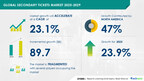
NEW YORK, Feb. 7, 2025 /PRNewswire/ — Report with the AI impact on market trends – The global secondary tickets market size is estimated to grow by USD 89.7 billion from 2025-2029, according to Technavio. The market is estimated to grow at a CAGR of 23.1% during the forecast period. Rising popularity of sports events is driving market growth, with a trend towards adoption of dynamic pricing. However, growing consumption of online content poses a challenge. Key market players include Ace Ticket LLC, Anschutz Entertainment Group Inc., Citizen Ticket Ltd., Coast To Coast Tickets LLC, CTS Eventim AG and Co. KGaA, eBay Inc., Eventbee Inc., Eventbrite Inc., Face-value Alliance Ticketing Ltd., Ideabud LLC, Live Nation Entertainment Inc., PrimeSport LLC, SeatGeek Inc., Ticket City Inc., TicketNetwork Inc., TickPick LLC, TiqIQ LLC, Twickets Ltd., Viagogo Entertainment Inc., and Vivid Seats Inc..
Key insights into market evolution with AI-powered analysis. Explore trends, segmentation, and growth drivers- View Free Sample PDF
Secondary Tickets Market Scope
Report Coverage
Details
Base year
2024
Historic period
2019 – 2023
Forecast period
2025-2029
Growth momentum & CAGR
Accelerate at a CAGR of 23.1%
Market growth 2025-2029
USD 89.7 billion
Market structure
Fragmented
YoY growth 2022-2023 (%)
23.9
Regional analysis
North America, APAC, Europe, South America, and Middle East and Africa
Performing market contribution
North America at 47%
Key countries
US, China, UK, Canada, Japan, Germany, India, Australia, South Korea, and France
Key companies profiled
Ace Ticket LLC, Anschutz Entertainment Group Inc., Citizen Ticket Ltd., Coast To Coast Tickets LLC, CTS Eventim AG and Co. KGaA, eBay Inc., Eventbee Inc., Eventbrite Inc., Face-value Alliance Ticketing Ltd., Ideabud LLC, Live Nation Entertainment Inc., PrimeSport LLC, SeatGeek Inc., Ticket City Inc., TicketNetwork Inc., TickPick LLC, TiqIQ LLC, Twickets Ltd., Viagogo Entertainment Inc., and Vivid Seats Inc.
Market Driver
The secondary tickets market, which includes the resale of tickets for sold-out concerts, big athletic events, and blockbuster theatrical plays, has seen a significant spike in demand due to customer willingness for convenient participation in these events. However, this market is not without its challenges. Fraudulent activities, such as unfair competition and ticket scalping, have raised moral concerns. Dishonest persons use bots and automated software to buy tickets in restricted quantities and resell them at exorbitant costs. These practices undermine consumer trust and create risks for sincere fans. Ethical considerations and technological changes are essential to creating an equitable ticket allocation in the user-friendly ecosystem of secondary ticket marketplaces. The entertainment industry and consumers alike must address these issues to ensure authentic tickets are available at acceptable prices.
Dynamic pricing is a flexible pricing strategy used by businesses to set ticket prices based on current market demand. In the secondary tickets market, event organizers and teams may adjust prices based on factors like holidays, player injuries, team records, day of the week, and weather forecasts. Prices can rise or fall within pre-set limits to maximize revenue and meet demand. This strategy allows for more efficient ticket distribution and can help ensure fair prices for consumers. Organizers often establish rules to prevent excessive price fluctuations, maintaining a balance between affordability and profitability.
Request Sample of our comprehensive report now to stay ahead in the AI-driven market evolution!
Market Challenges
The secondary tickets market presents significant challenges for official channels in the entertainment industry. With sold-out concerts, big athletic events, and blockbuster theatrical plays, the demand for tickets often outstrips the restricted quantity available. This creates an opportunity for fraudulent activities, such as unfair competition, ticket scalping, and resale of tickets at exorbitant costs. Dishonest persons use bots and algorithms to buy tickets in bulk and sell them at inflated prices, eroding customer trust. Moral concerns arise as sincere fans are priced out, while scalpers command a global market. However, consumer complaints and technological changes are driving innovation. Blockchain technology offers solutions through ticket ownership, authentic tickets, and acceptable prices. User-friendly ecosystems, security measures, and equitable ticket allocation are becoming essential to maintain a healthy market. The entertainment industry must address these challenges to ensure a fair and ethical secondary tickets market.In 2021, the online video market experienced a significant growth, with a ten-fold increase in the number of videos watched compared to previous years. This trend was driven by the increasing average Internet speed worldwide. Developing countries, such as Pakistan, India, and Brazil, reported notable gains, with a 56%, 71%, and 32% increase in Internet speed, respectively. Affordable Internet packages from network providers have contributed to this growth, enabling more consumers to connect at a lower cost. The availability of economic data plans has expanded Internet access, leading in the number of users.
Discover how AI is revolutionizing market trends- Get your access now!
Segment Overview
This secondary tickets market report extensively covers market segmentation by
TypeSports EventsConcertsPerforming ArtsMoviesMode Of BookingOnlineOfflineGeographyNorth AmericaAPACEuropeSouth AmericaMiddle East And Africa
1.1 Sports events- The sports events segment is anticipated to dominate the global secondary tickets market due to the increasing popularity of various sports like rugby, soccer, football, cricket, baseball, and tennis. Major events such as the NFL, MLB, UEFA Champions League, and Super Bowl have seen a In attendance, leading to an increase in sales of secondary tickets. Secondary ticket sellers acquire tickets from primary sources, including official team or league websites and box offices. Season ticket holders, who may not be able to attend all games, contribute significantly to the sports events segment. They sell their unused tickets on secondary platforms, thereby fueling market growth.
Download a Sample of our comprehensive report today to discover how AI-driven innovations are reshaping competitive dynamics
Research Analysis
The secondary tickets market refers to the buying and selling of tickets for events that have already been sold out through unofficial channels. This marketplace caters to the high demand for participation in sold-out concerts, big athletic events, and blockbuster theatrical plays. However, it is not without its controversies. Fraudulent activities such as unfair competition, ticket scalping, and resale of tickets at exorbitant costs by dishonest persons and automated software pose ethical concerns. Sincere fans may be left disappointed by inflated prices and deceptive advertising on third-party platforms. Moral concerns aside, the risks associated with the secondary tickets market include the possibility of purchasing fraudulent tickets and the lack of customer trust. Despite these challenges, the convenience of securing tickets to popular events remains a significant draw for many.
Market Research Overview
The secondary tickets market refers to the buying and selling of tickets for events outside of official channels. This marketplace is characterized by high demand for sold-out concerts, big athletic events, and blockbuster theatrical plays. However, it is not without its challenges. Fraudulent activities, such as unfair competition and ticket scalping, are common, raising ethical concerns. Demand for tickets often outstrips supply, leading to inflated costs and risks for customers. Dishonest persons use automated software, bots, and algorithms to buy tickets in large quantities and resell them at exorbitant prices. Moral concerns around ticket scalping and the resale of tickets have led to calls for more equitable ticket allocation and user-friendly ecosystems. Consumer complaints and technological changes are driving the adoption of blockchain technology to ensure ticket ownership and authenticity. The secondary ticket market is a global marketplace, with casual sellers and professional resellers/brokers commanding a commanding presence. The entertainment industry, urbanization, and customers’ appetite for experiences continue to fuel the demand for this market.
Table of Contents:
1 Executive Summary
2 Market Landscape
3 Market Sizing
4 Historic Market Size
5 Five Forces Analysis
6 Market Segmentation
TypeSports EventsConcertsPerforming ArtsMoviesMode Of BookingOnlineOfflineGeographyNorth AmericaAPACEuropeSouth AmericaMiddle East And Africa
7 Customer Landscape
8 Geographic Landscape
9 Drivers, Challenges, and Trends
10 Company Landscape
11 Company Analysis
12 Appendix
About Technavio
Technavio is a leading global technology research and advisory company. Their research and analysis focuses on emerging market trends and provides actionable insights to help businesses identify market opportunities and develop effective strategies to optimize their market positions.
With over 500 specialized analysts, Technavio’s report library consists of more than 17,000 reports and counting, covering 800 technologies, spanning across 50 countries. Their client base consists of enterprises of all sizes, including more than 100 Fortune 500 companies. This growing client base relies on Technavio’s comprehensive coverage, extensive research, and actionable market insights to identify opportunities in existing and potential markets and assess their competitive positions within changing market scenarios.
Contacts
Technavio Research
Jesse Maida
Media & Marketing Executive
US: +1 844 364 1100
UK: +44 203 893 3200
Email: media@technavio.com
Website: www.technavio.com/
View original content to download multimedia:https://www.prnewswire.com/news-releases/secondary-tickets-market-to-grow-by-usd-89-7-billion-from-2025-2029–driven-by-rising-popularity-of-sports-events-report-on-ais-role-in-market-transformation—technavio-302370836.html
SOURCE Technavio
You may like
Technology
Volvo Cars Q3 2026: taking decisive action to navigate a very tough environment
Published
48 minutes agoon
October 23, 2026By
GOTHENBURG, Sweden, Oct. 23, 2026 /PRNewswire/ — Volvo Cars today reports an operating income, excluding joint ventures & associates and items affecting comparability, of SEK -3.7 billion and a corresponding EBIT margin of -5.6 per cent for the third quarter of 2026. The result reflects a further deteriorating external environment, led by market developments in China and the US.
Q3 revenue was SEK 66.9 bn (SEK 86.4 bn in Q3 2025)Q3 operating income was SEK -5.6 bn (SEK 6.4 bn in Q3 2025)Q3 EBIT (excl. share of income in JVs & associates and IAC) was SEK -3.7 bn (SEK 5.8 bn in Q3 2025)Q3 EBIT margin was -8.4 per cent (7.4 per cent in Q3 2025)Q3 EBIT margin (excl. share of income in JVs & associates and IAC) of -5.6 per cent (6.7 per cent in Q3 2025)Q3 basic earnings per share were SEK -1.63 (SEK 1.75 in Q3 2025)Q3 fully electric car sales share at 32 per cent (22 per cent in Q3 2025)Q3 electrified car sales share at 53 per cent (46 per cent in Q3 2025)Q3 free cash flow of SEK -8.9 billion (SEK -4.3 billion in Q3 2025)
Volvo Cars today reports an operating income, excluding joint ventures & associates and items affecting comparability, of SEK -3.7 billion and a corresponding EBIT margin of -5.6 per cent for the third quarter of 2026. The result reflects a further deteriorating external environment, led by market developments in China and the US.
Volvo Cars remains a leader in the premium fully electric (BEV) segment, underpinned by a resilient performance in Europe where it had a BEV sales share of 45 per cent in Q3. But the situation in China and the US was considerably tougher, which also negatively affected free cash flow.
In China, Volvo Cars and other legacy premium brands faced hypercompetition from new Chinese alternatives, as well as severe pricing pressure. As a result, Volvo Cars’ revenues in China fell by almost 50 per cent year-on-year. In the US, Volvo Cars saw continued negative effects from tariffs and the removal of consumer incentives for electrified cars, which pressured margins.
The company’s Q3 result was also affected by other external developments: a negative revaluation of SEK 1.1 billion in CAFE credits due to legislation changes in the US, negative raw material developments, and SEK -0.9 billion due to the recognition of Polestar’s losses in Q2 2026.
In response to the result, Volvo Cars aims to reduce an additional SEK 5 billion in indirect spend and variable costs, on top of earlier cost programmes it successfully completed. These actions will lead to a structural reduction of approximately 2,500 jobs globally, of which 2,000 are based in Sweden, by ending consultant contracts, through natural attrition and by targeted exit packages to employees.
Full financial effects of these measures will be realised by the end of 2027, by which time the company’s overall indirect spend will be almost 25 per cent lower versus FY 2024.
The company is also working at speed on its recently announced, largest-ever product push. This consists of 13 new cars between now and the end of 2030, with a tailored portfolio of new cars for Europe, the US and China and more localised production. Already in 2027, Volvo Cars will reveal three of these new cars: one new car for Europe and two China-specific models.
More details about Volvo Cars’ performance can be found in the Q3 2026 financial report.
“We continue to operate in a very tough environment with strong external challenges: de-globalisation, hypercompetition and climate change. We are convinced that we have the right long-term strategy addressing these challenges,” says Håkan Samuelsson, president and CEO. “However, in the short term, with severely challenged volumes, we need to reinforce our turnaround plan with additional decisive actions, lowering our break-even point and improving cash flows to make us more resilient.”
A reinforced turnaround plan with the right regional products
Reflecting its strong BEV position in Europe, the EX60 has been a big success with over 50,000 European orders and it will be one of Volvo Cars’ most profitable models. Due to new industrial technology such as cell-to-body it is taking longer than planned to ramp up production, but Volvo Cars is steadily improving built volumes.
In 2027 Volvo Cars will introduce its next global BEV car, which targets a large, lower priced market segment in Europe, with the first customer deliveries starting after summer. This will further strengthen its BEV leadership and improve margins.
In the US, Volvo Cars has divided the market in four regions to enable faster decision-making and improve sales. It is fast-tracking the production start of the long-range plug-in hybrid versions of the XC90 and XC60, with European deliveries starting this year and the US shortly after. In Q1 2027, it will localise XC60 production in Charleston. By the end of the decade, it will localise a second, all-new car with multiple powertrain options.
In China, the next two years will remain tough, so Volvo Cars is taking further cost-efficiency actions to weather the storm. For example, it will combine its two offices in Shanghai by moving the sales office to the local HQ in Jiading.
Mid-next year Volvo Cars will reveal and start production of the first two of six new China-tailored cars, through closer cooperation with Geely. These cars will be developed with a Chinese tech stack and the latest ADAS technologies to make them fully competitive in China.
Additional cost and cash actions
Volvo Cars will achieve the additional savings of SEK 5 billion by driving structural change, lowering corporate overheads and empowering its regions. It is adapting its blue-collar workforce to current volumes by leveraging existing flexibility and will continue to reduce R&D costs, as it has already established its tech foundation with SPA3 and HuginCore.
Volvo Cars will also develop a more efficient production structure by concentrating on five dedicated Volvo plants globally. For its Chengdu and Ghent plants the company is exploring the option of multi-brand assembly together with Geely.
In addition, the company will further lower its variable costs, for example by increasing its common supplier base with Geely Group and adopting more common hardware parts in its cars.
Finally, Volvo Cars will continue to prioritise cash. The company has passed its investment peak and has now returned to normal and affordable investment levels, corresponding to an approximately 30 per cent reduction compared to 2024.
Note to editors
Volvo Cars will host a livestream on its Q3 2026 results for media, investors and analysts at 08:00 CET today. The presentation will be held in English and followed by a Q&A session.
It will be possible to ask questions during the Q&A session following the main presentation. To participate, you can either use the chat function online to type your question, or you can call in. To call in, participants need to register via the link below and will then receive the dial-in details and individual PIN.
This disclosure contains information that Volvo Car AB (publ) is obliged to make public pursuant to the EU Market Abuse Regulation (EU nr 596/2014). The information was submitted for publication, through the agency of the contact person, on 23-10-2026 07:00 CET.
For further information please contact:
Volvo Cars Media Relations
+46 31-59 65 25
media@volvocars.com
Volvo Cars Investor Relations
+46 31-793 94 00
investors@volvocars.com
This information was brought to you by Cision http://news.cision.com
The following files are available for download:
https://mb.cision.com/Main/20685/4414242/4335538.pdf
VCG_ENG_Q3 2026-10-23
https://news.cision.com/volvo-car-ab–publ-/i/jpg-medium-ste-1901-xc90-lr,c3575569
JPG Medium-STE 1901 XC90 LR
View original content:https://www.prnewswire.com/news-releases/volvo-cars-q3-2026-taking-decisive-action-to-navigate-a-very-tough-environment-302917802.html
SOURCE Volvo Car AB (publ)
Technology
Artery AT32 AI Studio Empowers Edge Intelligence, Accelerating AI Application Deployment
Published
49 minutes agoon
October 23, 2026By
TAIPEI, Oct. 23, 2026 /PRNewswire/ — As artificial intelligence (AI) technology continues to advance rapidly, AI is expanding from cloud computing to edge devices, with applications such as intelligent sensing, voice interaction, and visual recognition increasingly being integrated into a wide range of end devices.
Focusing on the development of edge intelligence, Artery continues to strengthen its AT32 ecosystem with AT32 AI Studio, a one-stop edge AI development platform designed to help developers efficiently build and deploy edge AI applications on AT32 MCUs, lower the barriers to AI development, and accelerate the transition from AI models to real-world products.
An Integrated Toolchain Streamlining the Entire Edge AI Development Process
AT32 AI Studio integrates key capabilities throughout the edge AI development process, including data processing, model training and optimization, simulation and validation, and code generation, into a unified development environment. This integration helps developers reduce tool switching and repetitive configuration, enabling more efficient integration of AI models into AT32 MCU applications.
With its graphical development workflow and automated code generation capabilities, developers can build AI applications more intuitively and quickly convert optimized models into embedded code compatible with the AT32 platform, further shortening the development cycle from algorithm validation to product implementation.
Optimized for Edge Computing, Enabling Lightweight AI Model Deployment
For resource-constrained embedded devices, model size, memory usage, computational requirements, and power consumption often directly determine whether AI applications can be successfully deployed.
AT32 AI Studio provides model optimization capabilities tailored to edge deployment requirements. Through techniques such as quantization and compression, the platform reduces model storage and computational resource requirements while maintaining accuracy and improving execution efficiency on AT32 MCUs. In addition, the platform includes lightweight neural network models designed for embedded applications, providing developers with an AI development foundation better suited to the resource constraints of MCUs. These capabilities enable AI algorithms to move beyond basic execution toward practical deployment and real-world applications.
Unlocking the Potential of AT32 Edge AI Across Diverse Applications
AT32 AI Studio has been successfully applied to various scenarios, including voice keyword recognition, Time-of-Flight (ToF)-based gesture recognition, and industrial anomaly detection, demonstrating its versatility. By leveraging AT32 AI Studio, developers can combine AI algorithms with the hardware capabilities of AT32 MCUs to enhance sensing and decision-making capabilities in end devices, expanding the potential of MCU-based applications in smart homes, industrial control, smart wearables, and human-machine interaction.
Focused on Practical Deployment, Bringing AI Development Closer to Real-World Products
For embedded AI applications, successful execution of a model on a PC does not necessarily guarantee stable operation on actual hardware. Model accuracy, resource utilization, and real-world performance must still be validated in the target hardware environment.
AT32 AI Studio incorporates simulation, evaluation, and practical deployment as essential stages of the development process, establishing a complete development–validation–deployment workflow. This approach helps developers thoroughly evaluate model performance on the AT32 platform during development, while automated code generation further facilitates integration with embedded software development.
Empowering the Ecosystem with Development Tools and Accelerating the Transition to Edge Intelligence
As applications evolve from traditional control to intelligent sensing, MCUs are becoming an important platform for extending AI capabilities to end devices. Artery Technology continues to enhance its software ecosystem and development toolchain centered on AT32 MCUs, reducing development complexity, improving model deployment efficiency, and providing developers with more comprehensive and efficient AI development support.
AT32 AI Studio represents an important part of Artery’s AI ecosystem development, bridging Physical AI and edge computing. Through an end-to-end development workflow, MCU-oriented model optimization, and automated deployment capabilities, Artery Technology will further unlock the potential of edge AI applications on the AT32 platform, helping developers integrate AI capabilities into end products more efficiently and bringing more intelligent applications from algorithms to reality.
Artery Technology specializes in the research, development, and innovation of 32-bit microcontrollers, providing high-performance, highly reliable products and solutions for a wide range of applications, including industrial control, consumer electronics, IoT, and smart applications. The company is committed to advancing intelligent technologies through continuous innovation.
View original content to download multimedia:https://www.prnewswire.com/apac/news-releases/artery-at32-ai-studio-empowers-edge-intelligence-accelerating-ai-application-deployment-302917813.html
SOURCE Artery Technology
STOCKHOLM, Oct. 23, 2026 /PRNewswire/ —
Highlights of the third quarter of 2026
Net sales increased to SEK 33,919m (32,318) with organic sales growth of 3.5% (4.6). All regions contributed to the growth, driven mainly by increased sales volumes in Europe, Middle East & Africa, Asia Pacific (EMEA APAC), and Latin America, as well as positive price development in North America.Operating income excluding non-recurring items (NRIs) was SEK 912m (890), corresponding to a margin of 2.7% (2.8). Cost efficiency contributed SEK 1.4bn to operating income, offsetting the significant negative impact from external factors, primarily from increased raw material and logistics cost as a consequence of the Middle East conflict, and U.S. tariff costs.Operating income of SEK 607m (890), corresponding to an operating margin of 1.8% (2.8), included negative NRIs of SEK -305m referring to previously announced restructuring costs related to the strategic partnership with Midea Group in North America, and global organization and footprint optimization costs. In the quarter, the factory in Rosario, Argentina, was closed.Income for the period was SEK -340m (192) and earnings per share were SEK -0.46 (0.39).Operating cash flow after investments was SEK 3,608m (624), mainly driven by improved working capital, and U.S. tariff refunds. Investments continued to be at a low level.Net debt/EBITDA improved to 2.2x (3.5).Manufacturing joint venture in Anderson, U.S., for Fabric Care, with Midea Group in North America, became operational on September 1.
Events after the close of the period:
Sales joint venture, U.S., and manufacturing joint venture in Juarez, Mexico, with Midea Group in North America related to Food Preservation products became operational on October 1.
President and CEO Yannick Fierling’s comment
Strong strategic execution and resilient performance
The third quarter marked strong progress in the transformation of Electrolux Group. We continued to execute the strategic priorities and delivered resilient performance in a challenging market environment. Competitive pressure remained high, alongside significant cost headwinds from external factors, including raw material, logistic costs and U.S. tariffs.
In North America, we reached an important milestone as our strategic partnership with Midea Group became operational. All three joint ventures have been established, including the sales joint venture for Food Preservation and the manufacturing joint ventures in Juarez, Mexico, and Anderson, U.S. The closure of the Anderson factory contributed positively to earnings in the quarter. The repurposing of the site for laundry production is progressing according to plan. The sale of the Juarez assets to Midea Group was completed on October 1.
Across the Group, we continued to progress on the global organization and manufacturing footprint optimization. We are creating a leaner organization, with fewer employees and a greater share of resources closer to consumers and markets. In the third quarter, we closed the factory in Rosario, Argentina. In Italy, discussions with trade unions and institutions regarding the optimization plan are progressing according to plan.
Navigating diverse regional challenges
In North America, inflation concerns continued to weigh on consumer confidence. Demand shifted towards lower price points as consumers are impacted by inflation and prioritize affordability. Higher tariffs added significant cost pressure, forcing the industry to further increase prices in the quarter. In Europe, consumer confidence deteriorated as geopolitical uncertainty increased and inflation weighed on purchasing power and demand. In Brazil, market demand remained positive, although growth slowed significantly as elevated interest rates continued to affect consumers’ financing and household spending.
Organic sales growth and strong cash generation
Organic sales grew in the quarter, with resilient performance across all regions. Strong commercial execution enabled us to increase our value market share for both the Electrolux and the AEG brands in Europe. In Latin America, growth was driven by higher volumes. In North America, organic sales growth mainly reflected the price increases implemented to mitigate higher tariff costs.
Operating income excluding non-recurring items was positively impacted by cost efficiency. This was offset by significant external headwinds, with the Middle East conflict impacting with full effect, leading to substantially higher raw material and logistics costs. U.S. tariff costs also had a negative impact in the quarter. We expect the pressure from external factors to remain in the coming quarters. Operating income benefited from a positive effect related to a recovery claim for overpaid tax, included in cost efficiency. This more than offset the negative effect from a customer-related provision in Brazil.
Operating cash flow after investment improved to SEK 3.6bn, supported by improved operating working capital and U.S. tariff refunds. The leverage ratio improved to 2.2x.
Full-year 2026 business and market outlook
We now expect volume, price and mix combined to have a neutral operating income contribution, compared with previously positive, reflecting the challenging market environment across regions. The expected contribution from cost efficiency is changed to about SEK 4.0bn, reflecting the strong traction in our cost efficiency initiatives. The business outlook for investments in consumer experience innovation and marketing, external factors and capital expenditure remains unchanged, as does our regional market outlook.
Building long-term competitiveness
We remain focused on what we can control to win in the marketplace: resetting North America operations, optimizing our organization and manufacturing footprint, and capturing growth opportunities.
We are reshaping Electrolux Group into a more agile, competitive and consumer-centric company. I am proud of the performance in the third quarter and the commitment and drive across Electrolux Group as we continue our transformation.
Webcast and telephone conference 09.00 CEST
A video webcast and simultaneous telephone conference is held at 09.00 CEST today, October 23. Yannick Fierling, President and CEO, and Therese Friberg, CFO, will comment on the report.
If you wish to participate via webcast, please use the link below. Via the webcast you are able to ask written questions.
https://edge.media-server.com/mmc/p/pb2vmwpk/
If you wish to participate via telephone conference, please register on the link below. After registration, you will be provided phone numbers and a conference ID to access the conference. You can ask questions verbally via the telephone conference.
https://register-conf.media-server.com/register/BI00fde9a3778945cbb8a8c2c1c778f2cb
The press release and presentation material is available for download on the Investor Relations section on electroluxgroup.com.
This is information that AB Electrolux is obliged to make public pursuant to the EU Market Abuse Regulation. The information was submitted for publication, through the agency of the contact person set out below, on 23-10-2026 07:00 CET.
For more information:
Ann-Sofi Jönsson, Head of Investor Relations & Sustainability Reporting, ann-sofi.jonsson@electrolux.com, +46 73 025 1005
Maria Åkerhielm, Investor Relations Manager, maria.akerhielm@electrolux.com, +46 70 796 3856
Henry Sjölin, Investor Relations Manager, henry.sjolin@electrolux.com, +46 76 863 51 85
Electrolux Press Hotline, +46 8 657 65 07.
This information was brought to you by Cision http://news.cision.com
https://news.cision.com/electrolux-group/r/electrolux-group-interim-report-q3-2026,c4414138
The following files are available for download:
https://mb.cision.com/Main/1853/4414138/4335007.pdf
Interim report – ENG – Q3 2026
View original content:https://www.prnewswire.com/news-releases/electrolux-group-interim-report-q3-2026-302917815.html
SOURCE Electrolux Group
Volvo Cars Q3 2026: taking decisive action to navigate a very tough environment
Artery AT32 AI Studio Empowers Edge Intelligence, Accelerating AI Application Deployment
Electrolux Group Interim report Q3 2026
Send Rakhi to UK swiftly with UK Gifts Portal
Whiteboard Series with NEAR | Ep: 45 Joel Thorstensson from ceramic.network
Nullmax and Renesas Forge Strategic Partnership to Deliver Competitive ADAS Solutions for the Global Market
Why You Should Build on #NEAR – Co-founder Illia Polosukhin at CV Labs
Whiteboard Series with NEAR | Ep: 45 Joel Thorstensson from ceramic.network
NEAR End of Year Town Hall 2021: The Open Web World, MetaBUILD 2 Hackathon and 2021 recap
Trending
-
Technology4 days agoGMIF2026: AI Inference Powers the “Token Factory” and Drives System-Level Rethinking of Memory & Storage
-
Technology4 days agoInstaMall Launches Same-Day Fashion Delivery Experience, Bringing 80+ Brands to Shoppers’ Doors in Miami
-
Coin Market4 days agoWorld Liberty’s USD1 stablecoin sheds $400M in market cap in two weeks
-
Technology4 days agoTruecaller announces preliminary numbers for the third quarter 2026
-
Technology4 days agoHISTOINDEX AND A*STAR PARTNER TO ADVANCE EARLY-STAGE DEVELOPMENT OF PIPELINE THERAPIES FOR FIBROTIC DISEASES
-
Technology4 days agoSALMON SECURES $140 MILLION (PHP 8.8 BILLION) TO DOUBLE DOWN ON THE GROWTH OPPORTUNITY IN THE PHILIPPINES
-
Technology4 days agoTrend Micro Announces Up to ¥10 Billion toward Cyber Resilience Initiative to Strengthen Security for Japanese Organizations in the AI Era
-
Technology5 days agoLinktel Technologies Highlights Breakthrough 1.6T LPO Performance & Strong Market Pull at OCP 2026