Connect with us

Technology

Pretred Brings Recycled Rubber Barriers to U.S. Roadways

Published

on

World’s first rubber barrier certified for use on U.S. roadways as sustainable alternative to concrete.

AURORA, Colo., Feb. 20, 2025 /PRNewswire-PRWeb/ — Pretred, Inc., a company that turns waste tires into recycled rubber barriers, has passed an important milestone on the path to improving the sustainability of the nation’s road infrastructure, with the official certification of its new Colorado Rubber Barrier™ for use on any road with speed limits up to 44 m.p.h.

“Every road operator in every state now has the opportunity to significantly reduce their environmental impact by replacing their carbon-intensive concrete barriers with the safe, sustainable, and cost-effective alternative of our Colorado Rubber Barrier.” – Eric Davis, Pretred CEO

The new certification means carbon-intensive concrete barriers used on hundreds of thousands of miles of U.S. roadways could be replaced by the world’s first sustainable alternative, manufactured from waste tires that would otherwise be incinerated or sent to landfill.

Since 2022, Pretred has been using proprietary processes to turn tons of waste tires into high density safety barriers, which are already used on construction sites, in parking lots, at airports, and at event venues. Pretred engineers developed the company’s new Colorado Rubber Barrier™ specifically for use on public roadways. It is named in honor of the state in which it was developed and as a counter to the traditional concrete ‘Jersey Barrier’.

“Passing the rigorous process of certification for use on public roadways is a major step forward both for the company and the environment,” said Pretred founder and CEO, Eric Davis. “Every road operator in every state now has the opportunity to significantly reduce their environmental impact by replacing their carbon-intensive concrete barriers with the safe, sustainable, and cost-effective alternative of our Colorado Rubber Barrier.”

A Waste-to-Value Solution to an Environmental Challenge:

Concrete has traditionally been used for barriers because it is easy to manufacture, extremely strong and durable. After water, it is the highest consumed product on earth. However, manufacturing concrete is an extremely carbon-intensive process; according to the National Ready Mixed Concrete Association, each pound of concrete produced releases 0.93lbs of carbon dioxide (CO2).

At the same time, waste tires have become a worldwide environmental challenge, with more than 1.8 billion sent to landfill or burned every year, including 300 million in the U.S. Both the incineration of tires and their use as landfill cover is being banned, state by state, leaving millions of waste tires languishing in stockpiles throughout the country.

Pretred’s solution addresses these twin environmental challenges. An independent Environmental Impact Assessment conducted by Boundless Impact Research and Analytics shows Pretred barriers have a Greenhouse Gas (GHG) Footprint of -107g of CO2 equivalent, 283% lower than conventional concrete barriers. Translated, that means one mile of barriers reduces carbon emissions by 2,750 tons. A standard 8ft Colorado Rubber Barrier™ is made using 100 waste tires and one mile of these barriers uses 65,000 (750 tons of) waste tires.

Rigorous Testing for Road User Safety:

Safety trumps every other consideration, and Pretred’s Colorado Rubber Barrier™ underwent rigorous testing to be certified for use on public roadways, showing them to be at least as safe as the commonly used alternatives.

The nationally recognized MASH (Manual for Assessing Safety Hardware) Standard Testing Method simulates the “worst practical conditions” by impacting the barrier with both a small car and a pickup truck traveling at 44 m.p.h.

The tests were carried out by Calspan, an independent provider of testing and technology development services, solutions, and systems in the aerospace, defense, and automotive industries. Calspan’s report notes that “the overall goal of a highway safety feature is to provide a forgiving roadway and roadside that reduces the risk of a serious crash when a motorist leaves the roadway, as well as towards bystander motorists and pedestrians”. Pretred’s Colorado Rubber Barriers were found to meet this goal.

A Path to More Sustainable Roadways:

Pretred CEO, Eric Davis sees the new certification as one step in a longer journey to make road networks more sustainable.

“With electrification and other initiatives, we see a lot of emphasis on reducing the environmental impact of vehicles, but much less on the roads themselves,” he said. “Our ambition is to play a major role in making the millions of miles of roads in the U.S. more sustainable.”

A Sustainable Alternative to Plastic and Concrete:

While most barriers are made from concrete, plastic barriers are also used in many circumstances and these too have a negative environmental impact.

The manufacture of a plastic barrier typically generates 6 kg of CO2 per kg of product, and the average plastic barrier weighs 45 kg. Plastic barriers are made using ‘virgin plastic’ rather than recycled materials. Furthermore, most plastic barriers require filling with about 380 liters (100 gallons) of water, to provide ballast, compounding the environmental impact.

As more cities and states ban the use of plastic products and pursue sustainable procurement policies, recycled rubber is emerging as a viable alternative.

About Pretred, Inc:

Pretred Inc. developed and manufactures the world’s first and only safety barrier made from recycled scrap tires. The venture-backed company’s ‘Colorado Rubber Barriers’ are a safe, sustainable and cost-effective alternative to traditional concrete or plastic barriers, and are used for construction and infrastructure projects, in parking lots, at airports, at event venues, and for multiple other purposes. For more information, visit pretred.com.

Media Contact
Jon Meakin, Coldharbour Communications, 1 9176243227, jon@coldharbourcomms.com, pretred.com

View original content to download multimedia:https://www.prweb.com/releases/pretred-brings-recycled-rubber-barriers-to-us-roadways-302380068.html

SOURCE Pretred, Inc

Continue Reading

Technology

Cash or Card? New Upgraded Points Survey Reveals How Travelers Pay Abroad

Published

on

By

AUSTIN, Texas, Oct. 28, 2026 /PRNewswire/ — A new Upgraded Points survey of 1,500 recent international travelers, including 1,000 Americans, finds that travelers use a mix of cash and cards abroad, but exchange rates, fees, and declined transactions can complicate purchases.

“Spending money should be the easy part of a trip abroad,” said Ryan Smith, Director of News at Upgraded Points. “But exchange rates, fees, and payment options can complicate even the simplest purchase. We wanted to learn how travelers prepare, where their plans run into trouble, and what they do when convenience and the best exchange rate move in different directions.”

Study Methodology

Upgraded Points surveyed 1,500 adults who had traveled internationally within the past 12 months, including 1,000 U.S. adults and 500 adults from other countries. Respondents answered questions about payment methods, cash habits, credit card use, airport currency exchanges, and their confidence navigating exchange rates. The results were compared to show how Americans’ payment habits differ from those of other international travelers.

Payment Planning Often Starts Months Before a Trip

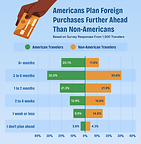
Nearly one-third (32%) begin planning how they’ll pay abroad three to six months before departure. U.S. travelers are more likely than non-U.S. travelers to start earlier, with 20% beginning more than six months ahead, compared with 12% of non-U.S. travelers.

Travelers’ Confidence in Exchange Rates Varies

Just 35% of respondents said they feel very confident understanding exchange rates abroad. Confidence also varied by age and gender:

44% of men feel very confident, compared with 26% of women.28% of Gen Z travelers feel very confident, compared with 40% of Gen X travelers and 37% of Baby Boomers.

Cash and Cards Remain Popular Abroad

Cash in the local currency and physical credit cards were nearly tied as the payment methods travelers most often use abroad. Mobile wallets were more popular among younger travelers:

71% use cash in the local currency.69% use a physical credit card.44% use a mobile wallet, including 56% of Gen Z travelers and 22% of travelers age 61 and older.35% use a physical debit card.

Most Travelers Carry Local Currency

More than 8 in 10 travelers (81%) carry cash in the destination’s currency, often for situations where cards may not be accepted:

64% use it at street vendors, markets, or small businesses.55% use it for tips and other customary cash payments.53% carry it for emergencies.

Travelers generally avoid carrying a large amount at once. About 44% exchange enough cash for several days, while 26% exchange enough for the full trip.

Familiar Card Brands Lead Among U.S. Travelers

Among U.S. respondents, Visa was the most commonly used card network, while Chase and Capital One were the most commonly used issuers:

Visa: 24%Chase: 21%Capital One: 19%American Express: 15%

Fees and Declined Cards Can Complicate Purchases

Among all respondents, travelers most often said their bank or card company contacted them about a purchase made abroad. Other issues increased the cost of a purchase or prevented it from going through:

38% were contacted by their bank or card company about a purchase.34% paid more than expected because of the exchange rate.29% were charged an unexpected foreign transaction fee.26% had a card declined.

Find the full study here.

About Upgraded Points LLC

Headquartered in Austin, Texas, Upgraded Points is a travel company that helps to demystify the complex world of travel and credit cards. Launched in 2016 by Alex Miller, Upgraded Points uses targeted research efforts and in-depth studies to help travelers maximize their travel, points, and experiences. Learn more at www.UpgradedPoints.com.

Media Contact:
Alex Miller, Founder
1-214-646-8866
425187@email4pr.com

View original content to download multimedia:https://www.prnewswire.com/news-releases/cash-or-card-new-upgraded-points-survey-reveals-how-travelers-pay-abroad-302922010.html

SOURCE Upgraded Points

Continue Reading

Technology

ESI supplying solar array components to missile defense programs

Published

on

By

SIMI VALLEY, Calif., Oct. 28, 2026 /PRNewswire/ — ESI Motion Inc. is proud to announce that it is supplying the Solar Array Drive Electronics (SADE) to Lockheed Martin for its work on the Space Development Agency’s Proliferated Warfighter Space Architecture (PWSA) programs.

Under the agreement, ESI Motion’s SADE technology will support SDA as the PWSA is developed.

Defending our nation in space is more important than ever. The Space Development Agency’s PWSA programs provide the military with a network of satellites with secure communication, missile tracking and space-based support to make sure our troops have the latest and greatest technology.

The SADE consists of our Space-rated, flight heritage, SuperNova and Pulsar motor controllers. These motion controllers ensure all mission parameters are fulfilled, with high-reliable technology. 

ESI Motion Inc., U.S. Company, is a trusted supplier and partner, supporting mission operations for space, military and industrial customers around the world for over 20 years. Please visit our website; www.esimotion.com

Mitchell Haerterich, mhaerterich@esimotion.com

View original content to download multimedia:https://www.prnewswire.com/news-releases/esi-supplying-solar-array-components-to-missile-defense-programs-302922454.html

SOURCE ESI Motion

Continue Reading

Technology

Envoy AI Launches “Boss of Machines” Program to Develop the Next Generation of Freight Leaders

Published

on

By

New AI Operations Lab will provide college students with hands-on experience in freight technology, operational transformation, and a $2,500 scholarship.

CHATTANOOGA, Tenn., Oct. 28, 2026 /PRNewswire-PRWeb/ — Envoy AI, the AI Native platform behind logistics autonomous agent system and execution layer Ellie, today announced the launch of Boss of Machines: AI Operations Lab, a new internship and scholarship program designed to prepare the next generation of logistics professionals for an industry increasingly shaped by artificial intelligence and digital labor.

The people starting their careers in freight now are going to spend a lot of their day managing agents. Somebody has to be the boss of those machines. We named the program after that job because it’s the one brokerages are going to be hiring for.

The program was introduced by Envoy AI CEO Robby Nathan during his fireside chat at FreightWaves’ F3: Future of Freight Festival on October 27.

“Freight has always been a people business, and that isn’t changing,” said Robby Nathan, Envoy AI CEO. “What is changing is how the work gets done. We want students to understand that shift firsthand. There’s a big difference between learning about AI in a classroom and seeing what it takes to put it to work in a real operation. Our goal is to give them that experience and help prepare them to become the leaders this industry will need.”

Launching in spring 2027, the three-month program will select two college juniors or seniors for an immersive experience working directly with Envoy AI’s product, engineering, and operations teams. Participants will gain firsthand exposure to how AI technology is developed, implemented, and used to solve real operational challenges across the freight industry.

Preparing Students for a Changing Industry

As freight companies adopt AI to automate routine work, improve productivity, and scale operations, the skills future logistics leaders need are evolving.

The Boss of Machines program bridges the gap between classroom education and the practical experience needed to lead technology-enabled operations.

Students will participate in four areas of learning:

Building AI for Operations: Understanding how AI agents are developed and applied to freight workflows.Deploying Digital Labor: Learning how new technology is integrated into existing systems, implemented with customers, and adopted by operational teams.Measuring Operational Performance: Exploring the role of analytics, productivity, and return on investment in evaluating technology initiatives.Leading Modern Freight Operations: Developing an understanding of how people and AI agents work together to manage and execute freight operations.

Investing in the Next Generation

The initiative reflects Envoy AI’s commitment to developing talent and giving students meaningful exposure to the technology and operational practices shaping the future of transportation.

“About 75% of the freight in our live accounts is already booked through Ellie, and that changes the job a new hire walks into,” said Nathan. “The people starting their careers in freight now are going to spend a lot of their day managing agents. That takes someone who can tell when a rate doesn’t make sense for the lane, and who’ll catch a carrier about to fall off before the shipper ever hears about it. Somebody has to be the boss of those machines. We named the program after that job because it’s the one brokerages are going to be hiring for.”

Throughout the program, students will work alongside experienced industry professionals, gaining exposure to product development, customer implementations, operational workflows, and the business decisions involved in deploying AI at scale.

Upon successful completion of the three-month program, each participant will receive a $2,500 scholarship to support their fall 2027 studies.

Applications and Program Timeline

The inaugural Boss of Machines: AI Operations Lab will welcome two students for the spring 2027 semester.

The program is open to college juniors and seniors interested in logistics, supply chain management, technology, engineering, business operations, and related fields.

Applicants will be asked to share their interests, relevant experience, and perspectives on how technology can improve freight operations.

Envoy AI will announce selected participants in January 2027, ahead of the spring program kickoff.

Additional program details and application information will be available through Envoy AI’s website.

About Envoy AI

Envoy AI develops AI-powered digital labor solutions for freight and logistics operations. Through its AI workforce, Ellie, the company helps logistics teams automate operational workflows, improve productivity, and execute freight processes across existing transportation systems. Envoy AI helps transportation organizations scale operations through practical AI applications.

Media Contact

Michelle McBride, Envoy AI, 1 972-821-2012, michelle@tryenvoy.ai, tryenvoy.ai

View original content:https://www.prweb.com/releases/envoy-ai-launches-boss-of-machines-program-to-develop-the-next-generation-of-freight-leaders-302922133.html

SOURCE Envoy AI

Continue Reading

Trending