Connect with us

Technology

CATL Unveils Six Major Innovations: Multi-Chemistry Systems to Redefine New Energy Mobility Experience

Published

on

BEIJING, April 21, 2026 /PRNewswire/ — CATL today hosted its Super Technology Day in Beijing, unveiling third-generation Shenxing Superfast Charging Battery, third-generation Qilin Battery, Qilin Condensed Battery, second-generation Freevoy Super Hybrid Battery, Naxtra Sodium-ion Battery and a fully integrated supercharging and battery-swapping solution. These innovations are designed to address diverse mobility needs across different usage scenarios.

At the event, Dr. Wu Kai, Chief Scientist of CATL, systematically elaborated on the respective strengths, limitations, and development pathways of different chemistries. He noted that LFP is nearing its theoretical energy density limit, making it better suited for a technology roadmap centered on extreme fast charging to achieve optimal balance. NCM’s high energy density keeps it at the forefront of global competition — underscoring that energy density remains the core metric for leadership. Sodium-ion batteries offer broad potential for extreme temperatures and energy storage applications. Whether from the perspective of differentiated consumer needs, or from the viewpoints of energy security and social development, the lithium-ion battery industry must pursue coordinated development across multiple chemical systems.

Robin Zeng, Chairman and CEO of CATL, emphasized at the conference that industrial innovation must be driven by a rigorous scientific spirit. For Chinese technology to go global, it relies not just on speed and scale, but on the quality of innovation, the ability to validate, and the credibility of the brand.

Third-Generation Shenxing Superfast Charging Battery: Making Superfast Charging and Ultra-Long Lifespan No Longer a Trade-Off

From an electrochemical standpoint, boosting charge rates while protecting battery lifespan hinges on one primary factor: temperature rise, not trickle current. As the Arrhenius equation shows, a 10°C increase in battery temperature can roughly double the rate of internal side reactions—an effect that can significantly shorten cycle life.

The third-generation Shenxing Superfast Charging Battery addresses heat generation and dissipation through three major measures: reduced heat production during operation, stronger thermal propagation, and higher precision control. As a result, after 1,000 complete cycles, the battery’s capacity retention remains above 90%, achieving an optimal balance between extreme superfast charging and ultra-long service life.

The latest third-generation Shenxing Superfast Charging Battery has reached what is claimed to be the industry’s strongest capability: an equivalent 10C and a peak 15C charging rate. Charging from 10% to 35% SOC (State of Charge) takes just 1 minute; from 10% to 80% SOC takes 3 minutes and 44 seconds; and from 10% to 98% SOC takes 6 minutes and 27 seconds. Even at −30°C in extreme cold conditions, charging from 20% to 98% SOC takes about 9 minutes.

In addition, by combining battery self-heating technology with a fully integrated supercharging and battery-swapping network, the system is designed to enable low-temperature superfast charging that is not limited by charging piles—offering both fast charging and battery swapping.

Third-generation Qilin Battery: Lighter, Stronger, More Premium, Redefining EV Excellence

Historically, achieving long range in premium EVs with LFP batteries has relied on simply adding more capacity — an approach that inevitably compromises vehicle lightweighting.

The third-generation Qilin Battery is designed for premium long-range EVs, achieving a cell energy density of 280 Wh/kg and enabling 1,000 km range while supporting 10C superfast charging.

The battery delivers 3 MW peak power, doubling the output of the second-generation Qilin track battery which competed on the Nürburgring (1,330 kW).

The entire battery pack weighs only 625 kg. Compared with equivalent LFP systems, this represents a weight reduction of 255 kg and space savings of 112 litres. The lightweighting metrics deliver exceptionally significant benefits:

Energy consumption per 100 km decreases by more than 6%, saving approximately 0.78 kWh per 100 km. Across a fleet of one million vehicles travelling 20,000 km annually, this equates to 156 million kWh in electricity savings and a reduction of 78,500 tonnes of CO₂ emissions.Performance and safety improvements include a 0.6–second reduction in 0–100 km/h acceleration, a 12% shorter overtaking risk window, an 8% higher moose test speed, a 6.5% lower body roll angle, a 15–25% gain in obstacle avoidance capability, and approximately 1.44 metres shorter braking distance.Durability is enhanced, with chassis component life extended by 40% and tyre life by over 30%, increasing replacement intervals by at least 10,000 km. The 112 litres of space saved can increase cabin headroom by at least 18 mm.

Building on the national standard for NP (No Thermal Propagation), safety is strengthened through “thermal-electrical separation”, with each cell incorporating an independent sealed exhaust channel to isolate thermal events and prevent propagation, ensuring “heat takes the heat path, electricity takes the electrical path”. 

Qilin Condensed Battery: Aviation-Grade Technology Applied to Passenger Vehicles for the First Time

The Qilin Condensed Battery applies aviation-grade technology to passenger vehicles for the first time, achieving 350 Wh/kg cell energy density and 760 Wh/L volumetric energy density — setting a new record for mass-produced batteries. This enables 1,500 km range for sedans and over 1,000 km for large SUVs, with pack weight controlled within 650 kg.

The condensed battery features a high-nickel cathode and low-expansion silicon-carbon anode, boosting energy density by 50 Wh/kg. Its first-ever aviation-grade titanium alloy case reduced thickness by 60% and weight by 30%, while tripling unit strength and delivering an additional 20 Wh/kg in energy density.

The technology builds on CATL’s electric aviation programme, where 500 Wh/kg systems have completed maiden flight validation on 4-tonne aircraft, with further validation underway on aircraft exceeding 8 tonnes.

Replacing liquid electrolyte with a condensed system eliminates risks associated with leakage and combustion, achieving “no liquid to leak, no liquid to ignite”. At the same time, CATL has adopted a new composite current collector that acts as a fast self-fusing fuse in extreme cases of internal short circuits.

Second-generation Freevoy Super Hybrid Battery: Bringing Hybrids into the 600 km Pure Electric Era

The second-generation Freevoy Super Hybrid Battery extends all-electric range to up to 600 km and standardises 10C superfast charging. It pioneers a “super hybrid technology” that integrates LFP and NCM materials through gradient-uniform mixing, with the olivine crystal structure of LFP serving as the core backbone, enabling a uniform hybrid of LFP and NCM materials at the powder particle level.

This achieves an energy density of 230 Wh/kg and increases range by over 15% without increasing pack weight compared with single LFP systems. This enables full coverage from mainstream family use to high-end, all-round hybrid scenarios, delivering optimal solutions across diverse applications.

The LFP version delivers up to 500 km pure electric range, enabling a “once-a-week charging” experience for daily commuting. The NCM version further extends pure electric range beyond 600 km, with total vehicle range exceeding 2,000 km, enabling a seamless dual-use experience for both daily electric driving and long-distance travel.

The system delivers 1.5 MW of instantaneous power at full charge and maintains 1.2 MW at 20% SOC, addressing power degradation in low-charge conditions. In off-road scenarios requiring over 350 kW output, the system provides more than three times the required power, ensuring consistent performance even at low charge levels.

Safety features include a reinforced bottom coating capable of withstanding 1,500 joules of impact energy (ten times the national standard) and waterproof sealing that allows continuous immersion in 2 metres of water for over 200 hours without performance degradation.

Naxtra Sodium-ion Battery: Achieving GWh-scale Sodium-ion Industrialisation

The Naxtra Sodium-ion Battery marks CATL’s transition from laboratory breakthrough to large-scale manufacturing. By systematically overcoming hundreds of engineering challenges, CATL has achieved GWh-level industrialisation.

In 2026, CATL successfully addressed four key industry bottlenecks for sodium-ion mass production—extreme water control, gas generation in hard carbon, aluminium foil adhesion, and self-forming anode systems—paving the way for reliable, large-scale deployment. The Naxtra Sodium-ion Battery is set to enter full-scale mass production by the end of 2026.

Integrated Supercharging and Battery-swapping Network: A Unified Replenishment Architecture

CATL also introduced an integrated supercharging and battery-swapping network, designed as a unified system rather than separate solutions, built on three complementary pillars—home charging, public charging, and battery swapping—to define the optimal energy replenishment ecosystem. All passenger vehicle “Choco-Swap” and heavy truck “QIJI” swapping stations will be equipped with Shenxing supercharging systems, enabling true charge–swap synergy, where each station serves both as a battery-swapping node and a high-power charging hub.

The integrated charge–swap stations feature shared compact substations and charging modules, reducing energy conversion steps and lowering overall power loss by more than 13 percentage points compared with conventional storage-equipped charging stations. In emergency scenarios, station batteries can discharge directly to charging piles, driving equipment utilization rate above 85%. This enables a service capacity of 3× per parking space compared with conventional storage-equipped charging stations, while the fixed investment cost of the supercharging segment is reduced to only one-fifth of comparable systems.

CATL launched the Choco-Swap #26 battery, featuring an 800V high-voltage architecture. The first release includes a 75 kWh version, with higher-capacity variants to follow, fully compatible with B- to C-segment 800V vehicles. With this launch, the Choco-Swap system will extend its coverage to a complete vehicle matrix from A0 to C-segment models.

In terms of network deployment, CATL plans to build 4,000 integrated charge–swap stations by the end of 2026, covering nearly 190 cities and a nationwide highway network spanning 12 vertical and 11 horizontal corridors. To date, the Choco-Swap network has already built 1,470 stations across 99 cities, with scaling continuing to accelerate.

Together with automakers and energy partners, CATL will co-develop a “charge–swap sharing network” based on technology sharing, seamless connectivity, and joint investment. Initial partners include Changan, Chery, GAC, Seres, SAIC-GM-Wuling, and BAIC, with a target of building over 100,000 shared energy replenishment facilities by the end of 2028.

Advancing full-scenario energy solutions

From five battery products covering the full material spectrum to an integrated supercharging and battery-swapping network, CATL has established a complete value chain from battery products to infrastructure.

CATL will continue to invest in advanced research, large-scale manufacturing and ecosystem collaboration to accelerate the transition from single-point innovation to full-scenario energy solutions, ensuring the benefits of technological progress are accessible across all mobility use cases.

View original content to download multimedia:https://www.prnewswire.com/news-releases/catl-unveils-six-major-innovations-multi-chemistry-systems-to-redefine-new-energy-mobility-experience-302749135.html

SOURCE CATL

Continue Reading

Technology

Hyundai Motor Group Accelerates Autonomous Driving Innovation with AI-Powered Data Flywheel

Published

on

By

Hyundai Motor Group hosts “HMG Autonomous Driving Media Day”, outlining its roadmap for the next era of autonomous driving; first showcase of Level 2++ technologyDual-Track strategy accelerates Level 2+ production through NVIDIA collaboration while internalizing key autonomous driving technologies through proprietary Atria AI
…NVIDIA solutions-based Level 2+ production targeted for the H1 2028 and Level 2++ in H2 2028, followed by Atria AI-powered Level 2++ vehicles in H2 2029
…Progressive sensor standardization across Hyundai Motor, Kia, 42dot and Motional brings together autonomous driving capabilities across the GroupData Flywheel strategy establishes a virtuous cycle of data collection, training, validation and deployment to continuously advance AI capabilities
…Expands the Group’s data ecosystem by leveraging its annual sales of 7 million vehicles and Data Union framework, while implementing a data-centric development framework based on hard example mining, continuous training and SER
…Real-world Level 4 pilot to launch in Gwangju by year-end in partnership with Korea’s Ministry of Land, Infrastructure and Transport to secure large-scale validation data42dot shares Vision-Language-Action (VLA)-based autonomous driving technology that integrates visual information and language-based reasoning to guide driving decisions
…VLA research focuses on addressing edge cases, while parallel development of end-to-end (E2E) autonomy and VLA models enhances technical stability and scalability
…VLA model validation currently underway, with on-road testing and the full development process scheduled to run through early next yearNew Atria AI urban driving videos — an executive ride-along, one-take footage, and edge-case handling — are live on the Group’s YouTube channel

SEOUL, South Korea, Sept. 12, 2026 /PRNewswire/ — Hyundai Motor Group (the Group) announced that it has put its Data Flywheel into full operation, marking a new phase in its autonomous driving technology strategy. The system creates a virtuous cycle of data collection, AI training, validation and deployment to secure a competitive advantage through accelerated learning and technology development.

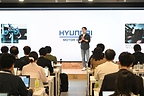
During the Group’s “HMG Autonomous Driving Media Day” at 42dot headquarters in Gyeonggi Province, Korea, the Group presented its autonomous driving development strategy, technology roadmap, key achievements and implementation plans. The presentation underscored the Group’s strategic positioning in the global autonomous driving technology competition and detailed how integrated data and AI systems form the foundation for next-generation vehicle technology.

At the event, the Group identified the Data Flywheel as a key element of its autonomous driving competitiveness and shared the operational framework and execution strategy that transforms large-scale real-world driving data into continuous technology improvements.

42dot also introduced key technologies and the development progress for the Group’s proprietary autonomous driving artificial intelligence, Atria AI, while outlining the background and future plans for its Vision-Language-Action (VLA) technology development initiative.

In line with the event, the Group unveiled footage of an Atria AI-equipped SDV Testbed navigating complex urban traffic without driver intervention. Operating at a Level 2++ capability, the autonomous driving system showcased in the footage illustrates how the Data Flywheel is enabling a continuous cycle of learning, validation and performance improvement. The footage is available on the Group’s official YouTube channel.

“Autonomous driving competition is no longer about comparing specific features. Competitiveness is determined by how much data you secure, how quickly you learn and how effectively you can reflect those results in actual products and services. At its core, autonomous driving competitiveness comes down to having systems that enable continuous, rapid learning. Hyundai Motor Group will develop autonomous driving technology that customers can trust, based on a virtuous cycle of data, AI and validation. Our goal is to ensure the safety and quality levels customers can trust while we learn and improve rapidly.” – Minwoo Park, President and Head of Advanced Vehicle Platform (AVP) Division at Hyundai Motor Group and CEO of 42dot

About Hyundai Motor Group

More information about Hyundai Motor Group can be found at: http://www.hyundaimotorgroup.com or Newsroom: Media Hub by Hyundai, Kia Global Newsroom, Genesis Newsroom

View original content to download multimedia:https://www.prnewswire.com/news-releases/hyundai-motor-group-accelerates-autonomous-driving-innovation-with-ai-powered-data-flywheel-302876366.html

SOURCE Hyundai Motor Group

Continue Reading

Technology

Allstream Energy Partners Nominated in Multiple Categories for Fast Company’s Best Workplaces for Innovators

Published

on

By

Nomination Categories for Fast Company’s Best Workplaces for Innovators in AI & Automation, Advertising, Marketing & PR

HOUSTON, Sept. 12, 2026 /PRNewswire/ — Allstream Energy Partners has been nominated in multiple categories for Fast Company’s Best Workplaces for Innovators program, recognizing organizations redefining their industries through innovation, leadership, and emerging technologies.

The company received nominations in six categories:

Best Workplaces for Innovators North AmericaAI, Automation and Machine Learning ExcellenceAdvertising, Marketing and PRSmall & Mighty CompaniesInnovative Leader of the Year: Efrain Garcia, Founder and CEOInnovative Team of the Year

The nominations recognize Allstream’s investment in proprietary AI-driven marketing technologies, digital publishing solutions, and workflows designed to change how energy companies build visibility, authority, and customer engagement.

Where Oil and Gas Digital Marketing Meets Publishing

Allstream Energy Partners has developed an agency-plus-publisher model combining digital marketing, content creation, industry communications, media publishing, executive networking, and business development.

As artificial intelligence changes how buyers discover suppliers, manufacturers, engineering firms, service companies, and technology providers, Allstream helps clients position themselves to be recommended—not simply found.

Its integrated capabilities include AI marketing strategy, AI-optimized website development, SEO for Oil and Gas, Answer Engine Optimization, Generative Engine Optimization, AI search visibility, content marketing, industry publishing, public relations, social media, paid search, email marketing, event promotion, podcasting, branding, and digital advertising.

Innovation Built for Energy

Unlike a general marketing agency, Allstream was built specifically for oil and gas, energy, engineering, construction, manufacturing, and industrial markets. Each founder brings 27 years of experience supporting sales, business development, capital projects, technical services, industrial marketing, and digital strategy.

This experience gives Allstream an understanding of how technical buyers evaluate suppliers, how projects move through the market, and how engineering, procurement, operations, and executive teams consume information.

The company continues investing in proprietary methodologies that combine industry knowledge, journalism, publishing, AI optimization, communications, and business development strategy. As AI becomes an important starting point for supplier research and vendor discovery, Allstream helps organizations evolve beyond traditional SEO.

“Marketing has fundamentally changed,” said Efrain Garcia, Founder and CEO of Allstream Energy Partners. “Our team recognized early that AI would transform how buyers discover companies, evaluate expertise, and make purchasing decisions. These nominations reflect our commitment to innovation and our mission to help the energy industry succeed in an AI-first world.”

About Allstream Energy Partners

Allstream Energy Partners is a Houston-based, AI-powered marketing and media company serving the energy and industrial supply chain. Through SEO, GEO, AEO, AI-optimized websites, publishing, strategic communications, networking events, and business partnerships, Allstream helps Oil and Gas companies strengthen their brands, improve visibility across search engines and AI platforms, and generate qualified business opportunities.
Visit www.AllstreamEP.com

Media Contact:
Efrain Garcia
efrain@allstreamep.com
8324963004

Photo(s):
https://www.prlog.org/13170255

Press release distributed by PRLog

View original content:https://www.prnewswire.com/news-releases/allstream-energy-partners-nominated-in-multiple-categories-for-fast-companys-best-workplaces-for-innovators-302876887.html

SOURCE Allstream Energy Partners

Continue Reading

Technology

Krelva Accepted Into the HBS Foundry Bootcamp at Harvard Business School

Published

on

By

Foster Britton spent four years learning to trade. Jerry Klamm grew a website to $100,000 a month in high school. Their bootstrapped, pre-launch company, Krelva, joins the new program in October and opens Krelva Meet, small live rooms where day traders trade the market together at their respective skill levels.

BUFFALO, N.Y., Sept. 12, 2026 /PRNewswire-PRWeb/ — Krelva, a bootstrapped, pre-launch Buffalo company built for futures day traders, has been accepted into the HBS Foundry Bootcamp at Harvard Business School, a new online program for founders working toward their first check. Foster Britton started trading in 10th grade, at 15, before settling on futures trading. Jerry Klamm, 19, built Geometry Spot at 16, grew it to more than 175 million pageviews and $100,000 a month in revenue before he finished high school, and left the University at Buffalo to run Krelva full time.

“Krelva Meet is the room I wish I had at 15.” Foster Britton, co-founder, Krelva

Krelva exists because of how hard Britton’s first four years were. Trading is highly complex, the internet is full of people teaching it, and most of what a beginner finds is confusing, contradictory, or sold by someone with something to sell. The question is never whether there is enough information. It is where to start and who to listen to.

“I started trading in 10th grade, in forex before anything else, and it took me four years to get it right,” Britton said. “It was not that the charts were hard. It was that there is so much online, most of it is confusing, and there is no way to know where to start or who to listen to.”

Today Krelva has two things. The first is a free beginner course that shows people where to start; it teaches the basics without promising anyone a payday. The second is Krelva Meet, which opens in October at $50 a month with a 14-day free trial: a new way to trade Nasdaq-100 and S&P 500 futures, not alone and not in a crowd of strangers, but in a small live room with people at your own verified level.

Krelva Meet started with a frustration anyone who has spent time in a trading Discord will recognize. People post their results, and some of those results are real. Screenshots are easy to fake, a few prop firms now issue verified payout cards, and none of it tells a beginner whether the person answering their question is actually where they say they are. So the beginner guesses, and the loudest voice usually wins.

Krelva Meet checks. Every trader has a level that Krelva verifies before they enter a room, and the company is building direct brokerage verification so the check happens automatically. Rooms are built from traders at the same level. Someone who has never passed a prop firm evaluation sits with others who have not either. Pass one, and you move up to rooms with traders who have passed. Get paid out, and you move up again. Alongside the rooms, Krelva is launching a rating: simple, earned over time, and moved by how you answer questions during the session rather than by what you claim. Rooms are not a signal service and tell no one what to buy or sell. They are about the process: reading the market before the open, talking it through with people at your level, and finding out afterward where and why you were right or wrong.

Krelva does not claim to make anyone a better trader faster. It is trying to give people a place to start.

“Krelva Meet is the room I wish I had at 15,” Britton said.

The HBS Foundry Bootcamp at Harvard Business School has drawn attention since its launch for its $699 price and its format, which from Krelva’s understanding pairs weekly live sessions with HBS faculty and guests with AI versions of those same professors, built to push back on weak ideas.

“I’m interested in this new program at Harvard Business School. I think using AI tools to learn is the future, but I’m curious to see how Harvard does it and if it actually works,” Klamm said. “I like that it says the AI professors are built to challenge weak ideas, so I’m going to push it to the limit and see how it performs compared to a real professor.”

The waitlist for Krelva Meet is open now at https://krelva.com.

“Most traders look at the chart at 9:30 every morning by themselves. There are thousands of other traders just like you,” Klamm said. “Why would you trade alone if you could trade with a group you trust? That is the whole idea.”

About Krelva

Krelva is a Buffalo, New York company built for futures day traders. Its free beginner course, built by co-founder Foster Britton, teaches the basics of trading. Its paid product, Krelva Meet, puts traders in small live rooms with other traders at the same verified level to trade Nasdaq-100 and S&P 500 futures together, for $50 a month with a 14-day free trial. Krelva was founded in 2026 by Jerry Klamm and Foster Britton. Learn more at https://krelva.com.

Media Contact

Jerry Klamm, Krelva, 1 716-261-7634, info@krelva.com, https://krelva.com/

View original content to download multimedia:https://www.prweb.com/releases/krelva-accepted-into-the-hbs-foundry-bootcamp-at-harvard-business-school-302876118.html

SOURCE Krelva

Continue Reading

Trending