Connect with us

Technology

Chainguard Launches Athena, the Industry Coalition to Fix Open Source Vulnerabilities Before Attackers Can Find Them

Published

on

Founding members — including BNY, Chainguard, Cisco, Cloudflare, Corridor, DepthFirst, Docker, JPMorganChase, Kyndryl, LTIMindtree, and PwC — back a coalition for the orchestrated defense of open source software that has already processed more than 20,000 findings and shipped over 2,000 patches across 500 open source projects

KIRKLAND, Wash., June 15, 2026 /PRNewswire/ — Chainguard, together with BNY, Cisco, Cloudflare, Corridor, DepthFirst, Docker, JPMorganChase, Kyndryl, LTIMindtree, and PwC, today announced Athena, an industry coalition for the orchestrated defense of open source software, built for the frontier-model era where AI systems can find serious flaws faster than anyone can patch them. Athena is operational today with more than two dozen member organizations. To date, it has processed more than 20,000 findings and generated over 2,000 patches across 500 open source projects. The first wave of disclosures begins next month.

Founding members span the full stack of the software ecosystem and include BNY, Chainguard, Cisco, Cloudflare, Corridor, DepthFirst, Docker, JPMorganChase, Kyndryl, LTIMindtree, and PwC. Many of the coalition’s submitting members surface these vulnerabilities using frontier AI programs they have access to — including Anthropic’s Project Glasswing and OpenAI’s Daybreak — and bring the resulting findings to Athena.

“The time to exploit has gone negative — exploits now land before a flaw is ever disclosed,” said Dan Lorenc, CEO and co-founder, Chainguard. “Athena’s whole job is to make the time to remediate even more negative, so the fix is already in place before the vulnerability is public. No one company can get ahead of this alone, and orchestrated defense is the only answer.”

The current system cannot keep up

Frontier AI models can now read code, reason across dependencies, and surface novel, chained zero-day vulnerabilities in open source software at machine speed — flaws that survived decades of expert review. In one recent case, a critical bug sat in media-processing code used by countless applications that automated fuzzers had run more than five million times without ever catching. The gap between a vulnerability being discovered and being exploited has collapsed from years to hours, and a growing share of exploits are weaponized before the bug is ever publicly disclosed. Coordinated disclosure was built for a world in which finding a serious flaw took weeks and the targets were few. That world is gone.

Left unaddressed, the shift pushes the industry toward fragmentation, with every cloud, vendor, and security team independently forking the same critical libraries and no shared understanding of what has actually been fixed. Athena is built as the alternative: it offers a single pipeline that pools findings, remediates them under embargo, and drives durable fixes back upstream, so a vulnerability is patched and protected before it is ever public.

Athena closes the full loop

Athena runs a shared, active platform that takes each vulnerability through its full lifecycle end to end. Within it, a clearinghouse pools and correlates findings from every member. Around that, Athena stacks independent layers of protection so that coverage exists even where a clean patch does not yet, and stays on every flaw until a durable upstream fix is in place:

Discovery. Vetted findings are pooled from across the coalition — including frontier research programs such as Anthropic’s Project Glasswing and OpenAI’s Daybreak. Athena accepts findings generated by all frontier models.Pre-embargo remediation. Private forks and rebuilt, hardened versions are made available to members through Chainguard Libraries before disclosure. Findings are addressed in batches across an entire library, hardening it against whole classes of issues rather than the single bug a model happened to surface first — so it stays quiet even when a more capable model arrives.Continuous reconciliation. Every finding is reconciled against upstream activity throughout the embargo, catching independent discovery and keeping fixes current as projects move at head.Platform, network, and infrastructure mitigations. Partners that operate infrastructure, platform, network, and security layers push non-patch mitigations ahead of disclosure: detection signatures, traffic-level rules, and platform-side blocks that neutralize a flaw without the affected software ever being touched, at machine speed and broad reach.Detections and vendor mitigations. Cybersecurity partners add their own detections, signatures, and virtual patching as a further independent layer.Upstream disclosure and hard forks. The coalition drives coordinated disclosure upstream, and Chainguard hopes to work with the Linux Foundation on a coordinated Security Incident Response Team (SIRT) for open source and a maintainer of last resort program.

No single layer is complete; together, they get as close to complete as the problem allows.

A significant share of Athena’s impact is invisible by design. Because a patch only protects systems that can apply it — and much of the world’s critical infrastructure cannot patch on an attacker’s timeline — Athena’s platform-level mitigations are intended to neutralize a vulnerability across the internet before public disclosure. The same open source libraries that run inside the largest technology companies also run inside facilities such as municipal water systems and regional hospitals that have little or no dedicated security staff; those organizations are protected without taking any action, and in most cases without ever knowing there was a threat.

A coalition across the software supply chain

With more than two dozen members, Athena’s coalition spans the layers the world’s software depends on, with each participant contributing a capability the others cannot. AI vulnerability-research teams and software consumers supply pre-disclosure findings; platform, network, and infrastructure providers extend protection at the layers exploits traverse; cybersecurity vendors build detections and virtual patches; and global system integrators carry fixes into client environments at scale. The coalition will coordinate disclosure upstream, and Chainguard hopes to work with the Linux Foundation on a coordinated Security Incident Response Team (SIRT) for open source and a maintainer of last resort program.

Supporting Quotes

“Trust is at the core of what we do. Our clients count on BNY to protect what matters most, including the software behind our systems. As AI speeds up the discovery of vulnerabilities, Athena may help us identify and address risks earlier.” – Dave Robinson, Chief Information Security Officer, BNY

“For decades, Cisco has helped secure the open-source ecosystem. That work now faces new urgency; frontier AI has accelerated the vulnerability discovery cycle beyond what traditional coordinated disclosure was built to handle. Chainguard’s Athena coalition represents an important evolution, the coordination of open-source vulnerability intelligence and defense at the pace these threats demand. As this space continues to evolve, Cisco is committed to protecting customers across their infrastructure and applications, including open source. Open source powers critical infrastructure worldwide. Securing it secures all of us.” – Anthony Grieco, SVP & Chief Security & Trust Officer, Cisco

“AI has fundamentally changed the speed of vulnerability discovery, and traditional, siloed patching simply can’t keep pace. Cloudflare is already using our global network to deploy automated, traffic-level mitigations before these flaws are ever made public. This collaboration allows us to better act as an industry to neutralize threats at the ecosystem scale, protecting critical infrastructure and businesses before an attacker even has the chance to exploit a bug.” – Blake Darché, Head of Cloudforce One, Cloudflare

Availability

Athena is open to vetted organizations through an application process. Members retain control of their findings — kept private, shared with a trusted subset of the coalition, or opened to everyone. Organizations that join before the first coordinated disclosure wave next month are covered under embargo ahead of it. Interested organizations can apply or start a conversation at chainguard.dev/athena.

About Chainguard

Chainguard is the trusted source for open source. Its solutions provide engineers and AI agents with the hardened, trusted, and production-ready artifacts they rely on, so organizations can build fast while staying compliant and protecting against AI supply chain attacks. Customers include Fortune 500 enterprises and global industry leaders, including Anduril, Canva, Fortinet, Hewlett Packard Enterprise, OpenAI, Snap Inc., and Snowflake. Chainguard is venture-backed by leading investors, including Amplify, IVP, Kleiner Perkins, Lightspeed Venture Partners, Mantis VC, Redpoint Ventures, Sequoia Capital, and Spark Capital. For more information, visit: https://www.chainguard.dev/

View original content to download multimedia:https://www.prnewswire.com/news-releases/chainguard-launches-athena-the-industry-coalition-to-fix-open-source-vulnerabilities-before-attackers-can-find-them-302799984.html

SOURCE Chainguard

Continue Reading

Technology

Hyundai Motor Group Accelerates Autonomous Driving Innovation with AI-Powered Data Flywheel

Published

on

By

Hyundai Motor Group hosts “HMG Autonomous Driving Media Day”, outlining its roadmap for the next era of autonomous driving; first showcase of Level 2++ technologyDual-Track strategy accelerates Level 2+ production through NVIDIA collaboration while internalizing key autonomous driving technologies through proprietary Atria AI
…NVIDIA solutions-based Level 2+ production targeted for the H1 2028 and Level 2++ in H2 2028, followed by Atria AI-powered Level 2++ vehicles in H2 2029
…Progressive sensor standardization across Hyundai Motor, Kia, 42dot and Motional brings together autonomous driving capabilities across the GroupData Flywheel strategy establishes a virtuous cycle of data collection, training, validation and deployment to continuously advance AI capabilities
…Expands the Group’s data ecosystem by leveraging its annual sales of 7 million vehicles and Data Union framework, while implementing a data-centric development framework based on hard example mining, continuous training and SER
…Real-world Level 4 pilot to launch in Gwangju by year-end in partnership with Korea’s Ministry of Land, Infrastructure and Transport to secure large-scale validation data42dot shares Vision-Language-Action (VLA)-based autonomous driving technology that integrates visual information and language-based reasoning to guide driving decisions
…VLA research focuses on addressing edge cases, while parallel development of end-to-end (E2E) autonomy and VLA models enhances technical stability and scalability
…VLA model validation currently underway, with on-road testing and the full development process scheduled to run through early next yearNew Atria AI urban driving videos — an executive ride-along, one-take footage, and edge-case handling — are live on the Group’s YouTube channel

SEOUL, South Korea, Sept. 12, 2026 /PRNewswire/ — Hyundai Motor Group (the Group) announced that it has put its Data Flywheel into full operation, marking a new phase in its autonomous driving technology strategy. The system creates a virtuous cycle of data collection, AI training, validation and deployment to secure a competitive advantage through accelerated learning and technology development.

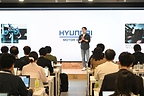
During the Group’s “HMG Autonomous Driving Media Day” at 42dot headquarters in Gyeonggi Province, Korea, the Group presented its autonomous driving development strategy, technology roadmap, key achievements and implementation plans. The presentation underscored the Group’s strategic positioning in the global autonomous driving technology competition and detailed how integrated data and AI systems form the foundation for next-generation vehicle technology.

At the event, the Group identified the Data Flywheel as a key element of its autonomous driving competitiveness and shared the operational framework and execution strategy that transforms large-scale real-world driving data into continuous technology improvements.

42dot also introduced key technologies and the development progress for the Group’s proprietary autonomous driving artificial intelligence, Atria AI, while outlining the background and future plans for its Vision-Language-Action (VLA) technology development initiative.

In line with the event, the Group unveiled footage of an Atria AI-equipped SDV Testbed navigating complex urban traffic without driver intervention. Operating at a Level 2++ capability, the autonomous driving system showcased in the footage illustrates how the Data Flywheel is enabling a continuous cycle of learning, validation and performance improvement. The footage is available on the Group’s official YouTube channel.

“Autonomous driving competition is no longer about comparing specific features. Competitiveness is determined by how much data you secure, how quickly you learn and how effectively you can reflect those results in actual products and services. At its core, autonomous driving competitiveness comes down to having systems that enable continuous, rapid learning. Hyundai Motor Group will develop autonomous driving technology that customers can trust, based on a virtuous cycle of data, AI and validation. Our goal is to ensure the safety and quality levels customers can trust while we learn and improve rapidly.” – Minwoo Park, President and Head of Advanced Vehicle Platform (AVP) Division at Hyundai Motor Group and CEO of 42dot

About Hyundai Motor Group

More information about Hyundai Motor Group can be found at: http://www.hyundaimotorgroup.com or Newsroom: Media Hub by Hyundai, Kia Global Newsroom, Genesis Newsroom

View original content to download multimedia:https://www.prnewswire.com/news-releases/hyundai-motor-group-accelerates-autonomous-driving-innovation-with-ai-powered-data-flywheel-302876366.html

SOURCE Hyundai Motor Group

Continue Reading

Technology

Allstream Energy Partners Nominated in Multiple Categories for Fast Company’s Best Workplaces for Innovators

Published

on

By

Nomination Categories for Fast Company’s Best Workplaces for Innovators in AI & Automation, Advertising, Marketing & PR

HOUSTON, Sept. 12, 2026 /PRNewswire/ — Allstream Energy Partners has been nominated in multiple categories for Fast Company’s Best Workplaces for Innovators program, recognizing organizations redefining their industries through innovation, leadership, and emerging technologies.

The company received nominations in six categories:

Best Workplaces for Innovators North AmericaAI, Automation and Machine Learning ExcellenceAdvertising, Marketing and PRSmall & Mighty CompaniesInnovative Leader of the Year: Efrain Garcia, Founder and CEOInnovative Team of the Year

The nominations recognize Allstream’s investment in proprietary AI-driven marketing technologies, digital publishing solutions, and workflows designed to change how energy companies build visibility, authority, and customer engagement.

Where Oil and Gas Digital Marketing Meets Publishing

Allstream Energy Partners has developed an agency-plus-publisher model combining digital marketing, content creation, industry communications, media publishing, executive networking, and business development.

As artificial intelligence changes how buyers discover suppliers, manufacturers, engineering firms, service companies, and technology providers, Allstream helps clients position themselves to be recommended—not simply found.

Its integrated capabilities include AI marketing strategy, AI-optimized website development, SEO for Oil and Gas, Answer Engine Optimization, Generative Engine Optimization, AI search visibility, content marketing, industry publishing, public relations, social media, paid search, email marketing, event promotion, podcasting, branding, and digital advertising.

Innovation Built for Energy

Unlike a general marketing agency, Allstream was built specifically for oil and gas, energy, engineering, construction, manufacturing, and industrial markets. Each founder brings 27 years of experience supporting sales, business development, capital projects, technical services, industrial marketing, and digital strategy.

This experience gives Allstream an understanding of how technical buyers evaluate suppliers, how projects move through the market, and how engineering, procurement, operations, and executive teams consume information.

The company continues investing in proprietary methodologies that combine industry knowledge, journalism, publishing, AI optimization, communications, and business development strategy. As AI becomes an important starting point for supplier research and vendor discovery, Allstream helps organizations evolve beyond traditional SEO.

“Marketing has fundamentally changed,” said Efrain Garcia, Founder and CEO of Allstream Energy Partners. “Our team recognized early that AI would transform how buyers discover companies, evaluate expertise, and make purchasing decisions. These nominations reflect our commitment to innovation and our mission to help the energy industry succeed in an AI-first world.”

About Allstream Energy Partners

Allstream Energy Partners is a Houston-based, AI-powered marketing and media company serving the energy and industrial supply chain. Through SEO, GEO, AEO, AI-optimized websites, publishing, strategic communications, networking events, and business partnerships, Allstream helps Oil and Gas companies strengthen their brands, improve visibility across search engines and AI platforms, and generate qualified business opportunities.
Visit www.AllstreamEP.com

Media Contact:
Efrain Garcia
efrain@allstreamep.com
8324963004

Photo(s):
https://www.prlog.org/13170255

Press release distributed by PRLog

View original content:https://www.prnewswire.com/news-releases/allstream-energy-partners-nominated-in-multiple-categories-for-fast-companys-best-workplaces-for-innovators-302876887.html

SOURCE Allstream Energy Partners

Continue Reading

Technology

Krelva Accepted Into the HBS Foundry Bootcamp at Harvard Business School

Published

on

By

Foster Britton spent four years learning to trade. Jerry Klamm grew a website to $100,000 a month in high school. Their bootstrapped, pre-launch company, Krelva, joins the new program in October and opens Krelva Meet, small live rooms where day traders trade the market together at their respective skill levels.

BUFFALO, N.Y., Sept. 12, 2026 /PRNewswire-PRWeb/ — Krelva, a bootstrapped, pre-launch Buffalo company built for futures day traders, has been accepted into the HBS Foundry Bootcamp at Harvard Business School, a new online program for founders working toward their first check. Foster Britton started trading in 10th grade, at 15, before settling on futures trading. Jerry Klamm, 19, built Geometry Spot at 16, grew it to more than 175 million pageviews and $100,000 a month in revenue before he finished high school, and left the University at Buffalo to run Krelva full time.

“Krelva Meet is the room I wish I had at 15.” Foster Britton, co-founder, Krelva

Krelva exists because of how hard Britton’s first four years were. Trading is highly complex, the internet is full of people teaching it, and most of what a beginner finds is confusing, contradictory, or sold by someone with something to sell. The question is never whether there is enough information. It is where to start and who to listen to.

“I started trading in 10th grade, in forex before anything else, and it took me four years to get it right,” Britton said. “It was not that the charts were hard. It was that there is so much online, most of it is confusing, and there is no way to know where to start or who to listen to.”

Today Krelva has two things. The first is a free beginner course that shows people where to start; it teaches the basics without promising anyone a payday. The second is Krelva Meet, which opens in October at $50 a month with a 14-day free trial: a new way to trade Nasdaq-100 and S&P 500 futures, not alone and not in a crowd of strangers, but in a small live room with people at your own verified level.

Krelva Meet started with a frustration anyone who has spent time in a trading Discord will recognize. People post their results, and some of those results are real. Screenshots are easy to fake, a few prop firms now issue verified payout cards, and none of it tells a beginner whether the person answering their question is actually where they say they are. So the beginner guesses, and the loudest voice usually wins.

Krelva Meet checks. Every trader has a level that Krelva verifies before they enter a room, and the company is building direct brokerage verification so the check happens automatically. Rooms are built from traders at the same level. Someone who has never passed a prop firm evaluation sits with others who have not either. Pass one, and you move up to rooms with traders who have passed. Get paid out, and you move up again. Alongside the rooms, Krelva is launching a rating: simple, earned over time, and moved by how you answer questions during the session rather than by what you claim. Rooms are not a signal service and tell no one what to buy or sell. They are about the process: reading the market before the open, talking it through with people at your level, and finding out afterward where and why you were right or wrong.

Krelva does not claim to make anyone a better trader faster. It is trying to give people a place to start.

“Krelva Meet is the room I wish I had at 15,” Britton said.

The HBS Foundry Bootcamp at Harvard Business School has drawn attention since its launch for its $699 price and its format, which from Krelva’s understanding pairs weekly live sessions with HBS faculty and guests with AI versions of those same professors, built to push back on weak ideas.

“I’m interested in this new program at Harvard Business School. I think using AI tools to learn is the future, but I’m curious to see how Harvard does it and if it actually works,” Klamm said. “I like that it says the AI professors are built to challenge weak ideas, so I’m going to push it to the limit and see how it performs compared to a real professor.”

The waitlist for Krelva Meet is open now at https://krelva.com.

“Most traders look at the chart at 9:30 every morning by themselves. There are thousands of other traders just like you,” Klamm said. “Why would you trade alone if you could trade with a group you trust? That is the whole idea.”

About Krelva

Krelva is a Buffalo, New York company built for futures day traders. Its free beginner course, built by co-founder Foster Britton, teaches the basics of trading. Its paid product, Krelva Meet, puts traders in small live rooms with other traders at the same verified level to trade Nasdaq-100 and S&P 500 futures together, for $50 a month with a 14-day free trial. Krelva was founded in 2026 by Jerry Klamm and Foster Britton. Learn more at https://krelva.com.

Media Contact

Jerry Klamm, Krelva, 1 716-261-7634, info@krelva.com, https://krelva.com/

View original content to download multimedia:https://www.prweb.com/releases/krelva-accepted-into-the-hbs-foundry-bootcamp-at-harvard-business-school-302876118.html

SOURCE Krelva

Continue Reading

Trending