Connect with us

Technology

Shield AI and Destinus demonstrate autonomous strike and teaming capabilities on an interceptor system in full-mission flight exercise


Published

on

PARIS, June 15, 2026 /PRNewswire/ — Shield AI and Destinus have successfully demonstrated autonomous collaborative strike capabilities on the Destinus Hornet, an interceptor system designed for counter-UAS missions against loitering munitions, drone swarms, and hostile uncrewed threats at scale. The tests, conducted in Segovia, Spain, validated Shield AI’s Hivemind AI piloting abilities to support autonomy-enabled coordination and in-flight adaptation in contested airspace and demonstrated how this capability can help operators respond more quickly to large-scale unmanned threats.

The milestone builds on two prior phases of integration: Phase 1 established Hivemind platform control on the Hornet in under two months and Phase 2 demonstrated V-BAT and Hornet multi-platform teaming in flight. For this phase, the Segovia campaign executed a complete operational concept developed for the Destinus Ruta, a low-cost turbojet strike platform designed for terrain-following penetration in GNSS-denied and contested environments. Hornet served as the initial integration baseline across the Destinus family due to a shared flight control architecture. This is intended to accelerate Hivemind integration across additional Destinus systems and reduce the technical risk ahead of the planned transition to Ruta.

“Autonomous systems must be able to sense threats, adapt, and act at the edge — especially in contested environments where direct command and control is degraded or denied,” said Christian Gutierrez, senior vice president of Hivemind at Shield AI. “What we demonstrated in Segovia is a repeatable, fieldable autonomous capability that closes the reconnaissance-to-strike loop at the speed the threat demands.”

Phase 3 exercised the full mission sequence aligned to the Ruta operational concept, including autonomy-assisted mission planning via ground control station, radio testing, autonomous terrain following, in-flight target updates, and autonomous terminal maneuver execution on operator command. The next phase will transition these capabilities to the Destinus Ruta platform in Ukraine, enabling coordinated strike behaviors between V-BAT and multiple Ruta systems. This follow-on evaluation will focus on repeatability, reliability, and integration with existing operator command-and-control architectures.

“Destinus platforms operate on our own flight control architecture, and Hivemind validated that we can integrate third-party autonomy without surrendering system design authority,” said Tim Moser, chief technology officer at Destinus. “Repeatable integration, clear command authority, fieldable capability — that is how autonomy moves from a demonstration to something operators can rely on in the field.”

The Destinus Hornet is a multi-role autonomous platform capable of counter-UAS, strike, reconnaissance, data relay, and security operations. Hornet systems form part of a broader layered air-defense architecture designed to protect high-value sites and critical infrastructure.

The Hivemind AI pilot enables platforms to sense, decide, and act independently, within operator-defined parameters under established command authority. Unlike traditional autopilots that cannot deviate from preplanned routes, Hivemind dynamically reroutes mission plans, responds to unexpected conditions, avoids obstacles, and executes complex tasks safely and effectively.

Shield AI will be exhibiting at Eurosatory in Hall 5A, stand A276, and Destinus will also be exhibiting in Hall 4, stand E255.

About Shield AI:

Founded in 2015, Shield AI is a venture-backed defense-tech company with the mission of protecting service members and civilians with intelligent systems. Its products include Hivemind autonomy software and V-BAT and X-BAT aircraft. With offices and facilities across the U.S., Europe, the Middle East, and Asia-Pacific, Shield AI’s technology actively supports operations worldwide. For more information, visit www.shield.ai. Follow Shield AI on LinkedIn, X, Instagram, and YouTube.

Media contact:

Charles Forrester, Communications Manager (Europe): media@shield.ai

About Destinus:

Destinus is a European defence and aerospace company built for the age of mass-produced threats. The company designs and manufactures autonomous strike systems and air defence systems in Europe for European and allied armed forces. Its edge is the combination of a unified autonomy stack, deep vertical integration, and industrial-scale production that turns fast iteration into fielded capability.

Media contact:

FTI Consulting: destinus@fticonsulting.com 

View original content to download multimedia:https://www.prnewswire.co.uk/news-releases/shield-ai-and-destinus-demonstrate-autonomous-strike-and-teaming-capabilities-on-an-interceptor-system-in-full-mission-flight-exercise-302799762.html

Continue Reading

Technology

uSMART Securities Singapore Marks Third Branch Opening in Bugis with Lion Dance and K-pop

Published

on

By

SINGAPORE, Nov. 14, 2026 /PRNewswire/ — uSMART Securities Singapore officially opened its third branch at 516 North Bridge Road, #01-00, Singapore 188740 expanding its physical presence in Singapore with a new uSMART Investor Hub. The opening was marked by a private ceremony featuring a speech, a traditional lion dance and a K-pop dance performance, bringing together the uSMART team, esteemed guests and partners.

The Bugis opening marks another milestone in uSMART’s expansion in Singapore, following the launch of its first local branch at Robinson Road in July 2025 and its Somerset branch in October that year. The new branch reflects the company’s approach of combining digital trading with face-to-face support, offering clients an additional location to make enquiries, receive assistance with account opening and engage directly with the team.

Speaking at the ceremony, Mr Eng Thiam Choon (TC Eng), Chief Operating Officer of uSMART, highlighted the importance of maintaining physical branches alongside digital brokerage services. Clients may appreciate the opportunity to discuss opening their first investment account, gain a better understanding of products available on the app or receive assistance with any issues.

“Customers should have a choice in how they deal with us. If they’re comfortable doing everything on the app, that’s fine. If they’d prefer to come in and talk, we want to make that possible too,” said Mr Eng.

Drawing on its experience operating branches in Hong Kong, uSMART has tailored this approach to the Singapore market through ongoing engagement and conversations with local clients.

Mr Eng also highlighted the importance of understanding different trading rules, currency exposure and diversification as investors explore more markets. Seminars and conversations with the branch team will support these learning opportunities, equipping clients with the knowledge and information they need to make informed investment decisions.

“You don’t need to come with a decision already made. You can come with a question,” said Mr Eng.

Beyond the opening celebrations, Mr Eng highlighted the importance of consistent client service through attentive listening, clear communication and following through on commitments.

About uSMART Securities (Singapore) Pte. Ltd.

Established in March 2021, uSMART Securities (Singapore) Pte. Ltd. is the Singapore entity of uSMART Group, which holds a Capital Markets Services licence issued by the Monetary Authority of Singapore (MAS) (Licence No. CMS101161).

Through the uSMART platform, the company provides access to stocks across global markets, as well as ETFs, options, futures, funds, Contracts for Difference (CFDs) and forex products. Its services include digital trading tools and client account support.

In addition to its digital trading platform, uSMART offers structured investment solutions, including Fixed Coupon Notes (FCNs), catering to investors with different investment objectives and risk preferences. Through its growing network of physical branches, the company also provides face-to-face assistance, investor education and account support, complementing its digital services.

Branch Address

uSMART Securities – Bugis Branch
516 North Bridge Road, #01-00
Singapore 188740

View original content to download multimedia:https://www.prnewswire.com/apac/news-releases/usmart-securities-singapore-marks-third-branch-opening-in-bugis-with-lion-dance-and-k-pop-302939511.html

SOURCE uSMART Securities (Singapore) Pte. Ltd.

Continue Reading

Technology

Chinese Team Drops a “Game-Changer”: Motphys Launches MotrixSim 1.0, Sparking Industry Buzz

Published

on

By

BEIJING, Nov. 14, 2026 /PRNewswire/ — If the global expansion of Chinese-made robots defined the hardware boom in the first half of the embodied AI race, the second half will be won by those that can bring down the high cost of real-world trial and error and make robot training more universal and accessible. In this underlying physics engine race long dominated by Western players, a Chinese team is now bringing a potential game-changer to the field.

Recently, Chinese company Motphys was invited to attend CoRL 2026, where it showcased its fully in-house embodied intelligence simulation engine—MotrixSim 1.0. In extreme benchmark tests against leading international physics engines, MotrixSim 1.0 demonstrates extraordinary capabilities: overwhelming established open-source engines in the contact and grasping test and vastly surpassing mainstream GPU-accelerated simulation platforms in training efficiency.

In the past, simulation was primarily used for error-proof verification at the end of the design phase. But in the era of embodied AI, AI requires massive amounts of interaction experience.

“Simulation once served to validate how machines perform. Now, it is where they learn how to perform,” said Zhang Heng, co-founder and CTO of Motphys. Simulation has evolved from a “post-design validation tool” into a “physical experience production system”. To power this system, Motphys builds its physics engine entirely in-house, developing the core from the ground up in Rust rather than building on existing open-source engines. This equips MotrixSim 1.0 with strong memory safety and computation power, enabling it to compete with established international players at the underlying architecture level.

True technical strength is proven in extreme tests.

In a “devil-level” disturbance-rejection grasping test where a Franka arm grasps objects of different shapes, MotrixSim 1.0 is the only engine to achieve a 100% pass rate at both 2 ms and 10 ms simulation step sizes. In the microscopic critical friction point test, MotrixSim exhibits hold-and-slip behavior near the critical friction consistent with Coulomb’s law, achieving 0mm slip distance.

In terms of compute and training efficiency. Through its unique pipeline supporting CPU/GPU parallel computation, MotrixSim can achieve a physics simulation throughput of millions of physics steps per second across 4,096 parallel environments. In a controlled comparison conducted on the G1 whole-body tracking task, under the same task environment configuration and the same RL algorithm, MotrixSim reaches the current tracking score in about 10.2 minutes of end-to-end time, while the Isaac Sim-based solution takes 130.8 minutes—a gap of about 12.8×.

Furthermore, for the Strandbeest complex closed-loop mechanism with 92 linkages, when traditional engines fail to maintain the stability of the mechanism at a large time step of 5ms, MotrixSim solves closed-loop constraints together with the multibody dynamics in generalized coordinates, so the mechanism maintains its assembly relationships during motion.

Beyond extreme physical conditions and compute, MotrixSim 1.0 has achieved breakthroughs in multimodal perception and developer experience: LiDAR simulation throughput reaches 124 million rays per second; visual synthesis maintains stable throughput even when resolution surges 16 times. In terms of developer experience and industrial deployment, MotrixSim 1.0 streamlines development with high-speed solving in a single line of code (98.42% success rate) and a “zero-conversion + AI auto-modeling” workflow. Forge is also launched as the industry’s first Blender-based extension tool, enabling AI Agents to automatically generate physics scenes.

Zhang Heng emphasized that the core proposition of Physical AI is to transform expensive and slow “real-world physical experience” into digital learning resources that can be generated at scale.

Motphys’s relevant research has been accepted to top international conferences such as RSS and CoRL, and the company has built a simulation and real-robot training center for embodied AI in China. Currently, the world’s leading physics engines primarily include Google’s MuJoCo and NVIDIA’s Isaac Sim.

View original content:https://www.prnewswire.com/news-releases/chinese-team-drops-a-game-changer-motphys-launches-motrixsim-1-0–sparking-industry-buzz-302939513.html

SOURCE Motphys

Continue Reading

Technology

HiTHIUM Partners with the University of Cambridge to Advance International Industry-Academia Collaboration in Long-Duration Energy Storage

Published

on

By

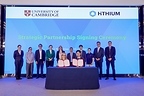
XIAMEN, China, Nov. 14, 2026 /PRNewswire/ — On November 12, the Global Energy Storage Colloquium was held in Xiamen. During the colloquium, HiTHIUM and the University of Cambridge signed a memorandum of understanding (MoU), establishing a strategic partnership. The two parties will collaborate on frontier scientific research, key technology innovation and industrial applications in battery energy storage, bringing academic research into closer alignment with industry needs and exploring new models for international industry-academia collaboration. The partnership aims to contribute to the advancement of global energy storage technology and the industry.

The UK has a strong track record in the development of modern battery technologies and fundamental research. The University of Cambridge is one of the world’s leading universities, with internationally recognized expertise in engineering, materials science and fundamental research. As a leading global energy storage technology company, HiTHIUM has long focused on energy storage technology development and commercialization. It continues to advance integrated research and innovation across the value chain, from high-capacity energy storage cells to long-duration energy storage systems and grid integration technologies.

The collaboration is intended to bring internationally leading academic research into closer engagement with innovation across China’s energy storage industry. The University of Cambridge’s strengths in fundamental science, materials research and engineering will offer new perspectives and approaches to key scientific questions and emerging technologies in energy storage. HiTHIUM will bring its experience in long-duration energy storage (LDES), product development and large-scale deployment, connecting research with real industry needs and application scenarios, and supporting the engineering validation and commercialization of research outcomes. By drawing on the strengths of both research and industry, the partnership will strengthen the links between frontier innovation and practical applications.

Under the cooperation plan, the two parties will establish joint management and research collaboration mechanisms, bringing together academic resources and corporate R&D capabilities. They will work together to plan research projects, facilitate scientific exchange and support the translation of research outcomes, strengthening connections between fundamental research, technology development and industrial applications so that innovation in energy storage can better serve industry needs.

The partnership also marks an important step in HiTHIUM’s efforts to expand its international innovation network. Building on this collaboration with the University of Cambridge, HiTHIUM will further strengthen academic exchanges and research partnerships with leading universities and research institutions around the world. By bringing together international research resources and talent, the company aims to encourage collaboration across disciplines and technology fields, explore the development of technologies such as LDES from a global perspective, and bring technical challenges and application needs from the front lines of industry into research and innovation. This will help research and industrial practice reinforce one another.

View original content to download multimedia:https://www.prnewswire.com/news-releases/hithium-partners-with-the-university-of-cambridge-to-advance-international-industry-academia-collaboration-in-long-duration-energy-storage-302939492.html

SOURCE HiTHIUM

Continue Reading

Trending