Connect with us

Technology

ISRO Scientists Launch Space Technology & Research Program 2026 at Chandigarh University

Published

on

CU Space Program to offer training & research by ISRO, IIST Scientists for research scholars and students

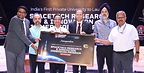
CHANDIGARH, India, June 16, 2026 /PRNewswire/ — In a major step towards strengthening space technology education and research, Chandigarh University, through its Kalpana Chawla Centre (KCC) has launched the KCC Space Technology & Research Program 2026 and the KCC Summer Internship Program 2026 at its campus on Monday.

The month-long national-level programme, running from June 15 to July 11, 2026, has brought together leading space scientists, satellite technologists and semiconductor experts from the Indian Space Research Organisation (ISRO), the Indian Institute of Space Science and Technology (IIST), the Semiconductor Laboratory (SCL) and other premier scientific institutions to mentor the next generation of innovators and researchers. The initiative will provide students with valuable insights into emerging space technologies and hands-on exposure to cutting-edge developments shaping India’s rapidly evolving space sector.

The inaugural ceremony was graced by Dr S Sudhakar, Deputy Director, U R Rao Satellite Centre (URSC), ISRO as the Chief Guest while Prof. Priyadarshnam, Head and Project Director, SSPACE, Indian Institute of Space Science and Technology (IIST) attended as the Guest of Honour. Distinguished guests included Dr. Kamaljeet Singh, Director General, Semiconductor Laboratory (SCL), Chandigarh, and Sri Jothy Soman, Group Director, URSC, ISRO.

Speaking on the occasion, Dr S Sudhakar, Deputy Director, U R Rao Satellite Centre (URSC), ISRO said, “As India works towards becoming a developed nation by 2047, science and technology will play a defining role in shaping the future. Science is going to govern the world and space technology will be one of the most important drivers of that transformation. One of the most important lessons young engineers and researchers can learn from ISRO’s journey is the value of developing indigenous technologies. We have achieved world-class results by building our own capabilities and relying on the talent of our people. Technology does not come free and acquiring it from elsewhere often comes at a significant cost. When we develop technologies ourselves, we not only reduce costs but also gain strategic advantages and self-reliance. This approach has enabled India to perform exceptionally well despite resource constraints.”

Dr S Sudhakar added, “Communication, navigation, scientific exploration and strategic applications will increasingly depend on advancements in the space sector. The coming decades will witness growing demand for space-based services, including surveillance, communication and navigation systems. The defence sector is also expanding its space-based capabilities, both independently and in collaboration with ISRO. At the same time, there will be increasing requirements for scientific research, exploration missions and technology development across multiple domains.”

“ISRO has already charted out an ambitious roadmap extending to 2047, including major programmes ranging from advanced exploration missions to long-term human spaceflight missions. To remain technologically ahead in an increasingly competitive global environment, India must continue to invest in indigenous technologies and strengthen its infrastructure,” added Dr Sudhakar.

Speaking on the occasion, Prof. Priyadarshnam, Head & Project Director, SSPACE, Indian Institute of Space Science and Technology (IIST) said, “ISRO has always been at the forefront of achieving maximum impact with limited resources. One of the key lessons from its journey is the importance of precision, rigorous testing and human expertise. While automation has its place, mission success ultimately depends on meticulous development, validation and the dedication of scientists and engineers. This culture of frugal innovation and uncompromising testing has been central to ISRO’s achievements over the years.”

On the role emerging technologies can play in strengthening the security systems in the country, Prof. Priyadarshnam said, “Quantum technology will be a major thrust area in the future. If we do not adapt to quantum systems, many of the present security mechanisms could eventually become vulnerable. Research organizations across India, including ISRO, are already working on quantum technologies, particularly quantum cryptography and quantum communications. Artificial intelligence is another technology that will have a profound impact on the space sector. While its adoption in satellite systems is still evolving, the enormous volume of data being generated by modern space missions will make AI indispensable for analysis, decision-making and future space applications. These areas will play a crucial role in securing communications, protecting critical infrastructure and strengthening national security in the years ahead.”

On space technology’s role in driving economic growth, he said, “Space technology is going to play a major role in India’s future development. Unless we are quick enough to adopt and integrate space technologies across the domains, the pace of development will not be sufficient. There is certainly a threat perception arising from the growing role of space-based technologies in security and strategic affairs. However, India has the capability to overcome such challenges through indigenous innovation and technological self-reliance. India’s greatest strength lies in its talent, and we must increase our workforce in this critical sector. Innovation in areas such as small satellite technologies and advanced space systems will be important in enhancing our preparedness and resilience.”

Dr Kamaljeet Singh, Director General, Semiconductor Laboratory (SCL) said, “Semiconductors are the foundation of the digital economy and will play a crucial role in India’s journey towards becoming a developed nation by 2047. Under the India Semiconductor Mission, significant progress is already being made with multiple manufacturing and assembly plants being established across the country. Our objective is to build a robust, full-stack semiconductor ecosystem that reduces import dependence and strengthens India’s technological capabilities. Semiconductors are critical for strategic sectors including space, telecommunications, defence, artificial intelligence and advanced computing.”

“The next step is to strengthen manufacturing, deployment and application ecosystems. As artificial intelligence becomes a key driver of future growth, India must leverage its vast data resources to develop indigenous technologies and sovereign AI models. Building strong capabilities in semiconductors and AI will not only boost economic growth but also enhance national security, technological independence and India’s competitiveness in the global innovation landscape,” added Dr Kamaljeet.

Over the next four weeks, nearly 15 eminent scientists, directors, senior researchers and technical experts from premier national institutions including ISRO, IIST, NewSpace India Limited (NSIL), Indian Institute of Remote Sensing (IIRS), Ministry of Earth Sciences (MoES), Semiconductor Laboratory (SCL) and other leading organizations will engage with Chandigarh University students and faculty through an intensive series of technical training sessions, expert lectures, laboratory demonstrations, mentoring programmes, research discussions and interactive workshops.

About Chandigarh University

Chandigarh University is a NAAC A+ Grade University and QS World Ranked University. This autonomous educational institution is approved by UGC and is located near Chandigarh in the state of Punjab. It is the youngest university in India and the only private university in Punjab to be honoured with A+ Grade by NAAC (National Assessment and Accreditation Council). CU offers more than 109 UG and PG programs in the field of engineering, management, pharmacy, law, architecture, journalism, animation, hotel management, commerce, and others. It has been awarded as The University with Best Placements by WCRC.

Website address: https://www.cuchd.in/ 


View original content to download multimedia:https://www.prnewswire.com/in/news-releases/isro-scientists-launch-space-technology–research-program-2026-at-chandigarh-university-302801168.html

Continue Reading
Click to comment

Leave a Reply

Your email address will not be published. Required fields are marked *

Technology

KBR Launches Inaugural Innovation Studio Powered by Applied Computing in Bengaluru

Published

on

By

BENGALURU, India, June 16, 2026 /PRNewswire/ — KBR (NYSE: KBR) launched its inaugural Innovation Studio, powered by Applied Computing, in Bengaluru, India, establishing a base from which the two will deliver industrial AI from India.

Co-located with Applied Computing’s Bengaluru office, the studio serves as KBR’s operational hub for remote monitoring and advisory services delivered through INSITE 3.0, powered by Applied Computing’s Orbital Platform. The collaboration is built on combining Applied Computing’s foundation AI for energy with KBR’s process technology. The hub will deliver remote monitoring and advisory services to KBR’s existing global industrial customers, while also serving as the foundation for deploying the new INSITE 3.0 AI capability to the first wave of customers later this year.

In March, KBR launched INSITE 3.0, its digital delivery platform powered by Orbital, marking the first product to integrate the foundation model with KBR’s process technology expertise.

At the studio’s opening event last week, KBR leadership hosted members of the media as well as subject matter experts, experienced field engineers, operations and maintenance specialists. The launch event offered a first look at the facility and a live demonstration of INSITE 3.0 in action.

Hari Ravindran, SVP and Global Head of Technology Solutions, KBR, said: “The Innovation Studio reflects KBR’s commitment to building deep technology partnerships in India and investing in the future of industrial operations here. Co-locating the KBR Innovation Studio, staffed by our operational experts, alongside Applied Computing’s engineering team base, brings the best of both together: decades of process technology knowledge and a foundation model built specifically for energy. This is a long-term commitment to our customers in the region and to the engineers and specialists who will deliver for them.”

Dan Jeavons, President of Applied Computing, said: “India is where the future of industrial AI is being decided. The scale of operations, the pace of growth and the willingness to adopt advanced technologies are unmatched anywhere in the world. This studio launch is our chance to show, in a live control room, what foundation AI built for energy can actually do. Orbital is already delivering results at some of the largest refineries on the planet, and bringing the industry together in Bengaluru is the clearest signal yet of where we believe this technology is heading.”

Read more about how KBR and Applied Computing are working together to advance AI in the energy sector on kbr.com.
Learn more about Orbital at appliedcomputing.com.

View original content:https://www.prnewswire.co.uk/news-releases/kbr-launches-inaugural-innovation-studio-powered-by-applied-computing-in-bengaluru-302801331.html

Continue Reading

Technology

Dun & Bradstreet Becomes the Trusted Partner for Global Agentic Workflows Through Integrations with Anthropic, OpenAI and Microsoft

Published

on

By

HONG KONG, June 16, 2026 /PRNewswire/ — Dun & Bradstreet recently announced a series of collaborations with OpenAI, Microsoft and Anthropic, bringing the D&B Commercial Graph™ into their respective platform ecosystems. Users can now access Dun & Bradstreet data across leading AI platforms including ChatGPT, Codex, Microsoft 365 Copilot and Claude.

The collaborations represent an important step in embedding trusted business data into agentic workflows. As enterprises increasingly adopt AI to support research, analysis, onboarding, compliance, finance and risk decisioning, access to verified, structured and continuously updated business information is becoming essential to improving confidence, consistency and governance in AI-powered outcomes.

D&B Commercial Graph Powers the Core Data Foundation for the AI Era

As artificial intelligence continues to advance into the agentic era, enterprises increasingly require high quality data that is structured, contextualized and machine readable. AI agents supporting complex workflows, including due diligence, compliance screening, financial analysis and business decision making, rely on trusted data to generate accurate, reliable and actionable insights.

Anchored by the D-U-N-S® Number business identifier, the D&B Commercial Graph™ provides a foundational context layer for understanding business identity, relationships and risk across the global economy. Only with verified business information can agents deliver true business value and ROI in finance and risk management scenarios.

The D&B Commercial Graph™ integrates public and proprietary commercial signals, as well as directly contributed business information, to create a continuously validated view of business identity, ownership, supplier relationships, financials, and risk indicators. The result is an authoritative view of how businesses connect and operate globally. With more than 100 billion verifications, tests, and checks each month, D&B’s Commercial Graph™ delivers coverage, accuracy, consistency, and governance across enterprise systems and AI applications.

Building on this foundation, Dun & Bradstreet is working with leading AI platforms to embed a trusted data layer directly into enterprise workflows.

Collaboration with OpenAI: Bringing Verified Business Context into Finance Workflows

Dun & Bradstreet has collaborated with OpenAI to enable users to access the D&B Commercial Graph™ in ChatGPT and Codex via Model Context Protocol, or MCP, servers. The integration allows financial professionals to bring verified business identity, ownership, relationship, credit and risk data directly into their workflows to accelerate due diligence, financial reporting, validation, guidance and credit origination.

Through D&B-hosted MCP servers, customers can securely connect Dun & Bradstreet data to ChatGPT and Codex, using natural language prompts and custom agents to streamline data-intensive workflows. Users can also access D&B Finance Analytics tools via MCP servers to support automated business credit decisions, powered by real-time insight into hundreds of millions of businesses and a rules-based engine. This enables finance teams to identify and manage risk across portfolios within a headless AI architecture.

“AI is quickly becoming a core part of how organizations make decisions across finance, risk, and growth, and its impact depends on the quality of the data behind it,” said Scott Spencer, General Manager, Finance & Credit at Dun & Bradstreet. “By bringing the D&B Commercial Graph into ChatGPT and Codex, we’re meeting customers where they are working. This helps teams of all sizes, including small and mid-sized businesses, to embrace the power of AI with confidence in their workflows.”

Collaboration with Microsoft: Bringing Verified Business Data into Microsoft 365 Copilot

Through its collaboration with Microsoft, Dun & Bradstreet has made its Graph Connector available in Microsoft 365 Copilot, giving developers and enterprises no-cost access to a curated sample of data from the D&B Commercial Graph™. This allows users to explore how verified business data can support use cases such as research, business identification and workflow enhancement within Copilot.”

The D&B Graph Connector provides access to foundational information on tens of thousands of global public and private companies, including company summaries, locations, contact information, and key data such as employee and revenue ranges.

“Knowing who you’re doing business with is an essential part of knowledge workflows,” said Chantrelle Nielsen, Principal Product Management for Microsoft 365 Copilot at Microsoft. “Integrating this sample of Dun & Bradstreet data into Microsoft 365 Copilot provides that crucial first step of business identification and opens the door for users to explore new ways to use D&B’s continuously updated business data in Copilot.”

Collaboration with Anthropic: Accelerating Onboarding, Risk and Compliance Workflows in Claude

In collaboration with Anthropic, Dun & Bradstreet is bringing verified business, risk and compliance data capabilities into Claude to help enterprises accelerate onboarding and compliance workflows.

By integrating the D&B Commercial Graph™ into Claude, users can access verified business information, corporate linkage data and risk intelligence within a unified workflow framework, enabling more efficient entity verification, relationship analysis and process execution.

This approach represents the future of knowledge work for enterprises: AI systems that do not simply summarize information, but operate with verified enterprise context, risk logic, and governance.

Dun & Bradstreet China: Empowering Local Agentic Workflows with Trusted Business Data

From OpenAI to Microsoft to Anthropic, a clear trend is emerging: trusted business data is rapidly integrating into agentic workflows, becoming a critical foundation for large language models to connect with real-world business scenarios, support task execution and enable decision-making. Dun & Bradstreet China continues to drive the deep integration of trusted business data with both local and global AI platforms.

Currently, Dun & Bradstreet’s global data along with China Data by Topics via MCP servers support integration with leading international platforms and developer tools such as Microsoft Copilot, Cursor, Claude Code and OpenClaw, while also being compatible with local AI ecosystems including Trae, WorkBuddy, QoderWork, Coze and CherryStudio.

Leveraging the D&B Commercial Graph™, the D-U-N-S® Number and business data covering nearly 900 million companies worldwide, Dun & Bradstreet China embeds global business data capabilities into enterprise large language models, AI agents and business workflows. This helps customers access global company information more efficiently, identify corporate linkage networks and gain insights into potential risks.

In the AI era, Dun & Bradstreet is becoming a trusted partner within agentic workflows, helping customers make smarter, faster and more confident decisions across key scenarios including customer acquisition, risk management, supply chain management, trade compliance and global expansion.

About Dun & Bradstreet

Dun & Bradstreet provides the verified commercial identity foundation for enterprises to deploy AI at scale. The company originated the D‑U‑N‑S® Number in 1963, now the global standard for identifying commercial entities. Anchored by this identifier, the D&B Commercial Graph structures and connects business identity consistently across systems, enabling AI to operate on accurate, validated data. Since 1841, businesses of every size have relied on Dun & Bradstreet to navigate change and accelerate growth. For more information, visit: www.dnb.com.hk

View original content:https://www.prnewswire.com/apac/news-releases/dun–bradstreet-becomes-the-trusted-partner-for-global-agentic-workflows-through-integrations-with-anthropic-openai-and-microsoft-302801349.html

SOURCE Dun & Bradstreet

Continue Reading

Technology

Wuhan extends sincere invitation to young people across the globe

Published

on

By

BEIJING, June 16, 2026 /PRNewswire/ — A report from China Daily

Wuhan in Central China’s Hubei province is shining in its golden era. The city is hosting the ongoing 2026 World Youth Development Forum from June 15 to 17, capturing global attention across central China. A frontrunner in the optical and chip industries, Wuhan resonates with young people worldwide and extends a sincere invitation to them.

The five letters spelling “WUHAN” act as five open windows to the world, forming the city’s unique identity and a heartfelt invitation to global youth.

Represented by the letter W for Water, Wuhan is a city nurtured by the Yangtze River. Sitting on the convergence of the Yangtze River and the Hanjiang River, it enjoys convenient access to the whole world. The city encompasses 165 rivers and 166 lakes, with water areas accounting for one-fourth of its total territory.

As an international wetland city with a population of over 10 million, Wuhan features romantic seasonal scenery all year round, featuring cherry blossoms in spring, lotuses in summer, sweet osmanthus in autumn and plum blossoms in winter. It is home to 1,050 parks of various styles and 2,500 kilometers of picturesque greenways and serves as a habitat for the Yangtze finless porpoise, known as the “giant panda of the water.” Endowed with abundant vitality, it stands as a magnificent city of picturesque mountains and rivers.

The letter U stands for University. Wuhan is China’s third-largest hub of intellectual resources, home to 95 higher education institutions, including Wuhan University and Huazhong University of Science and Technology. It ranks fourth nationwide in terms of the number of academicians from the Chinese Academy of Sciences and the Chinese Academy of Engineering. Fourteen of its disciplines, including remote sensing technology and earth sciences, rank among the world’s top ten. In the Nature Index Science Cities rankings, Wuhan takes the fifth place in China and eighth across the globe.

The city has rolled out over 50 world-class innovation achievements, including the world’s first Beidou high-precision chip and the world’s fastest maglev technology. One in ten Wuhan residents is a college student. Every year, 300,000 fresh college graduates choose to stay in Wuhan to start businesses or seek employment. It is truly a “land of talents where brilliance thrives.”

The letter H represents High-tech. Wuhan boasts nationally influential strength in scientific and technological innovation. The world-renowned Optics Valley of China is located right in Wuhan. The city hosts the world’s largest manufacturing hub for optical fibers and cables, as well as China’s leading production hub for optoelectronic devices and small-to-medium-sized display panels.

Pillar industries such as optoelectronic information, automobiles and biomedicine are accelerating toward the trillion-yuan level. Meanwhile, emerging and future industries covering the digital economy, quantum technology, commercial aerospace, 6G and hydrogen energy are maintaining steady growth. Wuhan has evolved into a dynamic, fast-evolving city of innovation.

The letter A symbolizes Art. With a 3,500-year history of urban construction, Wuhan acts as a vital carrier of Yangtze River civilization and Jingchu culture. The city features diverse charms, ranging from the poetic heritage of the Yellow Crane Tower and the futuristic vibe of the suspended monorail, to breathtaking scenery of vast rivers and lakes and a vibrant street-food culture.

More than 40,000 concerts, e-sports festivals and sports events are held in Wuhan annually. Consistently listed among China’s top ten most popular tourist destinations, it is an inclusive cultural city where ancient heritage and modern glamour complement and shine for each other.

Last but not least, the letter N stands for Network. Wuhan is a world-class comprehensive transportation hub. A 4-hour high-speed rail trip or a 2-hour flight can cover 80 percent of China’s major cities and reach a population of 1 billion.

The Yangtze golden waterway, China Railway Express (Wuhan) and multiple passenger and cargo hubs connect the Maritime, Land, and Air Silk Roads. Huahu Airport ranks fourth in the world and first in Asia among professional cargo airports. Equipped with a national-level internet backbone interconnection hub, Wuhan realizes seamless network connectivity nationwide, consolidating its status as a globally connected intelligent hub city.

During the ongoing forum, Wuhan is presenting a host of well-designed characteristic activities tailored for young people based on its superior resources. These events vividly showcase an authentic, multi-dimensional and vibrant urban panorama to participating global youth.

The forum is currently presenting Wuhan’s development experience as a thriving “City of Youth” to the world. It introduces China’s practices in building youth-development-oriented cities, displaying Wuhan’s all-round support for youth innovation, entrepreneurship and personal growth via startup incubators, talent apartments, targeted policies and comprehensive service platforms. At this moment, a sincere “Invitation from Wuhan” is being delivered to young people across the globe.

Delegates from all participating countries will explore Wuhan’s sci-tech innovation frontier in person. They will visit core innovation platforms including Hubei laboratories, Dongfeng Motor Group, the Hubei Humanoid Robot Innovation Center, and Xiaomi Smart Home Appliances Factory to experience the tremendous momentum of Wuhan’s “One City, Three Corridors, and Multiple Belts” innovation pattern and witness the diverse manifestations of Chinese modernization with their own eyes.

Participants will also immerse themselves in unique Jingchu cultural customs. They will pay a visit to the Yellow Crane Tower, Hubei Provincial Museum and the Changjiang Civilization Museum, admire the stunning night scenery along the two rivers, and explore the time-honored heritage of Zhiyin Culture and the profound essence of Yangtze River civilization. Furthermore, delegates will take part in the Youth Market and Dragon Boat Festival Intangible Cultural Heritage Experience activities.

They will communicate with young inheritors of Han embroidery, carved paper-cutting and traditional Chinese medicine sachets, and gain an in-depth understanding of the profound heritage of traditional Chinese culture as well as the innovative vitality of contemporary young craftsmen.


View original content to download multimedia:https://www.prnewswire.com/news-releases/wuhan-extends-sincere-invitation-to-young-people-across-the-globe-302801355.html

SOURCE China Daily

Continue Reading

Trending