Connect with us

Technology

Solidion Technology Announced AI-Assisted Design and Manufacturing Technology of Bipolar Solid-State Batteries for Space Vehicles, Ground, Sea, Air and Infrastructure

Published

on

The company’s revolutionary, patented bipolar electrode-to-pack technology increases the battery energy and power densities; reducing weight, volume, and cost

DALLAS, June 16, 2026 /PRNewswire/ — Solidion Technology, Inc. (Nasdaq: STI), an advanced battery technology solutions provider, today unveiled their patented bipolar electrode-to-pack (BEEP) battery technology, engineered to power electric vertical take-off and landing (eVTOL) aircraft, drones, robots, AI data centers, space infrastructure and devices.

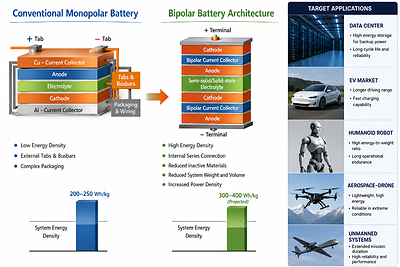
Rather than making individual cells and modules, Solidion’s AI-assisted designed BEEP technology entails directly stacking and connecting bipolar electrodes and solid electrolyte layers in series and in parallel to produce a solid-state battery pack that delivers exceptional power and energy densities.

Solid-state batteries are expected to revolutionize the electric vehicle and space industries with their inherent safety, fast charging, significantly extended driving or flying range on a single battery charge. However, two major issues have prevented the wide-spread commercialization of solid-state lithium batteries:

the difficulty and high cost of manufacturing solid-state batteries andthe limited space and payload weight available in an EV for ground, sea, air, or space transportation to accommodate a bulky and heavy battery system. Current battery pack designs devote much of that space to fire mitigation, a large number of connectors between cells or modules, and large volumes of protective housing materials.

Solidion’s BEEP technology solves both this design issue and reduces the manufacturing challenges, while contributing to reduced battery weight, volume and cost. This is accomplished owing to the BEEP pack requiring only one casing and a small number of connectors – instead of the hundreds of housings and connectors in today’s batteries. The bipolar electrode stacking procedure is intrinsically simpler and easier when compared to making individual cells and using external cables to connect multiple pre-fabricated cells.

Jaymes Winters, Chief Executive Officer of Solidion Technology, stated:

“BEEP represents a fundamental rethinking of how battery packs are built. By eliminating the redundant housings, connectors, and fire mitigation systems that burden conventional designs, we’ve created a pathway to batteries that are lighter, smaller, safer, and less expensive to manufacture — precisely the attributes demanded by next-generation eVTOL, space, and AI infrastructure applications. We believe this technology positions Solidion at the forefront of the solid-state battery revolution.”

About Solidion Technology, Inc.

Headquartered in Dallas, Texas, with pilot production facilities in Dayton, Ohio, Solidion Technology (NASDAQ: STI) is an advanced battery technology solutions provider focused on manufacturing next-generation battery materials and components, and developing high-performance batteries for energy storage, including UPS systems serving the AI data center market, electric vehicles, and aerospace applications. The Company holds a portfolio of over 385 patents, covering innovations such as high-capacity, silane-gas-free and graphene-enabled silicon anodes, biomass-based graphite, and advanced lithium-sulfur and lithium-metal technologies.

For more information, please visit www.solidiontech.com or contact Investor Relations.

Cautionary Note Regarding Forward-Looking Statements

This press release contains forward-looking statements within the meaning of the Private Securities Litigation Reform Act of 1995. Solidion Technology Inc. (NASDAQ: STI) (the “Company,” “Solidion,” “we,” “our” or “us”) desires to take advantage of the safe harbor provisions of the Private Securities Litigation Reform Act of 1995 and is including this cautionary statement in connection with this safe harbor legislation. The words “forecasts,” “believe,” “may,” “estimate,” “continue,” “anticipate,” “intend,” “should,” “plan,” “could,” “target,” “potential,” “is likely,” “expect,” and similar expressions, as they relate to us, are intended to identify forward-looking statements. We undertake no obligation to publicly update any forward-looking statements, whether as a result of new information, future developments, or otherwise, except as may be required by law.


SOURCE Solidion Technology, Inc.

Continue Reading

Technology

Increased Domestic Options Pave Way for New SHARx Stormproof Solution

Published

on

By

Recent federal import changes are raising questions about prescription access and sourcing options. SHARx CEO Corey Durbin says the company’s new Stormproof program is designed to help employers and members navigate uncertainty through expanded sourcing flexibility, prescription advocacy, and additional healthcare support.

ST. LOUIS, Nov. 19, 2026 /PRNewswire/ — Recent media coverage and evolving federal import requirements have drawn renewed attention to prescription sourcing and continuity of access. The news, changing policies, and shifting implementation deadlines have prompted questions from employers and benefits brokers about their sourcing options. The industry experts at SHARx, a supply-chain and procurement management company, have answers.

“Employers and brokers are right to ask what these developments mean for the people who rely on prescriptions, especially high-priced specialty pharmaceuticals,” said Corey Durbin, Chief Executive Officer and Co-founder of SHARx. “But the problem is getting worse as high-cost drugs (those that cost more than $4,000 per year) spending has doubled what it was in 2017. Our response has been in development for months.”

Stormproof emanated from a full review of all member medications. The increase in domestic sourcing options has made the inception of Stormproof possible and will shield employers and members from sourcing uncertainty.

“Stormproof is built around a full analysis of the domestic options and a determination that the value we bring to members and employers can be even greater than it has been. It gives our organization more ways to help members access the medications they need as sourcing conditions change. In this business, the operating conditions can change like the weather. It’s an atmosphere that has always driven us to be a highly responsive organization,” Durbin said.

Preparing for Changing Requirements

Recent headlines, including a November 11, 2026, CNBC report detailing a federal arrest of a top healthcare company official accused of illegal drug importation through an alternative funding program (AFP), come on the heels of Federal agencies announcing changes affecting customs procedures. First, a U.S. Customs and Border Protection (CBP) rule established new requirements for foreign importers of record, the parties legally responsible for declaring imported goods to CBP, takes effect January 5, 2027. Separately, CBP moved the mandatory implementation date for its Entry Type 13 process, an electronic filing process for certain international mail shipments, from October 22, 2026, to January 20, 2027.

The requirements address different customs processes. Their specific effects on individual prescription pathways may depend on how a shipment is handled and on applicable agency requirements. Durbin said SHARx’s policy and operations teams have been preparing for the changes and evaluating options to help members maintain access to their medications while minimizing potential disruptions.

“Policy changes create uncertainty for all stakeholders, but the need for affordable specialty medication is not going away,” said Paul Pruitt, Chief Growth Officer and Co-founder of SHARx. “Our role is to understand what is changing, help employers and members assess their options, and keep working on ways to support both.”

A Flexible Approach to Prescription Access

Stormproof is designed to support members with affordable options, depending on the member or employer preference, member circumstances, and applicable requirements. Durbin says SHARx is still committed to assisting members, most able to obtain their medications at no cost, regardless of sourcing pathways. Employers can choose from two different financial models – both with significant upside to the employer.

The program also includes additional member support designed to complement prescription assistance. These include AI-enhanced mental health and wellness support, 24/7 virtual primary care, and a very affordable weight-loss option that helps replace a benefit many employers had to cut out because of cost.

“Employees need affordable access but should not have to depend on a single sourcing pathway to help them manage high-cost medications,” Durbin said. “Stormproof gives us a broader framework to assist employers and members as circumstances change, while keeping affordability and access at the center of our plans.”

SHARx has worked with employer-sponsored health plans since 2017 to help address the financial impact of high-cost prescription drugs, while adhering to the highest standards of member access and support. The company says it will continue to monitor policy developments and provide clients with updates as it operationalizes Stormproof.

“Storms are part of this landscape, but too many try and run from the storm instead of through it. Stormproof reflects how we respond: stay prepared, adapt as conditions change, and keep working with employers and members to find the fastest path forward through the storm.” Durbin said.

About SHARx

SHARx is a procurement and supply chain management solution for high-cost prescription drugs. Working alongside employer-sponsored health plans, SHARx helps employers address the financial impact of expensive and specialty medications while providing members with personalized advocacy and access to cost-effective sourcing solutions. Learn more at SHARx.com.  

References:

U.S. Customs and Border Protection. (2026, November 6). Heightened requirements for foreign importers of record. Federal Register, 91(214), 69977–70007. govinfo.gov/content/pkg/FR-2026-11-06/html/2026-22735.htmgovinfo.govU.S. Customs and Border Protection. (2026, October 14). International mail Entry Type 13 mandatory implementation date extended to Jan. 20, 2027 [News release]. content.govdelivery.com/accounts/USDHSCBP/bulletins/42f29b6Zamost, S. (2026, November 11). Feds arrest top official of healthcare company, alleging illegal drug importation. CNBC. cnbc.com/2026/11/11/canarx-official-arrested-drug-importation.html

Media inquiries:
Karla Jo Helms
JOTO PR™
727-777-4629
Jotopr.com

View original content to download multimedia:https://www.prnewswire.com/news-releases/increased-domestic-options-pave-way-for-new-sharx-stormproof-solution-302944912.html

SOURCE SHARx

Continue Reading

Technology

Common Space Selects Satellogic to Build the First Community-Governed, High-Resolution Humanitarian Satellite

Published

on

By

Satellogic has been tapped to design, build, launch, and operate a NewSat Mark V satellite for Common Space’s humanitarian Earth observation mission, with launch targeted for July 2027

ST.LOUIS, Nov. 19, 2026 /PRNewswire-PRWeb/ — Common Space, a nonprofit building an independent, community-governed satellite constellation for the public good, today announced it has selected Satellogic Inc., the infrastructure company for Persistent Global Intelligence (PGI), to deliver Common Space’s first high-resolution Earth observation satellite. Satellogic has been tapped, after a competitive request-for-proposals process, to build a NewSat Mark V satellite and manage launch, ground segment, mission operations, and lifetime support for the mission.

With Satellogic as our spacecraft partner, Common Space is moving from vision to orbit and putting high-resolution data into the hands of those who need it most.

Targeted for launch in July 2027, the satellite aims to create a new model for Earth observation: high-resolution imagery collected specifically for humanitarian and public-interest needs, openly licensed, tasked based on community input, and governed with the people and organizations it serves.

High-resolution satellite imagery has become critical infrastructure for understanding a rapidly changing world. Yet much of the world’s highest-resolution imagery remains expensive, restrictively licensed, or hard to access precisely when and where it matters most, leaving humanitarian responders, human rights investigators, and journalists without the independent visibility and verification they need.

Common Space is pioneering a club-good model that makes high-resolution Earth observation more accessible and financially sustainable. Built around unmet demand quantified in Common Space’s 2026 Impact Report, the model turns satellite imagery into shared infrastructure. A single collection can help humanitarians respond to disasters, researchers track disease, journalists verify events, conservationists monitor environmental threats, and human rights investigators preserve evidence. By sharing the infrastructure, its cost, and its value across a growing community, Common Space can scale sustainably to support organizations serving billions of people worldwide.

“Crises aren’t waiting, and neither are we. Common Space is the kind of tech-for-good vision the world needs right now, shaped by an extraordinary community and made possible by supporters who believed in it early,” said Rhiannan Price, Co-Founder of Common Space. “With Satellogic as our spacecraft partner, we’re moving from vision to orbit and putting high-resolution data into the hands of those who need it most. This isn’t just another satellite. We’re building infrastructure to serve people for years to come.”

Common Space’s growing community includes some of the largest humanitarian, human rights, research, conservation, journalism, and mapping organizations in the world. More than 60 organizations have provided letters of support for the mission, including the World Food Programme, Doctors Without Borders, Global Fishing Watch, Humanitarian OpenStreetMap Team, Save the Children, Direct Relief, and Catholic Relief Services. Private-sector organizations will participate through an equitable, paid membership model that helps sustain the shared infrastructure and expand access for the public good.

“Common Space shares our belief that Persistent Global Intelligence shouldn’t be reserved for a few. Humanitarian responders and journalists are often first on the ground and last to get access, yet they need frequent, high-resolution imagery to see what’s really happening so they can act with confidence,” said Luciano Giesso, Vice President of Space Systems at Satellogic. “This mission puts our vision of democratized access into practice. Our vertically integrated approach lets us move quickly and cost-effectively, so imagery can start reaching the organizations that depend on it in 2027.”

Satellogic was selected after Common Space evaluated providers against its technical requirements, community needs, mission alignment, cost, and path to orbit. The NewSat Mark V will capture 4-band multispectral (RGB and near-infrared) imagery at 70 cm native resolution, with 50 cm SuperResolution, across a 6.5 km swath and up to 350,000 square kilometers of collection capacity per day. On-board edge computing will enable processing in orbit.

The mission builds on Satellogic’s long-standing commitment to humanitarian access. Since 2021, Satellogic has been an approved data contributor to the International Charter Space and Major Disasters, providing high-resolution, high-frequency imagery at no cost to the Charter’s Authorized Users during disaster activations worldwide. Satellogic imagery also supports disaster response through NASA’s Commercial Satellite Data Acquisition (CSDA) program, and the company provides free imagery to researchers through its Research & Science Program.

Satellogic designs, builds, and operates its spacecraft in-house, which allows it to deliver dedicated satellites on fast timelines without the cost and risk of new development. The company has a 100% deployment success rate across more than 60 launched satellites.

This first satellite is just the beginning. Common Space is raising philanthropic capital to build a six-satellite constellation capable of daily high-resolution coverage of priority areas worldwide by 2030, creating reliable infrastructure that organizations can build into everyday preparedness, research, decision-making, and response.

About Common Space

Common Space is a nonprofit building an independent, community-governed humanitarian satellite constellation for open, public-benefit Earth observation. Its high-resolution imagery is openly licensed, tasked by humanitarian need, and governed by and for the people and organizations it serves. Organizations interested in membership, partnership, or funding can learn more at commonspace.world.

About Satellogic

Founded in 2010, Satellogic builds the infrastructure for Persistent Global Intelligence (PGI): continuous, proactive awareness of the places, assets, and activities that matter. The company combines high-cadence satellite collection, best-in-class technology, AI-accelerated workflows, and sovereign-trusted architecture to help customers move from episodic imagery to persistent monitoring programs.

Satellogic serves allied defense and intelligence agencies, civil governments, and commercial markets that need reliable, scalable awareness of change across large portfolios of sites. Customers can begin with discovery, expand into persistent monitoring, and build toward dedicated or sovereign-controlled capacity as their mission requirements grow. To learn more, please visit: https://www.satellogic.com.

Forward-Looking Statements

This press release contains “forward-looking statements” within the meaning of the U.S. federal securities laws. The words “anticipate,” “believe,” “continue,” “could,” “estimate,” “expect,” “intends,” “may,” “might,” “plan,” “possible,” “potential,” “predict,” “project,” “should,” “would” and similar expressions may identify forward-looking statements, but the absence of these words does not mean that a statement is not forward-looking. These forward-looking statements are based on Satellogic’s current expectations and beliefs concerning, among other things, the capabilities, performance, and potential applications of Satellogic’s satellites, constellations, satellite software, and pipeline. Although we believe our plans, intentions and expectations reflected in or suggested by these forward-looking statements are reasonable, we cannot give any assurance that we either will achieve or realize these plans, intentions or expectations. Forward-looking statements are inherently subject to risks, uncertainties and assumptions, including risks related to the performance of satellites and software once in orbit and reliance on third parties. Many actual events and circumstances are beyond the control of the Company. Many factors could cause actual future results to differ materially from the forward-looking statements in this press release, including but not limited to the risks and uncertainties described in the “Risk Factors” section of Satellogic’s Annual Report on Form 10-K and other documents filed or to be filed by Satellogic from time to time with the Securities and Exchange Commission. Forward-looking statements speak only as of the date they are made. Satellogic assumes no obligation and does not intend to update or revise forward-looking statements, whether as a result of new information, future events, or otherwise.

Contacts

Common Space Media Relations:

Bill Greer, bill@commonspace.world, +1.607.342.2106

Satellogic Media Relations:

pr@satellogic.com

Satellogic Investor Relations:

ir@satellogic.com

Media Contact

Bill Greer, Common Space, 1 6073422106, bill@commonspace.world, https://www.commonspace.world

Satellogic Media Relations, Satellogic, pr@satellogic.com, https://satellogic.com/

View original content to download multimedia:https://www.prweb.com/releases/common-space-selects-satellogic-to-build-the-first-community-governed-high-resolution-humanitarian-satellite-302945072.html

SOURCE Common Space

Continue Reading

Technology

National Australia Bank Modernizes ATM Network with Diebold Nixdorf Cash Recycling ATMs and Payments Platform

Published

on

By

Integrated hardware and software solutions will enhance customer experiences, optimize cash management and support new physical and digital journeys for consumers across Australia

NORTH CANTON, Ohio, Nov. 19, 2026 /PRNewswire/ — Diebold Nixdorf (NYSE: DBD) announced that National Australia Bank (NAB) is modernizing customer experiences across its self-service network with more than 700 DN Series® cash recycling ATMs combined with the company’s next-generation Vynamic® Acquiring platform. 

Through 2028, NAB will upgrade its ATMs while transforming the software infrastructure that supports physical and digital transactions. Vynamic Acquiring is built on Diebold Nixdorf’s Vynamic Transaction Middleware platform and uses cloud-native, microservices-based architecture. The solution will help NAB modernize its switching environment, support regulatory compliance and introduce new customer journeys. 

NAB’s ATMs support more than 500,000 transactions each week, underscoring the continued importance of convenient, dependable cash access alongside digital and in-branch banking. The initiative will:

Improve availability across NAB’s network with modern, highly reliable ATMs, with at least two at most branches.Streamline the cash cycle by securely reusing deposited banknotes for future withdrawals, reducing replenishment needs.Deliver a significantly improved customer experience through clearer screens, faster processing and additional accessibility and language options.Reduce ATM disputes and improve resolution outcomes by increasing visibility into cash transactions, user interactions and deposits and withdrawals.

ATM monitoring, diagnostics, services and maintenance will be provided by ITS, Diebold Nixdorf’s licensed partner in Australia.

Paul Carter, Executive Retail Banking at National Australia Bank at National Australia Bank, said: “Our investment in Diebold Nixdorf’s cash recycling ATMs and payments middleware strengthens our commitment to providing convenient, dependable cash access and the best customer experience in this market for individuals and small businesses across Australia. By automating more cash-handling processes, improving cash availability and reducing operational interventions, we can serve customers more dependably and efficiently wherever and whenever they need access to their money.”

Jaivinder Singh Gill, senior vice president and managing director, Banking and Retail – APMEA at Diebold Nixdorf, said: “NAB’s modernization shows how self-service technology and software can strengthen critical banking infrastructure while creating more connected customer experiences. We are proud to partner with NAB on this nationwide transformation, combining intelligent cash recycling technology, advanced payments software and local expertise to make everyday banking more convenient, secure and reliable.”

About National Australia Bank

At National Australia Bank (NAB) Group, our ambition is to be the most customer-centric company in Australia and New Zealand. More than 41,000 colleagues at the bank provide 10 million customers with secure, easy and reliable banking services. About 88% of the Group’s workforce is located in Australia and New Zealand, while others work in Asia, London, New York and Paris. NAB is proud to be Australia’s largest business lender. We stand by our customers, and they have our ongoing support.

National Australia Bank Limited ABN 12 004 044 937 AFSL and Australian Credit Licence 230686.

About Diebold Nixdorf

Diebold Nixdorf, Incorporated (NYSE: DBD) automates, digitizes and transforms the way people bank and shop. As a leading global technology and services partner to many of the world’s top financial institutions and retailers, our integrated solutions connect digital and physical channels for consumers conveniently, securely and efficiently. The company has a presence in more than 100 countries with approximately 20,000 employees worldwide. Visit www.dieboldnixdorf.com for more information.

X: @DieboldNixdorf
LinkedIn: www.linkedin.com/company/diebold
Facebook: www.facebook.com/DieboldNixdorf
YouTube: www.youtube.com/dieboldnixdorf

DN-B

View original content to download multimedia:https://www.prnewswire.com/news-releases/national-australia-bank-modernizes-atm-network-with-diebold-nixdorf-cash-recycling-atms-and-payments-platform-302944800.html

SOURCE Diebold Nixdorf, Incorporated

Continue Reading

Trending