Connect with us

Technology

Assort Health Raises $120 Million Series C to Scale Largest Deployment of AI Agents for the Patient Journey

Published

on

SAN FRANCISCO, June 24, 2026 /PRNewswire/ — Assort Health, the most widely-used AI agents platform for the patient journey, today announced a $120 million Series C led by Menlo Ventures at a valuation of $1.2 billion. Assort has now raised more than $222 million to become the standard for healthcare organizations wanting to transform the patient journey with AI.

Healthcare providers now spend nearly twice as much on administration as on direct patient care. That $1.1 trillion in annual administrative burden, from scheduling calls to intake forms to referral loops, is one of the most consequential and correctable failures in modern healthcare. Assort was founded on a simple, uncomfortable conviction: the industry would never fix this problem from the middle. You had to start at the front door.

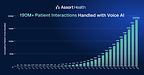
What began as the first voice AI agent to schedule a specialty appointment is now a platform spanning scheduling, intake forms, referrals, document processing, medication refills, real time eligibility, lab requests, and payments. That expansion has been powered by more than 190 million patient interactions, 62,000 care protocols, and 1.6 million decision pathways, creating the largest proprietary specialty dataset in healthcare.

Synapse, Assort’s proprietary AI model, learns the patterns of specialty workflows across every deployment, then generates the edge cases, tests, and simulations each one has to handle. Even the most complex, provider-specific workflows go live with high automation and resolution rates. That advantage compounds with scale. In the last 15 months, revenue has grown 20x.

“After investing in Anthropic, our thesis was simple: find the best application-layer companies in every category,” said Matt Murphy, Partner at Menlo Ventures. “The value of Assort’s platform compounds with every patient interaction. Each one surfaces a new edge case and a new way to improve care, and the platform gets better for the next patient, automatically. That is a structural advantage that grows with scale, and it lets Assort deliver outsized value for every customer in a way other platforms simply haven’t matched.”

“Every so often a company comes along that fundamentally reimagines how an industry operates. Assort is that company for healthcare,” said JP Sanday, Partner at Menlo Ventures. “They’ve built not just another point solution, but a unified platform of AI agents that elevates the entire patient journey. Assort’s customer-obsessed approach and exceptional product velocity position them to lead the AI transformation of the multi-trillion-dollar healthcare industry, which is why the best healthcare groups keep working with Assort.”

Assort’s platform now includes:

Concierge: handles inbound calls, triage, lab requests, med refills, scheduling, insurance eligibility, and intake in any language;Activatereaches patients proactively to close referral loops, automatically act on detected care gaps (i.e. mammograms, colonoscopies, vaccines), recover no-shows, and resolve payments;Orchestrate: runs the operational work behind each visit and writes every detail back to the EHR, including referrals, document processing, patient intake, and personalized pre-post visit forms;Empower: equips staff with an AI copilot to manage complex patient access needs in real time. It unlocks the ability to build and ship personalized AI agents with access to real time benchmarking data and insights on patient journey performance.

All four products are connected by Patient Journey Memory, patient context that creates a continuous record for each patient, allowing the platform to: 1) give every patient a personalized experience with their agent, 2) identify and act on signals across every modality, and 3) activate patients when they’re high intent, creating one continuous and unified patient journey across every interaction. Healthcare organizations are already seeing the impact of a more connected patient journey.

“When a patient reaches out for care, you often get one chance to earn their trust. A mishandled interaction doesn’t just create operational problems; it can mean losing that patient altogether,” said Jon Shaker, Executive Director, Boston Bone and Joint Institute. “That’s why we wanted a partner with a proven track record of handling specialty care complexity at scale. Assort’s experience across hundreds of deployments gave us confidence they could deliver from day one, and they’ve helped us ensure patients move through the right care journey from their very first interaction.”

“We evaluated every AI solution on the market. Assort was the only true platform,” said Dr. Parinita Amin, CEO of MDCS Dermatology. “It runs the full patient journey as one connected system, from referrals and document processing to intake, care gap closure, real-time eligibility, and payments. The difference is memory. Everyone else automates one piece and forgets the rest. Assort remembers every patient across every interaction and connects it all into one conversation. Our automation rate climbs every quarter as they execute against an ambitious roadmap, and the gap between Assort and everyone else keeps widening.”

“This market is going to consolidate in the same way every other one has. Provider groups know it, and the smart ones aren’t buying another point solution. They want one partner with the capital and the engineering depth to transform how they operate over the long run. That’s what we built. Our engineers learn across hundreds of customers and build every implementation for the specific practice in front of them, and we have now raised over $220M to make that engine better,” said Jon Wang, Founder and Co-CEO of Assort Health.

Assort also announced a major expansion into health system operations, bringing the platform behind the largest AI-powered patient access deployment among provider groups to health systems ranging from large community-based organizations to academic medical centers. Several health systems, such as John Muir Health, are partnering with Assort as demand grows for platforms that can support increasingly complex ambulatory operations.

“Specialty care is a different discipline than most AI vendors realize, and that difficulty only compounds at large health systems. It’s exactly what we built Synapse for. Our proprietary model learns the patterns of specialty workflows and gets sharper with every deployment, and that’s what lets us move past answering calls to automating the entire patient journey. That depth is our advantage, and Synapse is the foundation that lets us build faster than anyone in the market,” said Jeffery Liu, Founder and Co-CEO of Assort Health.

In addition to Menlo Ventures, investors participating in this latest round include Lightspeed Venture Partners, Felicis, First Round Capital, Chemistry, Joe Montana, Tau Ventures, and Quiet Capital. JP Sanday, partner at Menlo Ventures, will join Assort’s Board, and fellow partner Matt Murphy, will serve as a Board Observer.

For more information, or to join the team, visit assorthealth.com.

About Assort Health

Assort Health is the most-widely used AI agents platform for the patient journey, from scheduling and intake to referrals, forms, document processing, medication refills, and payments. It is built on 190 million specialty patient interactions and a model that updates in real time to handle the complexity of healthcare that general-purpose AI can’t. That foundation now powers patient access across multi-site practices, multi-specialty groups, and health systems. Customers see a 5% lift in appointment volume, a 115% increase in labor capacity, and a 4.3 out of 5 patient satisfaction score. The platform integrates natively with leading EHR and practice management systems, including Epic and Athena, enabling deployment without disrupting existing clinical workflows. Provider groups and health systems turn to Assort when the complexity outgrows their existing tools. To learn more, visit assorthealth.com.

Media Contact: Kara Spak, 120/80 MKTG, assorthealth@12080group.com

View original content to download multimedia:https://www.prnewswire.com/news-releases/assort-health-raises-120-million-series-c-to-scale-largest-deployment-of-ai-agents-for-the-patient-journey-302808634.html

SOURCE Assort Health

Continue Reading

Technology

Baidu Announces Inclusion of Its Class A Ordinary Shares in the Shenzhen-Hong Kong Stock Connect and Shanghai-Hong Kong Stock Connect Programs

Published

on

By

BEIJING, Sept. 6, 2026 /PRNewswire/ — Baidu, Inc. (“Baidu” or the “Company”) (Nasdaq: BIDU; HKEX: 9888 (HKD Counter) and 89888 (RMB Counter)), a leading AI company with strong Internet foundation, today announced that the Company’s Class A ordinary shares traded on The Stock Exchange of Hong Kong Limited (the “Hong Kong Stock Exchange”) have been included in the Shenzhen-Hong Kong Stock Connect program, effective today, September 7, 2026 (Beijing time). The previously announced inclusion of the Company’s Class A ordinary shares in the Shanghai-Hong Kong Stock Connect program also became effective today. Eligible investors in the Chinese Mainland now have direct access to the trading of Baidu’s Class A ordinary shares through both programs.

The inclusion of Baidu’s Class A ordinary shares in the Shenzhen-Hong Kong Stock Connect program is pursuant to the Announcement on Adjustment of the List of the Eligible Stocks in Hong Kong Stock Connect under the Shenzhen-Hong Kong Stock Connect issued by the Shenzhen Stock Exchange on September 7, 2026.

Taken together, the inclusion in the Shanghai-Hong Kong Stock Connect and the Shenzhen-Hong Kong Stock Connect marks an important step toward expanding the Company’s reach among Chinese Mainland investors and is expected to further diversify its investor base and enhance the liquidity of its shares.

Baidu appreciates the continued support of its shareholders and investors and remains committed to driving sustainable growth and creating long-term value for shareholders.

About the Shenzhen-Hong Kong Stock Connect

The Shenzhen-Hong Kong Stock Connect is a mutual stock market access mechanism between the Chinese Mainland and Hong Kong under which the Shenzhen Stock Exchange and the Hong Kong Stock Exchange have established technical connectivity to enable investors in the Chinese Mainland and Hong Kong to trade eligible shares listed on the other’s market through their local securities companies or brokers.

About the Shanghai-Hong Kong Stock Connect

The Shanghai-Hong Kong Stock Connect established a two-way trading link between the Shanghai Stock Exchange and the Hong Kong Stock Exchange. The stock connect allows qualified Chinese Mainland investors to access eligible Hong Kong shares (Southbound) as well as Hong Kong and overseas investors to trade eligible A-shares (Northbound), subject to a certain amount of daily quota.

About Baidu

Founded in 2000, Baidu’s mission is to make the complicated world simpler through technology. Baidu is a leading AI company with strong Internet foundation, trading on Nasdaq under “BIDU” and HKEX under “9888”. One Baidu ADS represents eight Class A ordinary shares.

Safe Harbor Statement

This announcement contains forward-looking statements. These statements are made under the “safe harbor” provisions of the U.S. Private Securities Litigation Reform Act of 1995. These forward-looking statements can be identified by terminology such as “will,” “expects,” “anticipates,” “future,” “intends,” “plans,” “believes,” “estimates,” “confident” and similar statements. Among other things, Baidu’s and other parties’ strategic and operational plans, contain forward-looking statements. Baidu may also make written or oral forward-looking statements in its periodic reports to the U.S. Securities and Exchange Commission, in announcements made on the website of the Hong Kong Stock Exchange, in its annual report to shareholders, in press releases and other written materials and in oral statements made by its officers, directors or employees to third parties. Statements that are not historical facts, including but not limited to statements about Baidu’s beliefs and expectations, are forward-looking statements. Forward-looking statements involve inherent risks and uncertainties. A number of factors could cause actual results to differ materially from those contained in any forward-looking statement, including but not limited to the following: Baidu’s growth strategies; its future business development, including development of new products and services; its ability to attract and retain users and customers; competition in the Chinese Internet search and newsfeed market; competition for online marketing customers; changes in the Company’s revenues and certain cost or expense items as a percentage of its revenues; the outcome of ongoing, or any future, litigation or arbitration, including those relating to intellectual property rights; the expected growth of the Chinese-language Internet search and newsfeed market and the number of Internet and broadband users in China; Chinese governmental policies relating to the Internet and Internet search providers, and general economic conditions in China and elsewhere. Further information regarding these and other risks is included in the Company’s annual report on Form 20-F and other documents filed with the Securities and Exchange Commission, and announcements on the website of the Hong Kong Stock Exchange. Baidu does not undertake any obligation to update any forward-looking statement, except as required under applicable law. All information provided in this press release and in the attachments is as of the date of the press release, and Baidu undertakes no duty to update such information, except as required under applicable law.

View original content:https://www.prnewswire.com/news-releases/baidu-announces-inclusion-of-its-class-a-ordinary-shares-in-the-shenzhen-hong-kong-stock-connect-and-shanghai-hong-kong-stock-connect-programs-302870913.html

SOURCE Baidu, Inc.

Continue Reading

Technology

People See One Brand. The Internet May Show Them Hundreds More.

Published

on

By

The gap between what organisations control and what people trust may be larger than many realise.

SINGAPORE, Sept. 7, 2026 /PRNewswire/ — Every day, consumers decide whether to trust a website, email, link or digital service. What they rarely see is where an organisation’s official digital presence ends and similar-looking identities begin.

For most people, trust is not determined by ownership records or technical boundaries. It is shaped by what appears familiar, legitimate and connected to the organisation they believe they are engaging with. As digital interactions continue to grow, the gap between what organisations control and what people trust may become increasingly important.

The inaugural ONESECURE’s The State of Digital Trust in Singapore 2026 found that each reference organisation domain was associated with a median of 151 similar-looking domains across the public internet. The study analysed 120,702 distinct lookalike domains associated with 448 reference organisation domains and found that 82% had observable internet or email infrastructure, or both. While this does not indicate malicious activity, it demonstrates how external identities can possess the technical characteristics needed to establish an online presence that people may encounter and interact with.

While organisations typically have visibility over the websites, systems and accounts they own, customers, employees and members of the public make trust decisions based on what they encounter online. Similar-looking identities can exist beyond those organisational boundaries, creating a broader challenge around how trust is recognised, monitored and governed.

“People don’t experience organisations through asset inventories or security diagrams. They experience them through names, emails, websites and links,” said Edmund How, Managing Director of ONESECURE Asia. “The findings suggest organisations may need to think differently about trust. The challenge is no longer just securing what belongs to you. It’s understanding what exists around you, recognising when an external identity becomes relevant, and having a consistent way to determine when action is needed.”

The report found external identity exposure across multiple sectors, including financial services, healthcare, education, public services, transportation and information services, suggesting the issue is not confined to any single industry.

While the findings are drawn from a Singapore-focused dataset, the underlying question is relevant wherever people rely on digital identities to access services, conduct transactions and engage with organisations online regardless of geography.

Understanding and monitoring that broader identity landscape may become an important part of how organisations safeguard trust, protect reputation and fulfil their responsibilities to the people they serve.

If Singapore’s benchmark is 151 distinct lookalike domains per organisation, what could yours be? The question is not simply what your organisation owns, but whether you understand the wider identity landscape that exists around it.

Download the full ONESECURE’s The State of Digital Trust in Singapore 2026 report.

About ONESECURE Asia

ONESECURE Asia, headquartered in Singapore, is a managed security services provider helping organisations strengthen security and resilience as digital risks evolve. Its capabilities span managed security operations and Webyith, a digital trust platform designed to protect the integrity and authenticity of digital environments. Bringing together technology, intelligence and human expertise, we serve as a trusted and accountable partner in addressing critical security gaps across Asia.

Visit www.onesecureasia.com

About This Report

The State of Digital Trust in Singapore 2026 examines observable external digital identity exposure across 448 Singapore-focused reference organisation domains as of August 2026.

The analysis covers 144,134 observed domain records, representing 120,702 distinct lookalike domains after exact self-domain records were excluded. It assesses domain registration, DNS resolution, mail-routing configuration and supporting infrastructure patterns.

The research distinguishes exposure from investigative or operational relevance. A lookalike domain is not automatically malicious, and observable infrastructure or registration characteristics do not by themselves indicate phishing, abuse or malicious intent. They provide context for understanding which external identities may warrant closer examination.

The findings represent a Singapore-focused, point-in-time baseline, not a population-wide survey or measure of confirmed malicious activity. Lookalike volumes may be influenced by reference-domain characteristics and study methodology; comparisons should not be interpreted as rankings of malicious activity or security performance.

The study provides a basis for organisations to better understand, prioritise and govern external digital identity exposure beyond environments they directly control.

View original content to download multimedia:https://www.prnewswire.com/apac/news-releases/people-see-one-brand-the-internet-may-show-them-hundreds-more-302870890.html

SOURCE ONESECURE Asia

Continue Reading

Technology

Asia Fintech Forum 2026 to Convene Regulators, Bankers and Fintech Leaders in Kuala Lumpur on 2 October

Published

on

By

Inaugural forum from Singapore’s Responsible Fintech Institute, title-sponsored by Remi Technology, puts AI, stablecoins and financial inclusion on a single agenda

KUALA LUMPUR, Malaysia and SINGAPORE, Sept. 7, 2026 /PRNewswire/ — The Responsible Fintech Institute (RFI) today opened registration for the inaugural Asia Fintech Forum 2026, a one-day summit on Friday, 2 October at the World Trade Centre Kuala Lumpur.

The forum will bring together 40 speakers from regulators, banks and fintech firms across Asia, and is expected to draw 1,000 delegates. Remi Technology, the Singapore-headquartered cross-border settlement provider, joins as title sponsor.

Convening under the theme “Architecting Asia’s Financial Frontier: AI, Digital Assets, and Inclusive Banking,” the forum is RFI’s first flagship event outside Singapore. The choice of Kuala Lumpur is deliberate: Malaysia is licensing a new generation of digital banks while ASEAN member states negotiate the Digital Economy Framework Agreement (DEFA), and the forum’s regulatory track is built around that gap between national rulemaking and regional interoperability.

Confirmed speakers include Mohammad Ridzuan Abdul Aziz, Chief Executive Officer of Aeon Bank; Aaron Tang, General Manager of Luno Malaysia; Kenneth Chan, Chief Executive Officer of Webull Malaysia; Victoria Wymark of PwC South East Asia; and Affendi Rashdi, Director-General, and Ja’afar Rihan, Head of Islamic Business Development at Labuan Financial Services Authority. The full roster of the speakers is published at https://asiafintech.org/#speakers.

“Asia is writing the rules for digital finance faster than any other region, and it is writing them in several places at once — a stablecoin framework in Hong Kong, digital banking licences in Malaysia, payment corridors out of Singapore,” said Chia Hock Lai, Chairman of RFI. “The risk is not that innovation outpaces regulation. The risk is that a dozen regulators solve the same problem a dozen different ways, and the cost of that lands on consumers and on any firm trying to operate across borders. We chose Kuala Lumpur for our first forum because that conversation has to happen where the market is growing, not only where the rules are already written.”

Main-stage sessions, hands-on workshops, and closed-door roundtables span:

ASEAN fintech and the Digital Economy Framework Agreement (DEFA)Agentic AI in financial servicesStablecoin clearing, settlement and cross-border paymentsIslamic fintech and digital bankingReal-world asset (RWA) tokenisation and its legal frameworksPost-Quantum Cryptography (PQC) migration and defense strategies for banksStrategic fintech branding, positioning, and market communicationGovernance standards and institutional frameworks for permissionless blockchains in APAC (Project Pigeon)Digital banks and financial inclusion

“Banks do not need another payment rail that routes around them. They need settlement infrastructure that runs inside their own compliance perimeter,” said Sam Su, Chief Executive Officer and Co-Founder of Remi Technology. “That argument only gets properly tested in a room that has regulators and bank treasurers in it, not just builders. That is why we are title sponsor: this is one of the few forums in the region that puts all three on the same agenda on the same day.”

“Malaysia has long flown under the radar in regional fintech, and hosting this forum in Kuala Lumpur—with the backing of regional regulators and industry leaders—signals its coming of age,” said Farah Jaafar, Co-Chair of the organising committee, Independent Non-Executive Director of Webull Securities (Malaysia), and Co-Chair of the Women in Fintech group within the Asia Fintech Alliance. “We built this agenda for practitioners, not the conference circuit. Malaysia brings critical pillars the regional dialogue needs: a mature Islamic finance ecosystem and proactive regulators willing to give digital models room to scale.”

“Real-world asset tokenisation and next-generation capital markets cannot scale in silos; they require shared liquidity, robust custody, and cross-border regulatory clarity,” said Calvin Ng, Chairman of NexStox. “As both strategic partner and venue sponsor, NexStox is proud to anchor this dialogue at the World Trade Centre Kuala Lumpur. The Asia Fintech Forum provides the institutional bridge APAC needs to transition tokenised assets and digital market infrastructure from pilot concepts into live capital deployment.”

NexStox, RegTank, Sumsub and VerifyVASP join as sponsors.

Supporting partners include the Labuan Financial Services Authority (LFSA), International Digital Economics Association (IDEA), the Digital Assets Association (DAA), Thailand Fintech Association (TFA), Fintech Philippines Association (FPA), Hong Kong Fintech Industry Association (HKFTA), Unified Fintech Forum (India), ACCESS Malaysia, Fintech Association of Malaysia (FAOM) and Taiwan Fintech Space.

Registration is now open at https://asiafintech.org/. Exhibition packages and speaker nomination forms are available on the same site.

Media accreditation: Journalists may request onsite access, interview slots with RFI and sponsor spokespeople, and the full press kit (logos, speaker headshots, agenda) from the contact below.

About Responsible Fintech Institute

The Responsible Fintech Institute (RFI) is a global nonprofit organisation based in Singapore. Its goal is to create a safe, trustworthy and reliable future for digital finance by building the digital utilities that support responsible innovation. RFI brings together public and private sector stakeholders to help build the rules and technology needed for new digital financial tools, and to make the digital asset sector sustainable and inclusive. Learn more at responsiblefintech.org.

About Remi Technology

Remi Technology is a Singapore-based fintech company that delivers stablecoin clearing and settlement infrastructures for banks and financial institutions worldwide. Find us at www.remitech.ai or www.linkedin.com/company/remi-tech.

View original content to download multimedia:https://www.prnewswire.com/apac/news-releases/asia-fintech-forum-2026-to-convene-regulators-bankers-and-fintech-leaders-in-kuala-lumpur-on-2-october-302870789.html

SOURCE Responsible Fintech Institute (RFI)

Continue Reading

Trending