Connect with us

Technology

Mantle Migrates Its Super Portal to Chainlink CCIP, Bringing Institutional-Grade Security to Every Cross-Chain Transfer of the $2.5B+ MNT Token

Published

on

The migration to Chainlink CCIP strengthens the security of MNT as it moves across chains, laying the foundation for Mantle’s strategy for powering the future of tokenized finance at scale.

DUBAI, UAE, July 9, 2026 /PRNewswire/ — Mantle, the premier distribution layer connecting traditional finance and on-chain liquidity, today announced the migration of its Mantle Super Portal, co-developed with Bybit, from LayerZero to Chainlink Cross-Chain Interoperability Protocol (CCIP). This upgrade brings the industry’s highest level of cross-chain security to MNT, the token underpinning Mantle’s $2.5B+ ecosystem, marking a significant step forward in hardening the infrastructure that moves value across the Mantle ecosystem.

With billions lost to cross-chain exploits, bridging infrastructure has emerged as one of the most security-sensitive surfaces in the industry, concentrating both the largest volume of value in transit and the greatest exposure to risk. Following a review of its cross-chain infrastructure to bolster higher ecosystem security, Mantle selected Chainlink CCIP as the solution that met its rigorous security requirements. Built on a defense-in-depth architecture, CCIP features:

Robust cross-chain security: CCIP establishes a strong security floor for all cross-chain transfers through the default use of Chainlink’s robust Decentralized Oracle Network (DON) infrastructure.Decentralized node infrastructure: Every CCIP bridge lane is secured by 16 independent, high-quality, and security-reviewed node operators.Advanced risk management: CCIP features native rate limits that act as circuit breakers to limit contagion during extreme scenarios.Institutional security standards: CCIP is SOC 2 Type 2 compliant, meeting the strict enterprise-grade security standards required by major institutions.

As the value moving through the Super Portal accelerates, the security standard required to secure rises with it. Mantle’s migration to Chainlink CCIP reflects a calculated decision to meet that standard, driven by security and risk considerations, and to align with a broader industry shift towards secure-by-default infrastructure.

The Super Portal will be temporarily suspended during the migration, tentatively scheduled for 9 to 15 July 2026. As with any infrastructure migration of this scale, the window may extend slightly beyond this estimate to ensure a complete and secure transition. No action is required from users: existing MNT on Ethereum and Solana is unaffected, as are all interactions involving MNT on Byreal and Bybit, and transfers will resume automatically once the migration is complete.

A Security Upgrade for the Mantle Super Portal

The Mantle Super Portal, developed in collaboration with Bybit, is Mantle’s cross-chain hub for moving MNT between ecosystems. It currently connects MNT between Ethereum and Solana, with further routes planned as Mantle expands.

With this migration, MNT has deprecated LayerZero OFT and adopted the Cross-Chain Token (CCT) standard, with all transfers through the Super Portal now secured by Chainlink CCIP. Under the CCT standard, all transfer controls are configured by Mantle, providing full autonomy and ownership over its smart contracts and cross-chain token pool.

Beyond strengthening security, the migration establishes the foundation for MNT to interoperate across a wider range of chains, venues, and markets as Mantle grows, complemented by Bybit’s support for MNT deposits and withdrawals on Solana.

Chainlink CCIP is widely adopted across the blockchain industry to secure cross-chain transfers of high-value assets, as it is built on the same battle-tested Chainlink infrastructure that secures approximately 70% of DeFi and has enabled $32+ trillion in onchain value.

“As tokenized financial assets move from concept to scale, the infrastructure that carries them across chains cannot be an afterthought,” said Emily Bao, Key Advisor at Mantle. “Deprecating our legacy bridging solution and migrating the Super Portal to Chainlink CCIP brings every MNT cross-chain transfer in line with the security standards of the world’s largest financial institutions. It is the level of assurance the next phase of on-chain finance demands.”

“We’re continuing to see an industry trend of leading protocols upgrading their cross-chain infrastructure to meet the requirements of institutional adoption. Mantle’s migration to Chainlink CCIP reflects the growing recognition that secure-by-default infrastructure is critical for any cross-chain deployment to succeed at scale.” Johann Eid, Chief Business Officer, Chainlink Labs

Building the Secure Foundation for Tokenized Finance

As tokenized equities, money market funds, and other regulated assets increasingly move on-chain, the infrastructure carrying them is being held to the standards of traditional finance. Securing the Super Portal with Chainlink CCIP reinforces Mantle’s position as the distribution layer connecting traditional finance and on-chain liquidity, where security of this caliber is a precondition and builds toward Mantle and Bybit’s continued commitment to grow MNT through further integrations, opportunities, and use cases.

Mantle’s vision of a full-stack RWA layer, built on bedrock liquidity, aligns directly with Chainlink’s evolution into an all-in-one oracle platform powering real-world asset tokenization, collateral mobility, and composability across chains. That alignment extends into the infrastructure itself as Chainlink secures the flow of value, Mantle secures the rails it moves on.

As the ecosystem grows, Mantle will continue to deploy the most secure infrastructure available across its stack, matching the protection of every asset to the value it carries.

About Mantle

Mantle positions itself as the premier distribution layer and gateway for institutions and TradFi to connect with on-chain liquidity and access real-world assets, powering how real-world finance flows. With over $2B+ in community-owned assets, Mantle combines credibility, liquidity and scalability with institutional-grade infrastructure to support large-scale adoption. The ecosystem is anchored by $MNT within Bybit, and built out through core ecosystem projects like mETH, fBTC, MI4 and more. This is complemented by Mantle’s partnerships with leading issuers and protocols such as Ethena USDe, Ondo USDY, and OP-Succinct.

For more information visit mantle.xyz.
For more social updates, please follow: Mantle Official X & Mantle Community Channel
For media enquiries, please contact: contact@mantle.xyz

About Chainlink

Chainlink is the industry-standard oracle platform bringing the capital markets onchain and the market leader powering the majority of DeFi. The Chainlink stack provides the essential data, interoperability, compliance, and privacy standards needed to power advanced blockchain use cases for institutional tokenized assets, lending, payments, stablecoins, and more. Since inventing decentralized oracle networks, Chainlink has enabled tens of trillions in transaction value and now secures the vast majority of DeFi.

Many of the world’s largest financial services institutions have also adopted Chainlink’s standards and infrastructure, including Swift, Euroclear, Mastercard, Fidelity International, UBS, S&P Dow Jones Indices, FTSE Russell, WisdomTree, ANZ, and top protocols such as Aave, Polymarket, Lido, Lighter, and many others. Chainlink leverages a novel fee model where offchain and onchain revenue from enterprise adoption is converted to LINK tokens and stored in a strategic Chainlink Reserve. Learn more at chain.link.


View original content to download multimedia:https://www.prnewswire.com/apac/news-releases/mantle-migrates-its-super-portal-to-chainlink-ccip-bringing-institutional-grade-security-to-every-cross-chain-transfer-of-the-2-5b-mnt-token-302822052.html

SOURCE Mantle

Continue Reading

Technology

Cash or Card? New Upgraded Points Survey Reveals How Travelers Pay Abroad

Published

on

By

AUSTIN, Texas, Oct. 28, 2026 /PRNewswire/ — A new Upgraded Points survey of 1,500 recent international travelers, including 1,000 Americans, finds that travelers use a mix of cash and cards abroad, but exchange rates, fees, and declined transactions can complicate purchases.

“Spending money should be the easy part of a trip abroad,” said Ryan Smith, Director of News at Upgraded Points. “But exchange rates, fees, and payment options can complicate even the simplest purchase. We wanted to learn how travelers prepare, where their plans run into trouble, and what they do when convenience and the best exchange rate move in different directions.”

Study Methodology

Upgraded Points surveyed 1,500 adults who had traveled internationally within the past 12 months, including 1,000 U.S. adults and 500 adults from other countries. Respondents answered questions about payment methods, cash habits, credit card use, airport currency exchanges, and their confidence navigating exchange rates. The results were compared to show how Americans’ payment habits differ from those of other international travelers.

Payment Planning Often Starts Months Before a Trip

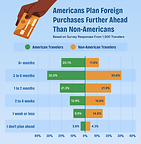
Nearly one-third (32%) begin planning how they’ll pay abroad three to six months before departure. U.S. travelers are more likely than non-U.S. travelers to start earlier, with 20% beginning more than six months ahead, compared with 12% of non-U.S. travelers.

Travelers’ Confidence in Exchange Rates Varies

Just 35% of respondents said they feel very confident understanding exchange rates abroad. Confidence also varied by age and gender:

44% of men feel very confident, compared with 26% of women.28% of Gen Z travelers feel very confident, compared with 40% of Gen X travelers and 37% of Baby Boomers.

Cash and Cards Remain Popular Abroad

Cash in the local currency and physical credit cards were nearly tied as the payment methods travelers most often use abroad. Mobile wallets were more popular among younger travelers:

71% use cash in the local currency.69% use a physical credit card.44% use a mobile wallet, including 56% of Gen Z travelers and 22% of travelers age 61 and older.35% use a physical debit card.

Most Travelers Carry Local Currency

More than 8 in 10 travelers (81%) carry cash in the destination’s currency, often for situations where cards may not be accepted:

64% use it at street vendors, markets, or small businesses.55% use it for tips and other customary cash payments.53% carry it for emergencies.

Travelers generally avoid carrying a large amount at once. About 44% exchange enough cash for several days, while 26% exchange enough for the full trip.

Familiar Card Brands Lead Among U.S. Travelers

Among U.S. respondents, Visa was the most commonly used card network, while Chase and Capital One were the most commonly used issuers:

Visa: 24%Chase: 21%Capital One: 19%American Express: 15%

Fees and Declined Cards Can Complicate Purchases

Among all respondents, travelers most often said their bank or card company contacted them about a purchase made abroad. Other issues increased the cost of a purchase or prevented it from going through:

38% were contacted by their bank or card company about a purchase.34% paid more than expected because of the exchange rate.29% were charged an unexpected foreign transaction fee.26% had a card declined.

Find the full study here.

About Upgraded Points LLC

Headquartered in Austin, Texas, Upgraded Points is a travel company that helps to demystify the complex world of travel and credit cards. Launched in 2016 by Alex Miller, Upgraded Points uses targeted research efforts and in-depth studies to help travelers maximize their travel, points, and experiences. Learn more at www.UpgradedPoints.com.

Media Contact:
Alex Miller, Founder
1-214-646-8866
425187@email4pr.com

View original content to download multimedia:https://www.prnewswire.com/news-releases/cash-or-card-new-upgraded-points-survey-reveals-how-travelers-pay-abroad-302922010.html

SOURCE Upgraded Points

Continue Reading

Technology

ESI supplying solar array components to missile defense programs

Published

on

By

SIMI VALLEY, Calif., Oct. 28, 2026 /PRNewswire/ — ESI Motion Inc. is proud to announce that it is supplying the Solar Array Drive Electronics (SADE) to Lockheed Martin for its work on the Space Development Agency’s Proliferated Warfighter Space Architecture (PWSA) programs.

Under the agreement, ESI Motion’s SADE technology will support SDA as the PWSA is developed.

Defending our nation in space is more important than ever. The Space Development Agency’s PWSA programs provide the military with a network of satellites with secure communication, missile tracking and space-based support to make sure our troops have the latest and greatest technology.

The SADE consists of our Space-rated, flight heritage, SuperNova and Pulsar motor controllers. These motion controllers ensure all mission parameters are fulfilled, with high-reliable technology. 

ESI Motion Inc., U.S. Company, is a trusted supplier and partner, supporting mission operations for space, military and industrial customers around the world for over 20 years. Please visit our website; www.esimotion.com

Mitchell Haerterich, mhaerterich@esimotion.com

View original content to download multimedia:https://www.prnewswire.com/news-releases/esi-supplying-solar-array-components-to-missile-defense-programs-302922454.html

SOURCE ESI Motion

Continue Reading

Technology

Envoy AI Launches “Boss of Machines” Program to Develop the Next Generation of Freight Leaders

Published

on

By

New AI Operations Lab will provide college students with hands-on experience in freight technology, operational transformation, and a $2,500 scholarship.

CHATTANOOGA, Tenn., Oct. 28, 2026 /PRNewswire-PRWeb/ — Envoy AI, the AI Native platform behind logistics autonomous agent system and execution layer Ellie, today announced the launch of Boss of Machines: AI Operations Lab, a new internship and scholarship program designed to prepare the next generation of logistics professionals for an industry increasingly shaped by artificial intelligence and digital labor.

The people starting their careers in freight now are going to spend a lot of their day managing agents. Somebody has to be the boss of those machines. We named the program after that job because it’s the one brokerages are going to be hiring for.

The program was introduced by Envoy AI CEO Robby Nathan during his fireside chat at FreightWaves’ F3: Future of Freight Festival on October 27.

“Freight has always been a people business, and that isn’t changing,” said Robby Nathan, Envoy AI CEO. “What is changing is how the work gets done. We want students to understand that shift firsthand. There’s a big difference between learning about AI in a classroom and seeing what it takes to put it to work in a real operation. Our goal is to give them that experience and help prepare them to become the leaders this industry will need.”

Launching in spring 2027, the three-month program will select two college juniors or seniors for an immersive experience working directly with Envoy AI’s product, engineering, and operations teams. Participants will gain firsthand exposure to how AI technology is developed, implemented, and used to solve real operational challenges across the freight industry.

Preparing Students for a Changing Industry

As freight companies adopt AI to automate routine work, improve productivity, and scale operations, the skills future logistics leaders need are evolving.

The Boss of Machines program bridges the gap between classroom education and the practical experience needed to lead technology-enabled operations.

Students will participate in four areas of learning:

Building AI for Operations: Understanding how AI agents are developed and applied to freight workflows.Deploying Digital Labor: Learning how new technology is integrated into existing systems, implemented with customers, and adopted by operational teams.Measuring Operational Performance: Exploring the role of analytics, productivity, and return on investment in evaluating technology initiatives.Leading Modern Freight Operations: Developing an understanding of how people and AI agents work together to manage and execute freight operations.

Investing in the Next Generation

The initiative reflects Envoy AI’s commitment to developing talent and giving students meaningful exposure to the technology and operational practices shaping the future of transportation.

“About 75% of the freight in our live accounts is already booked through Ellie, and that changes the job a new hire walks into,” said Nathan. “The people starting their careers in freight now are going to spend a lot of their day managing agents. That takes someone who can tell when a rate doesn’t make sense for the lane, and who’ll catch a carrier about to fall off before the shipper ever hears about it. Somebody has to be the boss of those machines. We named the program after that job because it’s the one brokerages are going to be hiring for.”

Throughout the program, students will work alongside experienced industry professionals, gaining exposure to product development, customer implementations, operational workflows, and the business decisions involved in deploying AI at scale.

Upon successful completion of the three-month program, each participant will receive a $2,500 scholarship to support their fall 2027 studies.

Applications and Program Timeline

The inaugural Boss of Machines: AI Operations Lab will welcome two students for the spring 2027 semester.

The program is open to college juniors and seniors interested in logistics, supply chain management, technology, engineering, business operations, and related fields.

Applicants will be asked to share their interests, relevant experience, and perspectives on how technology can improve freight operations.

Envoy AI will announce selected participants in January 2027, ahead of the spring program kickoff.

Additional program details and application information will be available through Envoy AI’s website.

About Envoy AI

Envoy AI develops AI-powered digital labor solutions for freight and logistics operations. Through its AI workforce, Ellie, the company helps logistics teams automate operational workflows, improve productivity, and execute freight processes across existing transportation systems. Envoy AI helps transportation organizations scale operations through practical AI applications.

Media Contact

Michelle McBride, Envoy AI, 1 972-821-2012, michelle@tryenvoy.ai, tryenvoy.ai

View original content:https://www.prweb.com/releases/envoy-ai-launches-boss-of-machines-program-to-develop-the-next-generation-of-freight-leaders-302922133.html

SOURCE Envoy AI

Continue Reading

Trending