Flagship conference to bring together 50+ global and regional leaders exploring how AI is reshaping marketing, media, commerce and customer engagement
Tickets available at: bit.ly/JoinIABC26
HONG KONG, Sept. 30, 2026 /PRNewswire/ — Artificial intelligence is moving from experimentation to scaled execution across the global marketing industry. According to IAB’s 2026 Outlook Study, five of the top six marketer focus areas in 2026 are AI-driven, reflecting how rapidly AI is becoming core infrastructure for marketing strategy and business growth.
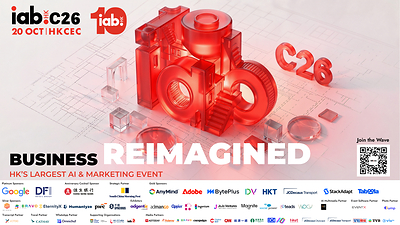
Against this backdrop, IAB Hong Kong announced the return of C26: Business Re-imagined, positioned as Hong Kong’s largest AI and marketing event, taking place on 20 October 2026 at the Hong Kong Convention and Exhibition Centre. The flagship conference will bring together 50+ speakers, 20+ sessions, and 20+ exhibitors and workshops, convening global and regional leaders across brands, technology, media, platforms, agencies and solution providers to explore how AI is reshaping brand building, content creation, commerce and customer experience.
Under the theme “Business Re-imagined”, C26 will focus on the next stage of AI transformation: moving beyond the adoption of new tools to rethinking how businesses create value, redesign workflows and lead with human judgment in an increasingly AI-powered environment. Through keynotes, executive panels, brand case studies and technology showcases, the conference will offer practical perspectives on how companies can turn AI innovation into measurable business impact.
Brian Hui, Chairman of IAB Hong Kong, said: “As IAB Hong Kong marks its 10th anniversary, C26 captures a defining moment for the digital marketing industry as AI redefines what is possible in this sector. By connecting innovators, technologists and marketers from Hong Kong, Mainland China and around the world, it also reinforces Hong Kong’s distinctive role as a place where ideas and expertise converge, creating new possibilities for our industry.”
Arthur Chan, C26 Organising Committee Chair, said: “Business Re-imagined reflects where the market is heading. AI is no longer just about doing things faster — it is changing how value is created, how work gets done and how brands remain relevant in an increasingly automated environment. This year’s C26 is built around three key areas: growth beyond speed, the shift from AI conversation to AI execution, and the continued importance of human leadership. Together, these themes reflect the questions every business leader now needs to answer: where can AI create new value, how will agentic workflows reshape operations, and how do we keep people, creativity and trust at the centre of transformation?”
Global and regional leaders to headline C26
The keynote stage will set the tone for C26, with global, regional and local leaders sharing perspectives on the forces shaping the industry’s next chapter. Speakers include Sir Martin Sorrell, Founder and Executive Chairman of S4 Capital and one of the world’s most influential advertising and marketing leaders; Caroline Laird, Senior Director, Google Technical Services & Consulting, who will share regional perspectives on how AI is advancing platform innovation, marketing effectiveness and brand growth; Shailley Singh, Chief Operating Officer and Executive Vice President, Product Management, IAB Tech Lab, who will offer global insights into the digital advertising infrastructure, standards and responsible innovation needed to scale AI-powered marketing; and Edward Bell, General Manager Brand, Insights and Marketing Communications, Cathay, who will share how a leading consumer brand is using AI to create smarter and more connected customer experiences.
Beyond the keynote stage, C26 will feature senior representatives from Adobe and Meta, alongside Chinese Mainland innovators including Alibaba, BytePlus, iFLYTEK, JD Technology, Huawei and iQIYI. Hong Kong and regional brand leaders from Cigna Healthcare,DFI Retail Group,Hang Seng Bank, HKBN, HKT, Langham Hospitality Group, Manulife, MTR, One Cool AIFX, Perion, PwC, SCMP, Starbucks, Visa, and V+Short will also share real-world perspectives on how AI and digital innovation are being applied to improve customer experience, marketing effectiveness, operational efficiency and business growth. Solution showcases from Bravo Media,EternityX, Google, Omnichat, and HKT will further demonstrate practical AI applications for marketing and enterprise transformation.
Across keynotes, executive panels, brand case studies and solution showcases, these leaders will address the topics defining the next phase of AI-powered marketing. Discussions will cover agentic commerce, including how AI agents may change consumer discovery and purchasing journeys; agentic advertising, including how AI-led workflows are transforming media planning, buying, optimisation and reporting; and AI governance, as companies scale adoption while maintaining accountability, transparency and brand safety.
The urgency of this agenda is underscored by recent industry data: according to DoubleVerify’s 2026 APAC Global Insights Report, over 500 million impressions of low-quality AI-generated content were identified in the first half of 2026 alone, while AI bots generated 10 times more clicks than humans in unprotected digital campaigns — costing brands both budget and trust.
The programme will also examine fast-growing areas including retail media, GEO and AI search, outbound marketing and AI-generated content, connecting these trends to the practical questions facing business leaders: how to grow across markets, improve marketing performance, build more responsive customer engagement and keep creativity and human judgment at the centre of AI transformation.
Explore next-generation AI marketing solutions
The C26 Exhibition Zone will bring together leading AI, advertising technology and digital marketing providers, including BytePlus, DoubleVerify, Magnite, StackAdapt, admanGO, Appier, AnyMind, Teads, Digital Zoo, Ingenium Digital, MindWorkz, Votee, WOGI and JoJo Ventures, among others. The zone will offer a closer look at how solutions across advertising intelligence, AI-powered analytics, SEO/GEO, content production, customer engagement and omnichannel media are moving from standalone tools into integrated marketing workflows, helping brands better understand what practical AI adoption can look like in real business settings.
C26 will also feature hands-on workshops. IAB Tech Lab Agentic Bootcamp will explore buyer and seller agents, data governance, automation, compliance and cross-market deployment, while sharing AI agentic advertising frameworks and emerging industry standards. Humantyze will demonstrate how enterprises can use Tencent WorkBuddy AI Agent to reimagine workflows and improve operational efficiency and execution.
Brands and creators to confront the realities of AI-era collaboration
Through the “IAB Chat: Creators Meet Brands in the AI Era” session, C26 will bring brands and creators face to face for an honest dialogue. Representatives from Hang Seng Bank and MTR will join the discussion alongside leading content figures such as digital content creator Ming Jai, AI expert Rannes Man, and Xiaohongshu marketing expert Vivian Evans to unpack how AI is transforming brand–creator collaboration.
With live voting on stage, brands and KOLs will compare views on briefs, creative control, authenticity, data and results — surfacing the uncomfortable truths behind partnerships in the AI era.
Developing the next generation of AI-ready marketing talent
An education-focused panel will bring together university representatives and industry leaders, including global marketing communications group WPP, to explore what employers now expect from AI-ready marketers and how academia and business can work more closely to develop future talent with the commercial judgment, adaptability and responsible AI capabilities needed to succeed.
Event Registration and Participation
Registration for IABHK C26 is now open — secure your spot today and join the new wave of AI-driven marketing! For details and registration: https://bit.ly/JoinIABC26
For enquiries, please contact: Email:c26@iabhongkong.com
Click here to watch the event trailer: https://youtu.be/6oX8qqwgdeE
Speakers including:
Sir Martin Sorrell, Founder & Executive Chairman, S4 CapitalCaroline Laird, Senior Director, Google Technical Services & Consulting, GoogleShailley Singh, Chief Operating Officer and Executive Vice President, Product Management, IAB Tech LabEdward Bell, General Manager, Brand, Insights and Marketing Communications, CathayAlan Chan, General Manager, Hong Kong and Taiwan, AdobeJoe Chang, Regional Director, BytePlusSarah Tam, Chief Customer Officer, Marketing & Partnership, Cigna Healthcare Hong KongAlan Chan, General Manager, Starbucks Hong Kong and Shake Shack, Coffee Concepts (Hong Kong)Chandana Sunder, Group Retail Media Director, DFI Retail GroupJordan Cheung, Chief Marketing Officer, Hang Seng BankBruce Lam, Chief Executive Officer, Consumer, HKTYang Yang, Director, Advertising Business Integrated Operation Department, Huawei Consumer Cloud Service, HUAWEIEvangeline Song, General Manager, Commercial & Strategic Partnerships (APAC & Middle East), iQIYISean Seah, SVP Strategy Technology Innovation, Langham Hospitality GroupCelia Ling, Chief Marketing Officer, Manulife Greater ChinaPhil Lam, Singer and Songwriter, Sony MusicClarissa Tanoesoedibjo, CEO, V+ShortLutricia Kwok, Head of Marketing Hong Kong & Macau, Visa
PR Newswire is the Official Press Release Distribution of the IAB HK.
About C26
Four years since the rise of generative AI, the conversation has matured from initial implementation to fundamental business transformation. At the forefront of this evolution is the IAB HK C26 AI Marketing Conference, Hong Kong’s premier gathering for marketing professionals, business leaders, and technology innovators. Under the theme “Business Re-imagined”, the conference moves beyond incremental efficiency to explore how AI is fundamentally reshaping commerce, leadership, and creativity. Through a curated series of dynamic keynotes, executive panels, and practical case studies, C26 illuminates the path for leaders to transition from AI potential to measurable, structural business impact.
About IAB Hong Kong
Celebrating its 10th anniversary, IAB Hong Kong (IAB HK) is a not-for-profit association that serves as Hong Kong’s bridge between East and West in digital marketing — connecting the city’s advertising ecosystem to a global network spanning 45 markets through the Interactive Advertising Bureau (IAB).
Representing over 130 member companies across media, ad tech, platforms, agencies, brands, and research organisations, IAB HK is recognised as one of the most credible and influential digital marketing associations in the city. Through initiatives such as the annual IAB HK Digital Awards, professional education programmes, and industry research, IAB HK drives standards, talent development, and marketing innovation. Founding members include comScore, Meta, Google, the South China Morning Post, and Yahoo, with PwC as a strategic partner. For more information, please visit www.iabhongkong.com.
View original content to download multimedia:https://www.prnewswire.com/apac/news-releases/iab-hong-kongs-c26-returns-as-hong-kongs-largest-ai-and-marketing-event-exploring-how-ai-is-reimagining-business-302896797.html
SOURCE IAB HK








 Coin Market5 days ago
 Technology4 days ago
 Coin Market5 days ago
 Technology2 days ago
 Technology4 days ago
 Technology4 days ago
 Coin Market5 days ago
 Technology4 days ago