Connect with us

Technology

Palabra.ai Takes #1 Spot for Speed in New Text-to-Speech (TTS) Benchmark

Published

on

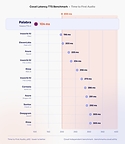
Palabra ranks #1 for latency on Coval’s independent, open-source text-to-speech benchmark, posting 104 milliseconds — roughly twice as fast as the nearest competitor — with a 6% word error rate.

Coval’s independent benchmark puts Palabra’s text-to-speech model at 104 ms latency — about twice as fast as the next-closest competitors.

LONDON, July 31, 2026 /PRNewswire-PRWeb/ — Palabra, a real-time speech AI company, has ranked #1 for latency on Coval’s independent TTS benchmark, a widely watched, continuously updated leaderboard tracking how leading voice AI models perform under real-world conditions. Palabra posted 104 milliseconds of latency and a 6% word error rate (WER), outpacing ElevenLabs, Cartesia, and other major players in the space — roughly twice as fast as the nearest competitor.

The hardest problem in speech AI is making voice agents feel indistinguishable from a real person. Latency above 200 milliseconds breaks that. We built our TTS for extremely low time-to-first-audio at production scale. Coval’s benchmark ranks us #1 at 104 ms, nearly twice as fast as the next model.

Latency is one of the key factors determining whether a voice AI system can support a fluid, real-time conversation. Even when the generated voice itself sounds highly natural, a noticeable delay before each response can disrupt the flow of dialogue, creating awkward pauses, causing people to talk over each other, and making the interaction feel less immediate. Many voice AI systems still operate at around 500 milliseconds of latency or more. Palabra’s model achieves 104 milliseconds in Coval’s independent benchmark, significantly reducing the delay between turns and enabling a more fluid, uninterrupted dialogue.

Coval’s benchmark is built to reflect production reality rather than idealized lab conditions: it measures Time to First Audio (TTFA) — the delay a listener actually notices, including any silence before the first audible sample — using pinned, versioned datasets so every provider is scored against identical inputs. Word error rate is calculated by transcribing each provider’s synthesized audio with a fixed ASR model and scoring it against the original text, so the number reflects whether the speech is intelligible, not just fast. The full runner and methodology are open-source and independently reproducible.

“Latency is one of the most consequential metrics in voice AI,” said Brooke Hopkins, Founder and CEO of Coval. “Humans respond in around 400 milliseconds, and systems slower than that feel unnatural regardless of output quality. What makes Palabra’s result significant is what it creates downstream: when a model is this fast, every other component in the stack gets more time to think.”

Palabra says the result reflects a new TTS architecture that achieves 35ms of time-to-first-audio before network overhead, paired with production infrastructure built to hold that speed at scale across large volumes of concurrent users.

“The biggest unsolved challenge that the world’s leading speech AI labs are working on today is making interactions with AI voice agents feel indistinguishable from conversations with another person,” said Artem Kukharenko, CEO & Co-founder of Palabra Al. “Latency above 200 milliseconds introduces a noticeable delay that disrupts the natural flow of communication. That’s why we’ve focused on building TTS with extremely low time-to-first-audio that could work at large scale in production systems. In Coval’s independent benchmark, we rank #1 at 104ms — the closest competitor is approximately twice as slow.”

The TTS result is part of a broader focus at Palabra on real-time speech models — spanning text-to-speech, speech recognition (ASR), and speech-to-speech translation — built around low latency as a core design principle across the stack.

About Palabra

Palabra is a voice AI lab developing real-time models for text-to-speech (TTS), automatic speech recognition (ASR), and speech-to-speech translation. Its proprietary models and APIs enable developers and enterprises to build low-latency multilingual voice experiences across customer support, conferencing, live streaming, education, and other real-time applications. Palabra recently raised $8.4 million in pre-seed funding led by Seven Seven Six (776) with participation from Creator Ventures, and prominent angel investors including Max Mullen, co-founder of Instacart; Anne Lee Skates, former partner at Andreessen Horowitz; Mehdi Ghissassi,, former Head of Product at DeepMind; and Namat Bahram, an early backer of ElevenLabs.

About Coval

Coval is the San Francisco-based evaluation platform for voice AI, founded by ex-Waymo engineer Brooke Hopkins. It builds independent, continuously updated, open-source benchmarks that measure how voice AI systems perform in production, rather than in idealized lab conditions. Coval recently raised a $28M Series A led by Norwest, with Twilio Ventures and Y Combinator also on the cap table, and is already trusted by over 60 organizations, including Zoom and Deepgram. Its public TTS leaderboard is available at benchmarks.coval.ai/tts.

Media Contact

Dmytro Tymoshenko, PALABRA.AI LTD, 380 939944325, d.tymoshenko@palabra.ai, palabra.ai

View original content to download multimedia:https://www.prweb.com/releases/palabraai-takes-1-spot-for-speed-in-new-text-to-speech-tts-benchmark-302839678.html

SOURCE PALABRA.AI LTD

Continue Reading
Click to comment

Leave a Reply

Your email address will not be published. Required fields are marked *

Technology

Aktion Associates Climbs to No. 15 on Accounting Today’s 2026 VAR 100 List

Published

on

By

MAUMEE, Ohio, July 31, 2026 /CNW/ — Aktion Associates, Inc., a leading national software reseller and IT infrastructure provider, is proud to announce it has been named No. 15 on Accounting Today’s 2026 VAR 100 list, moving up one spot from No. 16 in 2025. The annual ranking recognizes the top value-added resellers (VARs) of accounting and ERP software in North America based on revenue and industry leadership.

Published annually by Accounting Today, the VAR 100 highlights the industry’s leading technology partners that help organizations select, implement, and optimize accounting and ERP solutions. The ranking recognizes firms that deliver deep product expertise while helping clients navigate evolving business challenges through consulting, implementation, support, and ongoing innovation.

“The Accounting Today recognition provides confirmation that as we approach our 50-year anniversary, our overall business strategy continues to evolve and remain relevant to the modern ERP needs of our clients,” said Scott Irwin, CEO of Aktion Associates. “Today’s organizations are looking for more than a software reseller, they’re looking for a strategic partner who can help them deliver transformation strategies, leverage AI responsibly, and maximize the return of their technology investments. We’re proud to partner with our clients throughout that journey and honored to be recognized among the industry’s leading solution providers.”

Aktion’s continued rise in the rankings reflects its ongoing investment in cloud ERP, advisory services, managed services, Data-Driven Strategy, and AI-enabled solutions that help organizations modernize operations, improve visibility, and achieve long-term business success.

This year’s VAR 100 highlights the growing demand for technology partners that deliver strategic guidance alongside software expertise. Aktion remains committed to helping organizations modernize with cloud ERP, managed services, AI-enabled solutions, and business consulting that drive measurable results.

Read more about the 2026 Accounting Today VAR 100 here:
https://www.accountingtoday.com/data/the-2026-var-100

To learn more about Aktion Associates, visit www.aktion.com.

About Aktion Associates
Aktion Associates is a North American leader in delivering software solutions, IT infrastructure, and managed services to industries including manufacturing, construction, distribution, and professional services. With a focus on empowering businesses through cutting-edge technology and dedicated customer support, Aktion is committed to helping its clients achieve sustainable growth.

 Find out more about the value of the Aktion team.

View original content to download multimedia:https://www.prnewswire.com/news-releases/aktion-associates-climbs-to-no-15-on-accounting-todays-2026-var-100-list-302840210.html

SOURCE Aktion Associates, Inc.

Continue Reading

Technology

ueno bank reports strongest first half on record, driven by customer growth, corporate lending and strong international backing

Published

on

By

ASUNCIÓN, Paraguay, July 31, 2026 /PRNewswire/ — ueno bank closed the first half of 2026 with the strongest results in its history, supported by customer growth, corporate lending expansion and increased backing from international investors and development finance institutions.

ueno bank holds a full universal banking license in Paraguay and is the largest bank by number of customers, banking transactions, debit cards and credit cards. Since launching to the market in 2021, the bank has become an important contributor to the modernization, expansion and development of Paraguay’s financial system and has reinforced the role of the financial system in Paraguay’s economic and financial development.

During the first half, ueno bank’s customer base reached 2.94 million, consolidating its position as the largest bank by customers in Paraguay and reaching around 63% of the adult population. Since its launch, the bank has brought more than 1.2 million people into the formal financial system for the first time through ueno bank, expanding access to financial products and services across the country.

Also, during 2026 the bank completed a USD 350 million international bond issuance, the largest ever undertaken by a Paraguayan bank in international capital markets. It also secured USD 171 million in new credit facilities from development finance institutions. In addition, the bank increased its capital base by USD 88 million, with USD 46 million in capitalized earnings, USD 25 million in tier 2 bonds and USD 17 million in fresh capital injection from its strategic shareholder OTP Bank Plc.

These transactions included the Development Bank of Austria’s (OeEB) first investment in Paraguay: a USD 20 million credit facility aimed at expanding financing for micro, small and medium-sized enterprises, promoting women-led entrepreneurship and supporting sustainable finance.

Finance in Motion, through the eco.business Fund, also increased its investment in ueno bank to USD 20 million to support projects related to the green economy and sustainable development.

OTP Bank, one of Europe’s leading banking groups, increased its strategic investment in U Holdings, ueno bank’s parent company, to USD 47 million, further strengthening its position as one of U Holdings’ principal shareholders.

Collectively, these transactions strengthened the institution’s capital base and financial position, expanded its access to long-term funding and supported its continued growth.

ueno bank remains committed to advancing financial inclusion, supporting individuals and businesses, and contributing to Paraguay’s sustainable economic development.

Contact:

adriana.diaz@edelman.com

View original content:https://www.prnewswire.co.uk/news-releases/ueno-bank-reports-strongest-first-half-on-record-driven-by-customer-growth-corporate-lending-and-strong-international-backing-302840218.html

Continue Reading

Technology

University of Phoenix white paper introduces predictive framework for improving workforce engagement and wellness

Published

on

By

Author Dr. Jeffery Rhymes draws on organizational research and 2026 Career Optimism Index® findings to examine how alignment among workplace experience, employee perception and capability can shape trust, belonging and career optimism

PHOENIX, July 31, 2026 /PRNewswire/ — University of Phoenix has published a new white paper, “Aligning Experience and Perception: A Predictive Framework for Improving Workforce Engagement, Wellness, and Career Optimism,” by Jeffery Rhymes, DMgt, MBA, faculty in College of Doctoral Studies and fellow with the University’s Center for Organizational Wellness, Engagement, and Belonging (CO-WEB). In the paper, Rhymes introduces the Employee Experience Perception Alignment Model, a leadership framework proposing that workforce outcomes are influenced not only by the experiences organizations intend to create, but also by how employees interpret those experiences and assess their own capabilities.

The framework draws on organizational research and findings from the 2025 and 2026 Career Optimism Index® studies to examine a growing workforce challenge: Employees’ capabilities, confidence and expectations may be evolving faster than the organizational systems designed to support them. The 2025 study found that 51% of employees reported burnout and 43% lacked access to development opportunities, even as 86% actively sought opportunities to grow. The 2026 findings indicate that artificial intelligence is adding a new dimension to this gap, with 75% of employees reporting increased confidence and 66% reporting greater control over their careers because of AI adoption.

“Organizations can design thoughtful programs, policies and employee experiences, but their impact ultimately depends on how employees interpret them,” said Rhymes. “As artificial intelligence expands employees’ capabilities, confidence and expectations, leaders need to understand whether organizational intent, employee perception and workforce capability are moving in the same direction. Treating that alignment as a leading indicator can help organizations identify risks to trust, wellness, belonging and engagement before they become more difficult to address.” 

How the Employee Experience Perception Alignment Model works

The model integrates concepts from social exchange theory, employee engagement research, organizational justice, sensemaking and self-efficacy. It organizes workforce alignment around four interconnected elements:

Organizational experience: The actions, systems and experiences an organization intends to provideEmployee perception: How employees interpret organizational actions through leadership behavior, communication, context and prior experienceEmployee capability: Employees’ perceived control, skill development and adaptability, including their ability to use emerging technologies such as AIEmployee outcomes: Engagement, organizational trust, workplace wellness, belonging and career optimism

The paper proposes that alignment among organizational experience, employee perception and capability can serve as a leading indicator of workforce outcomes. Higher alignment may support stronger trust, engagement, wellness, belonging and career optimism, while lower alignment may signal disengagement, cultural friction, reduced trust and increased turnover intent.

Artificial intelligence is reshaping employee capability and expectations

According to the paper, AI is no longer functioning only as a productivity tool. Employees are also using emerging technologies to develop skills, increase autonomy and navigate career decisions more independently. As their capabilities expand, employees may evaluate workplace systems differently, comparing the development opportunities available within their organizations with possibilities outside them.

This creates a new form of workforce misalignment. Employees may remain in their roles for stability while simultaneously preparing for career mobility, making engagement increasingly conditional rather than committed. Organizations that continue investing in employee experience without accounting for changing employee capabilities and expectations may struggle to achieve consistent outcomes.

Workforce data highlights potential alignment gaps

The paper draws on findings from the Career Optimism Index studies to illustrate the urgency of improving alignment between organizational systems and employee needs:

51% of employees reported experiencing burnout43% lacked access to professional development opportunities86% were actively seeking opportunities to develop new skills21% reported a decline in their sense of career control75% reported greater confidence because of AI adoption66% reported greater control over their careers because of AI adoption

Together, the findings suggest that organizations face both an experience gap and a pace gap: Employees want opportunities to grow, and AI may be accelerating their capabilities and expectations more quickly than workplace systems can adapt.

Five actions leaders can take to improve workforce alignment

Rhymes identifies five practical actions organizations can take to better understand and address potential alignment gaps:

Conduct perception and capability audits. Regularly assess how employees interpret workplace experiences and whether organizational systems support their evolving skills and capabilities.Implement real-time feedback mechanisms. Use ongoing communication, employee voice and feedback systems to identify emerging concerns before they negatively affect engagement, trust or wellness.Prioritize internal mobility and development pathways. Create clear opportunities for employees to build skills, pursue growth and envision a future within the organization.Align leadership behavior with organizational messaging. Ensure that leadership decisions and behaviors consistently reflect stated organizational values and commitments.Treat perception and capability as leading indicators. Evaluate employee perceptions and capabilities alongside traditional workforce measures to gain an earlier view of organizational health.

The paper also encourages organizations to integrate AI into workforce strategy, foster psychological safety and better align talent acquisition, talent management and talent development systems.

About the author

Rhymes serves as doctoral faculty at the University of Phoenix College of Doctoral Studies and is a Fellow-in-Residence of CO-WEB. As an organization and technology operational readiness leader with over 20 years of consulting experience, he specializes in enhancing employee experiences, leading high-performing teams, driving strategic talent management initiatives and making complex concepts accessible through clear and engaging communication. Rhymes earned his Doctorate in Management and MBA from University of Phoenix, and a bachelor’s in computer science from Southern University and A&M College.

The full white paper is available on the University of Phoenix Research Hub.

About University of Phoenix
University of Phoenix is Built for Real Life. 50 Years Strong. The University innovates to help working adults enhance their careers and develop skills in a rapidly changing world through flexible online learning, relevant courses, academic AI pillars, and skills-mapped curriculum for associate, bachelor’s and master’s degree programs. Active students and alumni have access to Career Services for Life® resources including career guidance and tools. For more information, visit phoenix.edu.

About the College of Doctoral Studies
University of Phoenix’s College of Doctoral Studies focuses on today’s challenging business and organizational needs, from addressing critical social issues to developing solutions to accelerate community building and industry growth. The College’s research program is built around the Scholar, Practitioner, Leader Model which puts students in the center of the Doctoral Education Ecosystem® with experts, resources and tools to help prepare them to be a leader in their organization, industry and community. Through this program, students and researchers work with organizations to conduct research that can be applied in the workplace in real time.

View original content to download multimedia:https://www.prnewswire.com/news-releases/university-of-phoenix-white-paper-introduces-predictive-framework-for-improving-workforce-engagement-and-wellness-302840220.html

SOURCE University of Phoenix

Continue Reading

Trending