Connect with us

Technology

Palabra.ai Takes #1 Spot for Speed in New Text-to-Speech (TTS) Benchmark

Published

on

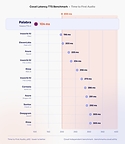
Palabra ranks #1 for latency on Coval’s independent, open-source text-to-speech benchmark, posting 104 milliseconds — roughly twice as fast as the nearest competitor — with a 6% word error rate.

Coval’s independent benchmark puts Palabra’s text-to-speech model at 104 ms latency — about twice as fast as the next-closest competitors.

LONDON, July 31, 2026 /PRNewswire-PRWeb/ — Palabra, a real-time speech AI company, has ranked #1 for latency on Coval’s independent TTS benchmark, a widely watched, continuously updated leaderboard tracking how leading voice AI models perform under real-world conditions. Palabra posted 104 milliseconds of latency and a 6% word error rate (WER), outpacing ElevenLabs, Cartesia, and other major players in the space — roughly twice as fast as the nearest competitor.

The hardest problem in speech AI is making voice agents feel indistinguishable from a real person. Latency above 200 milliseconds breaks that. We built our TTS for extremely low time-to-first-audio at production scale. Coval’s benchmark ranks us #1 at 104 ms, nearly twice as fast as the next model.

Latency is one of the key factors determining whether a voice AI system can support a fluid, real-time conversation. Even when the generated voice itself sounds highly natural, a noticeable delay before each response can disrupt the flow of dialogue, creating awkward pauses, causing people to talk over each other, and making the interaction feel less immediate. Many voice AI systems still operate at around 500 milliseconds of latency or more. Palabra’s model achieves 104 milliseconds in Coval’s independent benchmark, significantly reducing the delay between turns and enabling a more fluid, uninterrupted dialogue.

Coval’s benchmark is built to reflect production reality rather than idealized lab conditions: it measures Time to First Audio (TTFA) — the delay a listener actually notices, including any silence before the first audible sample — using pinned, versioned datasets so every provider is scored against identical inputs. Word error rate is calculated by transcribing each provider’s synthesized audio with a fixed ASR model and scoring it against the original text, so the number reflects whether the speech is intelligible, not just fast. The full runner and methodology are open-source and independently reproducible.

“Latency is one of the most consequential metrics in voice AI,” said Brooke Hopkins, Founder and CEO of Coval. “Humans respond in around 400 milliseconds, and systems slower than that feel unnatural regardless of output quality. What makes Palabra’s result significant is what it creates downstream: when a model is this fast, every other component in the stack gets more time to think.”

Palabra says the result reflects a new TTS architecture that achieves 35ms of time-to-first-audio before network overhead, paired with production infrastructure built to hold that speed at scale across large volumes of concurrent users.

“The biggest unsolved challenge that the world’s leading speech AI labs are working on today is making interactions with AI voice agents feel indistinguishable from conversations with another person,” said Artem Kukharenko, CEO & Co-founder of Palabra Al. “Latency above 200 milliseconds introduces a noticeable delay that disrupts the natural flow of communication. That’s why we’ve focused on building TTS with extremely low time-to-first-audio that could work at large scale in production systems. In Coval’s independent benchmark, we rank #1 at 104ms — the closest competitor is approximately twice as slow.”

The TTS result is part of a broader focus at Palabra on real-time speech models — spanning text-to-speech, speech recognition (ASR), and speech-to-speech translation — built around low latency as a core design principle across the stack.

About Palabra

Palabra is a voice AI lab developing real-time models for text-to-speech (TTS), automatic speech recognition (ASR), and speech-to-speech translation. Its proprietary models and APIs enable developers and enterprises to build low-latency multilingual voice experiences across customer support, conferencing, live streaming, education, and other real-time applications. Palabra recently raised $8.4 million in pre-seed funding led by Seven Seven Six (776) with participation from Creator Ventures, and prominent angel investors including Max Mullen, co-founder of Instacart; Anne Lee Skates, former partner at Andreessen Horowitz; Mehdi Ghissassi,, former Head of Product at DeepMind; and Namat Bahram, an early backer of ElevenLabs.

About Coval

Coval is the San Francisco-based evaluation platform for voice AI, founded by ex-Waymo engineer Brooke Hopkins. It builds independent, continuously updated, open-source benchmarks that measure how voice AI systems perform in production, rather than in idealized lab conditions. Coval recently raised a $28M Series A led by Norwest, with Twilio Ventures and Y Combinator also on the cap table, and is already trusted by over 60 organizations, including Zoom and Deepgram. Its public TTS leaderboard is available at benchmarks.coval.ai/tts.

Media Contact

Dmytro Tymoshenko, PALABRA.AI LTD, 380 939944325, d.tymoshenko@palabra.ai, palabra.ai

View original content to download multimedia:https://www.prweb.com/releases/palabraai-takes-1-spot-for-speed-in-new-text-to-speech-tts-benchmark-302839678.html

SOURCE PALABRA.AI LTD

Continue Reading
Click to comment

Leave a Reply

Your email address will not be published. Required fields are marked *

Technology

Takeads launches Zyntent: an AI revenue layer that puts shoppable products in front of users while they’re still deciding

Published

on

By

DUBAI, UAE, July 31, 2026 /PRNewswire/ — Takeads, an adtech company experienced in affiliate and monetization infrastructure, announced the public beta launch of Zyntent, an intent-based monetization platform built to modernize how affiliate and content publishers earn from commercial intent. Built on a live network of more than 55,000 merchants, Zyntent adds a native, intent-matched revenue layer to affiliate and content publishers — and to AI-powered products — running alongside existing affiliate and display revenue rather than replacing it.

Affiliate monetization has run on largely the same mechanism for two decades: an editor manually links a specific product, and only that link earns revenue. Everything else on a page typically earns nothing at all, even on sites with an active affiliate program.

Zyntent is built to close that gap directly. A single API call sends Zyntent a reader’s query or content context. Zyntent determines whether the query carries commercial intent, matches it against a live network of more than 55,000 merchants, and returns a native contextual recommendation — a card, inline suggestion, or search result — in under 50 milliseconds. There is no redirect, no banner, and no pop-up; if no relevant match exists, no placement renders at all.

For affiliate and comparison publishers, that means adding a native, intent-matched recommendation to content, on-site search results, and reader questions that a hand-placed affiliate link never covered — without touching the links and placements that already convert.

“Affiliate monetization has always earned on the one link an editor placed by hand — everything else a reader is asking or comparing on the page has been left on the table. We built Zyntent to close that gap without touching the affiliate and display revenue that already works, so publishers don’t have to choose between the two,” said Kyrylo Kravchenko, Product Lead at Zyntent.

Zyntent is available now in open beta. There is no setup fee; Zyntent operates on a revenue-share model. Documentation and a live sandbox are available as well.

About Zyntent

Zyntent is an intent-based monetization platform that helps affiliate and content publishers turn commercial questions, searches, and conversations into native recommendations, running alongside existing affiliate and advertising programs rather than replacing them. Zyntent is built by Takeads, operating a live network of more than 55,000 merchants.

Contact email: partners@zyntent.com 

View original content to download multimedia:https://www.prnewswire.com/news-releases/takeads-launches-zyntent-an-ai-revenue-layer-that-puts-shoppable-products-in-front-of-users-while-theyre-still-deciding-302840226.html

SOURCE Takeads

Continue Reading

Technology

Bidbus Raises $15 Million Series A to Scale Its Live Dealer Auction Marketplace

Published

on

By

Funding will support market expansion, product development, dealer network growth and technology-enabled marketplace operations

IRVINE, Calif., July 31, 2026 /PRNewswire/ — Bidbus, the online automotive marketplace that enables licensed dealers to compete in real time for vehicles directly from consumers, today announced $15 million in Series A funding. The round was led by Ibex Investors, with participation from Mucker Capital, Data Point Capital, FJ Labs, Motley Fool Ventures, Walter Ventures and existing investors.

Bidbus is building the transaction infrastructure for a more transparent and competitive vehicle-selling market. Through its live auction platform, consumers can complete a guided virtual vehicle inspection, set an expected price and receive competing bids from licensed dealerships, rather than relying on a single trade-in or instant-buy offer.

Since launch, Bidbus has served more than 10,000 vehicle sellers and reached approximately $300 million in annualized gross merchandise value. Over the past year, the company has grown sevenfold while expanding its dealer network and establishing operations across California and Texas.

Approximately 39 million used vehicles are sold in the United States each year, yet the process through which consumers sell vehicles and dealerships source inventory remains fragmented and inefficient. Sellers often receive limited visibility into actual dealer demand, while dealerships rely on costly and inconsistent acquisition channels. At the same time, dealers increasingly need access to locally sourced vehicles that match their specific inventory needs.

“Consumers should not have to visit multiple dealerships or negotiate against a single buyer to understand what their car is worth,” said Duke Yan, co-founder and CEO of Bidbus. “We built Bidbus to create a transparent marketplace where qualified dealers compete for every vehicle. This funding allows us to expand that marketplace while building the technology, operating systems and team required to scale.”

Expanding Technology, Operations and Market Coverage

The new capital will be used to expand Bidbus into additional metropolitan markets, grow its dealer network and strengthen its product, engineering and marketplace operations teams.

Bidbus will also continue investing in technology that improves virtual vehicle evaluation, auction performance and operational efficiency. This includes AI-powered seller communication, dealer recommendation tools and internal workflow automation

As Bidbus enters its next phase of growth, the company is transitioning from a founder-led operating model toward a more scalable system of functional ownership, repeatable processes and technology-enabled execution.

“Our next chapter is not simply about adding more markets or more people,” Yan said. “It is about building a marketplace and operating system that can compound—where better technology, stronger dealer participation and more efficient operations reinforce one another as we scale.”

About Bidbus

Bidbus is an online automotive marketplace that connects individual vehicle sellers with licensed automobile dealerships through a live auction platform. The company develops technology for virtual vehicle inspections, condition reporting, auction management, dealer bidding, transaction processing and marketplace operations, helping consumers access competitive dealer offers while giving dealerships a more efficient source of locally available inventory.

Bidbus is headquartered in Irvine, California, and currently operates across major markets in California and Texas. Learn more at www.bidbus.com.

Media Contact
Alex Weinberg
Chief Marketing Officer
Press@Bidbus.com

View original content to download multimedia:https://www.prnewswire.com/news-releases/bidbus-raises-15-million-series-a-to-scale-its-live-dealer-auction-marketplace-302839840.html

SOURCE Bidbus

Continue Reading

Technology

Nabsys and Indiana University Collaborate to Advance Electronic Genome Mapping Applications in Hematologic Malignancies

Published

on

By

Multi-year research collaboration will focus initially on AML and MDS while advancing Electronic Genome Mapping for broader hematologic research applications

PROVIDENCE, R.I., July 31, 2026 /PRNewswire/ — Nabsys 2.0, LLC (“Nabsys”), a pioneer in electronic genome mapping (EGM) technology, today announced a multi-year research collaboration with the Indiana University School of Medicine to develop and evaluate Electronic Genome Mapping applications for hematologic malignancies. As part of the collaboration, Kevin T.A. Booth, Ph.D., FACMG, Assistant Professor, Department of Medical and Molecular Genetics, Indiana University School of Medicine, and Clinical Laboratory Director, Indiana University Genetic Testing Laboratories, will evaluate the OhmX™ Platform to support the development and assessment of Electronic Genome Mapping applications, initially focused on acute myeloid leukemia (AML) and myelodysplastic syndromes (MDS), with the potential to extend to additional hematologic malignancies and constitutional disorders over time.

Structural variation plays a central role in many hematologic malignancies. Currently, multiple complementary technologies are required to fully characterize genomic abnormalities. Fluorescence in situ hybridization (FISH) interrogates a limited number of genomic regions, while conventional karyotyping provides a genome-wide view of structural information at relatively low resolution. Through this collaboration, Indiana University and Nabsys will evaluate the use of EGM as a complementary approach for detecting structural variation and determine how it may enhance existing cytogenetic research workflows.

The OhmX™ Platform uses proprietary electronic detection to analyze ultra-long DNA molecules. By replacing complex and expensive optical systems with precision electronics, EGM enables a compact, cost-effective platform capable of delivering high-resolution structural variant and copy number analysis. This fundamentally different approach supports Nabsys’ vision of bringing single-molecule insights to every laboratory in the world by making advanced genome analysis more accessible to researchers.

“Indiana University has long been recognized for excellence in cytogenetics, molecular genetics, and genomic medicine, making it an outstanding collaborator as we continue advancing Electronic Genome Mapping for hematologic malignancy research,” said Barrett Bready, M.D., Founder and CEO of Nabsys. “This collaboration builds on our growing body of work with leading academic laboratories and represents another important step toward developing research applications that address longstanding challenges in structural variant analysis. Dr. Booth and the Indiana University team bring valuable expertise that will help shape the future development of EGM.”

“Structural variation remains one of the most important yet technically challenging aspects of cancer genomics,” said Dr. Booth. “I’m excited to work with the Nabsys team to evaluate Electronic Genome Mapping in AML and MDS and determine where it can complement existing cytogenetic approaches. Every new technology offers an opportunity to see the genome in a different way. This collaboration has the potential to provide new insights into complex genomic abnormalities and advance how we study and understand structural variation.”

Nabsys will also participate in the Cancer Genomics Consortium (CGC) Annual Meeting, taking place August 1–5, 2026, in Houston, Texas, where the Company will present new research highlighting recent progress in Electronic Genome Mapping for hematologic malignancies. Through an oral presentation and three scientific posters, Nabsys will showcase EGM applications for structural variant and copy number analysis, demonstrating the platform’s ability to provide integrated, genome-wide genomic insights that complement existing cytogenetic approaches.

Nabsys’ OhmX™ Platform is a research-use-only EGM technology that is commercially available to laboratories worldwide.

About Kevin T.A. Booth, Ph.D., FACMG

Kevin T.A. Booth, Ph.D., FACMG, is an Assistant Professor in the Department of Medical and Molecular Genetics and Clinical Laboratory Director at the Indiana University School of Medicine. His work focuses on clinical cytogenetics, constitutional genetics, cancer genomics, and the evaluation and implementation of emerging genomic technologies. Dr. Booth is actively involved in advancing cytogenetic methodologies and developing, evaluating, and applying new genomic tools to improve genomic research, laboratory diagnostics, and our understanding of human disease.

About Nabsys

Nabsys is advancing genomics with a clear focus on accessibility and innovation through its proprietary electronic genome mapping (EGM) technology. Implemented on the OhmX™ Platform, EGM integrates precision electronics, nanofluidics, and computational biology to deliver high-resolution insight into genome structure. This approach expands what’s possible in cytogenetics, molecular genetics, and cell and gene therapy research, while providing comprehensive structural variation analysis to laboratories of all sizes.

The company was founded in 2005 and is based in Providence, Rhode Island. For more information, visit www.nabsys.com.

Media Contact
David Rosen
Argot Partners
nabsys@argotpartners.com
646-461-6387

View original content to download multimedia:https://www.prnewswire.com/news-releases/nabsys-and-indiana-university-collaborate-to-advance-electronic-genome-mapping-applications-in-hematologic-malignancies-302840233.html

SOURCE Nabsys

Continue Reading

Trending