Connect with us

Technology

Exploring an Innovative Path for Desert Green Power —- China-Egypt Belt and Road Joint Laboratory on Renewable Energy

Published

on

SOHAG, Egypt, Aug. 4, 2026 /PRNewswire/ — A news report from Science and Technology Daily‌:

On Karaman Island in Sohag, southern Egypt, rows of photovoltaic (PV) panels cover the roofs of the PV R&D base of Egypt’s Academy of Scientific Research and Technology (ASRT). The PV modules absorb sunlight, converting it into green electricity.

This is the work of the China-Egypt Belt and Road Joint Laboratory on Renewable Energy. Speaking of the major achievements made by the joint lab so far, Mohamed Zahran, a professor at the ASRT, listed several “firsts.”

In October 2023, Egypt produced its first locally made half-cut solar cell. One month later, Egypt fabricated its first locally made high-efficiency half-cell solar module.

“The joint lab is the core driver behind these achievements, providing comprehensive support for our technological breakthroughs and independent production,” Zahran said.

Building an R&D and production system

“Before the joint lab was launched for establishment, Egypt’s PV sector faced numerous constraints,” Zahran noted. There was a lack of standardized R&D facilities, complete sets of production equipment, and mature fabrication processes or technical systems. Since all solar cells relied on imports, local research teams had no means to conduct hands-on R&D or test trial-mass production.

The joint lab changed all of that.

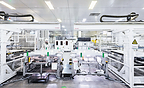
“It established a complete PV cell R&D and production system for Egypt,” Zahran said. The system covers core processes of PV cell manufacturing, a complete set of professional production and testing equipment, and a standardized, clean R&D and production facility tailored for desert climates.

“Over the years, the joint lab has truly become a standout ‘Chinese business card’ locally,” said Zhou Meng, deputy director of the research department at the 48th Research Institute of China Electronics Technology Group Corporation (CETC). Moving forward, the two sides will further promote joint R&D and transformation of advanced PV technologies, enabling local residents to enjoy more technological dividends from renewable energy.

Broadening the scope of collaboration

“Egypt is rich in solar resources, with an average of 3,000 hours of full sunshine per year, giving it uniquely gifted natural conditions for developing renewable energy like solar power. China possesses the world’s most mature PV technologies, equipment, and supply chains,” Zhou said. The cooperation between China and Egypt in the renewable energy sector represents a textbook case of complementary advantages, making the partnership “a perfect match right from the start.”

During the initial construction phase of the joint lab on Karaman Island, the site faced constraints in local power supply and water access.

“In response to these challenges, the joint lab has established a series of PV demonstration systems, including an on/off-grid PV system, a PV water pumping system, and a PV water purification system,” said Lu Yunzhang, a research fellow at the 48th Research Institute of CETC. These “small and beautiful” livelihood projects have effectively mitigated local power and water scarcity, serving as a practical model for regional energy security.

In the eyes of Aref Eliwa, a professor at the ASRT, there is immense potential for China-Egypt cooperation in the renewable energy sector, and the joint lab has a promising future in driving Egypt’s energy transition.

“Through the invaluable platform of the joint lab, scientists from China and Egypt can carry out deep cooperation and drive joint innovation,” Eliwa noted, citing an example. With collaborative research efforts, the joint lab overcame technical bottlenecks in high-resistance dense-grid solar cell technology. The milestone significantly enhanced PV cell efficiency and laid a solid technological foundation for developing PV products tailored to Egypt’s local solar environment.

Forging a deep friendship

In building and running the joint lab side by side, the two sides have shared thick and thin, leading to a steady deepening of their friendship and collaboration.

“In our day-to-day work, despite differences in language, culture, and habits, we have always been completely aligned, moving forward with a single mind and a shared purpose,” Lu said. One memory remains particularly vivid for him. On one occasion, the joint lab urgently needed an industrial component that could not be found locally. Upon hearing this, an Egyptian contractor immediately dispatched a courier to drive more than 600 kilometers through the night from Cairo to deliver it. “This kind of ‘we’re in this together’ solidarity is truly moving.”

What remains especially unforgettable for Zahran is that at the initial construction phase of the joint lab, the temperature inside the joint lab soared past 40 degrees Celsius during the testing and commissioning of the diffusion furnace. Yet, the Chinese staff still worked tirelessly for long hours to ensure the project stayed on schedule.

“It is moments like these that make me say with certainty: we have never been two separate teams, but rather one family tightly bound by a shared mission,” Zahran said. This shared mission is to jointly tackle breakthroughs in renewable energy technologies, steering Egypt and the entire African continent toward success in the green energy sector.

“In the future, we plan to upgrade the joint lab into a regional renewable energy innovation center,” stated Zhou. Through collaborative R&D, technology demonstration and promotion, as well as technical training, the joint lab will amplify its spillover and driving effects across the region.


View original content to download multimedia:https://www.prnewswire.com/news-releases/exploring-an-innovative-path-for-desert-green-power–china-egypt-belt-and-road-joint-laboratory-on-renewable-energy-302842069.html

SOURCE Science and Technology Daily

Continue Reading

Technology

Hong Kong Shopping Festival Marks Singapore Debut with 100 Brands and Over 350 Products to Discover

Published

on

By

SINGAPORE, Sept. 22, 2026 /PRNewswire/ — The Hong Kong Trade Development Council (HKTDC) announced the launch of its inaugural Hong Kong Shopping Festival in Singapore, marking the first time the event has expanded into an ASEAN market.

The festival runs from 21 to 27 September 2026, spotlighting some 100 brands and more than 350 featured products from Hong Kong across Beauty & Personal Care, Fashion, Food & Supplement, Fun & Smart Living, and Senior Wellness Essentials. Singapore consumers can explore participating brands and products through Shopee, Lazada and the official Hong Kong Shopping Festival website.

Themed “Hong Kong Highlights, One Click Away”, the campaign brings the energy and variety of Hong Kong’s shopping scene closer to Singapore consumers. From familiar household names to emerging brands and new finds, it offers shoppers a fresh way to experience the breadth of Hong Kong products while reconnecting with favourites they already know and love. Participating brands include Lee Kum Kee, CATALO, Chow Tai Fook, Chow Sang Sang, Wai Yuen Tong and Chicks, alongside a wider selection of brands and products.

Singapore marks the first step into ASEAN

The Singapore launch forms part of the initiative’s first expansion into ASEAN, with Singapore and Malaysia serving as its initial target markets. Following previous editions focused on the Chinese Mainland, the move marks a new phase for the programme as HKTDC looks to connect Hong Kong businesses with new consumers and markets across the region.

Supported by the HKSAR Government, the event gives consumers a trusted way to explore a curated selection of quality Hong Kong products. Throughout the week, shoppers can enjoy limited-time discounts of up to 50%, shopping vouchers and exclusive livestream offers as they discover participating brands across various online platforms.

Mr. Leung Kwan Ho, Regional Director, Southeast Asia & South Asia, HKTDC, said, “Hong Kong has always had a strong connection with Singapore consumers, from the brands they grew up with to the new products they continue to discover. Through the Hong Kong Shopping Festival, we hope to bring that experience closer to shoppers here, giving them an easy way to rediscover familiar favourites, uncover new brands and experience the diversity of what Hong Kong has to offer today.”

Bringing the shopping experience to life

Beyond browsing, the online shopping event will feature more than 30 hours of livestream shopping content led by popular livestream hosts and influencers in Singapore and Malaysia, giving consumers a more interactive way to engage with participating brands.

Through product demonstrations, first-hand reviews and real-time interaction, viewers can get a closer look at featured products and learn more about the brands behind them, while selected livestream sessions will also feature exclusive offers.

Dedicated campaign pages on Shopee and Lazada will also bring selected products and promotions together in one place, while the official festival website will feature participating brand information, promotional offers and curated recommendations throughout the week.

The Hong Kong Shopping Festival is the flagship annual event under HKTDC’s E-Commerce Express programme, which aims to help Hong Kong companies expand their cross-border e-commerce business and reach new markets. Through collaborations with leading e-commerce platforms, livestream promotions, and integrated marketing activities, HKTDC aims to help participating businesses enhance market visibility, gain practical cross-border e-commerce experience, and explore opportunities arising from the continued growth of ASEAN’s digital economy and e-commerce market.

The Hong Kong Shopping Festival (ASEAN) runs from 21 to 27 September 2026. For more information about the event, please visit Hong Kong Shopping Festival (ASEAN).

*Editor’s Note: For high-res images, please refer to the link: https://tinyurl.com/mb8ectm4

About HKTDC

The Hong Kong Trade Development Council (HKTDC) celebrates its 60th anniversary this year. The HKTDC is a statutory body established in 1966 to promote, assist and develop Hong Kong’s trade. With over 50 offices globally, including 13 in the Chinese Mainland, the HKTDC promotes Hong Kong as a two-way global investment and business hub. The HKTDC organises international exhibitions, conferences and  business missions to create business opportunities for companies, particularly small and medium-sized enterprises (SMEs), in the mainland and international markets. The HKTDC also provides up-to-date market insights and product information via research reports and digital news channels. For more information, please visit: www.hktdc.com/aboutus. Follow us on @hktdc and LinkedIn

View original content to download multimedia:https://www.prnewswire.com/apac/news-releases/hong-kong-shopping-festival-marks-singapore-debut-with-100-brands-and-over-350-products-to-discover-302885567.html

SOURCE The Hong Kong Trade Development Council (HKTDC)

Continue Reading

Technology

BDx Breaks Ground on 640MW AI Data Center in West Java, Backed by 845MVA of Secured Grid Power

Published

on

By

First 120MW building expected to enter service from early 2027, supporting liquid-cooled AI workloads of up to 500kW per rack.

SINGAPORE and JAKARTA, Indonesia, Sept. 22, 2026 /PRNewswire/ — BDx Data Centers (“BDx”) today broke ground on AI Campus 2 (CGK4), a 640MW AI data center campus in Jatiluhur, West Java, Indonesia. Dedi Mulyadi, Governor of West Java, and Saepul Bahri Binzein, Regent of Purwakarta, attended the groundbreaking ceremony alongside BDx and BDx Indonesia leadership.

The campus is backed by 845MVA of grid capacity from state utility PLN, part of BDx’s 1.2GVA+ secured power position across its AI-ready campuses in Indonesia. CGK4 is expected to be developed over approximately three years, with buildings commissioned sequentially to support accelerating demand for high-density AI capacity.

CGK4 reflects BDx’s evolution into an AI-first digital infrastructure platform, delivering secured power, high-density capacity, and faster time-to-market for AI workloads across Asia-Pacific.

CGK4 achieved certification under the NVIDIA DGX™-Ready Colocation Data Center program in April 2025. Located approximately five kilometers from the Jatiluhur Dam, the campus will receive power through PLN under Indonesia’s national grid framework and is actively pursuing lower-carbon power pathways, including a hydroelectric power arrangement with PJT, to support the region’s growing AI infrastructure with cleaner, more sustainable energy.

Construction has begun on Building 1, the first of six planned buildings at the site. Building 1 will deliver 120MW of IT capacity in phases, with the first contracted phase expected to enter service in early 2027. The facility is being built with a direct-to-chip liquid-cooling architecture engineered to support up to 500kW per rack for current and future AI accelerator generations.

CGK4 is already attracting strong interest from multiple hyperscalers, along with global technology companies, AI-native cloud providers and enterprises seeking AI-ready capacity across Southeast Asia and beyond. Demand at this pace reflects how quickly customer requirements are scaling.

“Indonesia is entering a new phase of digital and AI development, and CGK4 is a long-term investment in the infrastructure that phase requires. It anchors a growing AI ecosystem in West Java: scalable, high-density capacity built to bring advanced AI workloads into production faster, with a reliable path for customers as demand grows,” said Mayank Srivastava, Chief Executive Officer, BDx Data Centers.

CGK4 forms part of BDx’s AI-focused campus expansion in Indonesia, supported by a US$320 million loan facility secured in 2026.

“This is a practical step forward for Indonesia’s digital economy. We are putting sovereign, high-density AI infrastructure in place with our national partners. It allows local enterprises, government agencies, and developers to run advanced AI workloads domestically while creating skilled jobs and long-term value in West Java,” said Agus Hartono Wijaya, Chief Executive Officer, BDx Indonesia.

Indonesia is among the few Asia-Pacific markets that combine available grid capacity, campus-scale land, and strong domestic AI demand, supported by Special Economic Zone incentives for large-scale infrastructure investment. BDx’s Indonesia platform includes AI Campus 1 (CGK3/3A), AI Campus 2 (CGK4), and AI Campus 3 (CGK5), with 1.2GVA+ of secured grid capacity across its AI-ready campuses in Indonesia.

About BDx Data Centers

BDx Data Centers develops and operates AI-ready data center infrastructure across Asia-Pacific for hyperscale, cloud, AI, and enterprise customers. Transformed for AI and proven at speed, BDx is focused on converting secured power into powered, cooled, and operational capacity for customers scaling next-generation workloads. With operations in Singapore, Indonesia, Hong Kong SAR, and Taiwan region, BDx combines secured power access, high-density design, advanced cooling capabilities, standardized engineering, and local market execution to accelerate delivery across key digital markets. Backed by I Squared Capital, BDx provides the infrastructure platform customers need to move from power availability to live AI and cloud deployments across the region. For more information, visit www.bdxworld.com.

View original content to download multimedia:https://www.prnewswire.com/apac/news-releases/bdx-breaks-ground-on-640mw-ai-data-center-in-west-java-backed-by-845mva-of-secured-grid-power-302885578.html

SOURCE BDx Data Centers (BDx)

Continue Reading

Technology

Gold, Oil or Forex: Which Markets Are Attracting Traders’ Attention Today?

Published

on

By

KUALA LUMPUR, Malaysia, Sept. 22, 2026 /PRNewswire/ — Financial markets in 2026 face several key influences, including geopolitical risks, energy price swings, interest rate expectations, and uneven economic growth. According to IMF estimates, global GDP will grow by 3.0% in 2026, while energy importers, exporters, and countries benefiting from the technology cycle will face divergent market conditions.

With such changes occurring in the financial markets, traders increasingly focus on different asset classes: currencies, commodities, and indices. In Asia-Pacific, regional currencies, monetary policy, technology, and equity markets are among the key areas shaping trading activity.

Regional Currencies Reveal Diverging Economic Contexts

There is a clear example of Japan’s economy. According to the Bank of Japan, underlying inflation will gradually rise to levels that are compatible with its target of 2%. The BoJ will keep on fine-tuning monetary accommodation depending on changes in economic activity, prices and financial conditions. The Bank also mentions foreign exchange rate movements, crude oil prices and AI-related demand as key factors.

However, the economy of China looks different. Based on official estimates, China’s GDP grew by 4.3% year on year in Q2 2026, compared to 5.0% in Q1. Year-to-date growth was estimated at 4.7%.

Changes in economic growth estimates can influence the yuan’s rate, as well as sentiment among the economies associated with Chinese trade and commodity demand.

Indices Reflect Growth and Technology Trends

Regional stock indices offer traders another perspective on these trends. Indices in Japan, China, Hong Kong and other APAC markets may reveal changes in the expectations of growth, exports, consumer spending, manufacturing and technological progress.

The latter becomes especially relevant. According to the IMF, AI-driven demand supports the economies integrated in the technology production chain. Furthermore, the Bank of Japan highlights growing AI-related demand as a positive contributor to domestic economic activity.

Commodities Are Still Important

Both gold and oil belong to the APAC story. Rising energy prices may increase the cost pressure for importing economies, whereas Asia still plays a major role in the gold market.

World Gold Council expects investment activity in APAC to make a bigger contribution to gold-demand growth in H2 2026. During the first six months of the year, gold ETFs in Asia posted net inflows of 70 tons.

For APAC traders, Forex tends to reflect differences in monetary policies, indices highlight shifts in growth and technology, while commodities often tie back to global inflation and geopolitics.

Trade Across Markets with JustMarkets

Different conditions require different strategies, so traders should pay as much attention to flexibility as to the choice of assets. This is where JustMarkets comes in. It’s a global multi-asset broker providing access to more than 260 CFD instruments across Forex, gold, oil, indices, stocks, and other markets within one trading environment.

This broad access allows traders to adjust their focus as market conditions change. With MT4, MT5, Web Terminal, and the JustMarkets Trading mobile app, traders can enter these markets through the platform that best fits their trading style.

Risk Warning: Trading financial instruments involves significant risk and may not be suitable for all investors. Market conditions can change rapidly, and losses may exceed deposits. Ensure you understand the risks involved and trade responsibly.

View original content to download multimedia:https://www.prnewswire.com/apac/news-releases/gold-oil-or-forex-which-markets-are-attracting-traders-attention-today-302885591.html

SOURCE JustMarkets

Continue Reading

Trending