Technology
Global Times: SAIC-GM’s 20-year renewal highlights China’s key role in auto innovation and global growth
Published
4 months agoon
By
BEIJING, Aug. 6, 2026 /PRNewswire/ — Chinese auto giant SAIC Motor and the US automaker General Motors (GM) have signed an agreement to extend their joint venture (JV) partnership by 20 years to 2047.
Building on nearly three decades of cooperation, the renewed agreement aims to accelerate SAIC-GM’s transition toward intelligent electric vehicles (EVs) and advance its global expansion.
The extension of the JV reflects both sides’ confidence in the long-term potential of China’s auto market and their future cooperation, a Chinese industry expert said, noting that China has long been one of GM’s most important overseas markets and a key growth engine. As the auto industry shifts toward electrification and intelligent mobility, China has become a leading hub for NEV innovation and competition.
Despite US relentless attempts to hype “China security risks” and impose restrictions, American companies are voting with their feet, showing that China remains an irreplaceable strategic market for global automakers, the expert said, noting that the two countries still have substantial potential for cooperation in advanced manufacturing, green transition and cutting-edge innovation.
Strong messages
The renewed partnership ushers in a new stage for SAIC-GM, a major player in China’s auto industry since the late 1990s, with the JV set to accelerate innovation, expand growth opportunities and strengthen long-term profitability.
Speaking at the signing ceremony on Wednesday, GM Senior Vice President and President of GM China John Roth said that the agreement “reflects our shared confidence in SAIC-GM and its long-term growth potential,” stressing the company’s “commitment to strong performance in the China market.”
“It is not only about continuing what we have built together. More importantly, it is about building a more competitive, resilient, and sustainable business for the future,” he said.
On a further note, Roth said that “China’s automotive market moves fast. Customer expectations are rising, technology is advancing quickly, and competition grows more intense every day. To succeed, we need to move with speed, stay focused on customers, and execute with discipline.”
Having manufactured and delivered more than 20 million vehicles and established end-to-end vehicle development capabilities early on, SAIC-GM is building on its momentum with a growing portfolio of products defined and developed locally, according to the press release that the company shared with the Global Times on Thursday.
From ‘China-made’ to ‘China-innovated’
SAIC-GM’s JV, launched in 1997, is approaching 30 years. In 2025, the two sides accelerated cooperation, launching the “Xiaoyao” super integration architecture developed under the leadership of the Chinese team, as well as Buick’s premium new energy sub-brand – Electra. According to the plan, the Buick Electra E7 will enter overseas markets in October this year, becoming SAIC-GM’s first premium new energy vehicle (NEV) to be exported globally.
From its early manufacturing roots in Shanghai to exporting globally competitive NEVs, SAIC-GM’s growth reflects both the transformation of China’s auto industry and the expanding cooperation between Chinese and US companies, experts said.
“Extending SAIC-GM’s JV term by 20 years, among the longest in China’s auto sector, signals the US carmaker’s long-term commitment to the Chinese market. It shows that for global automakers, China is not just a source of short-term profits, but a key hub for innovation, competitiveness and future growth,” Cui Dongshu, secretary-general of the China Passenger Car Association, told the Global Times on Thursday.
China’s EV has been the leading development drive in the world. From January to June 2026, China accounted for 31 percent of global auto sales, while the country’s share of the global new-energy vehicle market reached around 60 percent, highlighting the strong global competitiveness and growing popularity of Chinese NEVs.
This cooperation also mirrors the bigger trend of the great transformation of China’s car industry.
Over the past three decades, China’s auto JV model has focused on “introducing technology, developing the industry and expanding the market,” with global automakers providing brands, technologies and management expertise, while Chinese partners contributed market access, manufacturing capabilities and supply chain strengths.
Cui said that as China’s NEV and smart connectivity technologies have advanced rapidly, the model is shifting from one-way technology transfer to two-way empowerment. Backed by a world-leading EV supply chain and innovation capabilities, China has become a key force driving the transformation of the global auto industry.
As China’s auto market accelerates toward electrified intelligent vehicles, SAIC-GM will launch at least 30 new-energy vehicles by 2030 and deploy more technology solutions developed in China for the Chinese market. It will further expand the EV product portfolios of Buick and Cadillac.
“To stay competitive in the evolving global auto industry, foreign auto companies including the US companies need to continue treating China as a strategic long-term market,” Cui said.
The partnership extension also reflects the fact that GM places great importance on the stability of the Chinese market. For the manufacturing sector, a 20-year cooperation period is a realistic and reasonable arrangement, Zhou Mi, a researcher at the Chinese Academy of International Trade and Economic Cooperation, told the Global Times on Thursday.
Given its position in the automotive industry, GM’s decision to further deepen its JV cooperation reflects its confidence in the long-term growth potential of the Chinese market, said Zhou.
From localization to globalization
While deepening their presence in China’s vast market, another key purpose behind the extension goes beyond China itself.
Roth said that they see meaningful opportunities to grow beyond China. “SAIC-GM has strong local capabilities across engineering, manufacturing, and quality, and we can apply those strengths in select international markets, including the Middle East, Africa, South America, Mexico, and Asia-Pacific,” he noted.
Going forward, the JV is expected to move beyond the traditional model of “foreign partners providing technology and Chinese partners handling manufacturing” toward a new stage of complementary strengths, joint innovation and shared global markets.
At the signing ceremony, SAIC Chairman Wang Xiaoqiu outlined a new direction for SAIC-GM’s development: Moving from “technology introduction and local production” 30 years ago to “local innovation and global sharing” today, JV automakers are entering a new stage of globalization, with Chinese-developed technologies and products expanding into global markets.
“China is no longer just a major market for global automakers, but also an increasingly important source of automotive innovation, product development and industrial capabilities for companies eager to go global,” Cui said.
The industry analyst’s words did not come out of the blue. In addition to GM, other US automakers such as Ford are also strengthening cooperation with Chinese automaker Geely by producing electric SUVs at Ford’s factory in Spain as part of their global expansion strategy.
Under a JV that will be 66 percent owned by Ford and 34 percent by Geely, the first Geely-brand electric SUVs will roll off the production line at the Valencia plant in 2028.
In the past, foreign automakers such as GM and Ford mainly brought their technological advantages to China and leveraged the country’s manufacturing workforce to expand their operations. Today, they are increasingly tapping into China’s innovation ecosystem and comprehensive industrial supply chains to support their global strategies, Zhou said, noting that GM’s latest cooperation agreement also reflects a broader market demand – the need to establish long-term and stable industrial partnerships.
For multinational automakers, increasing investment in China and deepening local partnerships not only serves the interests of the Chinese market, but is also crucial to strengthening their own global competitiveness, the expert said.
“As the auto industry evolves beyond the energy transition toward intelligent vehicles, China’s vast user base, data resources and application scenarios provide unique advantages. Deepening cooperation in China can create greater industrial value and deliver win-win outcomes for all stakeholders,” said Zhou.
View original content:https://www.prnewswire.com/news-releases/global-times-saic-gms-20-year-renewal-highlights-chinas-key-role-in-auto-innovation-and-global-growth-302845217.html
SOURCE Global Times
You may like
Technology
PayKings Offers Free Statement Analyzer That Shows High-Risk Merchants the Rate They Actually Pay
Published
5 minutes agoon
November 25, 2026By
A merchant quoted 2.6% can pay 3.5% once every fee is counted. The free tool finds the real number in about a minute.
LEHI, Utah, Nov. 25, 2026 /PRNewswire/ — PayKings, a high-risk merchant services provider, offers a free Statement Analyzer that shows merchants the actual rate they pay to accept cards. Merchants upload a statement from any U.S. processor and receive their effective rate, total fees, and a line-by-line breakdown in about a minute.
Most merchants know the rate printed on their contract, but the effective rate tells a different story. Calculated by dividing total processing fees by total card volume, it includes charges that contract rates may leave out, such as per-transaction, monthly, and PCI fees. A merchant quoted 2.6% can end up paying 3.5%. The analyzer works with any U.S. merchant statement, including those from CBD, firearms, nutraceutical, and telemedicine businesses PayKings specializes in.
“Most merchants we talk to have never seen their real processing rate,” said Kyle Hall, CEO of PayKings. “They see one number on a contract and assume that’s what they’re paying, but the reality is often much more complicated. We believe every business owner deserves complete transparency into their processing fees so they can understand exactly where their money is going and make informed decisions about their business.”
How it works:
Upload: Submit a processor PDF statement or a clear photo or scan of a paper statement.Read: The tool reviews percentage, per-transaction, monthly, and other processing fees.Breakdown: Merchants see their effective rate, total fees, categorized charges, and fees that may warrant a closer look.
Account and routing numbers are masked in every result. The tool is free, requires no obligation, and can also be used by anyone reviewing a statement shared by a merchant.
The Statement Analyzer is available at https://paykings.com/tools/statement-analyzer/?utm_source=prnewswire&utm_medium=press_release&utm_campaign=statement_analyzer.
About PayKings
Founded in 2011, PayKings has offices in Lehi, Utah, and St. Petersburg, Florida. The company specializes in payment processing for high-risk businesses, with more than 20 acquiring bank relationships and service across 50+ industries, including CBD, firearms, nutraceuticals, and telemedicine. PayKings approves 86% of merchants who apply. Learn more at https://paykings.com/. PayKings, 2901 Bluegrass Blvd, Suite 200-338, Lehi, UT 84043.
Media Contact
Mia Tandingan
Email Marketing Specialist
PayKings
Email: mia@813mgt.com
Phone: (801) 899-7255
Website: https://paykings.com/
View original content:https://www.prnewswire.com/news-releases/paykings-offers-free-statement-analyzer-that-shows-high-risk-merchants-the-rate-they-actually-pay-302950687.html
SOURCE PayKings
Technology
New McLean & Company Guide Helps HR Accelerate Job Architecture With AI
Published
5 minutes agoon
November 25, 2026By
A new resource from global HR advisory and research firm McLean & Company shows HR leaders how to practically use AI to develop and maintain job leveling criteria and structures. It keeps organizational context, key player input, and human oversight at the center of every decision as HR organizations continue to adopt ever-evolving technology.
TORONTO, Nov. 25, 2026 /CNW/ — According to McLean & Company’s new Guide to Accelerating Job Architecture With AI, AI can streamline HR’s job architecture work by analyzing organizational documentation, surfacing patterns and inconsistencies, generating alternatives, and testing assumptions. This support gives HR more capacity to focus on the decisions that require organizational knowledge, calibration, and judgment. The new AI-focused resource from the global HR research and advisory firm provides practical guidance for HR leaders so they can use AI in conjunction with human judgment to develop and refine job leveling criteria. It also helps them evaluate level structures, prepare for leadership discussions, and keep the framework relevant over time.
“AI can accelerate the work behind job architecture, but it cannot determine what is right for an organization,” says Lexi Hambides, director, HR Research & Advisory Services, at McLean & Company. “HR must bring organizational context, involve the right key players, and apply human judgment to every output. The strongest frameworks use AI to expand and test options while keeping people accountable for the final decisions.”
The guide explains that job architecture supports consistent decisions across talent management, career progression, workforce planning, and total rewards. However, developing and maintaining the framework requires extensive analysis, iteration, and input from key players.
In the resource, McLean & Company emphasizes that AI should support rather than replace HR expertise. The firm recommends HR leaders and their teams start with clear objectives and reviewing organizational and HR strategy, structure, job families, and supporting data to assess whether AI-generated recommendations align with business needs.
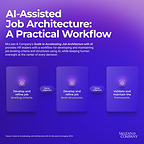
The Guide to Accelerating Job Architecture With AI outlines a practical workflow for developing and sustaining job leveling criteria and structures:
Develop and refine job leveling criteria. First, HR leaders can use AI to analyze organizational documents, identify recurring dimensions of work, and recommend clear criteria and definitions.
Develop and refine job level structures. Next, AI can be used to generate and compare level structure options, draft descriptors that differentiate work across levels, and identify gaps or inconsistencies before finalizing the framework.
Validate and maintain the framework. Finally, HR needs to prepare senior leaders to review major choices and trade-offs, confirm organizational fit, and establish a cadence for reassessing criteria and structures as work and business needs evolve.
The guide reinforces the importance of combining AI-enabled analysis with human judgment to develop job architecture frameworks that reflect organizational needs. McLean & Company advises that, by accelerating time-intensive design activities, AI can enable HR leaders to focus on evaluating options, strengthening decisions, and maintaining framework relevance as work evolves.
To access the insights, visit McLean & Company’s Guide to Accelerating Job Architecture With AI page. The resource can be paired with the firm’s Develop a Job Architecture Framework blueprint for end-to-end guidance on building and implementing a job architecture framework.
For support with alternative career tracks, HR leaders can explore McLean & Company’s Develop an Integrated Career Pathing Framework resource.
Media seeking research-backed insights or commentary from McLean & Company experts on job architecture, career frameworks, AI-supported HR work, or workforce planning can contact pr@mcleanco.com.
About McLean & Company
McLean & Company is a global HR research and advisory firm and trusted partner to people leaders navigating today’s most pressing workforce challenges. Informed by its work with thousands of HR professionals and executives, the firm provides evidence-based research, diagnostics, practical tools, hands-on support, and services spanning advisory, learning, and coaching. From workforce strategy and leadership to culture, engagement, retention, and AI adoption, McLean & Company helps leaders move from direction to execution and deliver measurable results for their people and organizations.
McLean & Company is a division of Infotech.
Media professionals can register for unrestricted access to research across IT, HR, and software, and hundreds of industry analysts through the firm’s Media Insiders program. To gain access, contact pr@mcleanco.com.
View original content to download multimedia:https://www.prnewswire.com/news-releases/new-mclean–company-guide-helps-hr-accelerate-job-architecture-with-ai-302946165.html
SOURCE McLean & Company
Technology
ASU research expenditures climb to nearly $1.14 billion, fueled by advances in engineering, health and national security
Published
5 minutes agoon
November 25, 2026By
University’s research enterprise grows 13.4%, strengthening its role in developing technologies and solutions that benefit Arizona and the nation
TEMPE, Ariz., Nov. 25, 2026 /PRNewswire/ — Arizona State University’s research enterprise continues to grow at a remarkable pace, reaching $1.137 billion in annual research expenditures in fiscal year 2025 — an increase of $134 million over the previous year.
This growth reflects the university’s expanding role in tackling some of the nation’s most pressing challenges, from strengthening national security and developing advanced semiconductor technologies to improving health care and securing Arizona’s water future.
The National Science Foundation on Tuesday released its annual Higher Education Research and Development, or HERD, survey, which collects research expenditure information from hundreds of institutions nationwide. In the latest survey reflecting fiscal year 2025, ASU ranked No. 33 overall, ahead of MIT, Purdue University, Michigan State University and the University of Arizona.
ASU ranked No. 4 among institutions without a medical school, ahead of MIT, Purdue University, UC Boulder and Princeton University. After the survey period, ASU officially launched the John Shufeldt School of Medicine and Medical Engineering, which received preliminary accreditation and an inaugural class of 36 students who began last summer.
The research growth builds on ASU’s historic achievement of surpassing $1 billion in annual research expenditures in fiscal year 2024, and joining the prestigious Association of American Universities (AAU).
This year also marks the first time that ASU has surpassed the University of Arizona in total research expenditures.
“We continue to build a new model of a great American research university, one that is committed to being accessible to students from every background and every conceivable pathway,” ASU President Michael Crow said.
Research expenditures measure the amount of funding used to conduct research each year. ASU receives funding from federal agencies, state and local grants, businesses and other private organizations, often awarded over multi-year periods. Research expenditures are the most effective way to measure research activity and compare the vitality of American research universities.
A top-tier national research university
The latest results continue a dramatic transformation of ASU’s research enterprise. Since Crow took office in 2002, the university has grown into one of the nation’s leading public research institutions, building a research model focused on scientific discovery, technological innovation and societal benefit. Consider that ASU ranked:
No. 5 out of 440 in federal funding from the Department of Health and Human Services among universities without a medical school, ahead of Purdue University, Georgia Institute of Technology, UC Boulder and Princeton.No. 9 out of 651 in National Science Foundation funding ahead of Columbia University, MIT, UC Berkeley and Purdue University.No. 9 out of 453 in NASA funding ahead of MIT, UCLA, UT Austin and Stanford University.No. 15 out of 576 in funding from state and local government, ahead of Ohio State University, the University of Minnesota, UC San Diego and UC Berkeley.
“ASU has a diverse funding portfolio, with support from federal agencies, industry partners, local governments and philanthropists who all have a vital interest in bringing ASU innovation to their communities,” said Sally C. Morton, executive vice president of ASU Knowledge Enterprise and chief research and innovation officer. “Our rapid growth reflects their confidence in our ability to deliver valuable results that benefit Americans.”
Engineering tomorrow’s technologies
Engineering research was the single largest contributor to ASU’s growth in fiscal year 2025.
Research expenditures in engineering reached $349.2 million, a 25.9% increase over the previous year. Engineering alone accounted for more than half of the university’s total research expenditure increase.
The growth reflects rising demand for technologies that can strengthen America’s national security, improve manufacturing, support advanced computing and accelerate the development of next-generation electronics.
One of the major contributors was the ASU-led Southwest Advanced Prototyping (SWAP) Hub, an industry-scale, professionally staffed semiconductor prototyping facility. Part of the Department of War’s Microelectronics Commons initiative, SWAP Hub delivers cutting-edge technologies that are critical to U.S. security and defense.
SWAP Hub’s Spaceborne Low Energy SI Computing (SLEAC) project brings together ASU, Sandia National Laboratories, Raytheon and university partners to develop efficient, radiation-hardened neural network processing for defense satellites. The technology uses less power, generates less heat and maintains the high computing performance needed to support real-time decision-making.
In its first two years, the team produced two radiation-tolerant prototype chips with object-tracking capabilities, moving the technology from the lab toward commercial fabrication.
Industry giant IBM also recently ordered from SWAP Hub a shipment of prototype wafers, the discs used to build microchips. ASU engineers designed, created and delivered the proof-of-concept products, which were used to demonstrate a process to build multiple structures on a molded wafer.
Powering national security
National defense emerged as one of the most important drivers of ASU’s research growth. Combined research expenditures supported by the Navy, Defense Advanced Research Projects Agency (DARPA) and Army increased by approximately $43.8 million between fiscal years 2024 and 2025.
ASU recently entered a 10-year agreement with the U.S. Army Installation Management Command that allows the university to provide energy services to Army installations across the continental U.S. Fort Huachuca, a military cybersecurity hub in Cochise County, Arizona, will be the first installation to participate.
The partnership builds on a pilot energy assessment that ASU’s Energy Efficiency Center conducted at Fort Huachuca in 2023, which showed how these assessments could address the installation’s needs. The center is part of the U.S. Department of Energy’s Industrial Training and Assessment Centers program.
Under the agreement, students with the Energy Efficiency Center, joined by students from Cochise College, will conduct detailed meter readings and evaluate energy use and efficiency. Their reports will help Fort Huachuca identify potential improvements to reliability, efficiency and operating costs.
The experience will prepare students for careers in energy efficiency while helping build a pool of trained workers near the installation.
Advancing health and medicine
Health-related research was another major source of growth. National Institutes of Health funded research expenditures increased $17.1 million over the previous year, helping scientists understand the human body to improve medical care.
Human blood contains a wealth of information about past infections, vaccinations and the health of the immune system. Researchers at ASU’s Biodesign Institute are developing powerful new tools to unlock that information, with support from the National Cancer Institute.
The researchers use a technology called the Multiplex In-Solution Protein Array, or MISPA, to measure antibody responses to hundreds of viruses and bacteria simultaneously. The technique allows scientists to track changes in immune responses over time, revealing evidence of exposure to pathogens and other immune challenges. It also makes it practical to conduct these tests on thousands of people in a single experiment.
In a recent study, the team identified special markers called sentinel antibodies that may provide a window into a person’s overall immune health. Individuals with stronger sentinel antibody responses generally mounted stronger responses to vaccination, suggesting a potential way to predict vaccine effectiveness.
The approach also generates enormous amounts of information that researchers can analyze using AI. By analyzing more than 2 million data points, the team uncovered patterns in immune responses that conventional testing might have missed.
ASU’s growing biomedical research enterprise is also advancing work in aging, cancer, infectious diseases, diagnostics, AI and personalized medicine.
Finding solutions to Arizona’s water challenges
As the Southwest confronts long-term drought, rising temperatures, population growth and increasing demands on limited water supplies, the need for new approaches to water management has never been more urgent.
In 2022, ASU’s Julie Ann Wrigley Global Futures Laboratory and Ira A. Fulton Schools of Engineering launched the Arizona Water Innovation Initiative, supported by $40 million from the state of Arizona. The initiative brought together researchers and partners to address water challenges facing Arizona and the broader Southwest.
The program connected ASU researchers with communities, agencies, industry, agriculture, tribal partners, municipalities and water leaders to accelerate practical, evidence-based solutions. Since its inception, AWII launched six technology test beds, advanced six patents, supported 10 startup companies and trained nearly 300 water professionals.
The initiative has built a foundation of research and relationships that will extend far beyond its four-year funding period. For example, AWII partners have supported rural groundwater resilience workshops and a peer-to-peer Rural Groundwater Resilience Exchange; released research on capturing precipitation, runoff and urban stormwater to replenish aquifers; and developed the AZ Water Blueprint’s “About My Water” app, which brings trusted, publicly-sourced data together in one place to provide a clear view of local water providers, groundwater conditions and water sources.
Leadership in key disciplines
ASU also achieved top 15 rankings for expenditures within many academic disciplines, including:
No. 1 out of 279 in anthropology, ahead of the University of Michigan, Harvard University, UA and the University of Massachusetts.No. 1 out of 372 in visual and performing arts, ahead of Florida State, University of Michigan, Syracuse University and Harvard University.No. 1 out of 593 in all non-science and engineering, ahead of Harvard University, University of Michigan, UT Austin, UC Berkeley.No. 2 out of 492 in education, ahead of the University of Virginia, UCLA, Stanford University and Harvard University.No. 3 out of 403 in business management and business administration, ahead of Harvard University, UC Berkeley, Cornell University and the University of Minnesota.No. 4 out of 338 in engineering, other, ahead of the University of Michigan, Purdue University, Johns Hopkins University and MIT.No. 4 out of 380 in geological and earth sciences, ahead of UT Austin, UC San Diego, Johns Hopkins University and Stanford University.No. 5 out of 174 in engineering, industrial and manufacturing, ahead of Pennsylvania State University, Ohio State University, Texas A&M and Purdue University.No. 6 out of 290 in civil engineering, ahead of Purdue University, UC Berkeley, Georgia Tech and the University of Michigan.No. 6 out of 376 in social sciences, political science and government, ahead of Indiana University, UCLA, Stanford University and NYU.No. 7 out of 313 in engineering, electrical, electronic, and communications, ahead of Purdue University, University of Michigan, University of Arizona and the University of Washington.No. 7 out of 212 in social work, ahead of University of Connecticut, University of Michigan, USC and Ohio State University.No. 8 out of 459 in geosciences, atmospheric sciences and ocean sciences, ahead of Columbia University, Johns Hopkins University, UT Austin and UCLA.No. 8 out of 314 in communication and communications technologies, ahead of Northwestern University, UC Berkeley, Georgia Tech and UCLA.No. 10 out of 522 in computer and information sciences, ahead of UNC Chapel Hill, Purdue University, Ohio State University and Cornell University.No. 13 out of 458 in humanities, ahead of University of Arizona, Notre Dame University, Syracuse University and UT Austin.
Turning research investments into real-world impact
Research expenditures do more than drive discoveries and inventions. They also support the local and regional economy. In fiscal year 2025, ASU research provided more than $77 million to Arizona-based vendors and subcontractors and more than $44 million to small businesses.
ASU’s growing research enterprise also creates opportunities for students to participate directly in scientific discovery and technological innovation, gaining experience that prepares them for careers in emerging industries.
“Our research mission works hand-in-hand with our educational mission,” Morton said. “Our students work on the cutting edge of science with leading researchers in their fields. We encourage hands-on learning and an entrepreneurial mindset. These are the skills they need for their own success and to make a positive impact.”
View original content to download multimedia:https://www.prnewswire.com/news-releases/asu-research-expenditures-climb-to-nearly-1-14-billion-fueled-by-advances-in-engineering-health-and-national-security-302950697.html
SOURCE Arizona State University – Media Relations
PayKings Offers Free Statement Analyzer That Shows High-Risk Merchants the Rate They Actually Pay
New McLean & Company Guide Helps HR Accelerate Job Architecture With AI
ASU research expenditures climb to nearly $1.14 billion, fueled by advances in engineering, health and national security
Send Rakhi to UK swiftly with UK Gifts Portal
Whiteboard Series with NEAR | Ep: 45 Joel Thorstensson from ceramic.network
Nullmax and Renesas Forge Strategic Partnership to Deliver Competitive ADAS Solutions for the Global Market
Why You Should Build on #NEAR – Co-founder Illia Polosukhin at CV Labs
Whiteboard Series with NEAR | Ep: 45 Joel Thorstensson from ceramic.network
NEAR End of Year Town Hall 2021: The Open Web World, MetaBUILD 2 Hackathon and 2021 recap
Trending
-
Near Videos5 days agoIllia Polosukhin on post-quantum keys and crypto agility | Solana Breakpoint 2026
-
Technology5 days agoAllooloo Tops 100M Capital Markets AI Agent Traffic a Month
-
Technology5 days agoAllooloo Tops 100M Capital Markets AI Agent Traffic a Month
-
Technology4 days agoHEARTBOT AI Wins Chunghwa Telecom Special Award at Meet Neo Star 2026
-
Coin Market5 days agoSky Protocol sees $2 billion in stablecoin withdrawals, disputes illicit fund claims
-
Coin Market5 days agoWrapped Monero token crashes 99.8% amid suspected $13.5M exploit
-
Technology5 days agoZiehm-Orthoscan Announces Executive Leadership Transition Following 18 Years of Significant Growth
-
Technology4 days agoA Seattle Startup Brings Your Pet to Life on Your Phone and Laptop With the Avatar Mirroring Their Every Move in Real Time