Connect with us

Technology

Pusan National University Introduces ASTRA-Net for Improved Lung Airway Mapping

Published

on

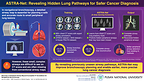
ASTRA-Net helps reconstruct overlooked peripheral airways, creating more complete maps for bronchoscopy procedures

BUSAN, South Korea, Aug. 6, 2026 /PRNewswire/ — Lung cancer is the most diagnosed cancer globally and is one of the leading causes of cancer-related deaths. Early detection can improve survival. However, collecting tissue samples from small tumors located deep within the lungs remains a big challenge. As many of these lesions are found in the peripheral regions of the lungs, physicians must navigate through an intricate network of tiny branching airways to reach the target.

In these cases, clinicians rely on lung navigation systems that use three-dimensional airway maps reconstructed from computed tomography (CT) scans to guide instruments toward suspicious lesions. The accuracy of these navigation systems depends on the completeness of the airway maps. Creating these maps is again difficult, as the smallest peripheral airways are extremely thin and difficult to distinguish from the surrounding tissues. This restriction raises a concern that if artificial intelligence (AI) systems are trained using incomplete information, they may also overlook clinically important airways.

To address this challenge, researchers from Pusan National University in South Korea developed ASTRA-Net (Anatomical Segmentation with Tree-aware Refinement Attention), an AI framework designed to identify previously overlooked airway branches and generate more complete airway maps. The study was led by Dr. MinWoo Kim from the School of Biomedical Convergence Engineering, Pusan National University, and Dr. Hee Yun Seol from the Division of Pulmonary and Critical Care Medicine, Research Institute for Convergence of Biomedical Science and Technology, Pusan National University Yangsan Hospital, in collaboration with other researchers. The paper was published in IEEE Transactions on Medical Imaging (Volume 45, Issue 6) on June 1, 2026.

Unlike conventional models that may be limited by incomplete training annotations, ASTRA-Net was designed to identify anatomically plausible airway structures that may have been omitted from the original labels.

“ASTRANET is not simply another airway segmentation model. It was specifically designed to identify peripheral airways that may have been overlooked during manual annotation, thereby helping to create a more complete roadmap for bronchoscopy,” explains Dr. Kim.

ASTRA-Net utilizes a multi-stage deep learning architecture like those employed in advanced medical image analysis. A part of this network learns the overall structure of the lungs, whereas another refines regions where airway boundaries are unclear. An additional attention mechanism helps the model focus on regions where small peripheral airways are difficult to distinguish or may have been omitted from the annotations. This allows the reconstruction of airway branches that are often missing from CT annotations. By incorporating anatomical clues from the surrounding lung tissues and blood vessels, which often run alongside the airways, the system can infer the continuity of previously unrecognized airway pathways.

Researchers also evaluated the framework using multiple datasets as well as clinical CT scans obtained from Pusan National University Yangsan Hospital. This model demonstrated strong performance in identifying fine peripheral airways and remained robust even when CT scans varied in image quality and slice thickness. Additionally, expert review of the model predictions showed that some structures initially counted as false positives were genuine airway branches that had been omitted from the original annotations.

“By providing physicians with a more complete airway roadmap, we hope this technology will improve navigation to difficult-to-reach lung lesions and support the development of future AI-assisted and robotic bronchoscopy systems,” concludes Dr. Kim.

Reference

Title of original paper: Discovery of Peripheral Airway Beyond Incomplete CT Annotations for Navigational Bronchoscopy

Journal: IEEE Transactions on Medical Imaging

DOI: 10.1109/TMI.2026.3672178 

About Pusan National University

Website: https://www.pusan.ac.kr/eng/Main.do

Contact:

Goon-Soo Kim

82 51 510 7928

420227@email4pr.com

View original content to download multimedia:https://www.prnewswire.com/news-releases/pusan-national-university-introduces-astra-net-for-improved-lung-airway-mapping-302844459.html

SOURCE Pusan National University

Continue Reading

Technology

Guidepoint Relocates Shanghai Office to Strengthen Regional Presence

Published

on

By

SHANGHAI, Sept. 21, 2026 /PRNewswire/ — Guidepoint, a global pioneer in access to expert insight, today announced the relocation of its Shanghai office to the Bund Center on East Yan’an Road.

Building on more than a decade of sustained growth in China, the relocation positions Guidepoint in the heart of Shanghai’s business district, bringing the firm closer to the clients and partners it serves while providing a modern, collaborative workspace for its growing team.

“Research today has evolved beyond standalone expert calls to more connected, AI-enabled workflows,” said Michael Wang, Guidepoint’s Director and Head of China. “The new Shanghai office brings together capabilities across research, product innovation, compliance, and operations, reinforcing Guidepoint’s commitment to delivering source-backed insight through rigorous standards, transparency, and integrity.”

“Shanghai remains one of the world’s most influential centers for business and finance, connecting decision-makers across industries and markets,” said Chris Bonsi, Head of APAC. “This relocation reinforces our long-term commitment to the region and strengthens our ability to serve clients and attract top talent.”

As demand for expert-led, source-backed insight continues to grow, Guidepoint is focused on expanding its research capabilities by combining expert knowledge, proprietary content, and technology-enabled workflows to help clients move from uncertainty to conviction with greater speed and confidence.

About Guidepoint
Guidepoint provides real-time access to expert insights, combining human expertise with AI-powered research tools to deliver knowledge at scale. Backed by a global network of more than 2M+ subject-matter experts, Guidepoint equips institutional investors, consulting firms, and corporations with the context they need across companies, markets, and trends. Through live, asynchronous, and agentic workflows, Guidepoint embeds expert knowledge directly into decision-making, turning answers into action when timing matters most.

More on Guidepoint

View original content:https://www.prnewswire.com/apac/news-releases/guidepoint-relocates-shanghai-office-to-strengthen-regional-presence-302880268.html

SOURCE Guidepoint

Continue Reading

Technology

Reap Launches First Ever Managed Fraud and Risk Service for Card Programs

Published

on

By

Reap Sentry configures and manages fraud controls for clients’ card programs, eliminating the need for additional monitoring tools or in-house fraud specialists.

HONG KONG, Sept. 21, 2026 /PRNewswire/ — Reap, a global financial technology company that enables financial connectivity and access for businesses worldwide through stablecoin-enabled infrastructure, today announced the launch of Reap Sentry, a managed card fraud and risk service. Through Sentry, Reap manages a client’s end-to-end transaction risk management – from configuring fraud rules and screening authorisations in real time to investigating alerts, processing chargebacks, and reporting confirmed fraud to Visa. Clients do not need to build or license additional fraud-monitoring tools, or hire a dedicated fraud team.

Payment card fraud losses worldwide totalled USD 33.41 billion in 2024 (The Nilson Report, January 2026), tied to global card volume of USD 51.920 trillion (The Nilson Report, January 2026). Every card in circulation is a live payment instrument, with authorisation decisions made in milliseconds. Fraud must be stopped at the point of authorisation, not afterwards, as the knock-on costs of fraud can often exceed the value of the fraud itself. Meanwhile, evolving attack patterns make fraud management an ongoing operational function.

Built on the technology within Reap’s issuing portfolio, Sentry combines the fraud policy, tooling, and day-to-day operations required to manage transaction risk effectively. Having issued millions of cards over eight years of card issuance, Reap brings to Sentry controls informed by fraud patterns observed across its entire issuing portfolio. These controls are tailored to each client’s business profile, including its cardholder segments, geographic footprint, and stated risk appetite.

Sentry conducts ongoing screening and declines suspected fraud in real time at authorisation; triages and investigates alerts; and continuously updates controls as new threats emerge, including BIN attacks and merchant breaches. The service also processes and represents chargebacks submitted by clients, reports confirmed fraud, and provides program performance reporting on an agreed cadence. Controls are reviewed and refined as each program evolves, without requiring client intervention. Clients can integrate with Sentry through a single Reap API.

Reap protects the authorisation layer it operates and observes, while clients retain responsibility for the cardholder relationship and key first-party fraud entry points, including onboarding, identity verification and account access.

“Most companies launching a card programme have to build a fraud function from day one. Doing so requires specialist tooling, dedicated expertise and several months of preparation before they can safely issue a single card, by which point the threat landscape may already have shifted. That is rarely how a team wants its first months to go.” said Harris Leow, Head of Product, Reap. “Sentry takes on that entire card fraud function: our controls, data and specialists, tailored to each card programme.”

Sentry is available to new Reap card issuing clients and to existing clients at contract renewal, on Reap’s own API.

To find out more about Sentry, visit our website: https://reap.global/products/sentry-fraud-risk-management

About Reap
Reap is a global financial technology company that enables financial connectivity and access for businesses worldwide through stablecoin-enabled infrastructure. We transform the financial landscape through more efficient money movement by merging traditional finance with digital assets, bridging disparate economies and connecting key financial markets.

Reap was an early leader in Asia to incorporate stablecoins into our solutions. In 2025, Reap processed billions in stablecoin-funded transaction flows. From stablecoin-enabled corporate cards to cross-border payments, we streamline financial operations and empower companies to scale with our integrated business accounts and embedded finance solutions.

Founded and headquartered in Hong Kong, Reap employs 300 people worldwide. More information about Reap can be found at reap.global.

View original content to download multimedia:https://www.prnewswire.com/apac/news-releases/reap-launches-first-ever-managed-fraud-and-risk-service-for-card-programs-302883396.html

SOURCE Reap

Continue Reading

Technology

Envision Energy Powers Morocco’s First Large-Scale Battery Storage System at OCP’s Benguerir Mining Site


Published

on

By

BENGUERIR, Morocco, Sept. 21, 2026 /PRNewswire/ — Envision Energy, a global leader in green technology, today announced the successful energisation of Morocco’s first large-scale lithium iron phosphate (LFP) battery energy storage system at OCP Green Energy’s Benguerir mining site. The 25 MW / 125 MWh system was supplied and commissioned by Envision Energy under a contract signed in late 2025, and is now undergoing testing before entering commercial operation.

Envision Energy provided the full storage system and led the commissioning work, integrating the BESS with the site’s solar generation, grid conditions and industrial load profile. The system is designed to shift surplus solar power from daytime generation to peak consumption hours, reducing the site’s peak-hour electricity bill by approximately 25%.

With five hours of storage capacity, the BESS functions as an industrial energy management tool rather than a short-duration grid asset. It is supported by USD 20 million from the Clean Technology Fund, managed through the African Development Bank Group, and is designed for a 25-year lifetime with daily charge-discharge cycles. For OCP, the value lies not in battery capacity, but in the system’s ability to reduce peak-hour costs over a 25-year operating life.

“The successful energisation of Morocco’s first large-scale battery storage project demonstrates the reliability, flexibility and cost-effectiveness of integrated renewable-plus-storage solutions in industrial applications,” said John Lee, General Manager of Envision Energy for the Middle East and Africa. “Envision is proud to be part of this landmark project and to contribute green technology to Morocco’s energy transition.”

As highlighted in OCP Group’s official press release announcing the milestone, Omar Kadir, CEO of OCP Green Energy, said: Storage is the natural extension of our energy strategy. It allows us to reconcile the variable output of renewable energy with the continuous needs of our industrial platforms, while strengthening the reliability of our energy supply. Beyond OCP Group’s own needs, this technology paves the way for a more harmonious integration of renewable energy into the national power system. By bringing greater flexibility and resilience to the grid, it will help accelerate the deployment of renewable capacity.”

The project marks a significant milestone for battery storage and industrial decarbonisation in Morocco. It supports the country’s target of achieving 52% of installed electricity capacity from renewable sources by 2030 and serves as a benchmark for industrial decarbonisation across Africa.

View original content to download multimedia:https://www.prnewswire.co.uk/news-releases/envision-energy-powers-moroccos-first-large-scale-battery-storage-system-at-ocps-benguerir-mining-site-302884224.html

Continue Reading

Trending