Connect with us

Technology

Kornhill Learnscape Open Day 2026 Makes a Grand Return, Two-Day Exclusive Course Offers Up to 50% Off

Published

on

HONG KONG, Aug. 14, 2026 /PRNewswire/ — Embracing the philosophy of “Diverse Learning • Wisdom in Bloom,” Kornhill Learnscape will host a grand Open Day over two days on 29–30 August 2026. Kornhill Learnscape brings together over 40 leading educational institutions and learning centres, offering courses spanning languages, music, art, dance, STEM, sports and academic enrichment – catering holistically to the learning needs of different age groups. During the Open Day, multiple educational organisations will offer free trial classes and enrolment discounts of up to 50% off, allowing parents and children to experience over a hundred short-term and regular courses on-site. Several institutions will also present music performances, Taekwondo demonstrations and fencing match exhibitions, enabling children to explore their interests in a relaxed and enjoyable atmosphere.

Over 40 Top-Tier Educational Institutions Gathered – Multiple Promotions During Open Day, Select Courses Up to 50% Off
Kornhill Learnscape is dedicated to creating a vibrant learning environment for children and adolescents – a flourishing “forest” where young minds can explore and unleash their potential. With over 40 renowned educational institutions, the course offerings are extensive, covering languages and academic enrichment, music and performing arts, visual arts, STEM and cognitive training, as well as sports and dance. Featured institutions include Hong Kong Fencing School; Dunn’s Education; the renowned English education group ABC Pathways School; STEM education provider The Genius Workshop; Hong Kong China Chess Academy; and the well-known music education brand Parsons Music, among many others – comprehensively addressing the learning needs of children and teenagers across different age groups. Parents are welcome to visit each educational institution during the Open Day to enquire about course details, and on-the-spot enrolments will enjoy exclusive offers.

Over the two-day Open Day, multiple educational institutions and learning centres will offer free or specially-priced trial classes covering creative writing, sports, music and arts, allowing children to experience class atmospheres first-hand. On-the-spot course enrolments will also come with exclusive discounts and exquisite gifts, with select courses offered at up to 50% off. Meanwhile, several institutions will present captivating performances, including a music recital by Parsons Music, a taekwondo demonstration by YD Taekwondo, and a fencing match exhibition by Hong Kong Fencing School – giving parents and children the chance to experience the appeal of different learning fields and gain deeper insight into each centre’s teaching characteristics and class operations.

Two Spending Reward Missions – Abundant Perks Galore
To encourage families to experience the diverse learning atmosphere of Kornhill Learnscape first-hand, this year’s Open Day specially introduces two spending reward missions. Participants can register for free as members of the hello Hang Lung Malls Reward Programme, and complete designated spending tasks during the event period to redeem generous rewards. Mission 1: Enrol in any course at a Kornhill Learnscape educational institution for a designated amount, and receive Hang Lung e-dining vouchers, Commercial Press vouchers, and XVENTURE indoor sports arena entry discount vouchers. Mission 2: After completing Mission 1, spend a designated amount via electronic payment at hello programme participating merchants in Kornhill Plaza, and enjoy an additional three hours of free parking at Kornhill Plaza. The first 30 redeemers will also receive The Kensington Pickleball e-vouchers or free pickleball paddle redemption vouchers. Each hello member may redeem the rewards for Mission 1 and Mission 2 once each, while stocks last.

Kornhill Learnscape Open Day 2026 Details     
Date: 29–30 August 2026 (Saturday & Sunday)
Time: 10:30 am – 6:00 pm
10:30 am – 9:00 pm (Spending Reward Redemption Hours)
Venue: Kornhill Plaza Office Tower (Take Exit A2 of Tai Koo MTR Station to the Office Tower Lift Lobby at M/F, Kornhill Plaza North Tower)
Reception Desk G/F, Kornhill Plaza North Tower

Kornhill Learnscape Open Day 2026 Spending Reward Campaign Details

Reward Mission

Spending Requirement During Event Period

Reward Content

Quota

Mission 1

Enrol in any course at Kornhill Learnscape for HK$1,000 or above (maximum of two receipts)


HK$20 Hang Lung e-dining voucher x 2HK$20 Commercial Press voucher x 2XVENTURE single-entry “Buy 4 Get 1 Free” admission and 50% off grip socks e-voucher x 2


250

Mission 2

Complete Mission 1 and spend HK$400 or above via electronic payment* at hello programme participating merchants in Kornhill Plaza (maximum of two receipts)


3-hour Kornhill Plaza e-parking voucher x 1 (First 30 redeemers only) The Kensington Pickleball e-voucher x 1 OR The Kensington Pickleball Free Paddle Redemption Voucher x 1


100


View original content to download multimedia:https://www.prnewswire.com/apac/news-releases/kornhill-learnscape-open-day-2026-makes-a-grand-return-two-day-exclusive-course-offers-up-to-50-off-302850731.html

SOURCE Kornhill Plaza

Continue Reading
Click to comment

Leave a Reply

Your email address will not be published. Required fields are marked *

Technology

TIER IV joins JST’s Next-Generation Edge AI Semiconductor R&D Program to open-source AI chip designs for autonomous driving

Published

on

By

TOKYO, Aug. 14, 2026 /PRNewswire/ — TIER IV, the pioneering force behind open-source software for autonomous driving, has joined the Next-Generation Edge AI Semiconductor Research and Development Program led by the Japan Science and Technology Agency (JST) to advance research and development of a software-defined system-on-chip (SoC) for Level 4 autonomous driving. Under the JST program, a research team led by Professor Yoshihiro Kawahara of Graduate School of Engineering, The University of Tokyo, will advance research into use-case-driven, functionally differentiated physical AI chip design. Meanwhile, TIER IV is developing the logic design of an AI chip designed to efficiently process inference for end-to-end (E2E) autonomous driving AI, with the goal of open-sourcing the design assets and associated toolchain.

High-performance computing technologies, including graphics processing units (GPUs), have played a central role in accelerating the rapid evolution of AI. Level 4 autonomous driving, however, requires AI models to operate continuously under real-world and real-time constraints. This calls for a new approach that complements existing high-performance computing technologies while further advancing not only power efficiency, but also adaptability, transparency, and verifiability.

Through this initiative, TIER IV will independently design an AI chip for autonomous driving that supports Autoware, the world’s leading open-source software for autonomous driving, and evaluate its effectiveness as part of an SoC. In addition to the chip’s logic design, TIER IV will open-source the compiler and related toolchain. By making these technologies available, TIER IV aims to establish an open ecosystem in which semiconductor manufacturers can leverage its platform technologies to accelerate the commercialization of SoCs for Level 4 autonomous driving.

Power efficiency

Autonomous driving AI increasingly relies on large-scale Transformer models that process sensor inputs, such as camera images and point cloud data, in an integrated manner from perception through motion planning. This initiative will focus on Transformer inference and develop a dedicated architecture that simplifies the complex control mechanisms required for general-purpose computing.

Data required for AI model execution will be efficiently placed in advance and repeatedly reused within the chip, reducing the power consumed by external memory transfers and computation control. The architecture will also incorporate dedicated compute circuits for operations frequently used in Transformers, including matrix multiplication and attention mechanisms.

Rather than optimizing only the chip’s peak performance, TIER IV will seek to improve performance per watt across the entire autonomous driving system, including Autoware. The design will support flexible deployment across a broad range of applications, from embedded devices operating at several watts to in-vehicle electronic control units operating at several tens of watts.

Adaptability

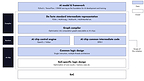
The technology landscape surrounding autonomous driving AI is evolving rapidly, making it difficult for architectures designed around a specific model or hardware configuration to adapt continuously to change. To address this challenge, TIER IV will introduce the Tensor Operator Set Architecture (TOSA), a standardized intermediate representation, between AI models and the AI chip.

Operations from AI models developed in frameworks such as PyTorch will be converted into a common TOSA representation. Optimization and code generation will then be performed through TOSA before execution on the AI chip, enabling loose coupling between AI frameworks and hardware.

As a result, changes in AI model architectures or computational methods can be accommodated primarily through software updates to components such as the compiler and runtime, without requiring the entire chip to be redesigned from scratch. TIER IV aims to realize a software-defined SoC whose performance and power efficiency can be continuously optimized through software.

Transparency

In safety-critical applications such as Level 4 autonomous driving, it is important to understand not only the AI model itself, but also the internal architecture and processing flow of the computing system on which it runs. Under this initiative, TIER IV will open-source the logic design of its autonomous driving AI chip, together with the compiler and related toolchain.

By making the design information publicly available, TIER IV will enable semiconductor manufacturers and developers to inspect the chip’s internal architecture and software behavior, and to modify, extend, and reuse the technologies according to their vehicle platforms, AI models, performance requirements, and power constraints.

Just as Autoware has enabled collaborative development of autonomous driving software, TIER IV will extend the same open-source philosophy to AI chip design and related toolchains. This will support an ecosystem in which autonomous driving AI technologies can be continuously improved and advanced without dependence on specific semiconductor products or closed development environments.

Verifiability

The process of executing an AI model on a chip involves model-format conversion, computational optimization, quantization, rounding, and other transformations. These processes are essential to improving performance and power efficiency, but they may also introduce numerical differences that affect the final computation results. A mechanism is therefore needed to assess the impact of such differences.

Using TOSA and its clearly defined operator specifications as a foundation, TIER IV will structure the compilation transformation process and introduce formal verification techniques. For selected transformations and operations, the initiative will establish mechanisms to mathematically verify numerical consistency before and after transformation, as well as compliance with predefined error tolerances.

Through this approach, TIER IV will pursue not only high processing performance, but also an execution environment in which the transformations applied to an AI model before chip execution can be traced and the correctness of the resulting processing can be verified. This will contribute to a more reliable execution environment for autonomous driving AI.

Supporting quotes

“Advances in AI have been accelerated by powerful computing platforms, including GPUs, which have enabled rapid progress across the industry,” said Shinpei Kato, founder and CEO of TIER IV. “As Level 4 autonomous driving moves toward broader deployment, we believe the next step is to complement these platforms with computing architectures designed for real-world and real-time requirements. Through this initiative, we are introducing a software-defined and open approach to AI chip design that combines power efficiency, adaptability, transparency and verifiability. In particular, the ability to understand how an AI model is transformed for execution and to verify the correctness of that processing will be increasingly important as autonomous driving systems are deployed in safety-critical environments. By extending the open-source philosophy behind Autoware from software to AI chip design and related toolchains, we aim to create an open ecosystem in which automakers, semiconductor manufacturers and developers can build upon the technology and continue advancing their own systems. This represents an important step toward a scalable, adaptable and reliable computing foundation for Level 4 autonomous driving.”

“In physical AI applications such as robotics and autonomous driving, GPU power consumption has long been a major bottleneck for deployment on battery-powered devices,” said Professor Yoshihiro Kawahara of Graduate School of Engineering, The University of Tokyo. “This project aims to fundamentally overcome this constraint through a functionally differentiated chip design backward-mapped from specific use cases. I look forward to TIER IV developing chips responsible for high-level decision-making – specifically, the high-level behavioral layer that handles the thinking process essential for end-to-end physical AI and autonomous driving. As the leading force behind Autoware, the global standard open-source software for autonomous driving, TIER IV is democratizing design, with an approach spanning application requirements to hardware. This enables applied researchers to shape their ideal semiconductors. This initiative, supported by an open ecosystem, has the potential to lay the foundations for a steady stream of Japanese startups creating high-value semiconductors.”

About TIER IV

TIER IV stands at the forefront of deep tech innovation, pioneering Autoware, open-source software for autonomous driving. With a comprehensive suite of platforms and services built around Autoware, TIER IV provides everything from software development and vehicle procurement to operational support. Through the Autoware ecosystem, TIER IV works with partners worldwide to shape the future of intelligent vehicles with open-source software, aiming to create mobility that is safer, more sustainable, and accessible to all.

Media contact
pr@tier4.jp 

The word marks and logos of TIER IV are trademarks or registered trademarks of TIER IV, Inc. in Japan and other countries. All other company names, product names, service names, and logos referenced herein are trademarks or registered trademarks of their respective owners.

Autoware is a registered trademark of the Autoware Foundation.

View original content to download multimedia:https://www.prnewswire.com/news-releases/tier-iv-joins-jsts-next-generation-edge-ai-semiconductor-rd-program-to-open-source-ai-chip-designs-for-autonomous-driving-302850781.html

SOURCE TIER IV, Inc.

Continue Reading

Technology

Security and Data-Residency Reviews Push Enterprise AI Buyers Toward Self-Hosted Platforms, and FastGPT Publishes Its Terms

Published

on

By

Open-source platform details private-deployment tiers, four support levels with stated first-response targets, and production results at a financial data provider, an auto-parts maker and a road-and-bridge group

HANGZHOU, China, Aug. 14, 2026 /PRNewswire/ — FastGPT, an open-source enterprise AI application platform, has published the commercial terms enterprise buyers evaluate alongside production deployments in regulated Chinese industries.

Enterprise AI in China has moved past the question of whether an application can be built. As the first wave reached production, security, procurement and audit teams began asking different questions: where data is stored, how permissions map to the organization chart, whether actions are logged, and who is accountable when something breaks.

Three deployments illustrate the shift. At a financial data provider, analysis of a single research report fell from three hours to 10 minutes, and daily output per editor rose from three-to-five report summaries to 50. At an automotive components manufacturer, 70 percent of repeat IT support requests are now handled automatically and response time moved from hours to seconds; its shared finance center, which processes over 520,000 documents a year, runs first-pass invoice checks in seconds, with exceptions still reviewed by staff. At a road-and-bridge infrastructure group in eastern China, a multi-agent inspection workflow cut full bridge inspection from days to hours.

FastGPT also published its purchasing terms. Private deployment is licensed per server in three tiers, selected in a fixed order based on tenant count, integration needs and billing requirements. Technical support has four tiers, from weekday ticket support to 7×24 coverage with a one-hour first-response target. Scope is set by the current commercial plan.

On reliability, FastGPT states that retrieval cannot guarantee complete recall under limited conditions, and that in some scenarios, after data-cleaning work, accuracy can come close to complete. Generated content still requires human review.

“Buyers evaluate these terms item by item, so we publish them up front,” a FastGPT spokesperson said.

About FastGPT

FastGPT is an open-source enterprise AI application platform offering RAG knowledge bases, visual workflows, agent orchestration, Skills, MCP and multi-channel publishing, available as a cloud service, community self-hosting or a commercially licensed private deployment. As of Aug. 13, 2026, its GitHub repository, labring/FastGPT, had 29,348 stars and 268 releases. The company reports more than 1,000 enterprise customers. More: github.com/labring/FastGPT


Media Contact
Carson Yang
carson@fastgpt.io 

View original content:https://www.prnewswire.com/news-releases/security-and-data-residency-reviews-push-enterprise-ai-buyers-toward-self-hosted-platforms-and-fastgpt-publishes-its-terms-302851616.html

SOURCE FastGPT

Continue Reading

Technology

KAILAS Mountain Adventure Project Celebrates 20 Years of Exploration in Chengdu

Published

on

By

CHENGDU, China, Aug. 14, 2026 /PRNewswire/ — On August 7, KAILAS celebrated the 20th anniversary of its Mountain Adventure Project with a special sharing session at Chengdu MixC. Climbers including Jon Otto, Li Zongli, Liu Junfu, Zhou Song, Zhang Qingwei “Yeren”, and Alan Rousseau gathered to reflect on two decades of mountain exploration, route development and the evolution of Chinese climbing.

Launched in 2006, the KAILAS Mountain Adventure Project has supported Chinese climbers in exploring unclimbed peaks, developing new routes and documenting first-hand mountain experience. Over the past 20 years, the project has witnessed the progression of Chinese climbing — from learning and following established routes to creating new lines and exploring unknown terrain.

Yaomei Peak, the highest peak of Mt. Siguniang, served as a key thread throughout the event. From earlier landmark ascents to newly developed routes, Yaomei Peak reflects how different generations of climbers have continued to search for new possibilities on the same mountain.

During the sharing session, the climbers discussed route development, technical progression, teamwork and the mindset behind exploration. Jon Otto shared his long-term experience in Chinese mountain exploration and climbing education. Li Zongli and Liu Junfu reflected on their experiences with established and new routes. Zhou Song and Zhang Qingwei shared insights from their 2024 ascent of the north face of Yaomei Peak and the development of the new route “Wu”. Alan Rousseau, an IFMGA-certified mountain guide and two-time Piolet d’Or winner, offered an international perspective on China’s climbing potential and the value of exchange within the global climbing community.

The event also marked the launch of the Mountain Adventure Project website, which brings together mountain and route information, expedition stories, project updates and climbers’ experiences accumulated over two decades. By organizing and sharing these resources, the platform aims to make exploration knowledge more accessible and support information exchange among climbers worldwide.

For KAILAS, 20 years of the Mountain Adventure Project represent more than a history of exploration. They reflect a long-term commitment to curiosity, respect, technical progress and knowledge sharing. As climbing continues to evolve, KAILAS will keep supporting climbers as they explore new routes, share experience and build connections across the global climbing community.

Make Your Own Path.

View original content to download multimedia:https://www.prnewswire.co.uk/news-releases/kailas-mountain-adventure-project-celebrates-20-years-of-exploration-in-chengdu-302851580.html

Continue Reading

Trending