Connect with us

Technology

HTX Research Examines U.S. AI Equities: Technology Remains Early, While Capital Expenditure and Valuations Have Entered the Late Cycle

Published

on

APIA, Samoa, Aug. 23, 2026 /PRNewswire/ — HTX Research, the dedicated research arm of HTX, has released a new report titled The Industrialization of Intelligence and the Bubble Cycle: Token Economics, Capital Expenditure, and the Repricing of Risk-Reward Across U.S. AI Equities. Its central argument is that the AI industry and AI equities are not at the same point in their respective cycles — technological diffusion remains in its early stages while capital expenditure, valuations, and investor sentiment have moved well ahead of it.

The Variables Driving Equity Prices

Markets first priced the scarcity of GPUs, high-bandwidth memory, servers, and data-center capacity, and later the capability gains delivered by frontier models and coding agents. In 2026, the variables driving equity returns are shifting away from model parameter counts and the scale of capital expenditure toward token production costs, task-completion reliability, usage intensity, enterprise-workflow penetration, and the ability of enormous AI investments to generate durable free cash flow.

Behind that shift is a change in the magnitude of capital spending. J.P. Morgan Asset Management estimates that five U.S. hyperscalers will spend approximately $697 billion in 2026, with capital expenditure rising from roughly 33% of their operating cash flow in 2023 to an estimated 93%. Once capital expenditure consumes the overwhelming majority of operating cash flow, market attention necessarily moves from revenue growth to return on capital.

The Bubble Sits in the Financial Architecture, Not the Industry

Cloud revenue, coding-agent adoption, semiconductor sales, and enterprise demand are all growing in real terms, meaning AI technology itself is not a false narrative. Capital expenditure, external financing, data-center projects, private-model valuations, and a number of high-multiple second-tier equities, however, display increasingly speculative characteristics.

Headline price-to-earnings ratios also fail to represent true valuation levels: Alphabet’s multiple is distorted by investment income, and Amazon’s current accounting profit does not reflect a normalized valuation. What genuinely offers value is the closest alignment among normalized valuation, competitive moats, cash flow, and AI optionality.

At current prices and cycle positions, the report views Alphabet as offering the most compelling overall asymmetry, and applies the same framework across Microsoft, Meta, TSMC, NVIDIA, Amazon, Oracle, Micron, AMD, Arista, and Vertiv — distinguishing businesses with high fundamental win rates from those whose valuations already demand near-flawless execution.

AI Is Reshaping How Crypto Investors Allocate Capital

AI’s role as a shared theme across global capital markets extends beyond U.S. equity pricing into the allocation behavior of crypto investors. As names including NVIDIA, Micron, TSMC, Broadcom, Meta, and Alphabet enter the everyday portfolios of crypto users alongside gold, crude oil, ETFs, and pre-IPO assets, a growing share of users now treat crypto and U.S. equities as different allocation directions within a single global risk-asset system.

HTX has been one of the earliest crypto exchanges to systematically pursue this direction. According to data disclosed in August 2026, cumulative trading volume in the platform’s TradFi perpetuals section has exceeded $2.5 billion, with support for more than 170 TradFi-related assets spanning U.S. equities, ETFs, gold, silver, crude oil, AI semiconductors, memory, aerospace, and pre-IPO themes such as OpenAI and Anthropic.

What makes this model work is the platform’s existing base of crypto users who have completed registration, verification, and funding. Holding stablecoins such as USDT, they can trade TradFi assets within the same account without opening a brokerage account or moving capital into a separate financial system — allocating toward gold, ETFs, or large-cap technology when risk appetite declines, and raising crypto and high-beta AI exposure when it recovers.

The Competitive Boundary for Trading Platforms Is Shifting

Competition among trading platforms will extend beyond spot markets, derivatives, liquidity, and listing speed toward a broader contest spanning multi-asset access, wealth management, and AI investment tools. Platforms with durable competitiveness will see their core capability evolve from execution alone toward global asset distribution.

This confirms a larger judgment in the report: AI is changing not only model capability and compute demand, but capital flows, allocation behavior, and how financial products are organized. HTX’s early positioning in TradFi corresponds with HTX Research’s sustained tracking of the AI theme and cross-market capital flows — identifying cycle positions, reading capital flows, and understanding how assets move in relation to one another sits at the core of research work, and also forms a source of first-mover advantage in business decisions. As AI drives global markets into a new phase of convergence, institutions capable of understanding both industrial cycles and capital flows are better positioned for the next round of competition.

*The above content is not an investment advice and does not constitute any offer or solicitation to offer or recommendation of any investment product.

About HTX Research

HTX Research is the dedicated research arm of HTX Group, responsible for conducting in-depth analyses, producing comprehensive reports, and delivering expert evaluations across a broad spectrum of topics, including cryptocurrency, blockchain technology, and emerging market trends. Committed to providing data-driven insights and strategic foresight, HTX Research plays a pivotal role in shaping industry perspectives and supporting informed decision-making within the digital asset space. Through rigorous research methodologies and cutting-edge analytics, HTX Research remains at the forefront of innovation, driving thought leadership and fostering a deeper understanding of evolving market dynamics. Visit us.

View original content to download multimedia:https://www.prnewswire.com/apac/news-releases/htx-research-examines-us-ai-equities-technology-remains-early-while-capital-expenditure-and-valuations-have-entered-the-late-cycle-302857765.html

SOURCE HTX Research

Continue Reading

Technology

Atalanta CEO Anjana Rajan Addresses Software Understanding Gap at The National Academies Cyber Resilience Forum

Published

on

By

Rajan’s remarks come amid a string of major technology outages across critical infrastructure

WASHINGTON, Nov. 20, 2026 /PRNewswire/ — The National Academies of Sciences, Engineering, and Medicine’s Forum on Cyber Resilience concluded today after two days of sessions with leaders from the NSA, the Department of War, AWS, Google, Microsoft, and others on the technical and operational challenges of closing the software understanding gap.

The forum convened as outages across transportation, banking, telecommunications, and national security exposed vulnerabilities in the complex systems underpinning U.S. critical infrastructure. Because these systems are built, maintained, and operated by multiple stakeholders across domains, it is increasingly difficult to predict how they will behave when something goes wrong.

Anjana Rajan, CEO and Co-Founder of Atalanta, gave a presentation titled “Forward Deployed Formal Methods,” which discussed Atalanta’s learnings from the front lines on how to apply mathematical rigor to real world missions.

“Over the last week, we have seen elected officials and leaders not know what caused these outages,” said Rajan. “There is a name for this phenomenon, and it’s called the software understanding gap.”

During her remarks, Rajan announced the launch of Ata, Atalanta’s new formal verification language. Ata brings mathematical verification to the operators responsible for today’s critical systems so they can verify how those systems will behave under normal, abnormal, or hostile conditions.

“How do I know my critical infrastructure will perform as intended, even when under attack?” Rajan said. “This is the fundamental challenge facing mission owners who need to know that the systems they depend on will work. Atalanta is already meeting this moment. “

Atalanta is currently working across a range of critical infrastructure sectors, including defense, space, and energy. In August, Viasat announced that it had used Atalanta’s platform, Argo, to demonstrate improved resilience of satellite networks against modern warfare threats. Atalanta is also supporting the Department of Energy’s Genesis Mission through its partnership with Idaho National Laboratory, bringing formal verification techniques to the development of autonomous nuclear reactors.

Press Contact
press@atalanta.tech

View original content:https://www.prnewswire.com/news-releases/atalanta-ceo-anjana-rajan-addresses-software-understanding-gap-at-the-national-academies-cyber-resilience-forum-302947339.html

SOURCE Atalanta

Continue Reading

Technology

S&P Global to Present at UBS Global Technology and AI Conference on December 2, 2026

Published

on

By

Session will be Webcast

NEW YORK, Nov. 20, 2026 /PRNewswire/ — Martina Cheung, President and Chief Executive Officer of S&P Global (NYSE: SPGI), will participate in the UBS Global Technology and AI Conference on December 2, 2026 in Scottsdale, AZ. Ms. Cheung is scheduled to speak from 9:35 a.m. to 10:05 a.m. Mountain Standard Time (11:35 a.m. Eastern Standard Time). The “fireside chat” will be webcast and may include forward-looking information. Mark Grant, Senior Vice President of Investor Relations and Treasurer, will join for investor meetings.

Webcast Instructions:  Live and Replay
The webcast (audio-only) will be available live and in replay through the Company’s Investor Relations website http://investor.spglobal.com/Investor-Presentations. Any additional information presented during the session will be made available on the Company’s Investor Presentations web page.

About S&P Global
S&P Global (NYSE: SPGI) enables businesses, governments, and individuals with trusted data, expertise and technology to make decisions with conviction. We are Advancing Essential Intelligence through world-leading benchmarks, data, and insights that customers need in order to plan confidently, act decisively, and thrive in a rapidly changing global landscape.

From helping our customers assess new investments across the capital and commodities markets to navigating the energy expansion, acceleration of artificial intelligence, and evolution of public and private markets, we enable the world’s leading organizations to unlock opportunities, solve challenges, and plan for tomorrow – today. Learn more at www.spglobal.com. 

Investor Relations:  http://investor.spglobal.com 

Contacts:

Investor Relations
Mark Grant
Senior Vice President, Investor Relations and Treasurer
Tel: + 1 (347) 640-1521
mark.grant@spglobal.com

Media
Christina Twomey
Chief Communications Officer
Tel: +1 (646) 407-3001
christina.twomey@spglobal.com

View original content:https://www.prnewswire.com/news-releases/sp-global-to-present-at-ubs-global-technology-and-ai-conference-on-december-2-2026-302947340.html

SOURCE S&P Global

Continue Reading

Technology

APEC CEO Summit 2026 Concludes Successfully in Shenzhen

Published

on

By

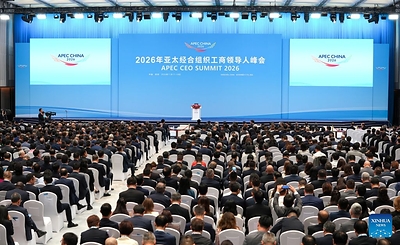
SHENZHEN, China, Nov. 20, 2026 /CNW/ — The APEC CEO Summit 2026 concluded on November 18 at the Qianhai International Convention Center in Shenzhen. Hosted by the China Council for the Promotion of International Trade (CCPIT), the summit was held from November 17 to 18 as a supporting event of the 33rd APEC Economic Leaders’ Meeting. President Xi Jinping attended the opening ceremony and delivered a keynote speech. The summit drew more than 2,000 political and business leaders from all 21 APEC economies and 13 economies beyond APEC, including the United Kingdom, France, Germany and Switzerland.

Under the theme “To Prosper and Win the Future Together,” the summit featured the opening ceremony, speeches by leaders of APEC economies, a business dialogue, thematic discussions, the closing ceremony and the handover of the hosting role. Leaders of APEC economies including Australia; Canada; Chile; Hong Kong, China; the Republic of Korea; Malaysia; Mexico; Russia; Thailand and Vietnam attended the summit, delivering speeches or remarks or joining panel discussions. More than 40 heads of leading Chinese and foreign companies and major business associations exchanged views on the Asia-Pacific economic outlook and new opportunities for cooperation, connectivity, artificial intelligence, sustainable development, the Free Trade Area of the Asia-Pacific (FTAAP), the digital economy, development of the Guangdong-Hong Kong-Macao Greater Bay Area, and digital and green transformation.

Ren Hongbin, Chairman of the CCPIT and Chair of the APEC CEO Summit 2026, presided over the opening ceremony. At the closing ceremony, on behalf of the Asia-Pacific business community, he released The Shenzhen Initiative of the Asia-Pacific Economic Cooperation (APEC) CEO Summit 2026, calling for deepening an open regional economy, driving inclusive growth through technological innovation, strengthening regional connectivity, and working together to achieve shared prosperity. It is the first time in the summit’s 30-year history that outcomes have been issued in the form of an initiative.

At the handover ceremony, Ren Hongbin passed the hosting role for the next APEC CEO Summit to Nguyen Quang Vinh, Vice Chairman of the Vietnam Chamber of Commerce and Industry.

More information: https://www.apecceosummit2026.cn/en/apec2026/

View original content to download multimedia:https://www.prnewswire.com/news-releases/apec-ceo-summit-2026-concludes-successfully-in-shenzhen-302947355.html

SOURCE CCPIT

Continue Reading

Trending