Connect with us

Technology

TEDCO-Backed Companies Generate More Than $9.9 Billion in Economic Output, Independent Study Finds

Published

on

Maryland Technology Development Corporation’s FY25 study finds $17 in economic activity for every $1 of state funding

COLUMBIA, Md., Sept. 10, 2026 /PRNewswire/ — TEDCO, Maryland’s economic engine for technology companies, announced the findings of an independent economic impact study detailing the contributions of TEDCO to the state of Maryland.

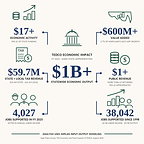
The 2026 study, conducted by Sage Policy Group, a Baltimore-based economic and policy consulting firm whose client base spans more than forty states, shows TEDCO as an economic powerhouse, contributing significant economic and fiscal returns to the Maryland ecosystem. In fiscal year 2025 alone, TEDCO supported more than $1 billion in statewide economic output, 4,027 jobs and $479 million in labor income — building on a track record that now totals more than $9.9 billion in economic output and 38,000 jobs since inception.

“TEDCO was created to lead innovation to market, and we are excited to continue doing just that,” said Troy LeMaile-Stovall, TEDCO CEO. “Our impact across Maryland’s ecosystem reflects the strength of the entrepreneurs, researchers and industry partners we’re proud to support. Every dollar we invest is designed to help promising ideas become viable companies, and this study confirms that approach is paying dividends for the entire state — in jobs created, in business expansions and in Maryland’s reputation as a place where innovation thrives.”

According to the study, for every state-funded dollar in FY25, TEDCO’s output represents more than $17.00 in economic activity across the state — activity that supported more than $479 million in labor income that year alone.

“Our analysis shows that TEDCO isn’t just supporting Maryland’s innovation economy — it’s actively expanding it, even as the state contends with real economic headwinds,” said Dr. Anirban Basu, chairman and CEO of Sage Policy Group. “We built this model conservatively, and the results still show more than $17 in economic activity for every dollar the state invests. That kind of return is rare, and it reflects the discipline TEDCO brings to deploying public capital.”

The findings arrive as Maryland confronts real economic strain. The state has lost more than 46,000 jobs since December 2024, driven largely by federal workforce reductions, and faces a structural budget gap projected to exceed $6 billion by 2030. Against that backdrop, TEDCO’s ability to convert public investment into private-sector jobs and tax revenue takes on added significance.

Even more striking is TEDCO’s return to local communities. In fiscal year 2025, TEDCO generated nearly $60 million in State and local tax revenue. This revenue, fueled by TEDCO-supported companies, includes $24.1 million returned to Maryland’s counties and municipalities — even though they do not contribute to TEDCO’s funding — enough on its own to cover the salaries of 420 public school teachers. That distinction matters now more than ever. As the state grapples with job losses and a widening budget shortfall, TEDCO’s track record offers a clear, data-driven case for continued investment.

See the full study here.

“TEDCO’s continued impact on Maryland’s growth and development can be seen across our programs, offerings, connections and portfolio companies,” said TEDCO Board of Directors chair, David Tohn. “These numbers are hardly a surprise – in my work on the TEDCO Board, I have seen the direct impact TEDCO makes across the state, the passion and dedication each employee has for the entrepreneurial ecosystem and can confidently say that, without TEDCO, Maryland’s growth would not be where it is today.”

Programs under the TEDCO umbrella include numerous investment opportunities – the Venture Funds, the Seed Investment Funds, the Social Impact Funds, the Rural Pre-Seed Funds, and allocated funding from the U.S. Treasury’s State Small Business Credit Initiative – as well as funding opportunities from the Maryland Innovation Initiative Fund and the Maryland Stem Cell Research Fund. Additionally, TEDCO offers various programs and resources intentionally designed to support the growth and development of Maryland’s ecosystem; such programs and resources include the Equitech Growth FundDefTechPrelude Pitch, strategic alliance Institute for Women Entrepreneur Excellence and more. 

About TEDCO

TEDCO, the Maryland Technology Development Corporation, enhances economic empowerment growth through the fostering of an inclusive entrepreneurial innovation ecosystem. TEDCO identifies, invests in, and helps grow technology and life science-based companies in Maryland. Learn more at www.tedcomd.com.

Media Contact
Tammi Thomas, President, TEDCO, tthomas@tedcomd.com
Rachael Kalinyak, Associate Director, Marketing & Communications, TEDCO, rkalinyak@tedcomd.com

View original content to download multimedia:https://www.prnewswire.com/news-releases/tedco-backed-companies-generate-more-than-9-9-billion-in-economic-output-independent-study-finds-302875502.html

SOURCE TEDCO

Continue Reading

Technology

Roofing Restoration Expert Travis Frees Explains Roof Repair vs. Replacement in HelloNation

Published

on

By

The Article Outlines Warning Signs That Help Homeowners Determine Whether Roof Repair or Replacement Is the More Practical Long-Term Solution.

READING, Pa., Sept. 10, 2026 /PRNewswire/ — What signs show whether a homeowner needs roof repair or roof replacement? HelloNation published an article featuring insights from Roofing Restoration Expert Travis Frees that answers this question.

The article explains that deciding between roof repair vs. replacement depends on several parts of a roofing system. Roof age, the extent of damage, and whether problems are isolated or widespread can all affect the decision. A professional inspection should consider shingles, flashing, valleys, pipe boots, attic ventilation, and decking, not just visible damage.

Storm damage is a common roofing concern in Reading and Berks County. The article notes that high winds, hail, and falling tree limbs can leave shingles missing or expose roofing materials. When damage is limited to a small area and surrounding shingles remain secure, targeted roof repair may provide sufficient protection.

The HelloNation article explains that widespread storm damage can look different. Shingles that repeatedly lift during windstorms, crack during handling, or become brittle may indicate aging materials. When deterioration affects larger portions of the roofing system, roof replacement may offer a more dependable solution than repeated repairs.

Granule loss is another warning sign the article discusses. Asphalt shingles naturally lose some granules over time, but excessive buildup in gutters can indicate advanced wear. As shingles lose their protective surface, they become more vulnerable to moisture, ultraviolet exposure, and further deterioration.

The article also identifies curling edges, cracked shingles, faded surfaces, and bald spots as signs of aging materials. Isolated problems may still be repairable, while widespread wear can indicate that the roofing system is approaching the end of its expected service life.

Roof age is another important consideration when comparing roof repair vs. replacement. According to the article, many asphalt shingle roofs last approximately 20 to 25 years. Actual lifespan can vary based on installation quality, ventilation, maintenance, and exposure to local weather conditions.

Interior warning signs can also reveal problems that are difficult to see from outside. Water stains on ceilings or walls may result from flashing failures, damaged pipe boots, or minor shingle damage. The article explains that repeated leaks in multiple rooms can point to broader roofing system failure.

Roofing Restoration Expert Travis Frees is also featured in the article’s discussion of problems beneath the roof surface. Poor attic ventilation can trap heat and moisture, contributing to warped decking, mold growth, and premature shingle deterioration. The article notes that a thorough inspection should evaluate attic conditions, ventilation, drainage patterns, and flashing details.

For older roofs, repeated repairs may temporarily address leaks while deterioration continues elsewhere. The article explains that homeowners should receive guidance based on the roof’s actual condition. Recommend proper repairs when they can realistically solve the problem, while widespread deterioration or recurring leaks may make replacement more practical.

The article concludes that homeowners in Reading and Berks County should watch for missing shingles, granule loss, water stains, storm damage, and attic ventilation problems. A professional inspection can help determine whether repairs are sufficient or replacement offers the more practical long-term approach.

Do You Need Roof Repair or Roof Replacement in Reading, PA? features insights from Travis Frees, Roofing Restoration Expert of Reading, Pennsylvania, in HelloNation.

About HelloNation

HelloNation is America’s Good News Network, a premier media platform built on the idea that good news travels faster when real people tell real stories. Through its community-focused publications and innovative “edvertising” approach, HelloNation delivers content that informs, inspires, and spotlights the leaders making a meaningful impact in their communities.

View original content to download multimedia:https://www.prnewswire.com/news-releases/roofing-restoration-expert-travis-frees-explains-roof-repair-vs-replacement-in-hellonation-302875587.html

SOURCE HelloNation

Continue Reading

Technology

Hivelocity Launches Gaming Bundle for Studios’ Always-On Infrastructure

Published

on

By

Dedicated bare metal infrastructure for build pipelines, production backends, and live game servers with predictable pricing for sustained workloads.

TAMPA, Fla., Sept. 10, 2026 /PRNewswire/ — Hivelocity, an infrastructure-as-a-service provider of bare-metal dedicated servers, colocation, and virtualized cloud solutions, today announced the Hivelocity Gaming Bundle.

Built for studios running live service titles and platforms, the bundle pairs single-tenant dedicated hardware with predictable, steady-state pricing and direct control over how game workloads are deployed and operated. It gives game studios, game-server orchestration platforms, and gaming security vendors a clear path to running build pipelines, production backends, and match-server fleets without paying cloud rates for elasticity their servers never use, and without handing off the orchestration they need to control.

The bundle is built around three common areas of game infrastructure:

Engineering Compute supports the development work behind modern games, including build farms, continuous integration pipelines, asset processing, testing environments, and other workloads that consume compute for long periods of time.

Production Compute runs the backend services players depend on every day, including account systems, authentication, progression, leaderboards, in-game commerce, telemetry, and matchmaking services.

Live Service Compute is designed for the latency-sensitive core of live games, including match servers, persistent world-state systems, voice services, and anti-cheat infrastructure. These workloads depend on consistent CPU performance, fast local storage, and network paths that can support a reliable player experience.

Game studios are taking a harder look at where public cloud fits, and where it starts to work against the economics of a live service business. Public cloud can be useful for burst capacity, GPU-heavy workloads, and development flexibility, but many live service workloads run continuously. Match servers, backend services, leaderboards, and telemetry systems often operate around the clock, and dedicated infrastructure can offer a more predictable cost model and greater operational control.

For content-heavy titles, bandwidth can also become a major cost driver. Large game patches, seasonal updates, and new releases can move massive volumes of data in a short period of time. Hivelocity’s Gaming Bundle is built to support sustained traffic with high-capacity network options, including 10 Gbps unmetered ports for appropriate workloads.

“Hivelocity’s Gaming Bundle is built for studios that want more control over the infrastructure behind their live games,” said Ned Pope, Chief Product Officer at Hivelocity. “Game teams already own the player experience, the matchmaking logic, the fleet orchestration, and the live operations model. We give them dedicated hardware, predictable economics, regional placement, and engineering support so they can run that stack with confidence.”

The bundle draws a clear line between what Hivelocity provides and what the studio operates. Hivelocity supplies the bare-metal foundation: single-tenant hardware, regional placement near concentrated player populations, network connectivity and transit, and network-level DDoS protection for the estate. The studio keeps matchmaking, fleet orchestration, anti-cheat operations, application security, and live ops uptime. A hybrid pattern is preferred by most organizations to take full advantage of all the cloud can offer, with bare metal for latency-critical core workloads for tick-rate-sensitive engines, a partner CDN at the edge, and the studio’s own cloud for burst and GPU workloads.

Studios manage their fleets through the myVelocity portal, public APIs, and Infrastructure as Code (IaC), with the same operations available in code as in the console. Hivelocity holds a SOC 2 Type II attestation for its core facilities, and a PCI-validated facility foundation is available at the Tampa facilities, with expansion in flight.

The Gaming Bundle is designed for studios already running their own server orchestration that have committed to a tick-rate target and need single-tenant bare metal, regional placement, and state persistence that shared infrastructure can’t reliably provide.

About Hivelocity
Founded in 2002, Hivelocity operates bare-metal infrastructure across globally distributed data centers, serving mid-market and enterprise customers in gaming, healthcare, SaaS, fintech, and high-performance computing. The company provides 24/7/365 in-house support with a 15-minute average ticket response time, backed by an SLA-guaranteed 99.99% network uptime.

View original content to download multimedia:https://www.prnewswire.com/news-releases/hivelocity-launches-gaming-bundle-for-studios-always-on-infrastructure-302875586.html

SOURCE Hivelocity

Continue Reading

Technology

Foundation Fighting Blindness Renames Venture Philanthropy Arm the Gund Vision Fund, Honoring Five Decades of Gund Family Leadership

Published

on

By

The new name honors the decades of leadership and giving by Foundation co-founder Gordon Gund and his family, honoring the Fund’s evolution into one of the most innovative venture philanthropy models in the retinal disease market

COLUMBIA, Md. and RALEIGH, N.C., Sept. 10, 2026 /PRNewswire/ — The Foundation Fighting Blindness today announced the rebrand of its venture philanthropy arm, formerly the Retinal Degeneration Fund (RD Fund), to the Gund Vision Fund.

The new name honors more than 50 years of leadership, advocacy, and philanthropic support from Gordon Gund and the Gund family, whose contributions to the Foundation have been immeasurable. It also reflects the Fund’s evolution since its launch in 2018, growing from an early-stage research funder into one of the most innovative venture philanthropy models in the market, catalyzing the translation of decades of research into real treatments.

“The Gund Vision Fund name reflects both where this Fund has been and where it is going. Gordon Gund and the Gund family did not support this work from a distance. They helped build it, and this name honors that,” said Jason Menzo, CEO, Foundation Fighting Blindness. “Vision speaks to our mission of advancing treatments and cures for the diseases that cause blindness, and to the forward-looking way we deploy capital to get there. We are proud of what the Fund has become and excited about what comes next.”

Since it was founded in 2018, the Fund – now the Gund Vision Fund – has built and proven its model by managing more than $140 million in strategic capital, deploying over $100 million directly into a portfolio of 20 companies, and syndicating with more than $1.5 billion in institutional capital from more than 60 co-investors. The Foundation is already the leading private funder of retinal disease research, with nearly $1 billion invested since 1971 and a patient registry of over 43,000 individuals.

The rebrand coincides with an active $100 million capital campaign to accelerate the development of treatments and cures for inherited retinal diseases and dry AMD. To anchor the campaign, the Gordon and Llura Gund Foundation has committed a $50 million lead challenge gift, matching every new or increased contribution to the Gund Vision Fund dollar for dollar up to $50 million. Every gift made during the campaign will be doubled, advancing more programs into clinical development and reaching more patients sooner.

“Building this Fund from the ground up has meant taking greater risks to bring treatments to patients and believing in companies when the path forward is uncertain. That conviction is being rewarded, treatments are reaching patients who had no options,” said Rusty Kelley, PhD, managing director of the Gund Vision Fund. “The Gund Vision Fund name honors the family that made this possible, and the gift from the Gordon and Llura Gund Foundation signals even greater conviction for the model, the momentum, and what’s next.”

The Gund Vision Fund’s updated website, GundVisionFund.org, has launched alongside updated social channels, marking the start of a new chapter for the Fund, with more to come in early 2027. For more information, visit GundVisionFund.org.

About the Gund Vision Fund
The Gund Vision Fund, formerly the Retinal Degeneration Fund (RD Fund), is the venture philanthropy arm of the Foundation Fighting Blindness and a 501(c)(3) not-for-profit subsidiary. Launched in 2018 as the first and only fund solely dedicated to advancing therapeutics for inherited retinal diseases and dry age-related macular degeneration, the Fund bridges the critical funding gap between discovery-stage research and drug development. For more information, visit GundVisionFund.org.

About the Foundation Fighting Blindness
Established in 1971, the Foundation Fighting Blindness is the world’s leading private funding source for retinal degenerative disease research. The Foundation has raised nearly $1 billion toward its mission of accelerating research for preventing, treating, and curing blindness caused by the entire spectrum of retinal degenerative diseases, including retinitis pigmentosa, age-related macular degeneration, Usher syndrome, and Stargardt disease. Visit FightingBlindness.org for more information.

Media Contact:
Chris Adams
Foundation Fighting Blindness
410-423-0585
CAdams@FightingBlindness.org 

View original content to download multimedia:https://www.prnewswire.com/news-releases/foundation-fighting-blindness-renames-venture-philanthropy-arm-the-gund-vision-fund-honoring-five-decades-of-gund-family-leadership-302875599.html

SOURCE Foundation Fighting Blindness

Continue Reading

Trending