Amid concerns about “AI slop,” Brandi AI’s study of approximately 900,000 AI answers finds that top-performing human-written content has a significant advantage in earning AI citations
MCLEAN, Va., Sept. 16, 2026 /PRNewswire/ — Brandi AI, the leading enterprise platform for Brand Intelligence, AI visibility and Generative Engine Optimization (GEO), today announced new research findings revealing that the most-cited human-written webpages appear as sources in artificial intelligence (AI) answers nearly six times as often as the most-cited AI-written webpages.
The Brandi AI study analyzed approximately 900,000 AI-generated answers to determine citation frequency and source authority between human-written and AI-written content. As the internet fills with “AI slop”—low-quality, mass-produced AI-generated content—the findings show that AI-written content can earn citations, but the highest-performing human-written pages captured substantially more citations.
Conducted in the second quarter of 2026, the research sampled responses across ChatGPT, Google AI Mode, Google Gemini and Microsoft Copilot, tracking 4,210 individual webpages linked as supporting sources. For the study, a citation was defined as an AI platform referencing or linking to a webpage as a source supporting its answer. Citation frequency measured how often a specific webpage appeared as a cited source across the dataset.
The results reveal a substantial gap between the best human-written and AI-written content:
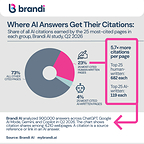
Average citation volume: The 25 most-cited human-written webpages averaged 682 citations per page, 5.7 times the 119 citations averaged by the 25 most-cited AI-written webpages.Top human-written performance: The 25 most-cited human-written webpages received 17,050 citations. Although they represented only 0.6% of the more than 4,000 webpages studied, they accounted for 23% of all citations in the dataset.Top AI-written performance: The 25 most-cited AI-written webpages received 2,975 citations. They also represented 0.6% of the webpages studied but captured just 4% of all citations.
“The scale of this gap points to a fundamental truth about the future of content: as AI makes content easier, cheaper and faster to produce, human intelligence becomes a premium,” said Leah Nurik, CEO and co-founder of Brandi AI. “In a world increasingly filled with derivative content, distinctly human contributions will determine which sources LLMs recognize, trust and cite most frequently.”
Human-Written Pages Capture a Greater Share of AI Citations
Across multiple performance thresholds, human-written webpages captured a substantially larger share of AI citations than AI-written webpages. The gap was most pronounced among the highest-performing pages.
Key findings include:
Top 1% of pages: The highest-performing 1% of human-written pages captured 27% of all citations, while the highest-performing 1% of AI-written pages captured less than 1%.Top 25 pages: The 25 most-cited human-written pages generated 23% of all citations, compared with 4% for the 25 most-cited AI-written pages.Top 250 pages: The 250 most-cited human-written pages captured 51% of all citations, compared with 10% for their AI-written counterparts.Sustained citation activity: Among pages still receiving citations during the study’s final month, human-written pages averaged 37% more citations per day than AI-written pages — 1.80 versus 1.31.
Brandi AI researchers also examined characteristics shared by the most-cited human-written pages to identify factors that may help explain the performance gap. The most-cited human-written pages frequently included information that is difficult to reproduce with generic content generation, such as original research, proprietary data, firsthand experience, subject-matter expertise, expert analysis, and distinctive conclusions.
While the Brandi AI study did not establish causation, the identified citation patterns challenge the common assumption that publishing more content alone increases a brand’s visibility in AI answers. Generative AI can dramatically increase content output, but Brandi AI’s data suggests that citation visibility is concentrated among pages that offer distinctive information, evidence or expertise.
For brands and publishers, the implication is that GEO increasingly depends on creating source material that contributes something new, specific or difficult to reproduce elsewhere.
Why the Growth of AI-Generated Content is Increasing the Value of Original Human Expertise
Brandi AI’s findings come amid mounting concerns about the high volume of inexpensive AI-written material appearing online, also known as “AI slop” when it is repetitive, derivative or produced primarily for scale rather than usefulness.
A Pew Research analysis of 10,000 webpages found that 10% showed significant signs of AI authorship. The share increased to more than one-third among pages published after ChatGPT’s release in late 2022, indicating a sharp upward trend in AI-generated web content. A May 2026 analysis by Graphite of 55,400 English-language articles found that 49.9% of online articles published in the first quarter of 2026 were primarily AI-generated. Separately, academic research published in April 2026 found that approximately 35% of newly published websites were AI-generated or AI-assisted.
“AI is making content abundant, but human expertise is what makes content valuable to AI,” said Nurik. “For publishers, journalists and marketers confronting an internet where generating another article has never been easier, the competitive advantage is creating genuinely original information worth citing. Brands and publishers that bring new evidence, expertise and thinking to the market give AI systems a stronger reason to cite them and a better chance to shape the answers people see.”
How Brands and Publishers Can Increase Their Chances of Earning AI Citations
The Brandi AI findings suggest that increasing content output alone is unlikely to be sufficient to earn AI citations. Instead, Brandi AI recommends that organizations use AI to improve research, organization, structure, optimization and production while concentrating human expertise on distinctive, evidence-based information that AI cannot easily reproduce.
For public relations, content, Search Engine Optimization (SEO), digital marketing and product marketing teams, GEO involves creating and strengthening source material to help AI systems answer specific questions accurately. Content that clearly answers a question, supports claims with evidence and contributes information or analysis that is not readily reproduced by AI gives an AI system more substantive material to reference.
Study Methodology and Content Classification Criteria
Brandi AI analyzed 4,210 cited webpages across 1,830 prompts and approximately 900,000 AI answers from ChatGPT, Google AI Mode, Google Gemini and Microsoft Copilot during the second quarter of 2026. The webpages were randomly sampled and filtered to those cited throughout the study period.
Brandi AI then used a proprietary multi-signal process to assess linguistic characteristics associated with human- or AI-written content. Pages classified as Highly Likely Human or Semi-Likely Human were grouped as human-written, while pages classified as Semi-Likely AI or Highly Likely AI were grouped as AI-written.
The Brandi AI classifications reflect signals present in the finished text and should not be interpreted as verified authorship. The methodology does not determine whether AI was used during research, outlining, drafting, editing, restructuring or optimization. Accordingly, “human-written” and “AI-written” describe the study’s classifications of the finished webpages and do not constitute independently verified accounts of how each webpage was produced.
The study measured citation frequency, depth, longevity, retention, continuing activity and concentration among the highest-performing pages.
About Brandi AI
Brandi AI™ is the leading platform for enterprise Brand Intelligence, AI visibility and Generative Engine Optimization (GEO). Built on a powerful intelligence layer, Brandi helps organizations stay visible as online discovery shifts from search engines to AI answer engines like ChatGPT, Google AI Overviews and Perplexity, revealing where brands stand in this new landscape. Brandi tracks the high-intent questions buyers ask AI and shows whether — and how — a brand is mentioned or cited in AI answers. With this foundation, Brandi AI provides data-driven guidance and optimization tools to help marketers refine existing web content and create new AI-ready content designed to earn brand mentions and citations in AI answer engines. Used by Fortune 500s, global agencies and mid-market brands across B2C and B2B industries, Brandi AI supports CMOs and product marketers in defining category strategy and content, and PR, SEO, and digital marketing teams in driving visibility. For more information, visit mybrandi.ai.
Media contact:
Michael Tebo
Gabriel Marketing Group (for Brandi AI)
Email: michaelt@gabrielmarketing.com
SOURCE Brandi AI










 Technology4 days ago
 Coin Market4 days ago
 Technology5 days ago
 Technology4 days ago
 Coin Market5 days ago
 Coin Market5 days ago
 Technology5 days ago