Connect with us

Technology

Arcfra Releases Neutree 1.2 to Add Non-LLM Model Support and Simplify AI Operations

Published

on

Flex Engine adds MinerU, PaddleOCR, and selected ML models, alongside simpler resource management

SINGAPORE, Sept. 17, 2026 /PRNewswire/ — Arcfra today announced Neutree 1.2, a new release that expands model support and simplifies resource planning and operations management for enterprise AI platforms.

Neutree 1.2 introduces Flex Engine, an Arcfra-developed inference engine that supports non-LLM models such as MinerU and PaddleOCR. Building on standard inference engines such as vLLM and SGLang, users can manage language, multimodal, embedding, rerank, document parsing, OCR, and machine learning models on one platform, then publish and manage service calls through Neutree’s unified model gateway. This reduces duplicated platform work and accelerates the path from model validation to business use.

Visual model registry management improves model asset visibility. Neutree 1.2 supports unified management of public and private models, showing source, connection status, visibility, model count, storage usage, and update time in one interface, along with each model’s parameter count, size, and precision.

Automatic KV-cache and GPU memory calculation makes deployment predictable. The platform parses model structure and calculates the KV-cache required for a deployment based on the user’s context window and concurrency settings, then recommends the GPU memory needed, reducing the risk of failed deployments and avoiding unnecessary GPU memory waste.

The platform also adds project-based API key management, letting users group multiple API keys by business project and identify ownership through the project name and description. Keys are shown with their workspace, status, usage, rate limit, supported models, and creation time, with search and filtering. This shifts API key management from a simple key list to a business-oriented view, clarifying business ownership across teams.

Through standardized model delivery, unified compute and model management, model governance, gateway management, and end-to-end observability, Neutree helps enterprises move from deploying models to unified governance across models, compute, and applications. Together with Arcfra Enterprise Cloud Platform, enterprises can build production-grade, governable model inference infrastructure.

Several customers have started using Neutree. A manufacturing leader used its existing Arcfra infrastructure as a production-grade AI foundation to streamline model delivery and unify compute and model resource management, and a shipbuilding customer brought compute management, model management, and the model gateway into a single platform, enabling faster model rollout, unified access, and visual observability.

Neutree 1.2 is now open source on GitHub. For Neutree Enterprise, please contact the Arcfra team.

View original content:https://www.prnewswire.com/apac/news-releases/arcfra-releases-neutree-1-2-to-add-non-llm-model-support-and-simplify-ai-operations-302881390.html

SOURCE Arcfra

Continue Reading

Technology

Insider One Introduces Agent One™, the Self-Optimizing Intelligence System for Autonomous Customer Engagement

Published

on

By

Agent One™ combines Agent One Teams and Agent One Audiences into a natively connected two-sided intelligence system where every interaction strengthens the next decision.

NEW YORK, Sept. 17, 2026 /PRNewswire/ — Insider One, the leading agentic customer engagement platform, today announced the launch of Agent One™, the self-optimizing intelligence system for autonomous customer engagement.

Agent One introduces a new operating model for customer engagement where intelligence compounds through every interaction. The self-optimizing intelligence system continuously understands customer context, determines what should happen next, takes action, learns from outcomes, and improves future decisions.

“There are decades where nothing happens and there are weeks where decades happen. This is the moment we have been building toward for years. This is where the next decade of customer engagement begins,” said Hande Cilingir, Co-Founder and CEO at Insider One. “The industry spent the last decade teaching systems to remember customers. The next decade will belong to systems that know when to change their mind. For years, companies have invested in collecting more signals, building richer profiles, and creating faster access to data. But data alone does not create understanding. Customers change. Context expires. The winning systems will not be the ones that remember everything. They will be the ones that understand what matters now. Agent One brings together more than a decade of AI and customer engagement leadership into a self-optimizing intelligence system. For the first time, brands can continuously adapt to changing customer intent at scale, closing the gap between what customers want and what businesses deliver in every interaction. As the system understands, decides, acts, and learns, it continuously improves the quality of every decision, allowing engagement and business outcomes to compound over time.”

At the core of Agent One is a natively connected two-sided intelligence system built around both sides of customer engagement: the business and the customer.

Agent One Teams runs customer engagement for teams, planning, deciding, creating, orchestrating, and optimizing toward the outcomes brands define. Instead of teams manually managing individual engagement decisions, Agent One Teams enables marketers to define objectives and guardrails while autonomous intelligence determines the next best action.

Agent One Teams brings together purpose-built agents designed for specific customer engagement roles. Based on the objective, the system calls upon the right agent for the task, whether planning a strategy, creating content, orchestrating experiences, or optimizing performance, combining decisioning and action in one continuous workflow.

As Agent One Teams operates, it learns from every interaction and outcome. As performance changes, the system continuously adapts, optimizing journeys, content, offers, segments, and engagement decisions to improve what happens next, autonomously.

Agent One Audiences listens directly to customers, understanding their intent in their own words and turning every interaction into intelligence that improves what happens next.

Through Agent One Audiences, brands can deploy customer-facing agents that move beyond static interactions. Shopping Agent helps customers discover and decide with personalized guidance, while Support Agent helps resolve customer needs through contextual conversations that continuously improve future engagement.

Together, Agent One Teams and Agent One Audiences create a continuous intelligence loop. Both systems read and write from the same living context, allowing what customers reveal in conversations to improve what brands do next, and what brands learn from all their interactions to improve every future customer conversation. What either side learns, the other inherits, creating a continuously improving intelligence system.

Agent One is designed to operate within the technology ecosystems brands already use. Through native integrations, APIs, and MCP-based connectivity, Agent One can connect intelligence across existing data environments, channels, and enterprise systems.

“The differentiation behind Agent One is the architecture that enables intelligence to continuously self-improve. Agent One was built natively as one intelligence system, connecting data, context, decisioning, orchestration, and execution into a continuous learning loop,” said Muharrem Derinkök, Chief Product Officer at Insider One. “Vertical integration gives Agent One the depth required for self-optimization, while warehouse-native access and open, composable architecture allow it to operate across any data environment, interface, or execution layer. This enables autonomous decisioning and action while every interaction strengthens the intelligence behind the next decision.”

Agent One is designed to deliver autonomy on the brand’s terms. Marketing teams define the outcomes they want to achieve, establish the objectives and guardrails, and determine where and how much autonomy the system should apply, ensuring clear and enterprise-grade governance.

Agent One elevates the role of marketing and customer engagement teams from operators of individual channels, campaigns, and decisions to owners of an intelligent customer engagement system, setting strategy, defining objectives, managing guardrails, and continuously optimizing how the system operates.

As Agent One continuously understands, decides, acts, and learns, teams can spend less time executing individual actions and more time collaborating across the business, aligning customer engagement with broader business outcomes, and shaping the strategies that guide autonomous decision-making. By enabling an intelligence system capable of making and acting upon millions of decisions simultaneously, Agent One allows customer engagement to deliver greater business value while moving marketing teams up the value chain toward strategy, innovation, and cross-functional collaboration.

“Marketers were promised agents. What they got were operators. They complete part of the work, then hand control back to the team. The result is that marketers are still managing decisions at a scale no human team can sustain,” said Serhat Soyuerel, Co-Founder and Chief Revenue Officer at Insider One. “Agent One changes that operating model. Brands define the outcomes and guardrails, while Agent One autonomously makes and acts upon millions of decisions, learns from every interaction, and improves what happens next. This changes what customer engagement teams can achieve, creating a lasting competitive advantage where every interaction strengthens the next decision and outcomes compound over time.”

Agent One Teams and Agent One Audiences are available as part of the Insider One platform, bringing autonomous intelligence into the complete customer engagement ecosystem. To learn more, visit: https://insiderone.com/agent-one

About Insider One

Insider One is the leading Agentic Customer Engagement Platform, enabling brands to deliver autonomous, end-to-end customer engagement and AI-driven growth.

Insider One is the only platform that brings together a native Customer Data Platform (CDP), journey orchestration across the broadest set of channels, purpose-built agents, advanced personalization, and AI, trusted by over 2,000 customers, including Samsung, L’Oréal, Unilever, Allianz, ING Group, Toyota, Singapore Airlines, and GAP.

Insider One has built a new operating model for marketing and customer engagement, where intelligent systems and agents do not just inform decisions; they execute them. Beyond AI decisioning, our Agent One solution plans, creates, executes, and optimizes the end-to-end customer journey autonomously. Marketing and customer engagement teams define the outcomes they want to achieve, and AI determines the optimal path to reach them, continuously ingesting and interpreting live signals to identify the next best action in real time, and orchestrating engagement across every channel, moment, and interaction.

At its core, Insider One operates on a closed-loop architecture where data, decisioning, and execution exist within one system, with every outcome feeding directly back into the intelligence layer, enabling real-time learning with no gap between insight and action, removing the need for campaigns completely. 

Loved by customers and recognized by analysts, Insider One is consistently ranked as a leader by Gartner, Forrester, IDC, and G2 in key categories, including: AI, Personalization, Cross-Channel Marketing, Customer Data, and more. Accolades include:

Leader in the IDC MarketScape: Worldwide AI-Enabled Marketing Platforms for Enterprise Companies Leader in the IDC MarketScape for Worldwide Omnichannel Marketing Platforms for B2C Enterprises Leader in the Gartner Magic Quadrant for Personalization EnginesInsider recognized as a Leader in The Forrester Wave™: Cross-Channel Campaign Management (Independent Platforms)Leader in the Forrester Wave for Experience Optimization Platforms2026 Gartner® Peer Insights™ Customers’ Choice for Multichannel Marketing Hubs with a Score of 100/100 for Willingness to Recommend2025 Gartner® Peer Insights™ Customers’ Choice for Personalization Engines™The #1 G2 Leader in 11 categories, including CDP, Personalization Engines, Mobile Marketing, Customer Journey Analytics, SMS Marketing, WhatsApp Marketing, eCommerce Search, and eCommerce Personalization, with a perfect 100/100 user satisfaction score

Today, Insider One is powered by more than 1,500 team members representing 50+ nationalities across 30+ offices. The company is woman-founded and predominantly women-owned, with 70% of senior executive roles held by women.

Through initiatives such as SheCodes, SheLeads, Young Engineers Club, and 100 Cities, 100 Projects, Insider One continues to expand its global impact, creating opportunities and advancing inclusion, education, and equity for future generations.

View original content to download multimedia:https://www.prnewswire.com/news-releases/insider-one-introduces-agent-one-the-self-optimizing-intelligence-system-for-autonomous-customer-engagement-302881519.html

SOURCE Insider One

Continue Reading

Technology

Lazada 9.9 Mega Brands Sale Fuels Brand Growth, with More Brands Joining Lazada’s Million-Dollar Club

Published

on

By

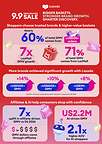
The number of brands generating at least US$1 million in GMV increased by nearly 10% compared with 6.6, alongside growth in brands reaching US$100,000 and US$500,000 milestonesUS$100+ baskets accounted for almost 60% of total GMV during the campaign, reflecting stronger demand for higher-value purchasesLazMall, affiliate-led discovery and AI-guided shopping continued to support brands across the consumer journey, from discovery to conversion

SINGAPORE, Sept. 17, 2026 /PRNewswire/ — Lazada, a leading eCommerce platform in Southeast Asia, saw more brands reach significant sales milestones during its 9.9 Mega Brands Sale, with the number of brands joining its “Million-Dollar Club” – brands generating at least US$1 million in GMV – increasing by nearly 10% compared with 6.6.

The growth of Lazada’s Million-Dollar Club highlights the platform’s growing role in helping brands move beyond campaign participation to achieve meaningful scale, as consumers across Southeast Asia increasingly make higher-value purchases through trusted brand channels and more relevant shopping journeys.

During the campaign, US$100+ orders contributed almost 60% of total GMV, Singapore led the region in higher-value shopping, with around three-quarters of GMV coming from US$100+ orders, followed by Thailand and Malaysia both at 60%. This is in line with an uplift of nearly 50% in overall platform average order value (AOV) compared with the same period last year.

Consumer confidence in trusted brand channels drives LazMall and brand growth

LazMall remains a key driver of trusted brand shopping during 9.9, reflecting continued consumer preference for official stores, authentic products and reliable shopping experiences. LazMall GMV grew by more than 7 times compared with non-campaign periods, with 1 in 2 orders (49%) coming from the trusted shopping channel across the region.  

In Singapore, 78% of orders came from LazMall, the highest among six markets, while Vietnam followed closely at 76%. LazMall also accounted for 49% of orders in the Philippines, 46% in Malaysia and 45% in Thailand.

This strong LazMall contribution reinforces the role of official brand stores in helping consumers shop with greater confidence, particularly as shoppers become more selective and intentional about where and how they spend.

At the same time, the 9.9 Mega Brands Sale helped more brands achieve significant growth milestones. Compared with 6.6 2026, the number of brands generating at least US$1M in GMV increased by 8.0%, alongside growth of brands hitting the milestone for US$100,000 and US$500,000. This reflects the strength of Lazada’s brand ecosystem and the campaign’s role in helping brands unlock higher-value growth.

Affiliates strengthen product discovery across the shopping journey

Beyond official brand channels, affiliates played a larger role in helping shoppers discover products and move from inspiration to purchase. Across Southeast Asia, affiliate GMV contribution increased more than 15% compared with 6.6, while affiliates accounted for almost 30% of total SEA GMV, equivalent to more than 1 in 4 GMV dollars coming through affiliate channels.

By deploying nearly 4 million high-commission products to fuel creator promotion, Lazada saw an uplift of more than 7 times in affiliate-driven GMV compared with non-campaign periods.

The results highlight the growing influence of creators, partners and content-led recommendations in shaping how consumers discover products, evaluate options and make purchase decisions during major campaigns.

AI-guided shopping supports more informed, higher-value purchases

Lazada’s AI-powered shopping journeys also gained traction during the campaign, as shoppers used LazzieChat to navigate product discovery and decision-making more efficiently.

During the campaign, AI-guided interactions in LazzieChat generated nearly US$2.2 million in GMV, representing a 38% uplift compared with 6.6 2026.AI-engaged shoppers also spent 2.1 times more per order on average, compared with non-AI shoppers. This suggests that AI-guided journeys are engaging shoppers with stronger purchase intent and supporting higher-value shopping decisions.

“Lazada’s 9.9 Mega Brands Sale shows that shoppers across Southeast Asia are increasingly making purchase decisions based on trust, relevance and confidence. LazMall continues to be a key destination for consumers seeking authentic products from official brand stores, while affiliates and AI-guided journeys are helping brands reach shoppers in more personalized and effective ways. For brands, this creates a stronger pathway to grow with us, from discovery and engagement to conversion,” said a Lazada spokesperson.

The campaign performance highlights the growing importance of trusted brand ecosystems in Southeast Asia’s digital commerce landscape. As shoppers move toward more intentional and higher-value purchases, Lazada continues to strengthen the channels that help brands grow: from official brand stores on LazMall to affiliate-led product discovery and AI-guided shopping journeys. Together, these touchpoints create a more trusted, relevant and efficient path for brands to engage consumers and scale across the region.

About Lazada Group 

Lazada Group is Southeast Asia’s pioneer eCommerce platform, advancing commerce through technology across Indonesia, Malaysia, the Philippines, Singapore, Thailand and Vietnam. Lazada connects shoppers to a trusted ecosystem of more than 170,000 global and local brands, sellers and partners, offering a diverse product assortment and engaging shopping experiences. Its technology, payments and homegrown logistics capabilities help make online shopping and selling more seamless, secure and accessible, supporting businesses of all sizes to grow in the region’s digital economy.

View original content to download multimedia:https://www.prnewswire.com/apac/news-releases/lazada-9-9-mega-brands-sale-fuels-brand-growth-with-more-brands-joining-lazadas-million-dollar-club-302881541.html

SOURCE Lazada Group

Continue Reading

Technology

TRAGIC CONFLICTS AND CLIMATE IMPACTS HAVE MADE THE CASE FOR THE ENERGY TRANSITION IMPOSSIBLE TO IGNORE

Published

on

By

Generation Investment Management’s 10th annual Sustainability Trends Report highlights how the energy shocks from tragic conflicts in the Middle East and Europe have strengthened the case for the clean energy transition, exposing the far-reaching economic, security and humanitarian consequences of continued reliance on fossil fuels

LONDON and SAN FRANCISCO, Sept. 17, 2026 /PRNewswire/ — Generation Investment Management, the sustainable investment manager, today published its 10th Sustainability Trends Report, an annual assessment of where the world stands in relation to a low-emissions economy and the broader sustainability transition.

Marking a decade since the report was first published, this year’s edition explores how the disruption to global energy markets following conflicts in the Middle East and Europe has exposed the economic, security and humanitarian risks of continued dependence on fossil fuels. The report explains that recent extreme weather events have provided a visible reminder of the costs of climate inaction and assesses the progress and priorities shaping the sustainability transition across the Power; Transportation; Buildings & Industry; and People, Land & Food sectors; and how Financing the Transition is progressing.

Al Gore, Chairman of Generation Investment Management, said: “There’s an old saying that the definition of insanity is repeating the same actions over and over and expecting a different result. Now that the world is in the midst of the second fossil energy crisis in four years, it has never been more clear just how insane it is for the world to perpetuate its dependence on oil, gas and coal. As high prices reward oil and gas executives with exorbitant profits, they leave consumers worldwide with skyrocketing costs on everything from fuel to food. Markets and governments are now waking up to the new reality: the clean energy transition is the best path for energy security, economic prosperity, and a safer and cleaner future. We see the energy transition not as a distant prospect, but as an urgent global imperative, driven by innovation, investment and a growing recognition that energy security, economic stability and climate action are, increasingly, one and the same.”

FOSSIL FUEL DEPENDENCE HAS BECOME AN UNTENABLE STRATEGIC LIABILITY

The energy shock that reverberated around the world after Russia’s invasion of Ukraine was not an anomaly. Four years later, the disruption to the Strait of Hormuz exposed the same structural vulnerability by bottling up a quarter of global seaborne oil trade, a third of global seaborne fertiliser trade and nearly a fifth of global trade in liquified natural gas.

The effects quickly spread far beyond energy markets. Shortages of critical materials such as helium disrupted semiconductor production and increased costs for healthcare providers reliant on MRI technology, while concerns over fertiliser supply raised risks for global food production. These vulnerabilities are compounded by the concentration of key commodity flows through a small number of exposed maritime chokepoints, creating risks that reverberate across the global economy.

Fossil fuel dependence, once seen primarily as an environmental challenge, is now increasingly understood as a question of energy security, food security, national resilience and the rising cost of living.

ENERGY SECURITY AND CLIMATE ACTION ARE NOW THE SAME IMPERATIVE

Energy security and climate action are no longer separate policy agendas. They increasingly require the same solutions. The strongest response to future crises is building economies in which fossil-fuel shocks matter less.

Fossil fuel systems remain inherently vulnerable to geopolitical shocks, trade disruption and price volatility. Renewable energy technologies, by contrast, convert an upfront investment into decades of energy production, reducing exposure to external disruptions over time.

This transition is already underway and consumers are responding. Electric-car sales in Europe rose 30 per cent in 2025. Separately, in the first quarter of 2026, Chinese exports of solar technology to Africa rose 120 per cent compared with the same period a year earlier. Heat-pump sales across 11 European countries increased by around 17 per cent over the same period, while sales of induction cookstoves in India rose tenfold. The lesson from recent years is that the best way to protect economies from fossil-fuel shocks is to reduce their dependence on fossil fuels altogether.

CHINA SITS AT THE CENTRE OF THE ENERGY TRANSITION

China is the fulcrum, simultaneously, of the fossil economy under pressure and of the renewable economy that is poised to replace it.

China remains the world’s largest consumer of fossil fuels and the largest emitter of greenhouse gases, while also being the dominant producer of solar panels, wind turbines, electric vehicles and large-scale batteries. Chinese investment helped drive the cost of solar panels down drastically over two decades, accelerating the deployment of clean technologies worldwide.

The latest fossil energy shock provides a reminder of why countries around the world are accelerating the energy transition, not only to meet climate goals but also to strengthen long-term resilience. But if they buy all the needed kit from China, will they be trading one set of dependencies for another? Unlike fossil fuels, which require continuous imports and expose economies to ongoing price shocks, technologies such as solar panels can generate electricity for decades once installed, reducing rather than perpetuating external dependence.

Nor does China’s current dominance mean permanent dependence. Europe remains a global leader in offshore wind, a sector that would not have reached scale without British and European investment. The think tank Ember estimates that, with the right policies, Europe could meet domestic demand for wind turbines, electric vehicles and heat pumps through its own manufacturing base. New capacity is also emerging across North America and India, creating a more diversified clean-energy supply chain over time.

While this capacity is emerging across Europe, North America and India, the energy transition will be faster, cheaper and more resilient if China and the West can sustain a constructive commercial relationship.

Accelerating trends across sectors and activities outlined in the report include:

Power

The power grid is emerging as the real bottleneck of the power transition. Clean sources of electricity grew fast enough in 2025 to satisfy all demand growth on the global power grid, and then some. Solar output jumped by 30 per cent in 2025, while global battery-storage capacity additions rose at least 40 per cent, showing that clean power and storage are scaling rapidly, but grid infrastructure is now lagging behind the technologies it needs to connect.

Transportation

The transition away from petrol-powered road transport has passed a critical tipping point. One in four new cars sold worldwide in 2025 had a power plug, and sales of petrol-only cars peaked in 2017 and will never recover to that level. While political opposition to electric vehicles is intensifying in some markets, many countries are determined to phase out petrol cars altogether. Furthermore, the economics and performance of the technology continue to drive adoption across both developed and emerging economies.

Buildings & Industry

Heat pumps are emerging as a breakthrough technology for decarbonising buildings and industry. Long viewed as a solution for homes and offices, heat pumps are now reaching a scale capable of replacing fossil-fuel boilers in factories, with new projects in Finland, Germany and the United States using the technology to produce industrial steam and heat. The missing ingredient in the transformation of industry is public policy. Whereas many governments are finally pushing to clean up the electric grid and to clean up cars, efforts are inadequate for cleaning up industry.

People, Land & Food

Food security remains deeply dependent on fossil-fuel supply chains and changes in weather. Synthetic nitrogen fertilisers underpinned food production for almost one in every two people worldwide, demonstrating how closely modern agriculture remains tied to fossil fuels and global trade. The Strait of Hormuz crisis has led to high prices and shortages of nitrogen fertiliser, offering a market opportunity for more environmentally benign alternatives.

Financing the Transition

Capital is increasingly backing the energy transition over fossil fuels. Global clean-energy investment reached a record $2.2 trillion in 2025, roughly double the amount invested in fossil fuels. Yet despite this acceleration, the International Energy Agency estimates that meeting the global climate goal of limiting warming to 1.5°C requires clean energy investment to reach $4.5 trillion per year by the early 2030s. While there is momentum, we are only about halfway there.

Looking Ahead

The world is becoming less stable and less predictable by the year. The heat accumulating across the Earth because of human-generated emissions continues to increase, with consequences including intense heatwaves, remarkably heavy rainfall and continued sea-level rise, all of which have been evident in recent years. At the same time, economic inequality has fed a growing public anger that, while justified in principle, has often been harnessed by populist political parties offering false solutions. Artificial intelligence is potentially the most profound disruption of the 21st century. While it is difficult to predict how disruptive the AI wave will be for society at large, AI could be a boon for the sustainability transition. On the one hand, it may help improve efficiency, eliminate waste and solve longstanding problems. On the other, AI models are already being used to extract more fossil fuels and, in the near term, AI is placing sudden and profound demands on a power grid that is not ready for them.

About Generation Investment Management

Generation Investment Management is an independent, private, owner-managed partnership headquartered in London, with a US presence in San Francisco. Since its founding in 2004, Generation has played a pioneering role in the development of sustainable investing. Its vision is a sustainable world in which prosperity is shared broadly, in a society that achieves wellbeing for all, protects nature and preserves a habitable climate. Generation pursues its vision with urgency by seeking to deliver long-term, attractive, risk-adjusted investment returns and positive impact, and by advocating for the adoption of sustainable investing across the wider market. For more information, please visit us at generationim.com

View original content:https://www.prnewswire.co.uk/news-releases/tragic-conflicts-and-climate-impacts-have-made-the-case-for-the-energy-transition-impossible-to-ignore-302880630.html

Continue Reading

Trending