Connect with us

Technology

ARTEMIS II CREW TO RECEIVE THE STEPHEN HAWKING MEDAL

Published

on

Astronauts Reid Wiseman, Victor Glover, Christina Koch and Jeremy Hansen honoured for inspiring millions through their outstanding communication of the science, technology and human adventure of Artemis II

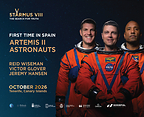
On October 17th, The Artemis II crew will receive the Stephen Hawking Medal for Science Communication at STARMUS VIII in Tenerife, recognising their exceptional work in inspiring millions around the world through interviews, social media, educational outreach and direct engagement with the public.

CANARY ISLANDS, Spain, Sept. 28, 2026 /PRNewswire/ — STARMUS today announces that the four members of the Artemis II crew — Commander Reid Wiseman, Pilot Victor Glover, Mission Specialist Christina Koch and Mission Specialist Jeremy Hansen — have been selected to receive the Stephen Hawking Medal for Science Communication.

Before, during and after Artemis II, the four astronauts became powerful ambassadors for science and space exploration. Through interviews, social media, live communications, educational initiatives and public appearances, they brought the science and technology behind an extraordinarily complex mission closer to millions of people around the world.

Their communication went far beyond explaining the technical milestones of Artemis II. They shared the human experience of science and exploration — the preparation, challenges, risks, teamwork, international cooperation and sense of discovery behind a mission that opened a new chapter in humanity’s exploration of the Moon.

In doing so, they helped audiences understand not only what Artemis II was doing, but why it mattered.

Most importantly, they inspired people — particularly younger generations — to engage with science, engineering, technology and space exploration, demonstrating the extraordinary power of communication to turn a scientific mission into a shared human experience.

The Stephen Hawking Medal for Science Communication

The Stephen Hawking Medal for Science Communication was launched in 2016 by Stephen Hawking and STARMUS to recognise those who make an exceptional contribution to bringing science, exploration and the wonder of the Universe closer to society.

The Artemis II crew joins an exceptional group of 2026 Stephen Hawking Medal recipients. This year, STARMUS has also announced legendary filmmaker Sir Ridley Scott.

The 2026 awards have particular significance as STARMUS celebrates the 10th anniversary of the Stephen Hawking Medal.

Previous recipients include some of the world’s most influential figures in science, exploration and culture, among them Buzz Aldrin, Jane Goodall, David Attenborough, Christopher Nolan, Hans Zimmer, Elon Musk, Brian Eno and Neil deGrasse Tyson.

From Apollo to Artemis

The recognition of the Artemis II crew continues a remarkable connection between STARMUS and human space exploration that began with the very first festival 15 years ago.

Over the years, nine Apollo astronauts have taken part in STARMUS, including Neil Armstrong, Buzz Aldrin, Apollo 8 astronauts Bill Anders and Jim Lovell, alongside legendary cosmonaut Alexei Leonov. They came to STARMUS not simply as pioneers of exploration, but to share their experiences, discoveries and vision directly with the public. Aldrin and Leonov returned to STARMUS several times in the years that followed.

Leonov held a particularly special place in the STARMUS family. In 1965, he became the first human being to walk in space, opening an entirely new chapter in human space exploration.

Fifteen years after STARMUS first brought together some of the pioneers of the Apollo era and the first spacewalk, the festival now welcomes the generation carrying human exploration back towards the Moon.

With Artemis II, that story enters a new generation.

A Medal that brings together science, space, art and music

The Stephen Hawking Medal itself embodies the philosophy of STARMUS.

Its design brings together some of the people and ideas at the heart of the festival: Stephen Hawking, Alexei Leonov and Brian May. It incorporates Leonov’s artistic depiction of Stephen Hawking and imagery connected with Brian May’s legendary Red Special guitar, bringing together science, human space exploration, art and music in a single object.

The presence of Leonov in the Medal’s design has a particularly powerful meaning. The man who became the first person to walk in space also used his talent as an artist to portray Stephen Hawking — and that image became part of a Medal devoted to communicating science to humanity.

The result is more than an award. It is a symbol of the idea on which STARMUS was founded: that science should not remain within laboratories, universities or spacecraft. It should be communicated, shared and made part of human culture.

That same philosophy now connects the pioneers of Apollo and Leonov’s generation with the astronauts of Artemis II.

“They brought millions of people with them”

Prof. Garik Israelian, astrophysicist and Co-Founder of STARMUS, said:

“Artemis II was an extraordinary scientific and technological mission, but this Medal recognises something different: the crew’s exceptional ability to communicate that adventure and inspire millions. They did not simply travel around the Moon — they brought millions of people with them. That is exactly the spirit of the Stephen Hawking Medal.”

Sir Brian May, astrophysicist, musician and Co-Founder of STARMUS, said, “It’s a special thrill for us at Starmus to be able to honor the intrepid Artemis II crew members in the same in the same way that we honored the Apollo astronauts who paved the way to the Moon over 50 years ago.”

Four astronauts, four voices

Each member of the Artemis II crew brought a distinctive voice to communicating the mission.

Reid Wiseman, Commander of Artemis II, communicated the mission with clarity, authenticity and a strong sense of purpose, helping audiences understand not only what the crew was doing, but why humanity continues to explore.

Victor Glover, pilot, brought a deeply human dimension to the story of Artemis II, connecting the science and technology of the mission with teamwork, trust, curiosity and courage, and communicating directly with audiences in an accessible and engaging way.

Christina Koch, mission specialist, is an engineer, scientist and astronaut, helped communicate both the scientific significance and the human experience of deep-space exploration, bringing audiences closer to the realities and possibilities of humanity’s return to the Moon.

Jeremy Hansen, mission specialist, communicated Artemis II with clarity, humility and enthusiasm, bringing an international perspective to the mission and highlighting how science and exploration can unite people and nations around common goals.

Together, the four astronauts gave Artemis II a powerful human voice and helped make one of the most complex scientific and technological endeavors of our time accessible to a global audience.

OMEGA and the Stephen Hawking Medal

OMEGA has been a long-standing collaborator of STARMUS and the Stephen Hawking Medal for Science Communication, sharing a unique connection with the history of human space exploration.

The OMEGA Speedmaster was officially qualified by NASA for crewed space missions in 1965 and went on to become inseparable from the history of lunar exploration and the Apollo programme.

As part of its collaboration with STARMUS, the company has created an inscribed special OMEGA Speedmaster referring to the Stephen Hawking Medal recognition of the crew of Artemis II. This further highlights the symbolic connection between the pioneers of the Apollo era, the legacy of Stephen Hawking and a new generation of explorers and science communicators.

For the Artemis II crew, that connection carries a particularly special meaning. The Stephen Hawking Medal and the OMEGA Speedmaster bring together two extraordinary legacies associated with humanity’s exploration of space — one celebrating the power to communicate science, and the other carrying a history intimately connected with humanity’s journeys beyond Earth.

The Medal Ceremony at STARMUS VIII

The Stephen Hawking Medal for Science Communication will be presented during the opening of STARMUS VIII — The Search for Truth on 17 October 2026 in Santa Cruz de Tenerife, Canary Islands.

The ceremony will bring together leading scientists, astronauts, Nobel laureates, artists and cultural figures from around the world, followed by a spectacular concert featuring Andrea Bocelli, Sarah Brightman and Brian May, performing with the Las Palmas Symphony Orchestra and an international house band.

The evening will also feature special guest appearances by legendary keyboardist Rick Wakeman and violinist Rusanda Panfili, bringing together science, space exploration and music in the tradition that has defined STARMUS since its creation.

STARMUS VIII will take place in Tenerife and La Palma from 17–22 October 2026 under the theme The Search for Truth, bringing together some of the world’s leading figures in science, space exploration, technology, music and the arts to explore the importance of evidence, knowledge, reason and scientific thinking in an increasingly complex world.

US: Dan DuPont, dupont0708@gmail.com, +1 202 380 7558

UK/EU: Nicole Ettinger, Nicole@ettingerpr.com, +44 7515 39407

Spain: Carlos Esteban, cesteban@IIyc.global, +34 69955 2854; Pablo Mate Sanllorente, pablo.mate@IIyc.gloabl, +34 656 53 7287

View original content to download multimedia:https://www.prnewswire.com/news-releases/artemis-ii-crew-to-receive-the-stephen-hawking-medal-302891838.html

SOURCE Starmus Foundation

Continue Reading

Technology

Multiply Launches AI Ad Spend Recovery Agent to Eliminate Hundreds of Thousands Of Dollars In Annual Google Ads Waste

Published

on

By

Multiply Launches Ad Spend Recovery Agent to Eliminate $126K in Average Annual Google Ads Waste

SAN FRANCISCO, Sept. 28, 2026 /PRNewswire/ — Multiply today announced the launch of its Ad Spend Recovery Agent, an AI agent built to help marketers identify and eliminate wasted advertising spend that is difficult to catch through manual account management or traditional rules-based automation.

Google Ads accounts typically lose 30% of their budgets to irrelevant or off-intent search traffic. An analysis of prospect data found an average of $126,000 in wasted Google Ads spend per year. The problem stems in part from the difference between the keywords advertisers bid on and the actual search terms Google matches against those keywords. Every day, accounts can generate thousands of new search terms, each requiring a judgment about whether the person searching was actually looking for what the advertiser sells.

Individually, those mismatches may cost only tens of dollars, but across an account, they quickly add up.

Multiply’s Google Ads Spend Recovery Agent analyzes actual search terms every day, understands the context of each campaign and ad group, and identifies traffic that does not match the advertiser’s intent. Marketers can then block irrelevant terms, redirect budgets, improve quality scores and address performance problems before they materially affect pipeline.

“Google Ads produces more decisions than any marketer can reasonably make by hand,” said Matt Jayson, founder and CEO of Multiply. “A marketer can look at a search term and know immediately that it has nothing to do with what they’re selling, but making that judgment across thousands of new terms every day is impossible. The Spend Recovery Agent gives every marketer an agent that can do that work continuously, learn how their specific account should operate and bring them the decisions that actually matter, while keeping them in control of what changes.”

Moving Beyond Rules-Based Advertising Automation

Traditional Google Ads automation relies heavily on predefined thresholds and performance metrics. A rule might pause a keyword after it spends a certain amount without generating a conversion, for example. That can automate an action, but it cannot determine why the keyword is underperforming.

Multiply analyzes the meaning behind the traffic itself.

The agent considers what an ad group is selling, the campaign’s objective and strategy, and what a searcher appears to be looking for. That allows it to distinguish between a bad keyword and a good keyword attracting bad traffic, rather than applying the same rule across an entire account.

The distinction matters because the appropriate response is different. A poorly performing keyword may need to be paused, while a valuable keyword attracting irrelevant searches may simply need additional negative keywords.

Multiply also adapts its analysis to different campaign strategies. Traffic that would be considered irrelevant in a tightly targeted non-brand campaign may be appropriate in a competitor or broader discovery campaign.

Turn Plain-English Instructions Into Running Automations

Multiply also introduces a new way for marketers to automate Google Ads search term management.

Instead of configuring a series of rules, filters and thresholds, marketers can tell Multiply what they want accomplished in plain English. For example, a marketer can ask the agent to review non-brand campaigns every weekday, identify keywords spending heavily on off-intent traffic, recommend which should be paused and preserve keywords that are still producing conversions.

Multiply converts those instructions into a scheduled automation that marketers can inspect and edit. Any action that can affect spend requires human approval before it is applied.

Finding Waste Beyond Search Terms

Multiply’s Spend Recovery Agent also identifies broader sources of account inefficiency that can gradually reduce performance.

The agent monitors quality scores, keyword performance, budget allocation and changes in account behavior over time. It can identify underperforming keywords whose budgets could be redirected toward stronger campaigns, flag deteriorating quality scores that may increase cost-per-click, and detect performance patterns before they translate into significant declines in leads or pipeline.

By continuously identifying off-intent traffic and other inefficiencies, the Spend Recovery Agent is designed to improve the underlying account over time. Better traffic can contribute to stronger quality scores and lower costs, while budgets previously spent on irrelevant searches can be redirected toward campaigns and keywords that generate results.

From Ad Spend to Pipeline

The Google Ads Spend Recovery Agent runs on live Google Ads and CRM data, allowing marketers to evaluate advertising performance against business outcomes rather than advertising metrics alone.

At launch, the product includes:

Live Campaigns Workspace, bringing spend, conversions, impression share, quality score and pacing into a single view using live Google Ads data.Actions Feed, which identifies wasted search terms daily and lets marketers block them as negative keywords directly from the feed.Ask Dot, an AI analyst and operator that answers questions about account performance and can propose actions including adding negative keywords, pausing keywords, adjusting budgets and bids, and editing responsive search ad copy.Pipeline Attribution, connecting campaign spend to pipeline dollars and cost per opportunity so marketers can identify campaigns that generate clicks and conversions but fail to produce sufficient revenue.

Together, these capabilities give marketers an AI system that can continuously analyze the account, identify waste, recommend improvements and execute approved actions.

About Multiply

Multiply is the first AI-native paid media agency, designed specifically to help B2B companies get discovered by their ideal customers and turn ads into a reliable pipeline engine. Early customers report outsized gains. Companies using Multiply have seen up to 700% improvements in sales meetings booked and pipeline generated from ads.

It combines proprietary AI with world-class experts in paid media who operate as an extension of a customer’s team. Multiply plugs directly into sales calls and CRM data to understand why customers actually buy. Its AI agents then translate those insights into personalized ads, launch hundreds of structured experiments to find the top-performing campaigns before doubling down and launching more experiments so ads are always improving. At present, Multiply’s services cover Google Ads, LinkedIn Ads and ChatGPT Ads, with other platforms like Meta, Reddit and Bing coming soon.

Learn more at www.gomultiply.com.

View original content:https://www.prnewswire.com/news-releases/multiply-launches-ai-ad-spend-recovery-agent-to-eliminate-hundreds-of-thousands-of-dollars-in-annual-google-ads-waste-302891915.html

SOURCE Multiply

Continue Reading

Technology

Federal Government Advances Climate Resilience at 2026 Adaptation Canada Conference

Published

on

By

TORONTO, Sept. 28, 2026 /CNW/ — From extreme heat and more intense storms to worsening wildfire seasons, droughts, and flash flooding, Canadians across the country are experiencing the impacts of climate change. That is why it is more important than ever to understand our risks and build our climate resilience.

Last week, more than 1,000 participants from across Canada gathered in Toronto for the 2026 edition of the Adaptation Canada conference. The event, funded in part by the Government of Canada and organized by ICLEI Canada, brought together academics, government officials, Indigenous leaders, decision-makers, and others on the front lines of adaptation to discuss how we can better build resilience and protect Canada from the worst impacts of climate change.

The conference featured over 70 sessions, plenaries, and specialized study tours to allow participants to explore real-life, innovative solutions. Highlights included discussions around the economic case for climate resilience initiatives; biodiversity loss and ecosystem resilience; building a climate-resilient North; and climate risk and national security. The three-day conference closed with a discussion on the work ahead to build a climate-resilient Canada.

These important exchanges will also help inform our whole-of-society approach to building climate resilience and support the ongoing implementation of Canada’s National Adaptation Strategy.

Protecting Canadians from climate change means preparing before the next flood or heat wave–not after. Taking these steps now helps keep people and communities safe, limit the costs borne by families and communities, and maintain the strength and competitiveness of the Canadian economy.

Quotes

“Climate change is already impacting Canadians’ safety and security, and it will continue to drive up costs. Through events like Adaptation Canada 2026, experts can explore actions and share solutions aimed at strengthening our climate resilience. By investing in the critical infrastructure needed to protect our communities and businesses from climate impacts, we are building a stronger, more resilient Canadian economy while raising awareness of the potential risks climate change poses to every region and sector across the country. By coming together, we can make more informed decisions, safeguard Canadians, and help ensure a sustainable future for generations to come.”

– The Honourable Julie Dabrusin, Minister of the Environment, Climate Change and Nature

“Canada’s response to extreme weather doesn’t have to be a trade-off between public safety and economic growth. Every dollar spent on protecting people, infrastructure, and ecosystems today saves up to fifteen dollars in avoided damages and recovery costs in the future. Adaptation Canada is the premier platform to bring together governments, Indigenous partners, and practitioners to infuse climate resiliency in all major decisions so that we’re serving Canadians not only today, but 100 years from now.”

– Shannon Miedema, Member of Parliament for Halifax

“Canada has the climate information, expertise, and experience needed to make real progress on adaptation. The challenge now is turning that knowledge into decisions that shape communities every day. That means bringing together the people doing the work across sectors and regions to share what is working, learn from one another, and move from evidence to action. Adaptation Canada 2026 is a chance to build those connections and accelerate the shift from understanding climate risk to implementing solutions.”

– Ewa Jackson, Managing Director, ICLEI Canada

Quick facts

Adaptation Canada 2026 ran from September 22–24, 2026, in Toronto. The conference opened with a pre-conference Gathering for Indigenous Climate Leadership on September 21, 2026.Canada’s Changing Climate Report 2026 confirms that Canada has warmed rapidly over the past 50 years, consistent with rapid global warming, and that these warming temperatures have driven wide-ranging, interconnected, and sustained changes.Insurance Bureau of Canada records show that insured losses exceeded $2.4 billion in 2025 and that 2026 is on track to be the hottest year on record.Research shows that for every $1 we invest in climate resilience measures, we save ourselves up to $15 across the economy.The Government of Canada published the first progress report for the National Adaptation Strategy in August 2026. The report highlights how whole-of-society commitments under the strategy are leading to action across the country, as well as where progress has been made and where more action is still needed. It includes contributions from all orders of government, Indigenous communities and organizations, the private sector, and civil society.

Associated links

Adaptation Canada 20262026 National Adaptation Strategy Progress ReportCanada’s Changing Climate Report 2026

Environment and Climate Change Canada’s X page

Environment and Climate Change Canada’s Facebook page

Environment and Natural Resources in Canada’s Facebook page

Environment and Climate Change Canada’s LinkedIn page

Environment and Climate Change Canada’s Instagram page

SOURCE Environment and Climate Change Canada

Continue Reading

Technology

Trintech Launches Three New AI Agents to Advance Governed Autonomous Finance

Published

on

By

New Data Access, Accruals Intelligence and Exception Management Agents expand AI execution across critical financial close processes

CHICAGO, Sept. 28, 2026 /PRNewswire/ — Trintech, the trusted AI platform for governed autonomous finance, today unveiled three new AI agents at Trintech Connect 2026, extending its portfolio of purpose-built agents designed to execute critical work across the financial close.

The Trintech Data Access Agent, Trintech Accruals Intelligence Agent and Trintech Exception Management Agent build on the agentic AI capabilities Trintech introduced earlier this year with the Trintech Flux Agent and Trintech Variance Analysis Agent, bringing governed AI execution to data preparation, accrual management and exception resolution.

Together, the five agents mark Trintech’s shift from AI that surfaces insights to AI that executes the work itself — within the same controls, approvals and audit trails finance teams already rely on.

“Finance teams do not need more AI that simply tells them what to do. They need AI that does the work — in ways they trust,” said Darren Heffernan, Chief Executive Officer at Trintech. “Today at Trintech Connect, we’re showing what that looks like in practice. These new agents extend AI deeper into the financial close, helping teams eliminate manual work, identify issues earlier and focus their time on the decisions that require human judgment.”

Trintech Data Access Agent: A Trusted Foundation for AI

The Trintech Data Access Agent connects to, retrieves, cleans, reshapes and delivers financial data from a wide range of sources, including systems that are notoriously hard to reach through traditional integrations. Instead of finance and IT teams pulling exports by hand or reconciling formats themselves, the agent builds a governed pipeline that does it for them, while giving both teams full visibility into how that data moves and changes along the way. It’s the connective tissue across the Trintech AI Platform, routing the right data to the right automation and giving every other agent something solid to stand on.

Trintech Accruals Intelligence Agent: Modernize a Critical Close Process

The Trintech Accruals Intelligence Agent takes on the most repetitive and highest risk part of the close. It reviews historical activity and prior period patterns to recommend accrual amounts, rather than repeating a fixed number from a template, and it catches true-ups and reversals before they turn into a problem.

When an estimate falls outside historical trends, it gets flagged automatically, so finance professionals spend their time and judgment where it’s actually needed instead of double-checking routine work.

The agent also tracks its own accuracy over time by preparer, account and methodology, so the estimates get sharper every period instead of staying static. Every recommendation still comes with its evidence, methodology, approvals and audit trail attached, so the process moves faster without losing any of the control finance depends on.

Trintech Exception Management Agent: Focus Finance Teams on What Matters

Exceptions don’t show up on a schedule, and the Trintech Exception Management Agent doesn’t wait for one either. It identifies, classifies and prioritizes exceptions as they surface, but it doesn’t stop at flagging them.

The agent investigates each one, names a likely root cause, attaches a confidence score to that finding, and gathers its own supporting evidence, so a person opens the case already knowing why it happened rather than just that it did.

It also groups related exceptions under a shared root cause instead of leaving a team to work through them one line at a time. That changes the job for finance teams. Instead of sorting through volume, they can go straight to resolving what matters, and every finding, every action the agent takes, and every step it holds for a person stays logged and visible the whole way through. The new agents were unveiled at Trintech Connect 2026 in Chicago, part of Trintech’s global event series bringing together customers, partners and finance leaders to explore practical applications of AI and the future of finance transformation.

Availability

Ready to see Trintech’s new agents in action?
For existing Trintech customers, contact your Account Manager.
For new Trintech customers, schedule time with one of our AI specialists.

About Trintech

Trintech is the trusted AI platform for governed autonomous finance, helping organizations modernize financial operations across the Office of the CFO. Guided by our purpose to give people time back for what matters most, our vision is to create trusted finance that runs itself.

Trintech’s AI platform automates reconciliation, transaction matching, close management, journal entry, intercompany accounting, and compliance, enabling finance teams to reduce risk, strengthen controls, and operate continuously, accurately, and with confidence.

Trusted by thousands of organizations worldwide, Trintech empowers teams to focus less on manual processes and more on strategic impact. Headquartered in Plano, Texas, Trintech supports customers across more than 100 countries through a global network of offices, partners, and strategic resellers — helping shape the future of trusted autonomous finance.

Media Contact:

Ned Tadic

Corporate Communications Manager

ned.tadic@trintech.com

View original content to download multimedia:https://www.prnewswire.com/news-releases/trintech-launches-three-new-ai-agents-to-advance-governed-autonomous-finance-302891598.html

SOURCE Trintech

Continue Reading

Trending