Connect with us

Technology

Jiangxi China-Africa Gen-Z Youth Entrepreneurship Competition Concludes Successfully

Published

on

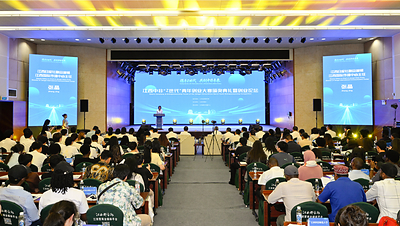
NANCHANG, China, Sept. 30, 2026 /PRNewswire/ — A report from Jiangxi International Communication Center(JXICC): On the afternoon of September 29, the Award Ceremony & Entrepreneurship Forum of the Jiangxi China-Africa Gen-Z Youth Entrepreneurship Competition took place in Nanchang, Jiangxi Province.

At the event, two outstanding projects, “The Bamboo Bridges China-Africa: Coolness Co-Creation Project” and “Jiangxi-Based Vertical AIGC Digital Collaboration Platform,” took the stage, showcasing how youth from China and Africa are using innovation to address real-world needs and sharing development opportunities through collaboration. Following the presentations, guests presented awards to the winning project teams and outstanding mentors.

During a roundtable discussion, representatives from the competition’s judging panel, Jiangxi-based enterprises engaged with Africa, Chinese youth, and university career guidance instructors shared insights under the theme “China-Africa Gen Z: Creating New Opportunities for Digital Innovation and Youth Entrepreneurship.” Drawing on their respective experience, they discussed how young people from both regions can harness digital technologies to deepen cooperation, foster innovation, and create new entrepreneurial opportunities.

The awards ceremony marked the completion of the 2026 Gen-Z China-Africa Youth Entrepreneurship Platform Series.

Looking ahead, an African youth representative Emmanuel Edward expressed hope that the competition would continue to grow and provide an even stronger platform for youth entrepreneurship between China and Africa. “I am proud to be part of this China-Africa youth journey,” Emmanuel Edward said.

The year 2026 marks the China-Africa Year of People-to-People Exchanges. In January, the Jiangxi China-Africa Youth Entrepreneurship Alliance was established in Nanchang, alongside the launch of the Jiangxi China-Africa Gen-Z Youth Entrepreneurship Competition. Since its launch, the competition has received 147 eligible entrepreneurial proposals, with 56 percent submitted by teams composed of both Chinese and African youth.

After multiple rounds of evaluation, 16 high-quality projects advanced to the final. Throughout the competition, participating teams received ongoing support. They refined and improved their business plans based on the realities of both Chinese and African markets, enhancing the feasibility and potential of their projects.

After systematic development and refinement, the selected projects advanced to the final pitch. These projects addressed practical needs in China-Africa cooperation, covering areas ranging from people’s livelihoods, such as healthcare and vocational training, to industrial sectors including modern agriculture and mining. They combined innovative thinking with strong potential for real-world application. Following intense competition, six projects won first, second, and third prizes, while 10 projects received excellence awards.

View original content to download multimedia:https://www.prnewswire.co.uk/news-releases/jiangxi-china-africa-gen-z-youth-entrepreneurship-competition-concludes-successfully-302894108.html

Continue Reading

Technology

Leads To Development Joins Clarenta Group, Strengthening Early-Stage Drug Development Expertise

Published

on

By

LONDON, Sept. 30, 2026 /PRNewswire/ — Clarenta today announced that Leads To Development (L2D) has joined Clarenta Group following a majority investment, strengthening Clarenta’s ability to support biotech and pharmaceutical sponsors from preclinical drug development strategy through first-in-human clinical trials and beyond. 

The partnership adds specialist non-clinical development, manufacturing, and regulatory strategy expertise at the critical early stages of drug development.

Based in France, L2D supports innovative biotech and pharmaceutical companies by defining development pathways, gathering and assessing preclinical evidence, initiating and trouble-shooting manufacturing, and creating regulatory strategies that help new therapies progress towards and through the clinic as efficiently as possible.

Together with Clarenta’s existing early development consulting expertise and Early Phase Unit, L2D’s capabilities strengthen the connection between early scientific strategy and first-in-human clinical research.

L2D joins Clarenta Group shortly after the launch of its new brand identity, marking another significant step in the Group’s strategy to build an integrated early development partner for biotech and pharmaceutical sponsors. They will continue to operate from their Paris HQ as a specialist team, supporting existing and new clients while being strengthened by the broader capabilities of Clarenta Group.

Leadership Commentary

“Welcoming L2D into Clarenta Group is an important step in building the company we want Clarenta to be,” said Dr. Chris Smyth, CEO of Clarenta. “Our focus is on helping clients navigate complexity from the earliest stages of development. L2D brings deep non-clinical, manufacturing and regulatory expertise that complements our existing strengths and helps sponsors connect the decisions made before the clinic with the realities of early clinical development.”

“This exciting partnership allows L2D to remain focused on the specialist non-clinical development expertise that defines us while benefitting from the huge level of clinical experience within the Clarenta Group,” said Jonathan Kearsey, Managing Director and Co-Founder of Leads To Development. “Our clients trust us to solve complex scientific and regulatory questions in the early stages of development – working alongside Clarenta enables us to connect those preclinical decisions with clinical strategies that deliver optimal, derisked and successful programmes.”

“L2D is a strong strategic fit with Clarenta and the direction in which we are building the Group,” said Christopher Backes, Co-Founder of EdgeCap Partners, the majority investor in Clarenta. “The partnership adds specialist expertise at the beginning of the development journey, where better decisions can create meaningful value for clients, while preserving the focus and expertise that have made L2D successful.”

About Clarenta

Clarenta, formerly Comac Medical Group, is a European clinical development partner helping biotech and pharmaceutical companies navigate complex clinical development with clarity, foresight and confidence. Clarenta connects early development strategy, regulatory expertise and clinical execution, from studies in its Phase I Unit to clinical delivery across Europe.

www.clarenta.com

About Leads To Development

Based in Paris, France, Leads To Development (L2D) provides specialist non-clinical development and regulatory consultancy alongside hands-on operations support. For over 15 years’, they have helped biotech and pharmaceutical companies excel in their early-stage drug development.

www.leadstodevelopment.com

marketing@clarenta.com

View original content to download multimedia:https://www.prnewswire.co.uk/news-releases/leads-to-development-joins-clarenta-group-strengthening-early-stage-drug-development-expertise-302894054.html

Continue Reading

Technology

UCLA Anderson Forecast Sees Resilient Growth Despite Inflation, Weak Labor Markets

Published

on

By

California continues to outpace the nation in economic growth, even as employment recession persists

LOS ANGELES, Sept. 30, 2026 /PRNewswire/ — The UCLA Anderson Forecast’s September 2026 outlook finds an economy that has largely weathered a series of disruptions, with economic growth remaining resilient, even as inflation and interest rates have risen and labor markets nationally and in California remain weak.

The outlook has shifted considerably over the course of the year. In March, the Forecast expected tax cuts and rapidly expanding investment in artificial intelligence to help reaccelerate the U.S. economy in 2026. Three months later, the war in Iran and resulting oil shock had replaced tariffs as the leading threat to that expansion.

The contrasting signals are particularly pronounced in California. The state’s economy grew at an annual rate of 3.7% in the first quarter of 2026, compared with 2.1% nationally, with only Washington state growing faster. Yet California’s unemployment rate stood at 5.1% in August, the highest of any state. The “employment recession” identified by the Forecast six months ago has continued, even though California has outperformed the nation in the production of goods and services.

Nationally, the Forecast expects growth to remain above 2% for the remainder of 2026 and near 2% in 2027 and 2028, supported in part by continued investment in AI infrastructure and the wealth effects associated with rising technology equity valuations. Inflation, meanwhile, is expected to move higher again this winter, keeping interest rates elevated and prompting the Federal Reserve to raise rates accordingly.

The National Economy

The September 2026 forecast describes a U.S. economy that has proved surprisingly resilient through a series of shocks. The tariff increases that dominated the outlook in late 2025 were followed by the war in Iran and a sharp increase in oil prices in the spring. Despite those disruptions, underlying economic growth has remained around or above 2%.

Credit the continued expansion of AI-related investment for much of the growth. Capital spending by large technology companies has supported nonresidential investment, while rising valuations of AI-related companies have increased household wealth and helped support consumer spending. The Forecast estimates that high-tech investment and the wealth effect associated with AI-related equities together account for nearly one percentage point of core GDP growth.

Fiscal policy has provided an additional boost. Larger income tax refunds and tariff refunds have increased disposable income, helping offset some of the drag from higher energy costs and interest rates.

The labor market, however, continues to send mixed signals. The unemployment rate fell in August to 4.1% from 4.5% in November 2025, but payroll growth has slowed substantially. Payrolls increased by 162,000 in August but averaged just 71,000 jobs per month over the previous three months, and 31,000 per month over the previous year. At the same time, immigration restrictions and demographic trends have reduced growth in the labor force.

The Forecast expects the labor market to stabilize rather than accelerate, with monthly payroll growth generally between zero and 50,000 jobs and unemployment remaining near 4.2% through the forecast horizon.

Inflation remains a more persistent concern. The disruption to world oil supplies caused by the Iran conflict, combined with attacks on Russian refining capacity, has kept energy prices elevated. Headline inflation, which declined to 3.4% in July and August after reaching 4.2% in May, is expected to move back toward 4% during the winter. Core inflation is expected to approach 2.9% in early to mid-2027 before gradually declining toward the Federal Reserve’s 2% target.

Higher inflation has also changed the outlook for interest rates. The 10-year Treasury yield has risen from below 4% in February to around 5%, reflecting inflation and fiscal risks, heavy private-sector borrowing associated with AI investment and continued expectations for economic growth. The Forecast expects long-term rates to remain elevated.

The Federal Reserve raised the federal funds rate by 25 basis points in September, to a target range of 3.75% to 4%. The Forecast expects another quarter-point increase in December, followed by no further changes through 2027, absent another adverse supply shock.

Overall, the Forecast expects GDP growth above 2% through the remainder of 2026 and around 2% in 2027 and 2028. The outlook is subject to significant risks in both directions. A sharp correction in AI-related equity valuations or financing could reduce investment and consumer spending, while another escalation in the Middle East could push oil prices sharply higher. Conversely, a resolution of the conflict and faster diffusion of AI-driven productivity gains could produce stronger growth with less inflation.

The California Economy

California continues to present an unusual combination of superior economic growth and inferior employment performance.

In June, the Forecast estimated that California’s economy had grown 2.9% in the first quarter of 2026. The actual growth rate was substantially higher: 3.7%, compared with 2.1% nationally. Over the year ending in the first quarter, California GDP grew 3.3%, compared with 2.7% for the nation. Adjusting for population migration leaves California’s growth rate unchanged and widens its advantage over other fast-growing large states whose economies benefited from population gains.

Much of that growth reflects California’s concentration in technology and other high-productivity industries. Six of the 10 largest venture capital investments in the Americas during the first quarter were in the San Francisco Bay Area, representing more than 95% of the value of the top 10 investments. In the second quarter, 82% of all venture capital investment went to California. Aerospace is also benefiting from increased commercial aircraft production, defense purchases, space exploration and satellite production.

But that strength has not translated into broad employment gains. California’s unemployment rate has remained above 5% for 31 months and stood at 5.1% in August, one percentage point above the national rate. Payroll employment increased by 138,500 jobs over the 12 months ending in August, while a separate household survey showed 246,700 fewer Californians employed and a decline of 351,100 in the state labor force over the same period.

The two measures capture different aspects of employment, but both point to continued weakness in labor demand. Job growth so far in 2026 has been concentrated primarily in health care and social services, education and retail — sectors that the Forecast does not expect to provide the same support going forward. Government budget constraints, reductions in federal support for health care and continued deportations are expected to limit hiring in several of those areas.

A stronger California labor market will therefore depend increasingly on technology, aerospace and other durable goods manufacturing. Aerospace is already benefiting from increased production and government and private-sector demand. Tech employment continues to decline, although at a moderating pace. The Forecast assumes AI-related hiring and the end of contraction elsewhere in the technology sector will produce employment growth beginning in 2027 and accelerating in 2028.

Housing remains another constraint. New-home construction has changed little since June, with the annual pace of permits around 110,000 units, well below the level needed to address the state’s housing shortage. Elevated mortgage rates, tariffs on imported building materials and the loss of construction workers through deportations are expected to continue limiting new construction.

Overall, the September 2026 California outlook is slightly weaker than the June forecast, largely because of continued disruption in energy markets. Recovery is expected to begin in early 2027, followed by stronger growth later in 2027 and in 2028.

The Forecast expects California’s unemployment rate to average 5.2% in 2026, 4.9% in 2027 and 4.4% in 2028. Total employment is forecast to decline 0.2% in 2026 before growing 0.6% in 2027 and 1.8% in 2028, while nonfarm payroll employment is expected to grow 0.9%, 1.2% and 2.2%, respectively. Real personal income is forecast to increase 1.0% in 2026, 2.4% in 2027 and 2.6% in 2028. The Forecast expects 116,000 residential permits this year, rising to 118,000 by the end of 2028.

Separating AI Investment from AI’s Economic Impact

In a new essay, senior economist Clement Bohr examines the distinction between the already substantial economic effects of investment in artificial intelligence and the effects of the technology itself. AI-related infrastructure spending and rising technology equity valuations are already contributing significantly to economic growth, Bohr writes, but evidence that AI itself is responsible for broad changes in employment or productivity remains inconclusive. He argues that it is too early to know how transformative AI will be, ultimately, and notes that previous general-purpose technologies took years to produce measurable economy-wide productivity gains.

UCLA Anderson Forecast’s fall 2026 economic outlook conference, Energy in the Age of AI and War, is organized in collaboration with the Center for Impact and takes place on September 30, 2026.

About UCLA Anderson Forecast

UCLA Anderson Forecast is one of the nation’s most widely watched economic outlooks and was unique in predicting both the seriousness of the early-1990s California downturn and the strength of the state’s rebound. The Forecast was credited as the first major U.S. economic forecasting group to call the recession of 2001 and was among the first to declare the COVID-19 recession in March 2020.

uclaforecast.com

About UCLA Anderson School of Management

UCLA Anderson School of Management is a world-renowned learning and research institution. As part of the nation’s No. 1 public university, its mission is to advance management thinking and prepare transformative leaders to make positive business and societal impact. Located in Los Angeles, one of the nation’s most diverse and dynamic cities and the creative capital of the world, UCLA Anderson places more MBAs on the West Coast than any other business school, and its graduates also bring an innovative and inclusive West Coast sensibility to leading organizations across the U.S. and the world. Each year, UCLA Anderson’s MBA, Fully Employed MBA, Executive MBA, UCLA-NUS Executive MBA, Master of Financial Engineering, Master of Science in Business Analytics and doctoral programs educate more than 2,000 students, while the Executive Education program trains an additional 1,800 professionals. This next generation of transformative leaders will help shape the future of both business and society.

anderson.ucla.edu

Follow Us

@uclaanderson

View original content to download multimedia:https://www.prnewswire.com/news-releases/ucla-anderson-forecast-sees-resilient-growth-despite-inflation-weak-labor-markets-302893583.html

SOURCE UCLA Anderson Forecast

Continue Reading

Technology

Everpure Announces New Data Management Capabilities for Production AI at Scale

Published

on

By

Platform innovations give enterprises governed access to their data and predictable AI costs as they move AI from pilot to production.

LONDON, Sept. 30, 2026 /PRNewswire/ — Everpure (NYSE: P), the company revolutionizing storage and data management, today announced new platform capabilities designed to simplify enterprise data management, advancing its Data Primacy vision. Introduced at Pure//Accelerate in June, Data Primacy is the principle that data—not applications—must be the core driver of enterprise architecture in the AI era. Today’s updates continue to advance the modern data management capabilities required to solve bottlenecks stalling enterprise AI at scale: fragmented context, unpredictable inference costs, and slow, complex deployments.

“Enterprise AI is hitting a wall not because the models are lacking, but because data is not ready for real-time, autonomous agents,” said Prakash Darji, General Manager, Data & Digital Experience at Everpure. “We are eliminating that friction. By making enterprise data continuously governed, automated, and instantly accessible, we’re giving organizations the foundation to move AI out of the lab and into production with the necessary confidence.”

Making Enterprise Data Management Simple and Secure

Enterprises deploying AI agents often struggle to give them reliable, governed access to data across the business, limiting how much those agents can actually achieve. Everpure Data Intelligence solves this by discovering, classifying, and contextualizing enterprise information at its source—spanning the Everpure Platform, public clouds, SaaS applications, and third-party storage. Building on this, new capabilities give autonomous agents and administrators direct, secure access to live enterprise context without custom API work:

Native MCP Integration: Implements the open Model Context Protocol (MCP) so AI agents and security tools can query live data catalogs using natural language. Agents can now find relevant data and understand its sensitivity class as an input to AI, Agent Workflows, and Analytics.Turn-Key Deployment: Streamlines deployment without complicated professional services engagements through the existing Pure1 console and accelerates time-to-value without the operational overhead of setting up separate management servers.Privacy-First File Intelligence: Shows who can access each file share and how stale it is, without ever reading file content, so teams can fix exposure and reclaim capacity before opening shares to AI agents.

Delivering AI Performance, Next-Gen Efficiency, & Cost Predictability

In order to support growing workloads from archive to AI, Everpure is expanding the bounds of performance and capacity efficiency in a non-disruptive way. The new capabilities bring high-performance AI execution directly to data at the source and deliver production speed without ever moving data from its system of record:

Accelerated LLM Inference via PureKVA (Key-Value Accelerator): Everpure FlashBlade now pre-stages context directly into GPU memory to deliver up to 20x faster Time to First Token (TTFT). Supports enterprise multi-tenancy with zero dataset relocation, eliminating GPU idle time, increasing token throughput, and decreasing response lag for real-time apps.Always-On DeepReduce Data Compression: Scans storage blocks continuously across FlashBlade systems to find sub-block data similarities that traditional deduplication misses, even on pre-compressed content. Usable storage capacity expands automatically without impacting write performance or requiring manual scheduling, significantly reducing hardware footprint and cross-cloud expenses.Intelligent Token Optimization Reference Architecture: Given the need for enterprises to own their own data and optimize AI spend, Everpure now delivers a reference architecture using open weight models. This allows more control over data and predictable AI costs, cutting overall API token usage from external providers.

Individually, these capabilities close specific gaps in simplicity, security, performance, and cost. Together, they give enterprises a single, continuously updated foundation for managing their data and running AI in production, built to keep pace as agentic workflows scale. Because these capabilities classify what data is sensitive and who touches it, they also strengthen cyber resilience, since the same context that makes data safe for AI to use is what determines how it gets protected and what gets recovered first. The new capabilities announced today will be available this October.

Additional Resources

Executive Perspective: From Data Processing to Data Primacy: The Agentic Inversion of Work and IT ArchitecturePress Release: Everpure Unveils Data-Primacy Architecture for the AI Era (June 2026)Blog: Your AI Strategy Is Stuck Behind Your Application-Centric Architecture

About Everpure

Everpure (NYSE: P) allows organizations to take control of their data with an industry-leading, ever-evolving storage and data management platform. We help companies unleash the power of their data by ensuring it is accessible, intelligent, and ready to perform in the AI era. We make data management effortless while simultaneously scaling performance and significantly reducing energy consumption. With one of the highest Net Promoter Scores for over a decade, Everpure is the choice of the world’s most innovative organizations. For more information, visit www.everpuredata.com.

This press release contains forward-looking statements regarding Everpure’s business and product roadmap. The timing, development, and release of any Everpure product, feature, or functionality described remain at Everpure’s sole discretion. The material provided is for informational purposes only and is not a commitment, promise, or legal obligation to deliver any material, code, or functionality. It should not be relied upon in making purchasing decisions, nor incorporated into any contract. Discussed performance metrics are informational and not a promise of performance; results may differ materially from those provided herein based on variances in deployed environmental and dataset conditions.


View original content to download multimedia:https://www.prnewswire.com/news-releases/everpure-announces-new-data-management-capabilities-for-production-ai-at-scale-302893569.html

SOURCE Everpure

Continue Reading

Trending