Connect with us

Technology

NEW RESEARCH WARNS COMPANIES MAY BE “BORROWING FROM TOMORROW” AS THEY REDESIGN WORK

Published

on

As companies race to adopt AI and redesign work, new research identifies a growing risk: organizations may be transforming faster than they can see what those changes are doing to talent, capability, and future value.

NEW YORK, Sept. 30, 2026 /PRNewswire/ — As companies race to adopt AI, redesign jobs, flatten organizations, and rethink how work gets done, new research from the Coqual Global Lab, part of the Center for Talent Innovation (CTI) warns that gains made today could come at the expense of the human capabilities businesses will need tomorrow.

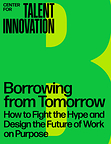
Released today, Borrowing from Tomorrow: How to Fight the Hype and Design the Future of Work on Purpose asks a fundamental question: Are companies designing the organizations they want to become—or allowing that future to emerge by default?

The research reveals significant gaps in leaders’ field of view. Only 2 in 5 executives surveyed report an expert understanding of their organization’s strategic priorities for the coming year, while only 35% strongly understand their organizations’ workforce priorities and 30% strongly understand their customer base.

At the same time, critical perspectives are often missing from decisions shaping the future of work. Nearly half (49%) of decision-makers surveyed say a broad range of human perspectives, experiences, and needs are never, rarely, or only sometimes intentionally considered in AI governance. The same is true for 47% in workflow redesign and 44% in workforce restructuring.

“Organizations are making thousands of choices right now about what to automate, which roles to redesign, what people should continue to do, and what capabilities they will need,” said Emily Gawlak, lead researcher and Executive Director of CTI’s Global Lab. “Those choices aren’t just changing how work gets done. Together, they’re building the organization that comes next. Leaders have an opportunity to make sure they’re building it on purpose.”

Borrowing from Tomorrow introduces the Human Talent Deficit: the gap between the human capabilities and contributions an organization will need to create future value and what its operating model enables people to develop, sustain, and contribute.

AI can make that risk harder to see and easier to scale. An entry-level task eliminated for efficiency may also have been where someone developed judgment. A management layer removed for speed may have carried relationships and institutional knowledge. A decision automated for consistency may also have been where people learned to recognize exceptions.

As the report puts it: “An entry-level task may be inefficient. It may also be how expertise develops.”

The future of work is also a future of access. As organizations redesign jobs and workflows, they are reshaping who gets to learn, contribute, advance, and lead—and the experiences through which people build expertise, gain visibility, form critical relationships, and prepare for leadership.

The question is not whether organizations should change. It is whether leaders understand what today’s ways of working produce before replacing them and whether they are deliberately creating what people and businesses will need next.

Rather than prescribing a single vision for the future workplace, Borrowing from Tomorrow introduces four Design Bridges to help leaders make better decisions under uncertainty:

Strategic Coherence — Get clear about the value the organization is trying to create and over what time horizon.Distributed Accountability — Keep authority and accountability connected as decisions spread across functions, vendors, leaders, and technology.Organizational Depth Perception — Bring operational expertise and human experience into the same consequential decisions.Applied Insight — Learn from what the organization builds while there is still time to adjust.

Together, the Design Bridges help organizations move from transformation by default toward Sustainable Transformation: creating value today while preserving and renewing the conditions required to keep creating value tomorrow.

The release of Borrowing from Tomorrow also marks Coqual’s return to its founding name, the Center for Talent Innovation.

For more than two decades, CTI has studied the dynamics organizations often miss about talent: how opportunity moves, how systems shape careers, how people experience work differently, and what allows organizations to make better use of the talent they have. Today, those questions sit inside some of the biggest decisions companies are making about AI, work design, skills, performance, development, and advancement.

“As companies change how work gets done, they are also changing how people learn, perform, lead, and advance,” said Jennie Glazer, CEO of the Center for Talent Innovation. “Our role is to help leaders see what those changes are setting in motion, especially what they may be missing. We bring research, employee experience, and the perspective of leaders across industries together so companies can make better choices while those choices are still theirs to make. That is talent innovation.”

CTI brings business, talent, and people leaders together through original research, trusted peer communities, and practical guidance to help organizations make better choices for their people and their business.

The future of work cannot be predicted. But it can be designed on purpose.

METHODOLOGY: Borrowing from Tomorrow draws on a survey of 173 organizational decision-makers, 44 semi-structured interviews with organizational leaders, practitioners, consultants, and subject-matter experts, executive convenings and a design lab, multidisciplinary scholarship, and more than two decades of CTI research into talent, leadership, workplace culture, relationships, and organizational systems.

About the Organization: The Center for Talent Innovation (CTI), formerly Coqual, is an independent nonprofit research organization and community of practice. As companies change how work gets done, CTI helps them change how people learn, perform, and move up. CTI combines original research, employee insight, trusted peer communities, and practical guidance to help leaders make better choices for their people and their business. For more information, visit https://www.talentinnovation.org

View original content to download multimedia:https://www.prnewswire.com/news-releases/new-research-warns-companies-may-be-borrowing-from-tomorrow-as-they-redesign-work-302894545.html

SOURCE Center for Talent Innovation

Continue Reading

Technology

NGEN Mission Critical Launches Single-Accountability Service Model, Helping Data Center Developers Unlock Manufacturing Capacity for Power and Cooling Equipment

Published

on

By

LITTLETON, Colo., Sept. 30, 2026 /PRNewswire/ — NGEN Mission Critical today launched its single-accountability service model, designed to help data center developers unlock manufacturing capacity for mission-critical power and cooling equipment. This model supports access to qualified global and U.S. OEM manufacturing, backed by U.S.-based engineering and full lifecycle accountability. NGEN’s service model provides supply chain transparency and scale, helping customers reduce lead times despite supply constraints. In addition, NGEN and Arizona-based manufacturer Air2O today announced a strategic partnership to deliver high-performance custom thermal management solutions.

AI infrastructure buildouts are straining supply chains, with limited equipment availability delaying data center development. Large power transformers can now carry lead times of up to four years, reinforcing the need for additional qualified supply channels and stronger coordination across procurement, certification and delivery. Many global manufacturers produce high-quality equipment but have a limited U.S. market presence due to complicated international trade requirements. Securing sufficient capacity can require developers to source across multiple manufacturers, introducing disparate equipment configurations and documentation packages that create additional complexity.

Instead of coordinating across several OEMs, NGEN acts as a single accountable partner, responsible for engineering oversight, documentation and certification, logistics and delivery support, equipment staging, field service, spare parts management and warranty coordination. This approach enables developers to access global manufacturing capacity that might otherwise be unavailable due to challenging engineering and documentation coordination, and lack of logistics and field support. NGEN’s U.S.-based engineering team also works with global and domestic OEM partners to fulfill the documentation requirements needed to meet customer specifications and applicable U.S. standards.

“This is a partnership we’re genuinely excited about. NGEN brings exactly the kind of engineering depth and project delivery capability that lets us focus on what we do best -and combining that with Air2O’s manufacturing expertise and 15 years of experience delivering high-performance, energy-efficient, and environmentally responsible thermal management systems means we can move faster and deliver better outcomes for mission-critical projects,” said Mike Sullivan, CEO of Air2O. “Customers get real, hands-on coordination across engineering, delivery and long-term support, backed by manufacturing purpose-built for environments where failure isn’t an option.”

Under the agreement, NGEN leads project delivery, solutions engineering and U.S. code-compliant documentation, with installation, commissioning and maintenance support delivered jointly. Air2O provides engineering support, technician training and certification, on-site repair support and long-term spare-parts availability.

NGEN Mission Critical was founded by infrastructure engineers and developers with deep experience in building mission-critical facilities and managing global manufacturing ecosystems. The founders recognized a gap between accelerating U.S. infrastructure demand and the constrained equipment supply, extended lead times and fragmented procurement models limiting data center development.

By combining U.S.-based infrastructure engineering and development expertise with established manufacturing capabilities across Asia and the U.S., NGEN helps customers access additional equipment capacity through a more transparent, accountable and coordinated supply chain.

“With today’s supply constraints, the industry needs a better way to tap into resilient supply channels and keep projects on schedule,” said Jean Esquier, CEO and Co-Founder of NGEN Mission Critical. “Our service model helps data center developers achieve those goals. Built on transparency, accountability and scale, we remove those traditional barriers, providing our customers with access to qualified manufacturing capacity through a single partner.”

Learn more about NGEN Mission Critical’s single-accountability service model.

About NGEN Mission Critical

NGEN Mission Critical is a U.S.-based provider of critical power and cooling infrastructure, serving data centers, AI factories and utility-scale power generation. NGEN reduces lead times by pairing global and domestic manufacturing scalability with a fully integrated American engineering and service platform. In a market defined by equipment scarcity, extended procurement cycles and heightened regulatory scrutiny, NGEN delivers deployment certainty through disciplined regulatory compliance, coordinated sourcing and lifecycle accountability. From engineering validation through commissioning and ongoing operational support, NGEN ensures compliance, documentation integrity and performance continuity in mission-critical environments.

Media Contact 

Jeannette Bitz, Engage PR 

+1 510 295 4972

jbitz@engagepr.com

View original content to download multimedia:https://www.prnewswire.com/news-releases/ngen-mission-critical-launches-single-accountability-service-model-helping-data-center-developers-unlock-manufacturing-capacity-for-power-and-cooling-equipment-302893497.html

SOURCE NGEN Mission Critical

Continue Reading

Technology

Bay Area’s Valley Humane Society Helps Turn Local Experience into First-in-the-Nation California Law

Published

on

By

Governor signs SB 1288, closing a gap in the transfer of beneficiary-designated securities and extending protections to individual beneficiaries. A two-and-a-half-year struggle by Pleasanton-based Valley Humane Society to receive their share of a donor’s IRA designations has resulted in a California law designed to help ensure all beneficiaries are notified of securities left to them, the first of its kind in the nation.

Bay Area’s Valley Humane Society Helps Turn Local Experience into First-in-the-Nation California Law

Governor signs SB 1288, closing a gap in the transfer of beneficiary-designated securities and extending protections to individual beneficiaries

PLESANTON, Calif., Sept. 30, 2026 /PRNewswire-PRWeb/ — A two-and-a-half-year struggle by Pleasanton-based Valley Humane Society to receive their share of a donor’s IRA designations has resulted in a California law designed to help ensure all beneficiaries are notified of securities left to them, the first of its kind in the nation.

“Most people who name a beneficiary reasonably believe the financial institution will contact that person when they die. “But we discovered that wasn’t necessarily happening.” —Melanie Sadek, President & CEO of Valley Humane Society

Governor Gavin Newsom signed Senate Bill 1288, the Legacy Act, authored by Senator John Laird (D-Santa Cruz) and co-sponsored by Valley Humane Society, San Diego Humane Society and CalNonprofits.

The new law addresses a gap in California’s system for securities registered for nonprobate transfer, which allows an account owner to designate beneficiaries to receive assets directly after death without probate or estate administration. While a financial institution may have both knowledge of an account holder’s death and the names of designated beneficiaries, existing law does not require the institution to notify those beneficiaries. At the same time, trustees, attorneys and family members attempting to settle the person’s affairs might encounter privacy restrictions that prevent the institution from disclosing beneficiary information to them.

“Most people who name a beneficiary reasonably believe the financial institution will contact that person when they die,” said Melanie Sadek, President and CEO of Valley Humane Society. “But we discovered that wasn’t necessarily happening. The institution could have the beneficiary’s name in its records while the beneficiary had no idea the asset even existed. That undermines the very reason people use beneficiary designations in the first place.”

Valley Humane discovered the issue after being named as one of nine nonprofit beneficiaries of a donor’s IRA. The organization knew about the gift only because the donor’s sister found paperwork identifying the account and contacted the beneficiaries. Even with that information, administrative requirements delayed distribution of the gift for approximately two and a half years.

The experience raised a larger question: What happens when no one finds the paperwork?

Nonprobate transfers are intended to provide a direct path for assets to reach designated beneficiaries without probate administration. But if a beneficiary does not know an asset exists, the institution does not notify them, and those handling the deceased person’s affairs cannot obtain the beneficiary information, that intended path can break down.

Over time, dormant financial property can ultimately be transferred to California’s Unclaimed Property Program, creating an entirely different process for recovering assets that the owner had already designated to specific beneficiaries.

“The troubling part for us was realizing how easily someone’s wishes could be lost in that gap,” Sadek said. “People carefully complete beneficiary designations because they want their assets to go to specific people or organizations. A system designed to avoid probate should have a reliable way to connect those assets with the beneficiaries already named on the account.”

SB 1288 places responsibility for notification with the registering entity that already possesses the beneficiary information. Once a registering entity receives information establishing knowledge of an owner’s death, it must initiate its beneficiary notification process and, within 60 days, make a reasonable and good-faith effort to notify each named beneficiary. The initial notification does not disclose account balances, transaction history or other private financial information.

The law also addresses barriers beneficiaries may encounter when attempting to receive designated assets. Among its provisions:

Registering entities must make a reasonable and good-faith effort to notify each named beneficiary within 60 days after receiving information establishing knowledge of the owner’s death.Nonprofits can establish their legal identity using organizational information without requiring employees or board members to provide extensive personal information.Beneficiaries cannot be required to open an account or become customers of the financial institution simply to receive assets designated to them.Multiple beneficiaries cannot be required to coordinate their claims or submit them simultaneously.Once all required documentation has been provided, a beneficiary must receive the designated share within 60 days, subject to specific legal, regulatory and asset-related exceptions.

The legislation does not change an account owner’s beneficiary designation or determine who is entitled to an asset. It establishes a process intended to help ensure that the designation already on file is carried out.

Other states have adopted versions of legislation commonly known as the Release IRA Funds Timely (RIFT) Act, focused on barriers charitable organizations encounter when collecting beneficiary-designated assets. California’s approach goes further. SB 1288 is the first such measure in the nation to extend these protections beyond charitable organizations to individual beneficiaries.

Beginning January 1, 2027, the provisions apply to qualifying nonprofit and charitable beneficiaries when the death of the final owner occurs on or after that date. Beginning January 1, 2028, the protections extend to other beneficiaries, including individuals, when the death of the final owner occurs on or after that date.

Valley Humane worked with San Diego Humane Society, which had experienced similar barriers, and CalNonprofits to pursue the legislative solution. The three organizations co-sponsored SB 1288, with Senator Laird authoring and carrying the legislation.

Throughout the legislative process, the co-sponsors worked with Senator Laird and his staff, legislators, financial institutions and other stakeholders through multiple rounds of amendments. The final legislation addressed notification, documentation, distribution timelines, legal exceptions and implementation. Financial-industry organizations that initially opposed the legislation ultimately moved to neutral.

“Senator Laird and his staff took a problem we were experiencing in the real world and helped turn it into workable legislation,” Sadek said. “San Diego Humane Society and CalNonprofits brought their experience and expertise, and the financial industry worked with us to address legitimate implementation concerns. We are incredibly proud that an experience here in Pleasanton helped create a first-in-the-nation solution for nonprofits, families and individual beneficiaries throughout California.”

MEDIA MATERIALS

Interviewees:

Melanie Sadek, CAWA, is President and CEO of Valley Humane Society and chair of the Legislative & Advocacy Committee for the California Animal Welfare Association. Valley Humane co-sponsored SB 1288 after experiencing delays in receiving an estate gift left by a donor. Sadek can explain how such delays affect nonprofits and their ability to carry out a donor’s wishes. Her work with animal welfare organizations across California also gives her a broader perspective on why clear standards for distributing charitable gifts matter.

Johni Hays, J.D., FCEP, is Executive Vice President of Thompson & Associates and a nationally recognized expert in charitable estate planning and planned giving. She has extensive experience helping donors, families, and nonprofit organizations navigate estate plans and the transfer of inherited retirement assets. Hays helped advance Iowa’s Release IRA Funds Timely (RIFT) law; the nation’s first state law focused on the timely release of IRA funds left to charitable beneficiaries. Her expertise provides important national context for the problems SB 1288 addresses and the growing effort to ensure that financial institutions honor account holders’ beneficiary designations.

Robert Moore became the executor and successor trustee of his mother’s estate after her death. Her assets included IRA and traditional brokerage accounts held at multiple financial institutions and divided among several beneficiaries, including charities. Although legally responsible for administering the estate, Moore could not obtain information confirming whether the institutions had distributed the funds as directed. More than two years after his mother’s death, money remained in her accounts. His experience provides an important consumer perspective on the notification and distribution problems SB 1288 was created to address.

Interview clips featuring Melanie Sadek, Johni Hay, J.D, FCEP, and Robert Moore for media use here.

Video credit: Valley Humane Society

ABOUT VALLEY HUMANE

Envisioning a world in which every animal is loved and every person knows the love of an animal, Valley Humane Society creates a brighter future for cats and dogs by encouraging and strengthening the bond between people and pets. Valley Humane rescues and rehabilitates companion animals, champions responsible caretaking, shares pets’ soothing affections with people in need of comfort, and supports and preserves existing pet-guardian relationships. Whether you’d like to adopt an animal, share your passion for pets, or meet like-minded people, Valley Humane Society is Your Means to a Friend™.

Media Contact

Melanie Sadek, Valley Humane Society, 1 925-462-8041, msadek@valleyhumane.org, https://valleyhumane.org 

View original content to download multimedia:https://www.prweb.com/releases/bay-areas-valley-humane-society-helps-turn-local-experience-into-first-in-the-nation-california-law-302894027.html

SOURCE Valley Humane Society

Continue Reading

Technology

Britive Launches Frictionless PAM Transformation Program to Modernize Privileged Access for the Autonomous Era

Published

on

By

Britive’s new Frictionless PAM Transformation Program helps enterprises move from fragmented, traditional Privileged Access Management (PAM) environments to a modern authorization model built for AI agents, non-human identities, and cloud-speed operations. 

LOS ANGELES, Sept. 30, 2026 /PRNewswire/ — Britive today announced the Frictionless PAM Transformation Program, a new initiative designed to help enterprises modernize privileged access from fragmented, static, credential-centric approaches to a dynamic runtime authorization model built for the autonomous era, where AI agents act alongside human and non-human identities at machine speed. 

Traditional PAM architectures were designed to protect administrator accounts, manage persistent credentials, and control access to relatively static infrastructure. But the environment has changed: cloud infrastructure is dynamic, SaaS has proliferated, machine identities continue to multiply, and AI agents have emerged as a new digital workforce, taking action autonomously and often with privileged access. The traditional question, “What access should we give this identity?” is no longer sufficient. The more important question: “Should this specific action be allowed right now?” 

Across our customer base, we consistently see privileged access environments that have become fragmented, with traditional infrastructure governed one way, cloud another, and non-human identities through entirely separate controls,” said Mohit Vaish, CEO, CyberSolve. “Organizations recognize that static models designed decades ago weren’t built for the cloud, automation, and AI use cases now in front of them. And the traditional answer has been to bolt another module onto the same architecture, which adds tools without changing the model and deepens the fragmentation it was meant to solve. The challenge isn’t seeing the problem. It’s knowing how to get their arms around it.” 

That is the runtime question every organization now faces: should this specific action be allowed right now? Answering it requires dynamic, contextual authorization rather than standing privilege. It is what the Britive platform delivers for every identity, and what Britive ARC™ (Agentic Runtime Control), launched last month, extends to the AI workforce. Rather than adding another tool, Britive ARC™ brings agents onto the same platform, under the same policies, authorization engine, and audit trail, so securing the newest identity type does not create the next silo. The Frictionless PAM Transformation Program gives enterprises a practical path from yesterday’s siloed PAM architecture to a single unified architecture capable of governing autonomous agents, non-human identities, and human identities across cloud, SaaS, and traditional infrastructure. 

“Privileged access is going through a fundamental shift,” said Garrett Long, VP of Business Development and Channel, Britive. “As AI agents become part of the workforce, enterprises can no longer think only in terms of what access an identity should have. They increasingly need to determine, in real time, whether a specific action should be allowed. This program helps organizations understand where they are today and chart the path toward the authorization model they will need for the future.” 

A Practical Roadmap for Transformation 

At the center of the program is a PAM Modernization Readiness Review, which establishes a clear view of the current environment and builds a prioritized path forward. The review covers: 

Current PAM architecture and operating model 

Privileged identity inventory across AI agents, non-human identities, and humans 

Standing privilege exposure 

Cloud, SaaS, automation, and machine identity access patterns, including readiness for agentic runtime control 

Continuous authorization readiness, including Shared Signals Framework (CAEP/RISC) adoption 

Gaps between current controls and cloud, Zero Trust, and AI initiatives 

Total cost of ownership and cost-rationalization opportunities 

The outcome is a PAM Modernization Roadmap and Executive Business Case deliverable aligned to the organization’s security, operational, and financial priorities, established before any product decision. 

“Traditional privileged access was built on giving people accounts, granting them privileges, and then trying to manage those privileges. That worked when environments were slower and there were few people. Now identities have exploded, and the blast radius of any standing account is bigger than it has ever been. If we get the identity model right for humans and non-humans, the same model extends to AI agents. If we don’t, we end up bolting AI access onto an architecture that’s already showing its age,” said Sameer Patwardhan, former SVP of Technology at Forbes, where he led the company’s move to Britive. 

Delivered With Leading Advisory Partners 

Privileged access transformation is a security and business transformation, not a technology replacement. Britive delivers it with leading cybersecurity advisory partners, who use the Britive platform to discover and classify existing privileged access exposure across cloud and on-premises environments and to build the transformation roadmap. As projects move into implementation, Britive provides the platform capabilities for ephemeral access, runtime authorization, and Zero Standing Privilege, including Britive ARC™ to extend the same model to AI agents. Authorization remains continuous after access is granted: inbound Shared Signals Framework events can revoke an agent’s active access mid-task, and every agent tool call is recorded with the prompt, tool, arguments, and, where supplied, the agent’s stated intent. 

“Enterprises understand that privileged access has to evolve. What they struggle with is how to make the leap from years of existing investments and siloed solutions to a more modern unified approach,” said David (DJ) Morimanno, Field CTO, Xalient. “That’s where they rely on partners to assess where privilege and exposure exist today, and to guide them along a pragmatic roadmap toward dynamic authorization built for an increasingly autonomous world.” 

Addressing the Commercial Side of Modernization 

Commercial complexity can also stall modernization. Many organizations maintain multiple overlapping access tools, each with its own licensing and operational burden. As part of the program, Britive and its partners advise on the commercial aspects of consolidation, including incentives that remove cost duplication during the transition, so decisions can be driven by security and business priorities rather than contract timing. 

Getting Started 
To request more information, schedule a demo, or connect with an advisory partner about the program, visit https://www.britive.com/resource/events/modernization-readiness-review 

About Britive
Britive is the runtime authorization platform for privileged access across every identity that runs the modern enterprise: AI agents, non-human identities, and people. Instead of managing standing privileged accounts and long-lived credentials, Britive creates privileged access at the moment an authorized action requires it and removes it when the work is done, across cloud, SaaS, databases, servers, and on-premises systems that still depend on traditional credentials. One access model and one audit trail govern every identity in one platform, with no endpoint software to deploy.

Britive ARC™ (Agentic Runtime Control) brings that model to every action an AI agent takes. Each tool call is authorized as it happens, privilege is created for that action without handing the agent a credential, and disallowed commands are blocked before they reach the resource. When the task ends, the access is gone, so nothing is left standing between tasks. Learn more at britive.com

Media Contact
Miad Moussawi
miad.moussawi@britive.com

View original content to download multimedia:https://www.prnewswire.com/news-releases/britive-launches-frictionless-pam-transformation-program-to-modernize-privileged-access-for-the-autonomous-era-302893915.html

SOURCE Britive

Continue Reading

Trending