Technology
AIPOCH Launches Open-Science, Making Research Easier to Follow, Learn From, and Share with .science Packages
Published
2 days agoon
By
An open-source AI research workbench with 23 built-in Skills, 525 marketplace Skills, 36 research connectors, and four agent frameworks—Claude Code, OpenCode, Codex, and CodeBuddy.
SINGAPORE, Oct. 14, 2026 /PRNewswire/ — AIPOCH today announced the formal public release of AIPOCH Open-Science, an open-source AI research workbench designed to help more people explore questions with AI, understand how results are produced, and share the work behind them. The release highlights .science packages, which bring selected conversation branches, file versions, notebook records, and verification evidence together, making the research process easier to follow, learn from, and share. This model has broad applicability and may become a new paradigm in the agent era. Whether for collaboration between people or the replication of expert experience, .science is an answer built for the agentic data transportability.
AIPOCH Open-Science is available now under the Apache License 2.0. A preprint describing AIPOCH Open-Science is available at https://arxiv.org/abs/2610.17110. Beyond AIPOCH, the paper’s authors are affiliated with 76 institutions worldwide. These institutions include medical centers such as Zhongshan Hospital of Fudan University, Amsterdam UMC, and Beth Israel Deaconess Medical Center, a Harvard Medical School teaching hospital; universities such as Peking University, Shanghai Jiao Tong University, Zhejiang University, the University of Illinois Urbana-Champaign, and the Technion – Israel Institute of Technology; and technology and biotechnology companies such as SenseTime and Amoy Diagnostics. This breadth of collaboration shows that the AIPOCH Open-Science approach has been validated by many of the participating institutions. To learn more, visit https://aipoch.com/ or check the GitHub source at https://github.com/aipoch/open-science.
AIPOCH Open-Science brings AI agents together with research files, scientific literature, data sources, executable tools, local and remote computing resources, and research artifacts in one environment. Researchers can move from a research question to literature review, data analysis, visualization, reporting, and the preparation of a .science package without separating the reasoning interface from the working environment.
Open-Science covers the broader research workflow, providing an open-source environment where AI agents can work with scientific materials, execute computational tasks, and produce traceable research artifacts. .science packages support the preservation and transfer of the context behind that work, giving researchers a structured way to prepare projects for review, collaboration, handoff, and long-term archiving. AIPOCH Open-Science is informed by open standards such as RO-Crate, which describes research data, code, authors, licenses, and provenance together as a single exchangeable “research object.” This gives .science packages a portable, standards-based foundation, so that research context can be shared, reviewed, and archived across projects and institutions.
Addressing the Challenges of AI-Assisted Research
AI tools are increasingly used in scientific and technical work, but researchers still face several barriers to incorporating them into their workflows.
Scattered research context. AI-assisted research often requires transferring files and copying conversation histories separately, making the complete research context difficult to review, hand off, and build upon.
Fragmented workflows. Literature, PDFs, datasets, code, compute environments, notes, and final outputs live in disconnected tools. Researchers spend time moving across disconnected applications.
Vendor and model lock-in. Research teams may depend on a single provider or hosted environment. Organizations and individuals with self-developed or locally deployed models may also lack a flexible way to connect those models to research files, tools, and computing resources.
Opaque AI outputs. A polished answer or figure can be hard to evaluate when its source material, producing code, execution history, or intermediate decisions are missing.
Limited handoff and collaboration. Some AI research tools are designed primarily for individual use, which can make it difficult to share working context, hand off a project, or continue research across people and devices.
AIPOCH Open-Science addresses these challenges by making research context portable and inspectable through .science packages and a persistent workspace. A package can contain selected conversation branches, file versions, notebook records, and verification evidence. It can be shared with another researcher, moved to another computer, or imported as a read-only record for review. Researchers can fork it into a writable copy to build on the shared work.
Open-Science also brings the research workflow into a persistent, inspectable workspace, with support for multiple AI model providers and configurable execution environments. More than a research workbench, AIPOCH Open-Science works as a research operating system—a foundational environment where AI agents, models, data, tools, and computing resources operate together as parts of one coherent system. For instance, instead of switching between different tools at each stage of a project, users of AIPOCH Open-Science can access research capabilities in one unified workbench. Literature exploration, computational analysis, visualization, and reporting become connected steps in a single, coherent research process.
From Research Questions to Reproducible Artifacts
With AIPOCH Open-Science, users can describe a task in plain language and work with an AI agent to plan and execute research workflows. Subject to user permissions, agents can inspect research files, search approved sources, query scientific data connectors, and run Python, R, and shell workflows. The agent can create reports, tables, figures, notebooks, and other research artifacts that users can inspect and review.
Key capabilities include:
Portable .science packages. Open-Science pioneers the sharing of recorded AI-assisted working processes between machines. A .science package preserves an AI-assisted research session in a portable format. It allows work done on one system to be opened, inspected, and continued on another. Users can export selected conversation content and branches, file and artifact versions, notebook records, available provenance, and verification evidence for sharing, inspection, handoff, continuation, and archiving across projects or computers. After import, the record opens in read-only mode; it does not automatically execute code, restore credentials, or reuse the original external-service authorizations. Users can fork the imported record into a new writable copy to continue working. Reproducing an original result still depends on whether the exported inputs, code, dependencies, runtime, execution records, and any required external data are complete and still available.Integrated literature library. Researchers can organize references and PDFs, use AI agents to search and read library materials, and generate formatted citations and bibliographies. Smart Collections can optionally use a configured classification model such as Jev to screen references against user-defined inclusion and exclusion criteria, helping users build a focused reading set while keeping the results available for human review. BibTeX and RIS import and export connect the library with existing reference workflows.Open-source and model-agnostic architecture. Open-Science supports multiple AI model providers, agent frameworks, compatible custom gateways, locally deployed AI models, reusable Skills, and scientific connectors. Users can configure different models for different tasks, matching each task with a model suited to its requirements and strengths. Its codebase is available under the Apache License 2.0.Integrated code execution. AI agents can run Python, R, and shell workflows directly, enabling them to perform computational tasks rather than simply recommend code.Traceable research artifacts. Reports, tables, figures, and notebooks are preserved as immutable versions, with available connections to inputs, producer code, execution history, environment details, conversation branches, and optional reviewer evidence.User-controlled infrastructure. Project data is stored locally by default. Users can configure access permissions and connect compatible locally deployed AI models or external services, subject to their respective configurations and requirements.
An Open Ecosystem for Scientific Capabilities
AIPOCH Open-Science includes the Skill Marketplace which currently offers 525 Skills, and the Specialist Marketplace which includes 10 Specialists. Both marketplaces support contribution and review processes, enabling users to discover and install research capabilities directly within the workbench. Skills provide reusable scientific methods and tools, while Specialists combine instructions, Skills, and data tools into AI assistants for specific research scenarios.
By inviting researchers and developers worldwide to contribute Skills and Specialists, Open-Science is building a global open-source community. The goal is to make research capabilities easier to discover, reuse, and extend across disciplines.
“The era of Vibe Research is coming, where more people can turn their curiosity and research ideas into meaningful work,” said Huimei Wang, CEO of AIPOCH. “AIPOCH Open-Science brings open research tools, reusable scientific methods, and AI capabilities together in one workbench. We hope to make scientific exploration more accessible and build an open ecosystem where researchers and developers can contribute to and benefit from one another’s work.”
Designed for Scientific and Technical Workflows
AIPOCH Open-Science is designed to give researchers greater control over their tools, infrastructure, and working environment.
AIPOCH Open-Science supports research and technical workflows across life sciences, bioinformatics, statistics, machine learning, chemistry, materials science, physics, and environmental science.
The workbench is designed for researchers, students, educators, developers, engineers, analysts, and anyone with a desire to explore with AI. It helps users form hypotheses, analyze data, run computational experiments, interpret evidence, and produce reproducible research artifacts.
About AIPOCH
AIPOCH is building an open ecosystem for AI-powered scientific research. By bringing together AI agents, scientific tools, reusable methods, and research infrastructure, AIPOCH aims to make scientific capabilities more accessible and enable researchers and developers around the world to explore, build, and share new ways of doing research. Learn more at: https://aipoch.com/.
View original content to download multimedia:https://www.prnewswire.com/news-releases/aipoch-launches-open-science-making-research-easier-to-follow-learn-from-and-share-with-science-packages-302908207.html
SOURCE AIPOCH
You may like
Technology
Oxipital AI Launches Foreign Material Detection Solutions at Pack Expo, Raising the Standard for Food Safety Inspection
Published
18 minutes agoon
October 16, 2026By
Running on the OX and VX hardware platforms already deployed in food manufacturing, the new capability delivers up to >99%* detection accuracy at line speed, with automated response, full audit logging, and analytics through the V-CORTX platform
BEDFORD, Mass., Oct. 16, 2026 /CNW/ — Oxipital AI today announced the launch of Foreign Material Detection, a new AI vision capability that identifies contaminants in real time on high-speed food production lines. These solutions are deployed and operating in production environments today, trained on the Foreign Materials most responsible for recalls and regulatory action, and available on the same OX and VX hardware platforms food producers already use for quality inspection and process automation.
Foreign Material Detection joins quality inspection and vision-guided robotics as part of Oxipital AI’s unified AI vision and intelligence platform.
“What we kept hearing from customers was that they needed a single platform that could handle quality, robotics, and food safety without adding complexity. Adding Foreign Material Detection to our platform is a direct response to that. Our customers told us they wanted fewer vendors, fewer integration headaches, and more confidence in what their inspection system could catch,” said Mark Chiappetta, CEO of Oxipital AI.
SYNTHETIC DATA GENERATION GIVES CUSTOMERS A HEAD START
Rather than waiting for contamination events to build training data, Oxipital AI uses synthetic data generation to train its models on the visual signatures of the foreign materials most commonly found in food production, including hard and soft plastics, wood chips, full and partial PPE, cardboard, metal shards, bone fragments, and more. Those signatures are simulated across varied lighting conditions, product types, and line speeds. Models arrive production-ready and start inspecting on day one of deployment.
The result is detection accuracy of up to 99%* in production environments, with precision tuning that keeps false positives low. Unnecessary stoppages cost time, product, and crew attention. Oxipital AI’s models are built to differentiate genuine foreign material from natural product variation, so the line keeps running when it should.
DETECTION THAT DRIVES ACTION, NOT JUST ALERTS
When a contaminant is detected, the system does not stop at simply flagging it to the user. V-CORTX integrates with existing line control systems to trigger automated responses based on severity classification. A minor anomaly can slow the line. A confirmed high-severity event stops it. No manual intervention, no delay.
The system also identifies the type of contaminant detected, not just its presence. That classification gives quality assurance and engineering teams the information needed to trace where a foreign material was introduced, whether it is a worn line component, a supplier issue, or a changeover gap.
A FULL AUDIT TRAIL COMPLETE WITH ANALYTICS
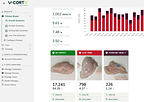
Every foreign material event is logged automatically in the V-CORTX analytics dashboard, with timestamp, classification, imagery, dimensional data, and throughput impact. Plant managers and corporate engineering teams get a continuous, searchable record that supports FSQA documentation, and root cause analysis giving them the tools they need to keep production running safely.
DEPLOYED AND RUNNING TODAY
Foreign Material Detection from Oxipital AI is operating on production lines in the food industry right now. Food and beverage manufacturers can see it running live at Pack Expo at the Oxipital AI booth S-3192 from October 18th to the 21st.
ABOUT OXIPITAL AI
Oxipital AI is a unified AI vision and intelligence platform for food and industrial manufacturing, bringing together quality inspection, foreign material detection, and vision-guided robotics. Built on the OX and VX hardware platforms, its technology gives producers one system to inspect, protect, and automate their lines. Spun out of Soft Robotics, Oxipital AI is deployed across production lines at some of the world’s largest food producers. Learn more at www.OxipitalAI.com.
MEDIA CONTACT
Drishti Shah
Dshah@OxipitalAI.com
* Vision-based inspection can only detect foreign material that is visible to the camera. Items that are too small to resolve at operating line speed, or that are not presented to the camera’s field of view, may not be detected.
View original content to download multimedia:https://www.prnewswire.com/news-releases/oxipital-ai-launches-foreign-material-detection-solutions-at-pack-expo-raising-the-standard-for-food-safety-inspection-302910805.html
SOURCE Oxipital AI Inc.
Technology
BizzyCar, the Leader in Recall Solutions, Names Simon Smith Chief Revenue Officer to Lead Go-to-Market Growth
Published
18 minutes agoon
October 16, 2026By
BizzyCar has named Simon Smith Chief Revenue Officer. The automotive and software veteran will lead the company’s Go-to-Market organization as dealer and OEM demand grows.
ST. PETERS, Mo., Oct. 16, 2026 /PRNewswire-PRWeb/ — BizzyCar, the AI-powered automotive SaaS company and the #1 leader in recall solutions, today announced that Simon Smith has joined the company as Chief Revenue Officer, effective October 2026. Simon will lead BizzyCar’s Go-to-Market organization.
BizzyCar built its position by helping dealerships and OEMs close open recalls through two-way text messaging powered by its proprietary AI agent. The company is now expanding beyond recalls. Service Engine, Mobile Service, and Fleet IQ carry the same outreach into everyday service work, and dealers and OEMs are responding with strong engagement.
That momentum is the reason for this hire. As demand for the platform grows, BizzyCar has added a seasoned revenue leader to put it in front of more of the industry. Simon’s role is to grow the number of dealers and OEMs that put BizzyCar to work.
“Simon has built and led revenue teams in the hundreds, run businesses up to $400M in ARR, delivered 98% logo retention, and pioneered outcome-based pricing. He knows dealers, he knows OEMs, and he knows how to scale,” said Ryan Maher, Chief Executive Officer of BizzyCar.
Simon brings nearly three decades of business experience, from frontline sales to executive leadership. His career includes time at AutoNation, CarsDirect.com, TrueCar, and Internet Brands, and he has worked in venture-backed startups and public companies, including through IPO processes.
Most recently, Simon was at Storable, an AI-powered software platform for self-storage operators. He joined in 2022 as Senior Vice President of Sales and Revenue for Self-Storage, and in 2024 moved to lead the company’s RV and Campground division as Senior Vice President and General Manager.
About Simon Smith
Simon Smith is Chief Revenue Officer at BizzyCar. He has nearly three decades of experience in sales, revenue, and executive leadership across automotive and software companies, including AutoNation, CarsDirect.com, TrueCar, Internet Brands, and Storable.
About BizzyCar
BizzyCar is an AI-powered automotive SaaS company based in St. Peters, Missouri, serving dealerships and OEMs. Its subscription products, including Recall Outreach, Service Engine, Mobile Service, and Fleet IQ, are powered by BizzyCar’s proprietary AI agent and operate through two-way, end-to-end SMS messaging. To learn more, visitwww.BizzyCar.com.
Media Contact
Matthew Sebalja, BizzyCar, 1 3148288194, matthew.sebalja@bizzycar.com, BizzyCar
View original content:https://www.prweb.com/releases/bizzycar-the-leader-in-recall-solutions-names-simon-smith-chief-revenue-officer-to-lead-go-to-market-growth-302910588.html
SOURCE BizzyCar
Technology
Causal AI Market worth $761.4 million by 2031 – Report by MarketsandMarkets™
Published
18 minutes agoon
October 16, 2026By
DELRAY BEACH, Fla., Oct. 16, 2026 /PRNewswire/ — According to MarketsandMarkets™, the global Causal AI Market is estimated at USD 158.7 million in 2026 and is projected to reach USD 761.4 million by 2031, registering a 36.8% CAGR during 2026–2031.
Browse 300 market data Tables and 50 Figures spread through 350 Pages and in-depth TOC on “Causal AI Market – Global Forecast to 2031”
Causal AI Market Size & Forecast:
Market Size Available for Years: 2021–20312025 Market Size: USD 110.7 million2026 Market Size: USD 158.7 million2031 Projected Market Size: USD 761.4 millionCAGR (2026–2031): 36.8%
Causal AI Market Trends & Insights:
Growth is being supported by demand for causal discovery, causal inference, counterfactual analysis, root-cause diagnosis, experimentation, and decision optimization across financial services, life sciences, marketing, industrial operations, and enterprise planning.Software is estimated to account for 77.8% of the Causal AI Market in 2026The decision intelligence & scenario planning segment is expected to register the fastest growth of 42.4% CAGR between 2026 and 2031The healthcare, pharma & life sciences segment is expected to be the fastest-growing segment across the forecast periodNorth America is estimated to account for the largest regional share of 37.1% in 2026
Download PDF Brochure: https://www.marketsandmarkets.com/pdfdownloadNew.asp?id=162494083
Rising enterprise demand for AI systems that can determine why outcomes occur, estimate intervention impacts, compare alternative actions, and support decisions amid changing business conditions is driving growth. Organizations are increasingly using causal discovery, treatment-effect estimation, counterfactual analysis, root-cause diagnosis, experimentation, and decision optimization to complement conventional predictive analytics. Adoption is expanding across life sciences, financial services, marketing, industrial operations, and enterprise planning. Integrating Causal AI with generative AI, agentic AI, digital twins, and automated experimentation is further accelerating commercialization by embedding causal reasoning directly into recurring operational and strategic workflows, rather than confining it to specialist data-science projects.
Software is becoming the primary layer for operationalizing causal reasoning at enterprise scale.
Software is expected to account for the largest share of the Causal AI Market in 2026, supported by rising adoption of platforms and point solutions that combine causal discovery, inference, simulation, experimentation, and decision optimization within reusable enterprise environments. Organizations are increasingly moving away from isolated causal modeling projects toward software that can connect with existing data estates, support multiple decision workflows, and make causal analysis accessible to business users. Broad Causal AI platforms are expanding into counterfactual simulation, intervention analysis, optimization, and agentic execution, while point solutions are gaining adoption in focused areas such as life sciences, marketing measurement, IT operations, and industrial analytics. This transition toward production-grade software is strengthening recurring revenue opportunities, increasing deployment scale, and enabling causal capabilities to become part of day-to-day enterprise decision processes rather than one-time analytical engagements.
Request for Proposal: https://www.marketsandmarkets.com/requestsampleNew.asp?id=162494083
Decision Intelligence & Scenario Planning is emerging as the strongest growth avenue for action-oriented Causal AI.
Decision intelligence & scenario planning is expected to be the fastest-growing application segment during the forecast period, as organizations increasingly seek to understand the likely consequences of alternative actions before committing capital or operational resources. The segment includes business-driver analysis, what-if modeling, counterfactual simulation, intervention-impact assessment, and resource-allocation optimization. Causal AI enables enterprises to move beyond forecasting what may happen toward estimating what could happen if controllable variables such as pricing, investment, promotions, capacity, or operating policies are changed. This is expanding adoption across strategic planning, commercial decision-making, capital allocation, and operational optimization. Vendors are consequently developing simulation-led environments that allow decision-makers to compare multiple courses of action, quantify potential trade-offs, and select interventions more closely aligned with desired business outcomes under changing market and operating conditions.
North America combines vendor concentration, enterprise AI maturity, and high-value causal use cases.
North America is expected to account for the largest share of the Causal AI Market in 2026, supported by a mature enterprise AI ecosystem, strong availability of advanced analytics talent, and high adoption of data-driven decision technologies across major industries. The region has particularly strong commercial activity in pharmaceutical research, marketing measurement, enterprise decision intelligence, explainable AI, and experimentation, where causal approaches are increasingly being integrated into production workflows. North America also hosts several prominent vendors, including Aitia, Alembic, LiftLab, Measured, Lifesight, and Howso, covering areas such as life sciences digital twins, enterprise causal intelligence, incrementality measurement, and understandable AI. High technology spending among pharmaceutical, financial services, retail, consumer goods, and technology companies, combined with an established ecosystem of data providers, cloud platforms, consulting firms, and AI developers, is expected to sustain the region’s market leadership.
Request Pricing: https://www.marketsandmarkets.com/Enquiry_Before_BuyingNew.asp?id=162494083
Top Companies in Causal AI Market:
The Top Companies in Causal AI Market are causaLens (UK), Aitia (US), Alembic (US), LiftLab (US), Prophet (Australia), Measured (US), Causaly (UK), Lifesight (US), Causify (US), and Howso (US). These vendors illustrate the different commercialization models emerging across the market, ranging from horizontal Causal AI platforms and enterprise decision-intelligence systems to life sciences digital twins, scientific intelligence, marketing incrementality, scenario simulation, and explainable AI. Competitive differentiation is increasingly determined by the ability to operationalize causal reasoning within existing enterprise workflows, integrate with data and AI environments, support domain-specific decision processes, and demonstrate measurable business outcomes. Vendors that combine proprietary causal technology with strong implementation capabilities, domain expertise, enterprise integrations, and repeatable applications are better positioned to expand contract values and move from departmental deployments toward broader enterprise adoption as the market matures.
Causal AI Market – Investment & funding +Merger & Acquisition
Investment Funding Context
Investment activity in the Causal AI Market is increasingly concentrating on vendors that can convert causal models into scalable enterprise decision systems rather than offering causal analysis as a standalone data-science capability. Capital is being directed toward real-time decision intelligence, causal simulation, domain-specific applications, and infrastructure capable of operationalizing causal reasoning at enterprise scale. In November 2025, Alembic raised USD 145 million in Series B and growth financing, led by Prysm Capital and Accenture, with participation from WndrCo, NextEquity, Silver Lake Waterman, Liquid 2 Ventures, and other investors. The financing is supporting expansion of its Causal AI research and high-performance computing infrastructure for enterprise intelligence.
Funding is also reaching smaller Causal AI specialists targeting operational decision-making. In September 2025, Causify raised an additional USD 2.2 million in seed capital to expand its enterprise causal decision-intelligence platform across financial services, energy, supply chain, and industrial applications. FireAI has similarly raised multiple early-stage rounds since 2025 to develop its causal decision-intelligence capabilities, including Causal Chain analysis, enterprise data integration, and conversational analytics. Public funding records indicate cumulative funding of more than USD 1.4 million by July 2026. These investments show a two-tier funding pattern: substantial capital is supporting the infrastructure and commercial expansion of established platforms, while smaller rounds are financing application-focused entrants seeking to embed causal reasoning into specific enterprise workflows.
Revenue Shift Context
Revenue generation in the Causal AI Market is progressively shifting from individual causal modeling projects toward recurring software platforms, decision-intelligence systems, and application-specific point solutions. The market is estimated to increase from USD 158.7 million in 2026 to USD 761.4 million by 2031, at a CAGR of 36.8%. As deployments mature, commercial value is moving beyond causal discovery and model development toward counterfactual simulation, intervention analysis, decision optimization, automated experimentation, and recurring operational workflows. This favors vendors that can integrate causal reasoning directly into existing business systems rather than require enterprises to build bespoke causal models for each use case. Two monetization models are becoming increasingly visible. Broad platform vendors are expanding revenue through enterprise-wide deployments that support multiple functions and integrate causal reasoning with agents, knowledge systems, and workflow automation. Point-solution vendors are monetizing narrower but high-value outcomes. This shift is expected to increase recurring software revenue and expand average contract values as Causal AI moves closer to production decision processes.
Mergers & Acquisitions
Direct M&A among pure-play Causal AI platform vendors remains relatively limited, reflecting the market’s early stage and the continued independence of many specialist companies. However, acquisition activity is increasing in causal measurement, incrementality, and decision intelligence, which form an important part of the Causal AI point-solution layer. Buyers are using acquisitions to add experimental measurement, counterfactual analysis, and causal performance intelligence to broader advertising, analytics, and enterprise decision platforms. The pattern indicates that larger analytics and advertising technology platforms are acquiring causal measurement capabilities to connect measurement directly with optimization and execution. Similar consolidation could emerge across other Causal AI applications as vendors seek differentiated capabilities in simulation, causal decisioning, life sciences, and operational intelligence.
CAUSAL AI MARKET: MERGERS & ACQUISITIONS, JANUARY 2025–MAY 2026
Month & Year
Deal Type
Company 1
Company 2
Description
May 2026
Acquisition
Smartly (US)
INCRMNTAL (Israel)
Smartly completed its acquisition of INCRMNTAL, adding always-on incrementality measurement and causal marketing intelligence to its creative and media optimization platform. Financial terms were not disclosed.
August 2025
Acquisition
Circana (US)
Nielsen (US)
Circana completed the acquisition of Nielsen’s Marketing Mix Modeling (MMM) business, expanding its capabilities for measuring incremental marketing impact and optimizing cross-channel investment. Financial terms were not disclosed.
March 2025
Acquisition
DoubleVerify (US)
Rockerbox (US)
DoubleVerify acquired Rockerbox to add MMM, incrementality testing, attribution, and outcome measurement to its media performance platform. The purchase price was approximately USD 82.3 million, net of cash acquired.
Company Revenue Share Details
The top five companies account for approximately 42% of the Causal AI Market in 2025. The leading group comprises causaLens, Aitia, Alembic, LiftLab, and Prophet. Their positions reflect different Causal AI commercialization models, ranging from broad causal reasoning and enterprise decision platforms to life sciences digital twins, marketing incrementality, and simulation-led decision intelligence. The top ten vendors collectively account for approximately 66% of the market. In addition to the leading five, Measured, Causaly, Lifesight, Causify, and Howso form the broader leading competitive group. Measured and Lifesight strengthen the market’s causal measurement and incrementality segment, while Causaly is concentrated on scientific intelligence and life sciences research. Causify focuses on enterprise causal decision intelligence, while Howso combines explainable AI with causal analysis, counterfactuals, and intervention optimization. The relatively high share held by the top ten indicates increasing concentration around vendors with differentiated causal technology, established enterprise deployments, domain expertise, and the ability to embed causal reasoning directly into recurring business decisions.
Browse Adjacent Markets: Artificial Intelligence (AI) Market Research Reports & Consulting
Related Market Reports:
Artificial Intelligence (AI) Market by Offering [Hardware (AI Chips, Memory, Storage), Software, Services], Technology (ML, NLP, Generative AI, Neurosymbolic AI), Business Function (Operations & Supply Chain, Sales & Marketing) – Global Forecast to 2033
Decision Intelligence Market by Type (Decision Automation, Decision Augmentation, Decision Support System), Business Function (Marketing & Sales, Finance & Accounting (Financial Planning, Cost Optimization), Operations, R&D) – Global Forecast to 2030
About MarketsandMarkets™
MarketsandMarkets™ has been recognized as one of America’s Best Management Consulting Firms by Forbes, as per their recent report.
MarketsandMarkets™ is a blue ocean alternative in growth consulting and program management, leveraging a man-machine offering to drive supernormal growth for progressive organizations in the B2B space. With the widest lens on emerging technologies, we are proficient in co-creating supernormal growth for clients across the globe.
Today, 80% of Fortune 2000 companies rely on MarketsandMarkets, and 90 of the top 100 companies in each sector trust us to accelerate their revenue growth. With a global clientele of over 13,000 organizations, we help businesses thrive in a disruptive ecosystem.
The B2B economy is witnessing the emergence of $25 trillion in new revenue streams that are replacing existing ones within this decade. We work with clients on growth programs, helping them monetize this $25 trillion opportunity through our service lines – TAM Expansion, Go-to-Market (GTM) Strategy to Execution, Market Share Gain, Account Enablement, and Thought Leadership Marketing.
Built on the ‘GIVE Growth’ principle, we collaborate with several Forbes Global 2000 B2B companies to keep them future-ready. Our insights and strategies are powered by industry experts, cutting-edge AI, and our Market Intelligence Cloud, KnowledgeStore™, which integrates research and provides ecosystem-wide visibility into revenue shifts.
MarketsandMarkets™ SalesPlay is an AI-driven Revenue Intelligence Co-Pilot designed to help revenue teams prioritize the right accounts, identify critical changes early, and surface opportunities ahead of demand, so pipeline builds naturally and deals close with greater consistency.
To find out more, visit www.MarketsandMarkets™.com or follow us on Twitter, LinkedIn and Facebook.
Contact:
Mr. Rohan Salgarkar
MarketsandMarkets™ INC.
1615 South Congress Ave.
Suite 103, Delray Beach, FL 33445
USA: +1-888-600-6441
Email: sales@marketsandmarkets.com
Visit Our Website: https://www.marketsandmarkets.com/
Content Source: https://www.marketsandmarkets.com/PressReleases/causal-ai.asp
View original content to download multimedia:https://www.prnewswire.co.uk/news-releases/causal-ai-market-worth-761-4-million-by-2031–report-by-marketsandmarkets-302911204.html
Oxipital AI Launches Foreign Material Detection Solutions at Pack Expo, Raising the Standard for Food Safety Inspection
BizzyCar, the Leader in Recall Solutions, Names Simon Smith Chief Revenue Officer to Lead Go-to-Market Growth
Causal AI Market worth $761.4 million by 2031 – Report by MarketsandMarkets™
Send Rakhi to UK swiftly with UK Gifts Portal
Whiteboard Series with NEAR | Ep: 45 Joel Thorstensson from ceramic.network
Nullmax and Renesas Forge Strategic Partnership to Deliver Competitive ADAS Solutions for the Global Market
Why You Should Build on #NEAR – Co-founder Illia Polosukhin at CV Labs
Whiteboard Series with NEAR | Ep: 45 Joel Thorstensson from ceramic.network
NEAR End of Year Town Hall 2021: The Open Web World, MetaBUILD 2 Hackathon and 2021 recap
Trending
-
Technology3 days agoMesa School of Business raises ₹110 crore to expand its portfolio of programmes for the AI era
-
Technology3 days agoCresta Launches Deputy Agent: an AI Agent That Keeps Working Long After the Customer Hangs Up
-
Technology4 days agoPayJoy to Acquire Strategic Assets of Finia AI, Advancing AI Underwriting and Financial Product Innovation
-
Technology3 days agoIntellistake Highlights NanoAi’s Collaboration With Global Defense Helmet Leader Gentex Corporation
-
Technology4 days agoJK Tech Names Mahesh Ramakrishnan as New Chief Technology Officer
-
Technology4 days agoFraikin announces exclusive agreement with Asterion Industrial Partners to support its next phase of growth
-
Technology4 days agoASE Technology Holding Co., Ltd. Announces Monthly Net Revenues*
-
Technology4 days agoFlex Expands Prefabricated Modular Data Center Portfolio to Accelerate AI Factory Deployment