Connect with us

Technology

Payoneer Checkout Launches in Singapore, Helping Businesses Turn Global Demand into Revenue

Published

on

Powered by Stripe, the enhanced Checkout experience enables eligible Singapore businesses to accept payments from customers worldwide through their own online stores

SINGAPORE, Oct. 15, 2026 /PRNewswire/ — Payoneer (NASDAQ: PAYO), the global financial technology company powering business growth across borders, today announced that Payoneer Checkout is available to eligible Singapore-registered businesses. Powered by Stripe, the enhanced solution enables merchants to accept payments from international customers through their own online stores, supporting multiple payment methods including cards and digital wallets, while helping businesses manage proceeds across markets through Payoneer’s global financial platform.

As Singapore businesses look beyond domestic growth, many established brands selling through marketplaces such as Shopee, Lazada and Amazon are also investing in direct-to-consumer (DTC) channels. Building their own digital storefronts gives businesses greater control over the customer experience and more opportunities to foster direct customer relationships but also introduces complexity.  Businesses need to offer payment experiences that reflect local customer preferences while navigating different currencies, markets and payment methods. Friction at checkout can mean losing a sale along with marketing and customer acquisition investments.

For Singapore businesses expanding internationally, these considerations are increasingly important. Digital payments account for more than 60% of transactions inSoutheast Asia, while three in five consumers in the region shop online, underscoring the importance of making the payment experience simple and familiar to customers across markets.[1]

“Singapore businesses have become increasingly sophisticated in how they reach global customers, with many building a presence across both marketplaces and their own DTC channels,” said Nagesh Devata, SVP of APAC, Payoneer. “As more businesses take control of their customer journeys, they need a payment partner they can trust to support that expansion — one that understands the complexity of operating across markets, currencies and payment behaviours. Payoneer Checkout is designed to be that partner, helping businesses convert global demand into revenue wherever their customers are.”

Global DTC businesses are already seeing the impact of Payoneer Checkout. Leading South Korean skincare brand COSRX achieved a higher payment approval rate, helping customers complete purchases frictionlessly through its DTC store. Similarly, Dr. Melaxin, which operates local entities in regions like the U.S. and Hong Kong, achieved improved payment approval rate, to support conversion and simplify its cross-border payment operations.

This announcement builds on Payoneer’s strategic partnership with Stripe, whose cross-border financial infrastructure powers Payoneer Checkout, enabling Singapore businesses to reach and serve customers worldwide.

With Payoneer Checkout now available in Singapore, eligible local businesses have access to a payment solution built to support their global ambitions. As more merchants diversify beyond marketplaces to build direct relationships with customers worldwide, Payoneer is committed to equipping them with the financial tools needed to compete confidently across borders, turning global reach into lasting growth.

[1] Google, Temasek & Bain & Company. e-Conomy SEA 2025: Singapore Report. 2025.

About Payoneer 

Payoneer is the financial platform for cross-border business and global payments. Payoneer empowers millions of businesses with the financial tools and services they need to grow and transact globally with confidence. We make it easier for businesses, particularly in the emerging markets, to connect to the global economy, pay and get paid across borders, manage their funds across multiple currencies, and grow their businesses.

Payoneer Singapore Private Limited is licensed by the Monetary Authority of Singapore as a Major Payment Institution. Product availability and services are subject to eligibility, applicable terms, risk assessment and regulatory requirements.

View original content:https://www.prnewswire.com/apac/news-releases/payoneer-checkout-launches-in-singapore-helping-businesses-turn-global-demand-into-revenue-302909281.html

SOURCE Payoneer

Continue Reading

Technology

Samsung Semiconductor Highlights 400+ Layer V-NAND and zNAND-O at GMIF2026 as Foundation for Agentic AI

Published

on

By

SHENZHEN, China, Oct. 15, 2026 /PRNewswire/ — The 5th GMIF Innovation Summit (Global Memory Innovation Forum 2026, GMIF2026), co-hosted by the Shenzhen Memory Industry Association and the School of Integrated Circuits at Peking University, recently concluded in Shenzhen. Themed “The Future Built on AI Memory and Storage,” the summit drew more than 3,000 registered professional attendees for discussions on AI inference, enterprise storage, and cloud-edge-device coordination as AI infrastructure enters a new cycle.

Kevin Yoon, CVP & CTO of Samsung Memory China at Samsung Electronics, delivered a keynote titled “The Memory Revolution: Building the Foundation of Agentic AI,” presenting Samsung’s full-stack portfolio from server SSDs to on-device zNAND-O. As AI has moved from generative to agentic, multiple agents collaborate on complex tasks and massive numbers of tokens have been generated, driving up KV cache capacity and reuse needs. Once KV cache outgrows GPU memory, an independent shared storage tier becomes inevitable.

PM1763 and BM1773: A Two-Track Server SSD Lineup

Yoon introduced two server SSDs for KV cache shared storage. The performance flagship PCIe Gen6 SSD PM1763 combines V-NAND TLC with an enhanced cooling system and will sample in Q4 2026. The capacity flagship BM1773, built on V9 QLC, spans 16TB to 256TB and is billed as “the world’s smallest 256TB SSD.”

“With these two SSDs, we will drive both the performance and capacity markets,” Yoon said.

V10: The Industry’s First 400+ Layer V-NAND

At the NAND process level, Yoon introduced Samsung’s latest V10 BV-NAND, the industry’s first V-NAND with over 400 layers. Compared with V9, it delivers 58% higher bit density, 33% faster I/O, and 25% lower power consumption. The key, Yoon said, is advanced bonding technology: memory cells and peripheral circuits are manufactured separately and then bonded vertically, enabling high-density stacking.

zNAND-O: 10x the Bit Density of DRAM for On-Device AI

With AI models expected to exceed one trillion parameters by 2030, keeping all weights in DRAM under the traditional UMA would sharply raise on-device costs. Samsung’s answer is zNAND-O, a next-generation NAND architecture designed for on-device AI, now in development in 4-layer and 8-layer versions. It is co-packaged with the MPU and connected through the UCIe interface, delivering 10x the bit density of DRAM and 7x the read bandwidth and read energy efficiency of NAND flash.

In a simulation using Moonshot AI’s Kimi K2-1T model, an NPU-optimized architecture with zNAND-O cut memory cost to 1/4 at equal performance and fit a model nearly twice as large.

Outstanding AI Memory & Storage Industry Leadership Award

GMIF annually recognized companies driving core technology breakthroughs and compute ecosystem building across the industry chain. Samsung Semiconductor received the Outstanding AI Memory & Storage Industry Leadership Award for its sustained leadership in DRAM and NAND, including the zNAND-O 3D architecture, 400-plus layers V10 NAND, and CXL memory, setting a benchmark for the global memory industry and providing important support for the build-out of global AI infrastructure.

Closing

As an annual gathering for the memory industry, GMIF brought together leaders from across the value chain, and Kevin Yoon’s keynote gave the industry a clear view of where memory and storage are heading in the agentic AI era. As KV cache outgrows GPU memory, Samsung is answering at every layer, from PCIe Gen6 and high-capacity server SSDs for shared KV cache, to 400+ layer V10 NAND, to zNAND-O for on-device AI. With its second consecutive GMIF award, Samsung has shown that it is not only keeping pace with agentic AI’s demands on memory & storage, but helping define the path forward.

Carina Gu, wenjing.gu@gmif.com.cn 

View original content to download multimedia:https://www.prnewswire.com/apac/news-releases/samsung-semiconductor-highlights-400-layer-v-nand-and-znand-o-at-gmif2026-as-foundation-for-agentic-ai-302909420.html

SOURCE Shenzhen Memory Industry Association (SMIA)

Continue Reading

Technology

How The Mobile Robot Company is Upending Logistics by Stopping at 80% Automation

Published

on

By

While the industry chases full autonomy, founders Emil Hauch Jensen and Odin Kudahl Skovsted built an award-winning firm by empowering warehouse workers rather than replacing them.

COPENHAGEN, Denmark, Oct. 15, 2026 /PRNewswire/ — When Emil Hauch Jensen visited an Amazon distribution center in 2023, he noticed a startling lack of mobile robots. The reason was flexibility: the facility faced up to ten process changes a week. That insight struck a chord. In November 2024, Jensen and co-founder Odin Kudahl Skovsted launched The Mobile Robot Company, aiming to build machines that adapt to human workers rather than replace them.

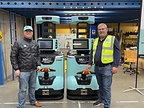
Their first product, the J1600 self-driving pallet jack, is a dual-mode vehicle that bridges the gap between manual labor and full automation. Instead of striving for 100% autonomy, which demands complex system integration and massive capital, the founders targeted the sweet spot of human-in-the-loop automation. The operator manually handles the judgment-heavy pallet pickup, and the robot takes over the long, repetitive transport. The J1600 offers an 80% reduction in manual transport work, allowing small and medium enterprises to reap automation’s benefits at a fraction of the usual cost.

The startup’s pragmatic design philosophy recently secured the prestigious IFOY Industrial Truck of the Year 2026 award, beating established industry giants just nineteen months after the company’s founding. Unlike competitors who hide costs behind lengthy sales negotiations, The Mobile Robot Company embraces transparency by publishing its €65,000 list price. The pricing and ROI model is openly accessible, drastically lowering the barrier to entry for facilities looking to modernize their material flows.

By stopping at partial autonomy, Jensen and Skovsted solved the rigidity that plagues modern warehouse robotics. The J1600 enables workers to intervene instantly with a familiar tiller, turning a potential breakdown into a brief manual override. “The operators are the first ones to buy into this product,” Jensen noted, emphasizing that workers feel empowered, not replaced. “When they have this feeling like, hey, this is not scary. This is not coming for my job. This is helping me. And I can do it myself,” the initial hesitation completely vanishes.

With distributors now active across eight countries and a rapidly expanding footprint, this Copenhagen-based hardware firm proves that sometimes, solving an industry’s biggest challenge requires putting humans back in the driver’s seat.

Related Links:

The Mobile Robot CompanyThe Mobile Robot Company Knowledge CenterThe Mobile Robot Company on LinkedIn

Emil Hauch Jensen
CEO
The Mobile Robot Company ApS
+45-88109012
emil@mobilerobot.com

This release was issued through WebWire®. For more information, visit http://www.webwire.com.

View original content to download multimedia:https://www.prnewswire.com/apac/news-releases/how-the-mobile-robot-company-is-upending-logistics-by-stopping-at-80-automation-302902877.html

SOURCE The Mobile Robot Company ApS

Continue Reading

Technology

Xinhua Silk Road: Forum held in Jakarta to boost Belt and Road tax administration cooperation

Published

on

By

BEIJING, Oct. 15, 2026 /PRNewswire/ — The 7th Belt and Road Initiative Tax Administration Cooperation Forum (BRITACOF) kicked off on Tuesday in Jakarta, Indonesia.

Themed “Smart Taxation, Shared Prosperity”, this forum brought together over 300 participants, including heads of tax administrations from nearly 40 countries and regions, representatives from eight international organizations, and delegates from Chinese and foreign multinational enterprises.

During the three-day event hosted by the Directorate General of Taxes of Indonesia, participants will discuss topics such as tax administration digitalization, taxpayer service facilitation, and coordinated capacity building. A tax dialogue among businesses will also be held to discuss taxpayer service improvements.

The event will witness the release of the Tax Administration Product Portfolio (TAPP) 2.0, the Taxpayer Service Product Portfolio (TSPP) 2.0, and the 2026 Compilation of the Belt and Road Initiative Tax Administration and Taxpayer Service Product Portfolio. It will also update the courses of the Belt and Road Initiative Tax Administration Capacity Enhancement Group and publish the Belt and Road Initiative Tax Administration Cooperation Mechanism (BRITACOM) Annual Report (2026).

These deliverables, by pooling advanced practices and typical cases, will promote alignment of tax administration rules and mutual recognition of standards of Belt and Road partner countries, thus providing comprehensive toolkits and practical models for the participants to enhance their tax governance capacity and optimize tax-related business environment.

The BRITACOM was initiated and established by China in April 2019. It currently has 38 members and 30 observers, making it a significant multilateral tax cooperation platform under the Belt and Road Initiative. 

Since the inception of the BRITACOM, a series of consensuses has been reached, and steady progress has been made in boosting tax certainty, advancing digital transformation of tax administration, improving tax-related business environment and strengthening tax administration capacity building.

The previous six editions of the BRITACOF were held in China, Kazakhstan (online), Algeria, Georgia, China’s Hong Kong Special Administrative Region, and Nepal, respectively. 

Original link: https://en.imsilkroad.com/p/352544.html

View original content to download multimedia:https://www.prnewswire.com/apac/news-releases/xinhua-silk-road-forum-held-in-jakarta-to-boost-belt-and-road-tax-administration-cooperation-302909326.html

SOURCE Xinhua Silk Road

Continue Reading

Trending