Connect with us

Technology

Out of Hormuz Energy Shocks, the Ingredients for a Global Food Crisis

Published

on

High costs and shortages of fertilizer and fuel – combined with the looming effects of El Niño – are becoming a threat to global food security, S&P Global Analysis says

NEW YORK, Oct. 19, 2026 /PRNewswire/ — Beyond the more well-documented impacts from the disruption of transit through the Strait of Hormuz lies the beginnings of what could be a global food crisis, a new S&P Global analysis says.

In the first major report from the S&P Global Institute, authors Daniel Yergin, Shankari Srinivasan, Allan Pickett and Simon Blakey say that the reinforcing shocks of higher energy and fertilizer costs, resilient biofuel-linked demand and El Niño-related weather risk are starting to come into view.

“The world’s food producers rely on a steady supply of natural gas and sulfur for fertilizer, diesel for machinery and transport, and open sea-lanes for trade,” they write. “Conflict is now testing all of them at once, just as El Niño tests the harvest.”

The paper – entitled Energy disruption and El Niño: Leading to a global food crisis? – points to “pressure building in fertilizer and diesel markets.” The article reflects the combined expertise of S&P Global’s agricultural and energy research services and research by S&P Global Ratings.

Fertilizer Bottlenecked

While it has become common knowledge that about 20% of global oil supply and 20% of global LNG trade flowed through the Strait of Hormuz prior to the war, less recognized is the Middle East’s role as a major supplier of fertilizer, as well as the feedstocks that other countries rely on to produce it.

Roughly 29% of global trade of urea, the world’s most widely used nitrogen fertilizer, normally passes through the Hormuz Strait, as does nearly half of the global sulfur trade and about 21% of the merchant trade of ammonia.

Yet, the fertilizer disruption is only the first channel through which the Iran war reaches global agriculture, the authors say. Fertilizer producers elsewhere depend on energy, mainly natural gas, for feedstock as well as fuel for their manufacture. By restricting oil and LNG flows through the Strait of Hormuz, the conflict also raises fertilizer production costs and farm operating costs far beyond the Gulf.

South Asia is particularly exposed to a double vulnerability of disrupted fertilizer supply from the Gulf and higher costs for the LNG used by domestic producers, the authors note. The Gulf producers are an important source of imported urea for India, while LNG supports around 85% of its domestic urea production. In Bangladesh, the lack of available LNG has resulted in four of the country’s five urea fertilizer plants ceasing operation since March 2026.

Diesel Scarcity Tightens the Squeeze on Farm Economics

The global squeeze on diesel – a key operating cost for farmers – extends to those regions that may otherwise be better insulated from immediate fertilizer and LNG shocks.

The Middle East and Russia normally account for half of global net diesel exports. Middle Eastern diesel exports have fallen by more than half since July 2025 to less than 1 million b/d in July 2026. Meanwhile, Ukrainian drone attacks and an export ban have pushed Russian diesel exports from roughly 1 million barrels per day toward zero. China has tightened its restrictions on exports of diesel and jet fuel, also.

With remaining refining capacity already operating near operational limits, diminished supply and low inventories coinciding with seasonal harvest and winter heating demand has taken its toll. The price differential between a barrel of crude oil and a barrel of diesel (historically between $12 and $20) rose above $100 per barrel in the first week of September.

“The conflict has driven diesel prices up much faster than crude oil prices, exposing farmers to a sharp increase in operating costs,” the authors write. “Faced with this increase, on top of more expensive fertilizer, farmers in the most affected regions either have to reduce fertilizer purchases and the rate at which they apply fertilizer to their crops, or they may choose to reduce the acreage that they plant. Either way, less food would be produced than would otherwise have happened.”

Biofuels intensify the food-or-fuel trade-off

High oil prices also make biofuels more competitive with petroleum, which strengthens demand for the crops and vegetable oils used to produce them. For the first time in recorded history, biofuels became cheaper than oil-based shipping fuels in Europe in September 2026. The resilient demand and policy support for biofuels means that crop markets have less scope to rebalance toward food production.

“Biofuel policy is thus doing more than supporting demand. It is influencing what farmers plant in the middle of an input-cost shock,” the authors write.

El Niño compounds the input-cost shock

The anticipated strong El Niño would add further stress just as farmers face higher fertilizer and fuel costs, leaving crops less resilient to heat and disruptive rainfall. The National Oceanic and Atmospheric Administration (NOAA) projects sea-surface temperatures to reach at least 2 degrees C above normal — a threshold reached in only seven episodes since the 1950s.

S&P Global’s agriculture modelling now indicates:

Brazil’s corn output forecast has been reduced by 6 million metric tons to 137 million metric tons, with a further decline of 10 million metric ton possible if El Niño intensifies.Australia’s wheat production could fall to 22 million metric tons, compared with the current forecast of 28 million metric tons.India’s rabi wheat crop faces increased downside risk if monsoon deficits persist; September rainfall was approximately 14% below average.Brazil’s soybean output forecast has been lowered by 6 million metric tons to 177 million metric tons. A model incorporating El Niño severity and reduced phosphate application produces a probability-weighted estimate of 168 million metric tons, with a 65% probability that output falls between 160 million and 170 million metric tons. The effects will be felt globally: Brazilian soybeans are a major feed for Chinese livestock.Palm oil production in Indonesia and Malaysia faces downside risks of 5.8 million metric tons and 2.5 million metric tons, respectively.

Unlike changes in oil prices, which register immediately, the impact on food will take time to appear. The ultimate extent and severity are yet to be determined, the authors write:

“Farmers buy seed, fertilizer and fuel months before they sell a crop. The squeeze now bearing down on farm budgets may therefore not reach food markets in force until 2027.

“A global food crisis is not foreordained. But neither is it any longer a distant risk. If war continues to impede the movement of energy and fertilizer, and if weather cuts harvests across several major producing regions, the elements of such a crisis will be falling into place.”

Media Contacts:

Isabel Allanwood
S&P Global
+44 7483 368 605
isabel.allanwood@spglobal.com

Jeff Marn
S&P Global Energy
+1 202 463 8213
jeff.marn@spglobal.com

Notes to Editors:

About the S&P Global Institute

The S&P Global Institute is S&P Global’s new center for enterprise-wide thought leadership.

The Institute delivers insight on the complex and interconnected challenges facing today’s global leaders. Geopolitics, artificial intelligence, the energy transition, and capital flows can no longer be understood in silos.

They are colliding to fundamentally reshape the markets and the global economy.

To navigate this complexity, the Institute brings together data, research, and specialized expertise from across the entire S&P Global enterprise (Ratings, Energy, Market Intelligence, S&P Dow Jones Indices).

Operating at the intersection of capital markets, technology, and global policy, we are dedicated to connecting the dots on these structural transformations, delivering the forward-looking perspectives that clients and decision-makers need to lead with confidence.

To find out more and read the full report, visit: spglobal.com/en/research-insights

About S&P Global  

S&P Global (NYSE: SPGI) enables businesses, governments, and individuals with trusted data, expertise and technology to make decisions with conviction. We are Advancing Essential Intelligence through world-leading benchmarks, data, and insights that customers need in order to plan confidently, act decisively and thrive in a rapidly changing global landscape. 

From helping our customers assess new investments across the capital and commodities markets to navigating the energy expansion, acceleration of artificial intelligence, and evolution of public and private markets, we enable the world’s leading organizations to unlock opportunities, solve challenges and plan for tomorrow – today. Learn more at www.spglobal.com. 

View original content to download multimedia:https://www.prnewswire.com/news-releases/out-of-hormuz-energy-shocks-the-ingredients-for-a-global-food-crisis-302912525.html

SOURCE S&P Global

Continue Reading

Technology

AmeriTrust Solutions Expands Point-of-Care Medicaid Application Support to All 50 States

Published

on

By

Available today, the platform gives hospitals and RCM partners a practical way to help eligible patients pursue coverage without a major IT project.

WASHINGTON, Oct. 22, 2026 /PRNewswire/ — AmeriTrust Solutions today announced that its Medicaid application platform is available across all 50 U.S. states. As hospitals and revenue cycle management (RCM) partners prepare for Medicaid changes under H.R.1, the platform gives them a practical way to help eligible patients pursue coverage and address uncompensated care at the point of care.

The platform addresses a source of uncompensated care that begins before billing: patients who may qualify for Medicaid but never complete an application. By simplifying the process when the need for coverage is immediate, AmeriTrust Solutions helps patients overcome application barriers and gives hospitals a path to reimbursement for care that might otherwise be written off.

The scale of the problem is substantial: U.S. community hospitals provided $42.7 billion in uncompensated care in 2020, according to the American Hospital Association.

Uninsured encounters are often written off as uncompensated care, even when patients may qualify for Medicaid. Long applications, confusing questions and information patients struggle to gather can stand between them and coverage, leaving hospitals without payment for care that could otherwise qualify for reimbursement.

“Hospitals already know what uncompensated care is costing them,” said Peter Justen, founder and CEO of AmeriTrust Solutions. “They need a practical way to help eligible patients get covered and create a path to payment for the care they provide. That starts with an application patients can actually finish.”

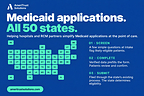
AmeriTrust Solutions uses verified third-party data to prefill available information and plain-language questions to guide patients through what remains. Patients review and certify their information before submission through the state’s existing process. The state makes every eligibility decision.

Available today, the platform is designed for straightforward deployment alongside existing hospital workflows, without a major IT project or replacement of state eligibility systems. Hospitals can begin submitting applications as soon as the platform is live, creating the potential for Medicaid reimbursement within weeks, depending on state eligibility decisions and claims processing. Hospitals can offer the experience under their own brand, giving existing teams a straightforward way to help patients complete applications at intake or the bedside.

RCM partners can add this capability to their hospital offering without developing Medicaid application technology internally. That gives them another way to support hospital clients serving uninsured and self-pay patients, with a focus on helping more applications reach submission.

As healthcare organizations evaluate AI and other new technologies, AmeriTrust Solutions puts the emphasis on a clear, guided application process and the value it can deliver. The platform uses verified information, relevant questions and applicant review to make a complex administrative task more manageable.

“The questions hospital leaders are asking are straightforward: What will this do for us, and how soon can we put it to work?” Justen said. “Our focus is helping patients complete applications now, so hospitals can begin addressing the coverage gaps that contribute to uncompensated care.”

Hospitals and RCM partners can learn more about the platform and discuss deployment at ameritrustsolutions.com/.

About AmeriTrust Solutions
AmeriTrust Solutions helps hospitals and RCM partners reduce uncompensated care by simplifying Medicaid applications at the point of care. Verified data prefill and guided questions help patients complete more accurate applications for submission through existing state eligibility processes. By reducing administrative burden and helping eligible patients access coverage, the company creates a clearer path to reimbursement—supporting rural hospital financial stability and helping preserve local access to care. Visit https://ameritrustsolutions.com/

Media contact
Tina Burgess
AmeriTrust Solutions
(202) 770-0272
pr@ameritrustsolutions.com

View original content to download multimedia:https://www.prnewswire.com/news-releases/ameritrust-solutions-expands-point-of-care-medicaid-application-support-to-all-50-states-302917246.html

SOURCE AmeriTrust Solutions

Continue Reading

Technology

University of Phoenix highlights career-focused, transfer credit-friendly degree programs

Published

on

By

University data highlights affordability as students apply transfer credits toward business, management, healthcare, technology and other career-focused degree programs while reducing education costs

PHOENIX, Oct. 22, 2026 /PRNewswire/ — University of Phoenix is recognizing National Transfer Student Week by highlighting the degree programs receiving the highest volumes of transfer credits, demonstrating how adult learners are benefiting from affordability, transparency and certainty as they apply previously earned academic credit toward career-focused degrees. Many of these programs align with occupational fields projected for growth by the U.S. Bureau of Labor Statistics, underscoring how students are building on prior academic achievements while pursuing educational pathways connected to workforce needs.

According to University transfer-credit data for the past year, students applied more than 525,000 accepted transfer credits to the Bachelor of Science in Management program and more than 275,000 accepted transfer credits to the Bachelor of Science in Business program. University data also shows associate and bachelor students saved an average of more than $12,010 through transferred credits, excluding military students, underscoring the role transfer pathways can play in making higher education more affordable.

“Transfer credit can help students do more than save time and money,” said Devin Andrews, vice president, Office of Admissions and Evaluations. “It can help them continue making progress toward degrees that align with their professional goals. By recognizing eligible transfer credit, we help students build on what they have already accomplished and focus on the education and skills needed for the next phase of their careers.”

As University of Phoenix celebrates its 50th anniversary in 2026, the institution is reflecting five decades of helping working adults build on previous academic achievement and professional experience rather than start over. Today, transfer-credit pathways remain an important part of that mission, helping eligible students reduce costs while pursuing degrees aligned with career goals.

Students apply transfer credits across career-focused degree programs

University transfer-credit data shows students are applying significant volumes of transfer credit toward degree programs aligned with business, management, healthcare, public service and technology careers.

Programs receiving the highest volumes of accepted transfer credits include:

Bachelor of Science in Management: 525,085 accepted transfer credits and 447,622 applied transfer credits.Bachelor of Science in Business: 275,745 accepted transfer credits and 243,281 applied transfer credits.Bachelor of Science in Health Administration: 165,159 accepted transfer credits.Bachelor of Science in Criminal Justice Administration: 159,810 accepted transfer credits and 139,898 applied transfer credits.Bachelor of Science in Information Technology: 140,604 accepted transfer credits.Bachelor of Science in Social Work: 135,583 accepted transfer credits.

These programs represent areas where students are frequently building on previously earned academic credits as they continue toward degree completion and career goals.

University of Phoenix transfer student Joshua Barron decided to earn his degree while working full time and raising his child. “I have always had a goal of earning my bachelor’s degree,” said Barron, who came to the University with previous college credit. “I transferred credits from another college and used self-paced provider options to accelerate my progress. What started as a goal became a clear path toward achieving the degree I wanted for my future.”

Affordable degree pathways align with growing workforce needs

Several of the University’s most popular transfer-friendly programs align with occupations projected by the U.S. Bureau of Labor Statistics (BLS) to experience faster-than-average employment growth through 2034. Management occupations, Healthcare occupations, and Information Technology occupations all fall into high-growth categories according to BLS projections.

Learn more about transfer-credit opportunities

Students interested in learning how previously earned credits may apply toward a degree program can learn more here.

About University of Phoenix

University of Phoenix is Built for Real Life. 50 Years Strong. The University innovates to help working adults enhance their careers and develop skills in a rapidly changing world through flexible online learning, relevant courses, academic AI pillars, and skills-mapped curriculum for associate, bachelor’s and master’s degree programs. Active students and alumni have access to Career Services for Life® resources including career guidance and tools. For more information, visit phoenix.edu.

View original content to download multimedia:https://www.prnewswire.com/news-releases/university-of-phoenix-highlights-career-focused-transfer-credit-friendly-degree-programs-302917249.html

SOURCE University of Phoenix

Continue Reading

Technology

/C O R R E C T I O N – Verisave/

Published

on

By

In the news release, Verisave appoints Payments Veteran Chris Lefebvre as Chief Executive Officer to Drive Product Development and Growth, issued 22-Oct-2026 by Verisave over PR Newswire, we are advised by the company that changes have been made. The complete, corrected release follows, with additional details at the end:

Verisave appoints Payments Veteran Chris Lefebvre as Chief Executive Officer to Drive Product Development and Growth

SALT LAKE CITY, Oct. 22, 2026 /PRNewswire/ — Verisave, a leading provider of payments optimization solutions, today announced the appointment of Chris Lefebvre as Chief Executive Officer, effective October 1, 2026. Lefebvre, who joins from Fiserv, succeeds Jeremy Layton, who will transition into the role of Founder and Chief Commercial Officer to ensure strategic continuity.

Lefebvre brings more than 30 years of executive leadership across payments, financial services and technology, with a track record of guiding companies through growth, transformation and successful exits. He led financial services for a major retailer and was selected to serve on the Merchant Advisory Board for the card networks. As COO of BankServ, he led the company’s national expansion and its successful exit. Lefebvre has since held C-suite roles at eCommerce sales and marketing companies, after which he founded CRC, a management and strategy consulting firm serving regulated companies in healthcare, energy and financial services. Most recently, he served as Global Head of Relationship Management for Grocery, Petroleum, and Technology at Fiserv, and was instrumental in reshaping their client engagement strategy.

“I am extremely proud of the work Verisave has done over the years,” said Jeremy Layton, Verisave Founder and Chief Commercial Officer. “I am confident in our ability to continue bringing solutions and transparency to an industry that is largely unregulated and highly complex. Our clients increasingly need better solutions to control costs and manage their payments proactively. Chris brings deep payments expertise and a track record of building products and solutions around this need.”

“Verisave has built something rare: a trusted platform that delivers real and measurable value for its clients,” said Chris Lefebvre. “What drew me to the role is how much opportunity lies ahead, both in deepening our core solutions and expanding our reach across the broader financial ecosystem. I’m energized by the prospect of working with such a talented team as we look to accelerate Verisave’s growth and bring even greater value to our clients.”

About Verisave
Verisave is a payments optimization and consultancy firm, specializing in merchant account, payments stack, processing fee, and interchange fee solutions. Verisave identifies wasted spend and inefficiencies within the payments operations and merchant account settings, bringing significant direct and operational cost savings to clients. Headquartered in Salt Lake City, the company is backed by Ceto Capital. Learn more at verisave.com

Media Contact:
Samuel Barber
sam@pitchr.ai

Correction: A headshot of Chris Lefebvre has been added.

View original content to download multimedia:https://www.prnewswire.com/news-releases/verisave-appoints-payments-veteran-chris-lefebvre-as-chief-executive-officer-to-drive-product-development-and-growth-302917253.html

SOURCE Verisave

Continue Reading

Trending